

Latest
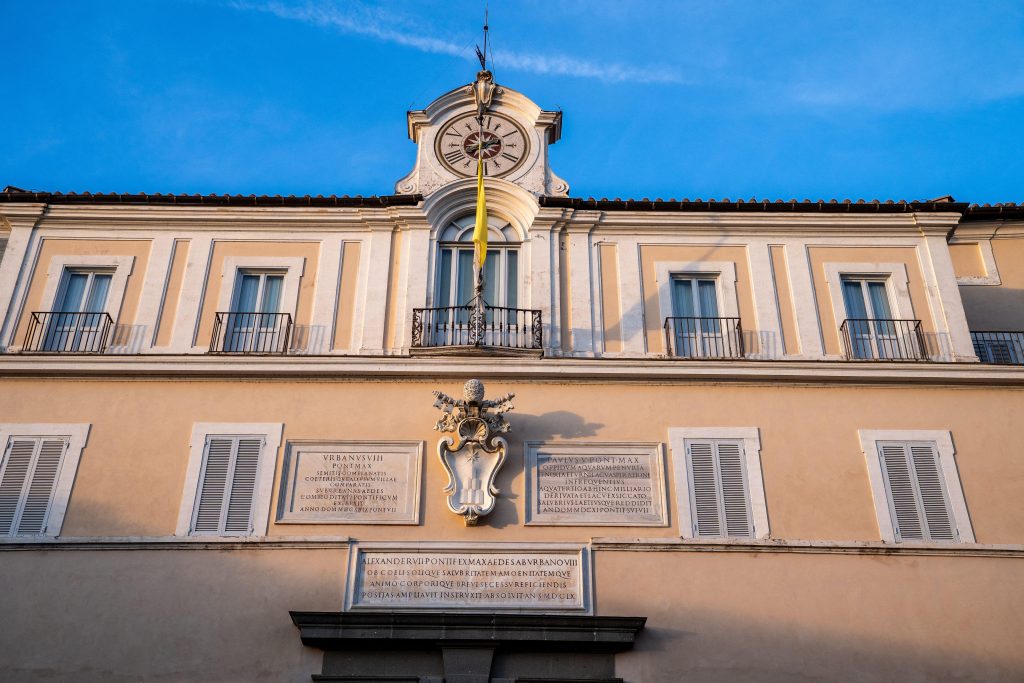
At Castel Gandolfo, Pope Leo XIV says Church must remain open to all
Pope Leo XIV has said the Catholic Church must remain open to everyone, especially those living on society’s margins, during a lunch with 200 poor and vulnerable people at Castel Gandolfo Pope Leo XIV used a lunch with 200 poor and vulnerable people at Castel Gandolfo on Saturday to outline his vision of a Church rooted in hospitality, justice and reconciliation, telling those gathered that the Catholic Church must remain open to all, particularly those living on society’s margins. Hosting the gathering in the Pontifical Gardens on 11 July, the Pope set aside prepared remarks in favour of an impromptu reflection centred on solidarity with those living on the margins of society. “I came without a prepared speech,” he told his guests, “but I did come with hunger—hunger for justice, hunger for genuine charity, hunger for a Church that truly knows how to open its doors, to welcome everyone; where there is love for all, and no one is an enemy, where all of us know how to live reconciliation, forgiveness, and peace.” The event brought together around 200 people from the Diocese of Rome living in situations of hardship, including nearly 40 children. Refugees, single mothers with children, people with disabilities and others supported by diocesan charities spent the day at Borgo Laudato Si’ in Castel Gandolfo, a section of the papal estate that has been transformed into a centre dedicated to the principles of Pope Francis’s 2015 encyclical Laudato si’ . The day began with Holy Mass before touring the papal estate and sharing lunch with the Pontiff. Guests were served traditional Italian dishes, including pasta all’amatriciana and roast veal, followed by strawberries with whipped cream. During his remarks, Pope Leo told those gathered: “As you know well, one of the Pope’s titles is Pontiff—a builder of bridges. And today we too want to build a bridge with all of you, with your families, and with the society in which we want to live—a society marked by justice, where the causes of poverty and the injustices that still exist in our world can be overcome.” “This is the Church we want to be,” His Holiness added. Returning repeatedly to the image of a shared table, the Pope suggested that such encounters offer a model for overcoming social divisions. “Whenever we come together, whenever we share this spirit of encounter around the same table—the one table where Jesus is also present among us—we are truly building a different world, a world of hope, a world that is a light in the midst of our own.” The initiative formed part of the Pope’s stay in Castel Gandolfo, where Borgo Laudato Si’ has become an increasingly prominent setting for projects linking ecological stewardship with social outreach. The programme combines care for creation with practical support for vulnerable communities through education, training and community initiatives. Ahead of the lunch, Donatella Parisi, Communications Coordinator of the Laudato Si’ Higher Education Centre, described the gathering as a visible expression of a Church open to those most often overlooked. She noted that the papal estate, long inaccessible to the public, has undergone a symbolic transformation in recent years. “This place is especially precious because it was closed to the world for 400 years, then opened by Pope Francis and today is thrown wide open by Pope Leo,” she said. “It is now welcoming these people, who for us are the guests of honour.” “The message is that the Church should always be open to everyone, especially those living on the existential peripheries,” she said, adding that Pope Leo “repeats this often”. She also linked the initiative to the Pope’s recent visit to Lampedusa, saying the event reaffirmed that “the Church is open to everyone and is a family, a community, and a safe harbour for those who need it most.” Rather than seeing those invited merely as recipients of charity, Parisi suggested they offer an important witness to the wider Church. “In reality, what we experience every day here at the Laudato Si’ Village is that these very people are the ones who give. They give their all and they enrich the Village and, I would even say, the whole Church through their presence and their call for a different way of looking at society—a perspective that points to fragility as a new source of strength for our communities.” The organisers hope the initiative will continue annually, welcoming participants from different dioceses each year. Last year’s gathering involved people from the Diocese of Albano, while this year’s guests came from Rome through diocesan charities and affiliated organisations. Holy Mass was celebrated by Cardinal Fabio Baggio, Director General of the Laudato Si’ Centre for Higher Education, and concelebrated by Archbishop Luis Marín de San Martín, Prefect of the Dicastery for the Service of Charity.
Jul. 14, 2026
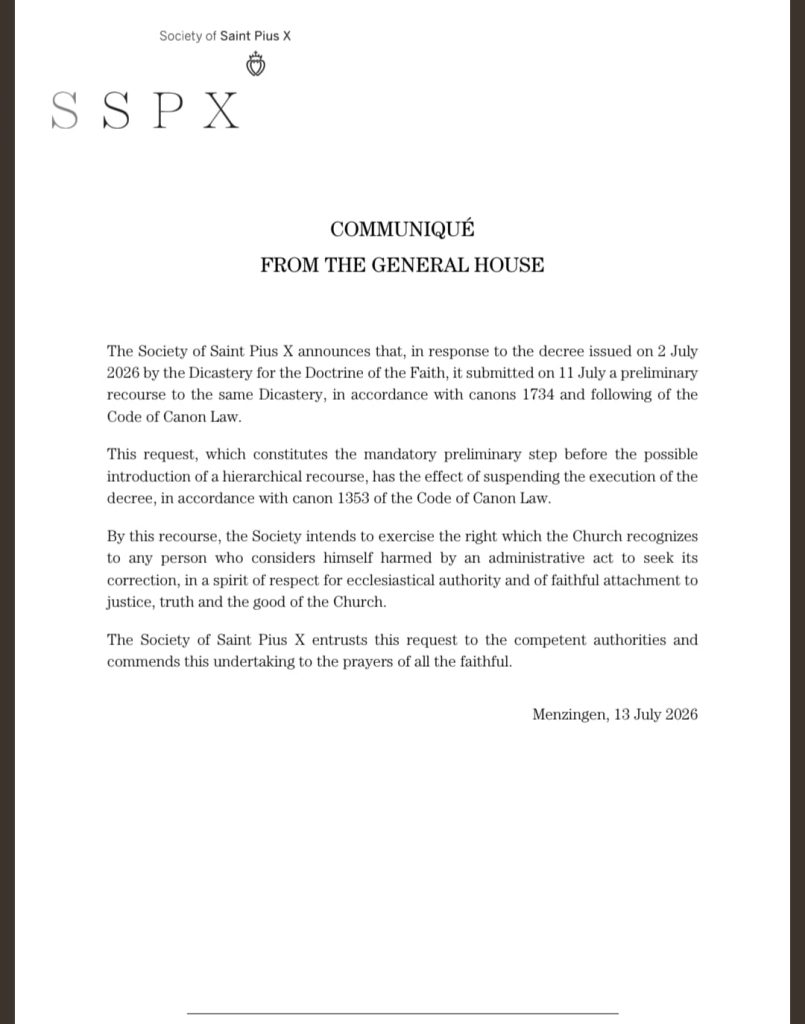
Analysis: The SSPX’s canonical challenge to Vatican excommunications
The SSPX has formally challenged the Vatican’s 2 July decree under the 1983 Code of Canon Law. Our analysis examines the Society’s legal arguments, how the recourse process works and what could happen next in its dispute with Rome The Society of Saint Pius X has taken its dispute with the Holy See into a new canonical phase after announcing that it has formally challenged the Dicastery for the Doctrine of the Faith’s decree of 2 July by means of a preliminary recourse under the 1983 Code of Canon Law. In a communiqué issued at 9 pm Central European time from its headquarters in Menzingen on 13 July, the SSPX confirmed that it had submitted the recourse petition on 11 July in accordance with canon 1734, arguing that the measure automatically suspends the penalties of the Vatican decree under canon 1353 while the matter is under review. The communiqué issued from SSPX headquarters in Menzingen on 13 July The move is the first formal procedural response by the SSPX since Rome declared that the episcopal consecration of four priests on 1 July without a pontifical mandate constituted “an act of a schismatic nature”, triggering the most serious confrontation between the Society and the Holy See since the 1988 excommunications. Rather than presenting the filing as an act of defiance, the Society described it as the exercise of a right recognised by the Church. “The Society intends to exercise the right which the Church recognizes to any person who considers himself harmed by an administrative act to seek its correction, in a spirit of respect for ecclesiastical authority and of faithful attachment to justice, truth and the good of the Church,” the communiqué states. The procedural significance of the filing lies in the canons cited by the Society. Canon 1734 requires anyone wishing to challenge an administrative decree first to request in writing that its author revoke or amend it before lodging a higher appeal. The petition must normally be filed within ten useful days of notification. Canon 1353 provides that recourse against decrees which inflict or declare a penalty has a suspensive effect, while canon 1736 confirms that where the law itself suspends execution, the preliminary petition produces the same effect. In practical terms, the SSPX argues that the penalties and declarations contained in the decree cannot be enforced while its request remains pending before the Dicastery for the Doctrine of the Faith. The canonical process does not end with this first submission. Under canon 1735, the Dicastery has thirty days to respond by revoking, correcting or rejecting the request. If it issues a new decree, or if it rejects the petition, the Society may then pursue a hierarchical recourse under canon 1737. That appeal would seek a review by the competent higher authority, with the superior possessing the authority to confirm, revoke or modify the original decree. The legal process creates a temporary pause while preserving the possibility of a fuller examination of the dispute. For the Society, however, the procedural arguments are only one part of a much broader disagreement with Rome over the character of the July consecrations themselves. In an extensive analysis published on 9 July, the SSPX rejected the Dicastery’s central conclusion that the consecrations were schismatic. Referring directly to the decree, the Society argued that “the decree claims that ‘Monsignor Alfonso de Galarreta’ committed ‘an act of a schismatic nature by the episcopal consecration of four priests, without a papal mandate and against the will of the Sovereign Pontiff.’ But such an assertion is hasty and reveals a flawed understanding of schism.” Drawing upon classical canonists and theologians, including Monsignor Raoul Naz and Cardinal Cajetan, the Society sought to distinguish schism from disobedience. It maintained that while the consecrations had taken place contrary to the wishes of Pope Leo XIV, they did not involve a rejection of the Roman Pontiff’s authority. “The Society of Saint Pius X and its Superior General have always affirmed that they recognize Leo XIV as their head. They address him as a subject addresses his superior, as a son addresses his father. … The Society has never claimed to constitute a parallel or autonomous Church.” In its view, schism requires the refusal of submission to the Roman Pontiff or separation from communion with the Church. The SSPX insists that it continues to recognise papal authority while disputing what it considers an unjust administrative act. From its perspective, the dispute concerns the lawfulness and necessity of the episcopal consecrations rather than communion with the Holy See itself. The Society also devoted considerable attention to the penalties declared by the Dicastery. It argued that canon law does not impose penalties automatically without regard to personal culpability, invoking the longstanding principle of nulla poena sine culpa . Citing canons 1323 and 1324, it maintained that a person acting out of necessity or under grave fear may not incur canonical penalties in the ordinary way. The document concludes that “these two canonical considerations are sufficient to affirm with certainty that neither the consecrating bishops nor the bishops consecrated on July 1, 2026, are excommunicated.” According to the SSPX, the necessity in question is not subjective but arises from what it describes as “the grave danger threatening the complete preservation of the faith and the ordinary means of sanctification”. That appeal to a state of necessity has formed the backbone of the Society’s canonical reasoning since Archbishop Marcel Lefebvre justified the 1988 episcopal consecrations on similar grounds. The Society’s decision to pursue a formal recourse also recalls another episode involving traditionalist Catholics. During the early 1990s, six Catholics in Hawaii who had been declared excommunicated by the local bishop because of their association with SSPX sacramental life sought hierarchical recourse to Rome. Following a review by the Congregation for the Doctrine of the Faith under Cardinal Joseph Ratzinger, the decrees were ultimately declared null, with the Vatican concluding that the actions in question did not amount to formal schism. While the factual circumstances differ substantially from the present dispute, the Hawaii case remains one of the clearest examples of the Holy See overturning canonical penalties after the recourse procedure. The comparison with 1988 is unavoidable, yet the present situation differs in one significant respect. Following Archbishop Lefebvre’s consecration of four bishops without papal approval, Rome declared that he and the newly consecrated bishops had incurred excommunication. The Society consistently maintained that those penalties had never been valid because of necessity but did not pursue the structured administrative recourse now available under the current procedural framework. Instead, the dispute evolved through years of theological dialogue until Pope Benedict XVI remitted the excommunications in 2009 without requiring the Society first to acknowledge that they had been validly incurred. The present case therefore combines continuity with a twist. Substantively, the SSPX continues to reject both the accusation of schism and the penalties attached to it. Procedurally, however, it is making full use of the mechanisms provided by the 1983 Code of Canon Law. The SSPX’s reservations concerning the post-conciliar reforms extended to the legal framework established after the Second Vatican Council. Yet by relying explicitly upon canons 1353 and 1734 to 1737, the Society is invoking the authority of the very Code promulgated by Pope John Paul II in 1983. Indeed, recognition of the validity of the 1983 Code appeared as the fifth point in the Memorandum of Understanding signed by Cardinal Joseph Ratzinger and Archbishop Lefebvre on 5 May 1988 before the agreement collapsed the following day. Beyond that, the SSPX readily acknowledges that the Dicastery has issued a decree and that the decree purports to impose canonical consequences. What it does not accept is that those consequences have been validly incurred. Its decision to file recourse therefore seeks simultaneously to suspend the decree’s effects, protect its apostolate and challenge the Vatican’s position using the Church’s own judicial mechanisms. The Dicastery for the Doctrine of the Faith will in theory make the next move. It may revoke or amend its decree, reject the petition outright or simply reaffirm its earlier conclusions. Should that occur, the Society would then be entitled to pursue hierarchical recourse within the Roman Curia under the timetable established by canon law. The competent authority would have the power to uphold, rescind or modify the decree, while the Pope himself could intervene personally at any stage, either by deciding the matter directly or by instructing the Dicastery to adopt a different course. For now, the dispute enters a new but no less consequential phase. The canonical process offers neither side an immediate victory. Instead, it places the latest confrontation between Rome and the Society of Saint Pius X within the legal structures of the Church.
Jul. 13, 2026
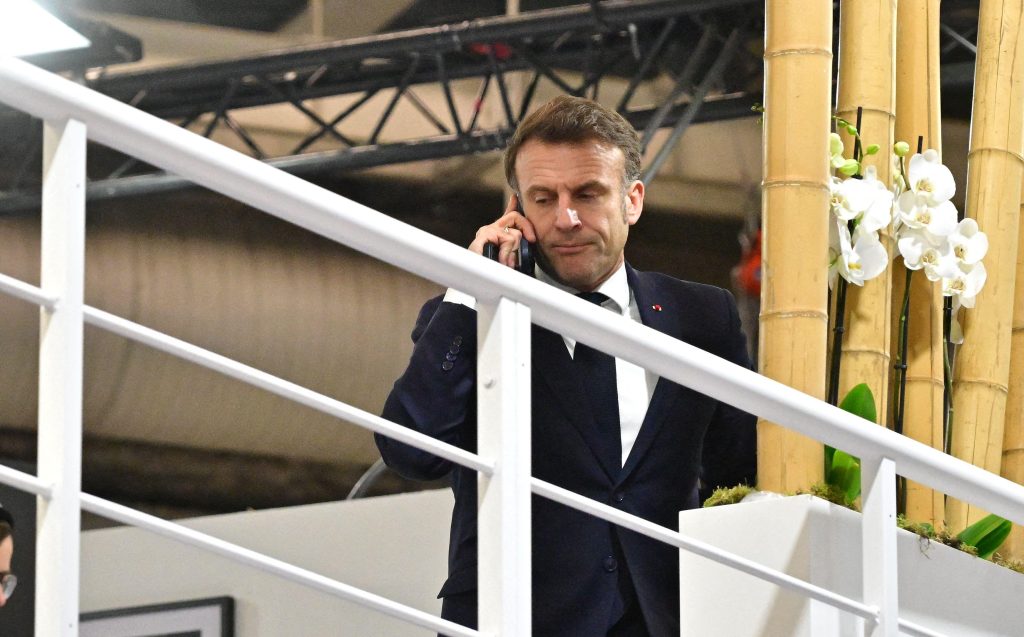
Pope Leo XIV personally lobbied Macron over French euthanasia bill, sources say
Exclusive: Sources tell AdVaticanum that Pope Leo XIV held regular direct calls with President Emmanuel Macron in an effort to slow France’s euthanasia bill ahead of his forthcoming visit to the country A notable feature of the June Consistory was Pope Leo XIV’s call for frankness in addressing the pressing issues facing the Church. According to sources close to AdVaticanum, this approach has recently been put into practice through the Pope’s personal engagement with the highest levels of the French government on the question of euthanasia. The intervention has taken place through quiet but consistent channels. While sources could not confirm exactly when it began, Pope Leo XIV is said to have initiated a series of direct communications with Emmanuel Macron. According to sources within both the diplomatic sphere and the Vatican, His Holiness has been making regular 15-minute phone calls to the French President focused solely on the euthanasia and assisted suicide bill. These conversations have centred on ways to slow the bill’s progress and prevent France from following paths seen in other nations, such as Canada, where the law is now responsible for more than 5 per cent of deaths. It is understood that His Holiness has been focusing particularly on euthanasia because several European countries, including the United Kingdom, are pursuing similar legislation, and a liberalisation in France may encourage others to follow. The third vote in the Senate on the euthanasia and assisted suicide bill failed, with senators rejecting the measure by a narrow margin. The bill will now return to the National Assembly for what could prove a decisive reading. Sources have also told AdVaticanum that His Holiness’s strengthened focus on life issues is a defining priority of his pontificate. This is reflected in the promotion of Archbishop Renzo Pegoraro, President of the Pontifical Academy for Life, who was elevated from monsignor to the episcopate in under a year. The political dimension of the upcoming papal trip to France is likely another factor behind the Pope’s personal engagement. The overall atmosphere surrounding the visit will be shaped by the country’s policy of laïcité, the strict secular framework separating Church and State. The French legislature will be keen to avoid any appearance of external influence on matters of public policy, particularly on moral questions such as euthanasia. However, the Pope is likely to use the visit to make a firm defence of human life, as seen during his recent apostolic journey to Spain. On that occasion, as the first Pontiff to address the Spanish Parliament, he asked: “Can a community that casts into the shadows the unborn child, the elderly, the sick, those who suffer in silence, or those who depend entirely on the care of others be called fully just?” He went on to insist that “every human life must be recognised and safeguarded from conception to its natural end, in every circumstance of its existence.” President Macron has publicly backed the assisted suicide legislation, describing it as “aid in dying” for adults facing incurable illness and intractable suffering. His government has framed the measure as a compassionate option, avoiding terms such as euthanasia or assisted suicide. His party and its allies in the National Assembly have largely supported the bill, arguing that it protects personal dignity and individual choice in end-of-life decisions. Yet the Senate’s repeated rejections indicate significant resistance to the state facilitating suicide. Pope Leo XIV has met President Macron on several occasions since his election. Their first in-person meeting took place shortly after the conclave in May 2025, when Macron travelled to Rome for a private audience at the Vatican to discuss European affairs, including migration and peacebuilding. If the bill ultimately passes, the Pope’s visit to France will carry clear political sensitivities. He will encounter an environment in which any strong defence of the Church’s teaching on the sanctity of life may prompt accusations of interference in domestic affairs. With the French visit on the horizon, the climate of secular sensitivity means that every word and gesture will carry weight. Macron’s government has continued to advance the legislation despite Senate setbacks, setting the stage for potential tension. Yet the repeated failures in the Senate also suggest that concerns about assisted suicide—particularly its implications for the value of human life and the protection of the vulnerable—remain firmly present within French political life.
Jul. 13, 2026
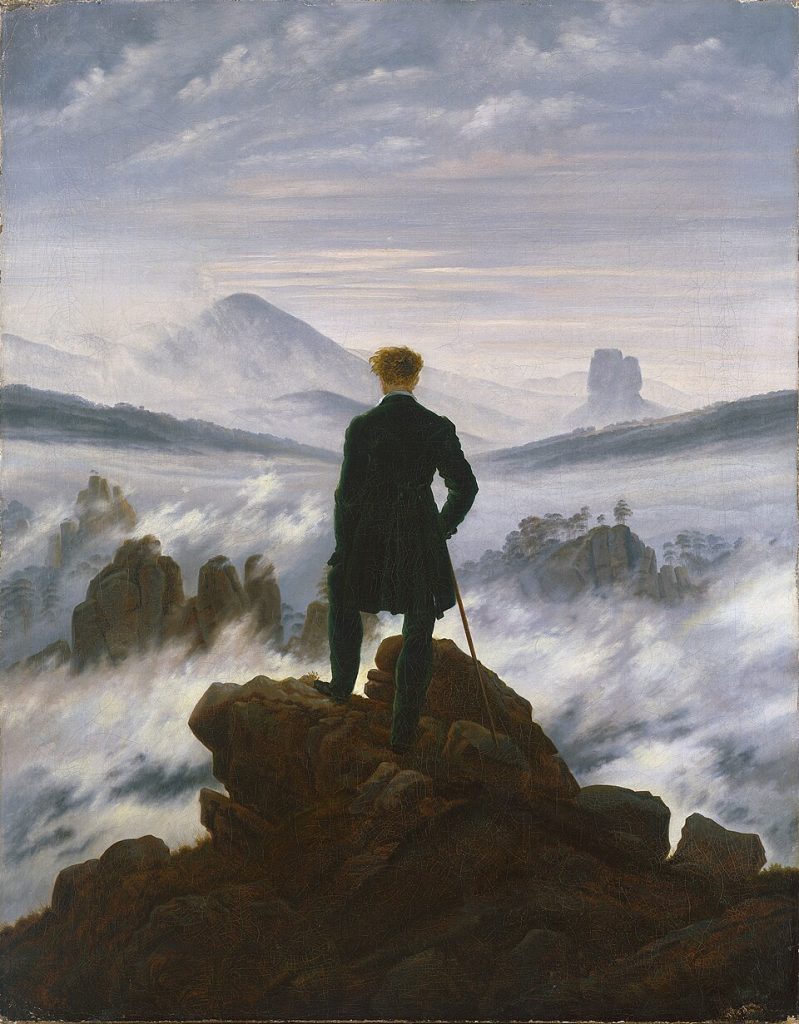
The legacy of the Enlightenment: anthropocentrism
Has humanity replaced God with itself? René Stockman examines the legacy of the Enlightenment and its impact on morality, technology and the modern world Since the advent of the Enlightenment, the world – and humankind as the centre of the world – has undergone a major transformation. We read about it in philosophy, we see it in art, and we also observe a shift taking place in theological thought. It is a process that has been underway for several centuries, with moments that sparked a revolution and others when it continued its course unnoticed, yet steadily, like an underground lava flow. Today, this lava flow has found new openings through which to continue its journey with full force and without restraint, thereby influencing many areas of social life from within. The Enlightenment has not remained a movement that expressed itself solely as a new philosophical approach to humanity and the world, but has become firmly established in society, bringing about a profound cultural shift. Whilst at the outset of this new philosophical trend humanity was given a more central place, without completely pushing God aside, it is now that very same humanity that has entirely taken God’s place. Theocentrism has given way to anthropocentrism, and this in its most radical form. In the West in particular, Christian thought has been successfully relegated to the background, and with it an entirely new history of humanity is being written. On the opening pages of this new historical narrative, we read that humankind created God as an ideology that enslaved humanity for centuries, and from which it is now completely liberated by crowning itself as a god. The consequences of this new conception are enormous, first and foremost for humanity itself, which henceforth regards itself as the absolute master of its own life and that of others. There is no longer any authority above humanity that can prevent it from deciding how to shape its life, nor whether its own life and that of others should continue. Humanity has literally seized all power in this sphere for itself. Absolute self-determination, as an extension of absolute autonomy and, indeed, absolute freedom, has elevated humanity to lord and master over life. Whilst during the French Revolution the demand for liberty and equality was still linked to fraternity, today this third principle is scarcely mentioned and has therefore been sacrificed on the altar of absolute liberty and equality. The logical concern and care for the well-being of one’s fellow human beings, which is called for by fraternity, has, just as with Cain after the murder of his brother Abel, completely disappeared from view. “Am I my brother’s keeper?” (Gen. 4:9) – I heard these words spoken not long ago by someone who was holding a farewell party because he was due to undergo euthanasia the following week. This was, of course, as always, widely publicised in the media and almost celebrated. The question of what this act meant for his family and friends, and the grief it would cause them, was brushed aside by him with the blunt statement that he felt no responsibility for it whatsoever. He did not believe he was his brother’s keeper. This extreme anthropocentrism also leads to moral relativism. When there is no longer any authority above humanity, it is humanity itself that determines what is good and what is evil. Humankind has become its own compass and is, for the most part, guided by its own feelings. In doing so, it has brought the healthy functioning of its conscience to a halt and silenced that voice within itself which was previously regarded as the voice of God. People now listen only to what their feelings tell them and align themselves with what the majority in society says and thinks. Any critical reflection is thereby stifled and regarded as a hindrance to the attempt to conform completely to the masses. People believe they have thereby discovered their own identity, but in fact the exact opposite has happened: they are allowing themselves to be swept along by the crowd. Instead of developing and flourishing as unique persons, people have become trapped in a stifling form of individualism, in which they fixate on their own narrow existence and allow themselves to be guided by what others think of them. Paradoxical as it may sound, the person who, driven by extreme individualism, demands absolute autonomy simultaneously allows himself to be swept along by the crowd and focuses his thoughts and actions on what and how the people around him think and act. The media and advertisers eagerly capitalise on this, as it were intoxicating people with services and goods they feel virtually compelled to buy in order to meet the expectations of the “average person”. The entire consumer culture is geared towards this, from which, of course, industry reaps the benefits. By holding out the illusion of freedom, people ultimately become slaves to this consumer society. Even schoolchildren are already being swept up in this trend and succumb to the social pressure to wear certain trainers and designer clothes, just like everyone else, for fear of being ostracised from the group. Moral relativism, of course, has even greater implications than simply being swept along by others when it comes to lifestyle choices. Increasingly, serious ethical problems are emerging, with the boundaries of what is ethically acceptable shifting ever further. Ever-evolving technology is opening up possibilities that were previously unthinkable and belonged more in the realm of science fiction. With artificial intelligence, we are still only at the beginning of a dizzying evolution, and it is already becoming apparent how difficult it will be to keep it under control, to manage it and to ensure that it does not take on a life of its own. Once again, it sounds like a paradox: drawing on its ever-increasing technical capabilities, humanity believes it can control and bend more and more to its will, whilst at the very same moment it risks becoming both the victim and the slave of that very technology. Humanity is increasingly controlled and manipulated by the very systems it has developed itself. It is becoming ever more difficult to put a stop to this, partly because those who control these systems are among the wealthiest in the world and therefore possess the means to realise their wildest dreams, over which ultimately no one will have any control. Ethics committees across the various disciplines must continually adjust their boundaries in line with the new possibilities that are being created. What was previously deemed ethically unacceptable is now considered acceptable, ostensibly because one does not wish to hinder or block further evolution. These are subtle shifts that become increasingly apparent when one compares reports over the years. Experiments involving nascent human life that are taking place today were technically unfeasible and ethically irresponsible only ten years ago. Ever-advancing technologies, and everything associated with them, have become the new idols. Humanity imagines itself to be the Creator, having surpassed God in His creation. The story of the Tower of Babel (cf. Gen. 11:1–9) is repeating itself, and people live under the delusion that there will be no limits to this endeavour. In their pride, people allow themselves to be swept up in this dizzying progress, and some even dream of a journey to Mars to create a new world there, of which humanity itself will be the creator, as a sign of its supreme power. Instead of channelling energy into improving the lives of people here on Earth, they look away from this and become insensitive to the ever-widening gap between rich and poor. That is someone else’s problem, for the drive for power and prestige has completely consumed them. Despite all this technological progress, we cannot paint a positive picture of the world in which we live today. It is a world dominated by the violence of war, which in so many places has led to a virtually hopeless situation, with billions being spent on armaments and hostility seemingly increasing even further. It is this same drive to be first and best that pits countries against one another and drags entire peoples into destruction and misery. The very bodies created to maintain world peace watch powerlessly as both their appeals and their warnings are ignored. The stories from the opening pages of the Bible are endlessly repeated: that of the first man who wanted to become his own god, and that of Cain who, out of jealousy, killed his brother Abel. In both stories, humanity seeks to sever itself from God and ultimately ends up as God’s rival and, by extension, as the rival of fellow human beings. Homo homini lupus . The shared task of stewarding creation ends in selfishness and the hoarding of what was once given as a gift to be made into something beautiful together, in imitation of the One who created everything in perfect harmony. It seems we find ourselves in a rather sad story, and there is only one path out of this dead end. This is when, as human beings, we once again become who we truly are and let go of all vain pursuits of personal power. We must dare once more to place ourselves under God’s protective and guiding hand and entrust ourselves to Him anew. Then we shall become not less, but more human, because the image that God has placed within us of Himself will be allowed to blossom anew. As long as we banish God from our lives and from the world, and seek to rule over this world as gods ourselves – sometimes even in the name of God, whose name we then grossly abuse – we shall continue to wander like sheep without a shepherd, or follow false shepherds who seek only to enslave us. Fortunately, there is God, who continues to wait patiently until we turn back to Him. It is a comfort to us that He, as our God, will never forsake us, even when we have forsaken Him, for He continues to love His creation despite everything. Just as, after the Flood, He caused a rainbow to appear in the sky as a sign of His covenant with us: “Never again shall there be a flood to destroy the earth… never again shall the waters swell into a flood that destroys everything and everyone” (Gen. 9:12, 15). These are comforting and hopeful words, but it is up to us to leave the first and last word on humanity and the world to God, rather than, blinded by our own abilities and power, presuming to speak for Him ourselves. Otherwise, we may bring about a new flood ourselves.
Jul. 12, 2026
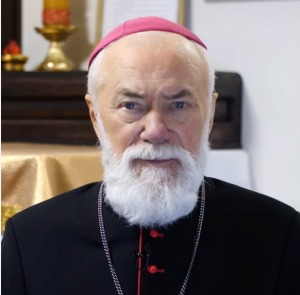
Controversial retired archbishop defends SSPX after excommunications
Controversial retired Archbishop Jan Paweł Lenga has publicly defended the SSPX following the excommunications over its episcopal consecrations The Society of St Pius X has received a public defence from the controversial Archbishop Jan Paweł Lenga, retired Archbishop Emeritus of Karaganda in Kazakhstan, following its 1 July episcopal consecration of four bishops without a papal mandate. In a lengthy statement published in English by SignoftheCross Media, Archbishop Lenga denounced the Holy See’s excommunication decree in uncompromising terms, describing it as evidence that the Vatican had “departed from Christ and from the faith”. His intervention is the first public endorsement of the Society by a bishop since the “maximalist” sanctions imposed on the SSPX following the illicit episcopal consecrations. Opening his statement, the retired archbishop contrasted the Society’s episcopal consecration with what he described as the state of the contemporary Church. “It was worth seeing the consecration of the bishops of the Society of St Pius X: what peace, what joy, what prayerful atmosphere, what solemnity!” the archbishop said. “Nothing like that can be seen in the post-conciliar Church anymore. In contrast, the Vatican is in chaos.” Archbishop Lenga argued that the Society had sought reconciliation with Rome for many years but claimed those efforts had failed because of those now holding senior positions within the Vatican. He went on to accuse senior Church leaders of abandoning their pastoral mission, alleging that they were more concerned with enforcing canon law than safeguarding the faith. “They appeal to canons – which were written to prevent heresies, to prevent schism – yet these cardinals and bishops themselves are in schism. They are the ones who should be excommunicated, because they no longer have anything at all in common with the Church of Christ.” The former Archbishop of Karaganda also rejected suggestions that the Society had broken communion with the Holy See, insisting instead that it remained faithful to the Petrine ministry. “They do not wish to be separated from the See of Peter,” he said. “They are not separating themselves from Peter; rather, the false Peter has separated himself from them.” His criticism extended directly to Pope Leo XIV, whom he referred to by his secular surname. “Prevost’s approval of the excommunication is proof that he no longer represents the Church that follows Jesus and leads people to salvation,” Archbishop Lenga declared. The retired archbishop repeatedly defended the Society’s founder, Archbishop Marcel Lefebvre, portraying him as a bishop who foresaw the dangers facing the Church after the Second Vatican Council. He argued that the Society’s attachment to the Church’s traditional liturgy and doctrine represented fidelity rather than rebellion, while describing the post-conciliar reforms as a departure from the Church’s authentic mission. Referring to the episcopal consecration itself, he praised both the liturgy and the homily delivered during the ceremony. “The homily at the ordination Mass of the new bishops was in the spirit of Cyril of Alexandria and in the spirit of those who suffered at the hands of people during their lives,” he said. “It was in the spirit of Saint Athanasius.” Archbishop Lenga concluded by insisting that the Vatican’s penalties had no spiritual effect on the Society and urged its members to remain steadfast despite the sanctions. “Remain faithful to Christ,” he said. “Some will call into question the sacraments you administer, but remain faithful to Christ, and whoever endures to the end will be saved.” While the archbishop’s statement is likely to be welcomed within SSPX circles, Archbishop Lenga has long occupied a controversial position within the wider Church because of his own disciplinary history. Following his retirement, the Diocese of Włocławek in Poland imposed restrictions on the retired archbishop after a series of public interventions directed against Pope Francis. The disciplinary measures prohibited him from preaching at Mass and speaking to the media, although Archbishop Lenga immediately rejected the sanctions by granting a televised interview in which he said he intended to continue speaking publicly. Fr Artur Niemira, chancellor of the Diocese of Włocławek, said at the time that Bishop Wiesław Mering had imposed the restrictions to prevent scandal among the faithful. According to the Polish Catholic news agency KAI, the sanctions followed Archbishop Lenga’s refusal to mention Pope Francis by name during Mass and were to remain in force pending a judgment by the Holy See. His criticism of Pope Francis had already become well known. The Polish journal Więź reported that he had described Pope Francis as a “usurper and heretic”, quoting him as saying: “Bergoglio preaches untruth, preaches sin, and does not preach a tradition that lasted so many years, 2,000 years… He proclaims the truth of this world and this is the truth of the devil.” The Polish bishops’ conference also distanced itself from his interventions after he appeared on Polish television in 2020. Its spokesman, Fr Paweł Rytel-Andrianik, emphasised that Archbishop Lenga was not a member of the conference and that “the statements of Archbishop Lenga cannot be identified in any way with the Polish episcopal conference. They cannot be treated as positions of Polish bishops.” Born in present-day Ukraine in 1950, he was ordained secretly in 1980 during Soviet persecution of the Church before serving as Apostolic Administrator of Kazakhstan following the collapse of the Soviet Union. He later became Archbishop of Karaganda, remaining in office until Pope Benedict XVI accepted his resignation in 2011.
Jul. 11, 2026
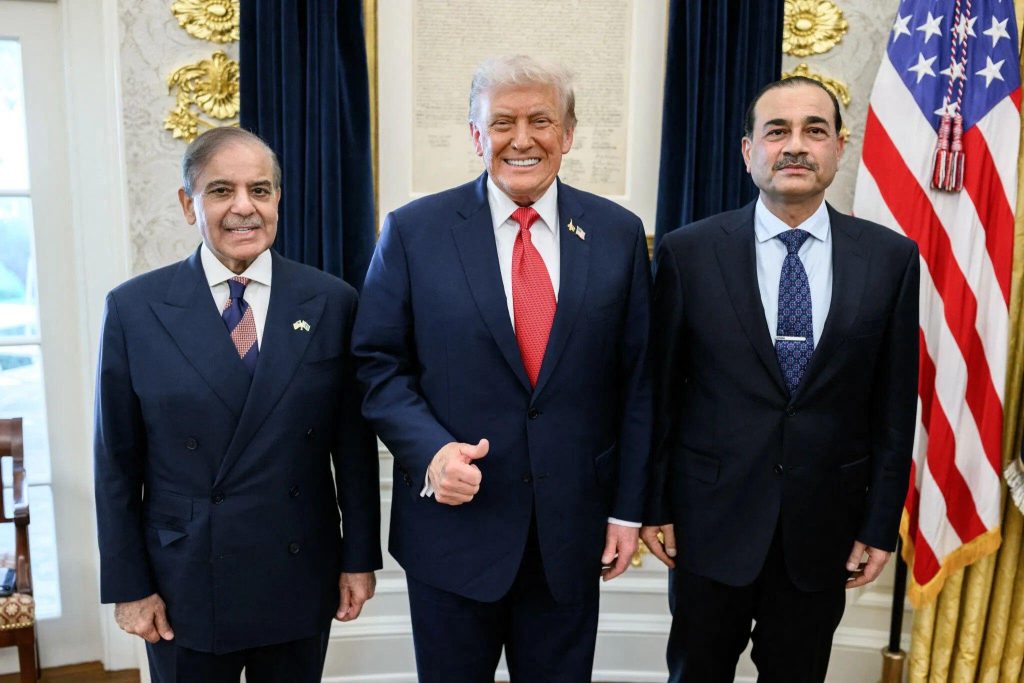
Trump says he is defending Christians. So why is he embracing Pakistan?
The Trump administration has repeatedly pledged to defend persecuted Christians around the world. Yet Washington continues to strengthen its relationship with Pakistan, one of the world’s worst countries in which to be a Christian At the end of last month, at a luxury resort overlooking Lake Lucerne in Switzerland’s Bürgenstock, JD Vance, the Vice President of the United States, joked that there were two “very important people” in his life, “an Indian and a Pakistani”. The Indian is, of course, his wife, Second Lady Usha Vance, born to Brahmin parents who immigrated to the U.S. in the 1980s. The Pakistani is Field Marshal Syed Asim Munir Ahmed Shah, whom Vance said he had spoken to more than anyone over the last three months. Vance said “we would not be here without his statesmanship” and that he is “a great military leader” and a “great diplomat”. The reason for his thanks is that, alongside Qatar, Pakistan has been leading negotiations between the United States and Iran to end the conflict between the two countries. Ignoring the fact that these negotiations have failed and that, for many, the war in Iran is something the United States should not be involved in, there is another pressing question. Why does Donald Trump’s apparently Christian-centric administration feel so comfortable in the hands of a country that has shown such hostility towards its Christian communities? The man whom Vance spends so much time talking to, and with whom Donald Trump held an unprecedented meeting at the White House, is one of many Pakistani leaders who have a long history of failing to protect Christians. After returning from Saudi Arabia, where he memorised the Quran, he was appointed brigadier. Since 2016, he has climbed the military ladder, leading to his appointment as Chief of Army Staff in 2022. Perhaps his most notable failure to address anti-Christian violence was the Jaranwala church arsons in 2023. The incident occurred after torn pages of the Quran were allegedly found near the Christian quarter of the city of Jaranwala, Punjab. Local mosques quickly took to their loudspeakers to encourage potential rioters and, soon, 26 Christian churches were burned alongside Christian homes being destroyed. The day after most of the violence had been carried out, the military stepped in to look busy and some order was restored. Field Marshal Asim Munir described the events as “extremely tragic”, and then let the police do their job, which included arresting two Christian men identified in social media posts as being responsible for the Quran pages being torn. But it should be noted that Field Marshal Asim Munir is one among many pernicious forces in a country where Christians are treated as second-class citizens. Indeed, there is an entire culture built around violence against religious minorities. Forced conversion is one notably horrid practice about which little is done, whereby Christian girls, normally underage, are taken from their family homes and intimidated into converting and marrying a Muslim man. The practice is so common that it has led to interventions by the United Nations. Another is the imprisonment and death penalty for Christians who allegedly insult Islam. Insulting members of Muhammad’s family, companions or wives carries a three-year prison sentence, defiling, damaging or desecrating the Quran means life imprisonment, and making derogatory remarks about Muhammad results in a mandatory death penalty. The laws effectively serve as a constant threat hanging over every Christian in the country, with Christians aware that the accusation alone could result in their death through mob violence long before the state carries out its own investigations. The law also has an extremely low evidential threshold, and defendants can often spend years in prison awaiting trial or appeal. Indeed, this week, Amir Peter, the brother of a Catholic priest in Pakistan, died in prison after being detained over allegedly false blasphemy charges while awaiting trial. Having allegedly made derogatory remarks about Muhammad, any conviction would likely have led to his execution anyway, but his health deteriorated rapidly, in part because the authorities allegedly denied him medical care during his imprisonment. Despite all of these concerns, a special relationship continues to be fostered. Indeed, it was Pakistan that unironically nominated Donald Trump for the Nobel Peace Prize in June 2025, and the following month the United States and Pakistan agreed a trade deal. Amid all this diplomatic cosying up, at no point has President Trump publicly raised the plight of the country’s Christians. Any concern has instead been channelled through the State Department’s annual reporting and through USCIRF, a rather limp response in comparison with its reaction to the Christmas Day bombings in Nigeria. According to Open Doors, a charity which documents the persecution of Christians around the world, Pakistan is the seventh worst country in the world in which to be a Christian. It therefore seems contradictory that, while the Trump administration claims to be “saving Christians throughout the world”, as the President himself said while speaking at the Faith & Freedom Coalition’s 2026 policy conference in Washington this month, it has not taken a stronger public stand against Pakistan’s treatment of its Christian minority.
Jul. 11, 2026