The Society of Saint Pius X has taken its dispute with the Holy See into a new canonical phase after announcing that it has formally challenged the Dicastery for the Doctrine of the Faith’s decree of 2 July by means of a preliminary recourse under the 1983 Code of Canon Law.
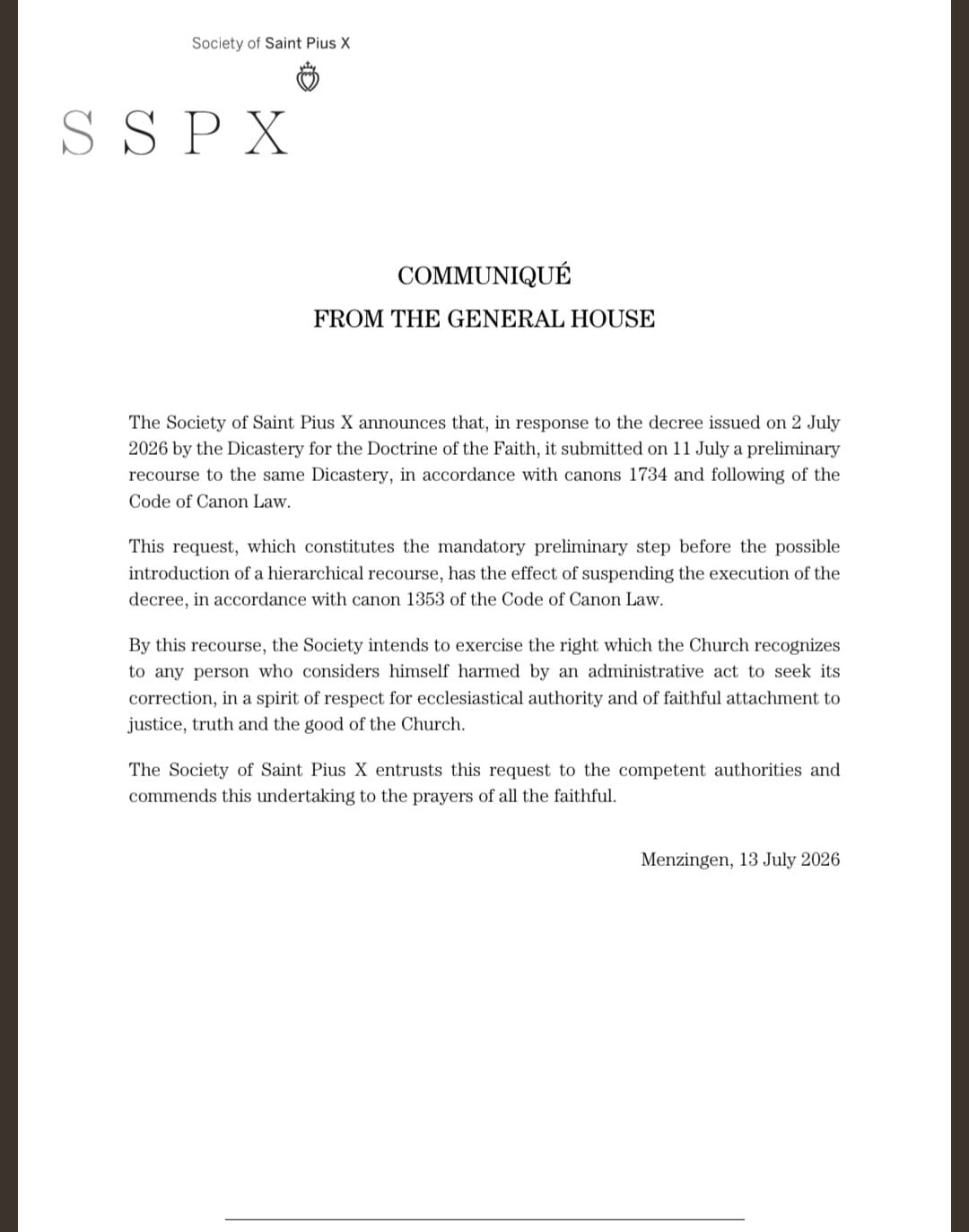
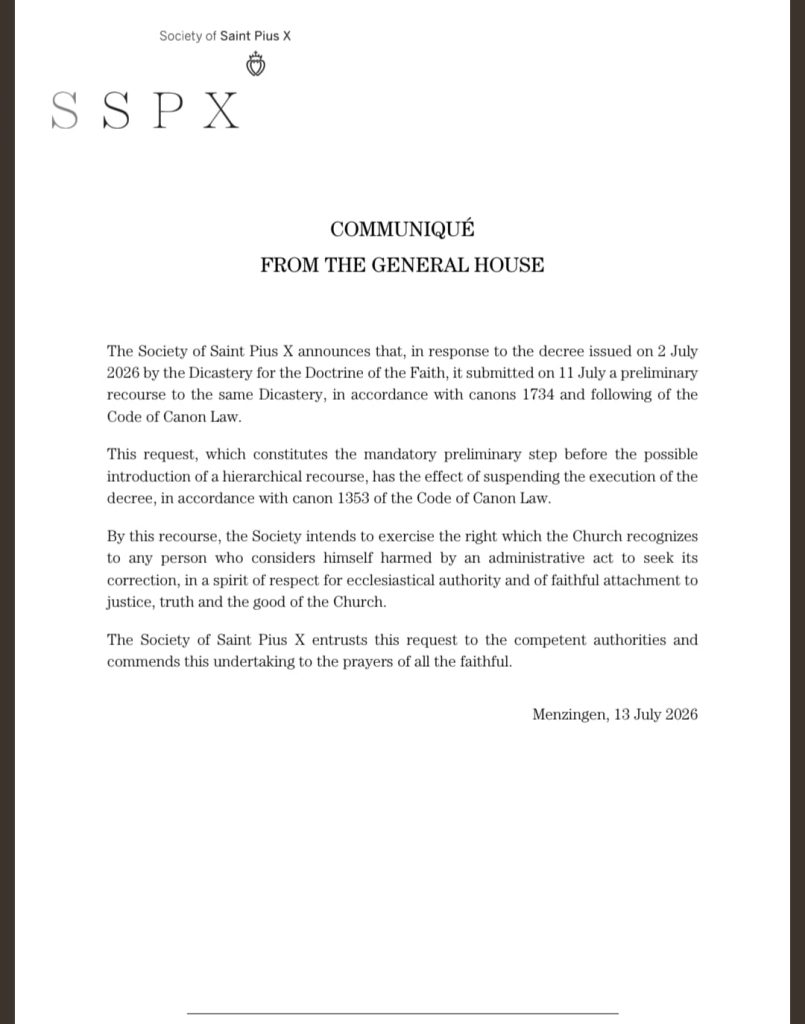
In a communiqué issued at 9 pm Central European time from its headquarters in Menzingen on 13 July, the SSPX confirmed that it had submitted the recourse petition on 11 July in accordance with canon 1734, arguing that the measure automatically suspends the penalties of the Vatican decree under canon 1353 while the matter is under review.
The move is the first formal procedural response by the SSPX since Rome declared that the episcopal consecration of four priests on 1 July without a pontifical mandate constituted “an act of a schismatic nature”, triggering the most serious confrontation between the Society and the Holy See since the 1988 excommunications.
Rather than presenting the filing as an act of defiance, the Society described it as the exercise of a right recognised by the Church. “The Society intends to exercise the right which the Church recognizes to any person who considers himself harmed by an administrative act to seek its correction, in a spirit of respect for ecclesiastical authority and of faithful attachment to justice, truth and the good of the Church,” the communiqué states.
The procedural significance of the filing lies in the canons cited by the Society. Canon 1734 requires anyone wishing to challenge an administrative decree first to request in writing that its author revoke or amend it before lodging a higher appeal.
The petition must normally be filed within ten useful days of notification. Canon 1353 provides that recourse against decrees which inflict or declare a penalty has a suspensive effect, while canon 1736 confirms that where the law itself suspends execution, the preliminary petition produces the same effect.
In practical terms, the SSPX argues that the penalties and declarations contained in the decree cannot be enforced while its request remains pending before the Dicastery for the Doctrine of the Faith.
The canonical process does not end with this first submission. Under canon 1735, the Dicastery has thirty days to respond by revoking, correcting or rejecting the request. If it issues a new decree, or if it rejects the petition, the Society may then pursue a hierarchical recourse under canon 1737.
That appeal would seek a review by the competent higher authority, with the superior possessing the authority to confirm, revoke or modify the original decree. The legal process creates a temporary pause while preserving the possibility of a fuller examination of the dispute.
For the Society, however, the procedural arguments are only one part of a much broader disagreement with Rome over the character of the July consecrations themselves. In an extensive analysis published on 9 July, the SSPX rejected the Dicastery’s central conclusion that the consecrations were schismatic. Referring directly to the decree, the Society argued that “the decree claims that ‘Monsignor Alfonso de Galarreta’ committed ‘an act of a schismatic nature by the episcopal consecration of four priests, without a papal mandate and against the will of the Sovereign Pontiff.’ But such an assertion is hasty and reveals a flawed understanding of schism.”
Drawing upon classical canonists and theologians, including Monsignor Raoul Naz and Cardinal Cajetan, the Society sought to distinguish schism from disobedience. It maintained that while the consecrations had taken place contrary to the wishes of Pope Leo XIV, they did not involve a rejection of the Roman Pontiff’s authority. “The Society of Saint Pius X and its Superior General have always affirmed that they recognize Leo XIV as their head. They address him as a subject addresses his superior, as a son addresses his father. … The Society has never claimed to constitute a parallel or autonomous Church.”
In its view, schism requires the refusal of submission to the Roman Pontiff or separation from communion with the Church. The SSPX insists that it continues to recognise papal authority while disputing what it considers an unjust administrative act. From its perspective, the dispute concerns the lawfulness and necessity of the episcopal consecrations rather than communion with the Holy See itself.
The Society also devoted considerable attention to the penalties declared by the Dicastery. It argued that canon law does not impose penalties automatically without regard to personal culpability, invoking the longstanding principle of nulla poena sine culpa. Citing canons 1323 and 1324, it maintained that a person acting out of necessity or under grave fear may not incur canonical penalties in the ordinary way. The document concludes that “these two canonical considerations are sufficient to affirm with certainty that neither the consecrating bishops nor the bishops consecrated on July 1, 2026, are excommunicated.”
According to the SSPX, the necessity in question is not subjective but arises from what it describes as “the grave danger threatening the complete preservation of the faith and the ordinary means of sanctification”. That appeal to a state of necessity has formed the backbone of the Society’s canonical reasoning since Archbishop Marcel Lefebvre justified the 1988 episcopal consecrations on similar grounds.
The Society’s decision to pursue a formal recourse also recalls another episode involving traditionalist Catholics. During the early 1990s, six Catholics in Hawaii who had been declared excommunicated by the local bishop because of their association with SSPX sacramental life sought hierarchical recourse to Rome.
Following a review by the Congregation for the Doctrine of the Faith under Cardinal Joseph Ratzinger, the decrees were ultimately declared null, with the Vatican concluding that the actions in question did not amount to formal schism. While the factual circumstances differ substantially from the present dispute, the Hawaii case remains one of the clearest examples of the Holy See overturning canonical penalties after the recourse procedure.
The comparison with 1988 is unavoidable, yet the present situation differs in one significant respect. Following Archbishop Lefebvre’s consecration of four bishops without papal approval, Rome declared that he and the newly consecrated bishops had incurred excommunication. The Society consistently maintained that those penalties had never been valid because of necessity but did not pursue the structured administrative recourse now available under the current procedural framework. Instead, the dispute evolved through years of theological dialogue until Pope Benedict XVI remitted the excommunications in 2009 without requiring the Society first to acknowledge that they had been validly incurred.
The present case therefore combines continuity with a twist. Substantively, the SSPX continues to reject both the accusation of schism and the penalties attached to it. Procedurally, however, it is making full use of the mechanisms provided by the 1983 Code of Canon Law.
The SSPX’s reservations concerning the post-conciliar reforms extended to the legal framework established after the Second Vatican Council. Yet by relying explicitly upon canons 1353 and 1734 to 1737, the Society is invoking the authority of the very Code promulgated by Pope John Paul II in 1983. Indeed, recognition of the validity of the 1983 Code appeared as the fifth point in the Memorandum of Understanding signed by Cardinal Joseph Ratzinger and Archbishop Lefebvre on 5 May 1988 before the agreement collapsed the following day.
Beyond that, the SSPX readily acknowledges that the Dicastery has issued a decree and that the decree purports to impose canonical consequences. What it does not accept is that those consequences have been validly incurred. Its decision to file recourse therefore seeks simultaneously to suspend the decree’s effects, protect its apostolate and challenge the Vatican’s position using the Church’s own judicial mechanisms.
The Dicastery for the Doctrine of the Faith will in theory make the next move. It may revoke or amend its decree, reject the petition outright or simply reaffirm its earlier conclusions. Should that occur, the Society would then be entitled to pursue hierarchical recourse within the Roman Curia under the timetable established by canon law. The competent authority would have the power to uphold, rescind or modify the decree, while the Pope himself could intervene personally at any stage, either by deciding the matter directly or by instructing the Dicastery to adopt a different course.
For now, the dispute enters a new but no less consequential phase. The canonical process offers neither side an immediate victory. Instead, it places the latest confrontation between Rome and the Society of Saint Pius X within the legal structures of the Church.