

Latest
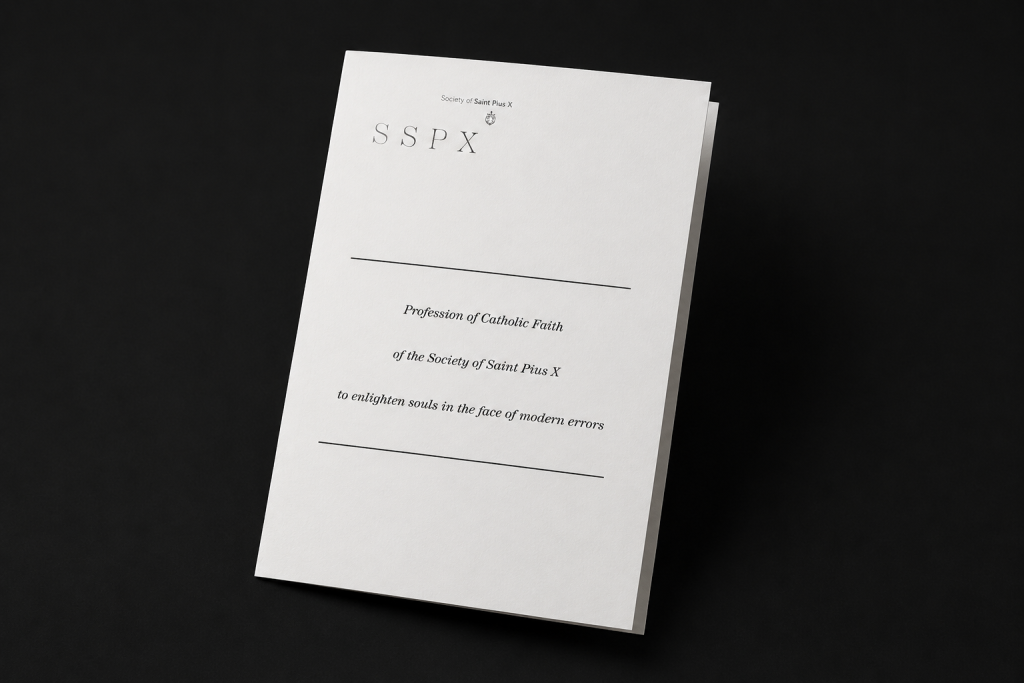
SSPX sends 28-page profession of faith to Pope and cardinals ahead of consistory
The SSPX has sent a 28-page profession of faith and open letter to Pope Leo XIV and the College of Cardinals ahead of the Extraordinary Consistory, just days before its planned episcopal consecrations at Ecône. One senior cardinal tells AdVaticanum the looming consecrations are already on the minds of the princes of the Church as they prepare to gather in Rome The Society of Saint Pius X has issued an open letter to Pope Leo XIV and the College of Cardinals during the week of the Extraordinary Consistory at the Vatican, releasing a 28-page Profession of Faith just days before its planned episcopal consecrations at Ecône on 1 July. The letter, dated 24 June, the Feast of the Nativity of St John the Baptist, is signed by SSPX Superior General Fr Davide Pagliarani, First Assistant Bishop Alfonso de Galarreta, Second Assistant Fr Christian Bouchacourt, former Superior General Bishop Bernard Fellay and former Superior General Fr Franz Schmidberger. The documents were first published in Italian by the traditionalist website Messa in Latino, which said it had received them from “sources at the highest levels”. AdVaticanum later obtained the full text of the Profession of Faith through SSPX sources. Addressing Pope Leo XIV and the cardinals directly, the Society said it believed the time had come to make “an integral profession of the Catholic faith” and place it before the Church’s highest authorities. “On the eve of the Consistory scheduled for the end of this month, and only days before the episcopal consecrations planned for 1 July at Ecône, it seems to us that the time has come for the Priestly Fraternity of Saint Pius X to make an integral profession of the Catholic faith, which we wish to place into the hands of Your Holiness and of each of the Cardinals,” the letter states. The SSPX said the Church was facing grave difficulties and that it could not remain silent. “Today the Church suffers under the pressure of new forces, arising both from within and from without, which are driving her in every possible direction except, so it seems to us, the right one. Faced with such suffering, we cannot remain indifferent.” The Society said the answer to the Church’s present problems was not to be found in new solutions but in fidelity to Tradition. “It does not belong to the Priestly Fraternity of Saint Pius X to indicate the path to be followed, but rather to the Church’s bimillennial Tradition, faithfully preserved and handed down by the Apostolic See throughout the centuries, and which many now regard, in practice, as an outdated reality, subject to continual evolution.” The letter says the accompanying Profession of Faith was written “in the face of the principal errors and the gravest dangers of our time” and argues that Catholic Tradition contains the remedies for the Church’s present crisis. “We are convinced that Tradition contains all the remedies for the deepest evils from which the Church and the world suffer, and for which solutions are sought in vain outside it.” The Society also expressed the hope that the text could become the basis for future discussions with the Holy See. “We hope that one day this doctrinal text may serve as the basis for a frank discussion with the Holy See, in a peaceful, fraternal, and charitable spirit.” Describing the declaration as a positive affirmation of Catholic belief rather than a protest document, the SSPX added: “The text that we present to you is not the sterile litany of a group of nostalgics, but the necessary expression, peaceful yet resolute, of our faith.” The Profession of Faith itself is a detailed restatement of traditional Catholic doctrine and includes explicit rejections of a number of theological and philosophical currents which the Society says have contributed to confusion within the Church. Early in the document, the authors argue that current circumstances require a complete presentation of Catholic teaching. “In the present confusion, it is no longer sufficient to recall a few isolated truths. It has become indispensable to set in full light the entire order of Catholic doctrine, in its supernatural coherence and luminous harmony, omitting no dogma, diminishing no truth.” The text goes on to state: “I consequently reject all errors contrary to this Faith, and in particular those of liberalism, indifferentism, modernism, ecumenism, and laicism, condemned by Popes Pius IX, Leo XIII, Saint Pius X, Pius XI, and Pius XII.” Among the themes addressed are grace, original sin, redemption, the Church, the liturgy and the social kingship of Christ. Rejecting what it describes as modern attempts to redefine faith, the declaration states: “I consequently reject the error of modernism, as it still rages today, which reduces faith to an interior experience, to a sensible aspiration, or to a progressive realisation in the believing community.” On original sin, it says: “In Adam, however, the nature of man was not destroyed, but only wounded,” before adding: “I likewise reject all doctrines which, in a senseless optimism, minimise original sin, naively exalt the native goodness of man.” The document also reaffirms traditional teaching on Christ’s redemptive sacrifice. “I therefore reject every doctrine which would reduce the Redemption to a simple manifestation of God’s love. The Cross is not merely a sign: it is the altar of the redemptive Sacrifice.” The text follows this with a rejection of what it calls “false ecumenism”. “I therefore reject false ecumenism, which rests upon the idea that the Holy Ghost would not refuse to use separated communities as means of salvation.” One of the longest sections concerns the Social Kingship of Christ, a doctrine strongly associated with pre-conciliar Catholic social teaching. “I profess that Our Lord Jesus Christ is King not only of individuals, but also of families, institutions, peoples, and nations.” The declaration adds that Christ’s reign “must extend to the external forum, to laws, morals, education, culture, and public life”. The final section deals with the liturgy and offers a defence of the traditional Roman Mass while criticising the reforms introduced after the Second Vatican Council. “I profess that the traditional Roman Mass expresses with incomparable clarity the Catholic doctrine of Sacrifice.” The text continues: “I observe with sorrow that the contemporary liturgical reforms have departed considerably from the traditional liturgy, and thereby contributed preponderantly to the loss of the sense of the sacred.” The letter concludes with the words of St Paul, “For we can do nothing against the truth, but only for the truth,” before adding: “We too believe; therefore we speak.” As the Extraordinary Consistory convenes this Friday, with the Vatican expected to bring all the cardinals to Rome, including those beyond voting age, one senior cardinal speaking off the record to AdVaticanum earlier this week acknowledged that the impending 1 July SSPX episcopal consecrations remain a “looming topic” among the princes of the Church, even if they will not feature in any public discussion. “We are reminded by the statements from Cardinal Fernández earlier this year and more recently,” the senior cardinal said, “and we are intellectually aware of the episcopal consecrations.” The cardinal added: “As the consistory is only this Friday, we think about it, about the implications for unity and for the Church’s witness in a fractured age.”
Jun. 24, 2026
Another “influencer priest” leaves the priesthood
Fr Damián María Montes, a Spanish Redemptorist priest, has announced that he will no longer exercise his priestly ministry. A well-known figure across Spain, Fr Damián came to prominence through his participation in the third series of La Voz in 2015, where he reached the quarter-finals. During the programme, he performed secular songs including “Angels” […] Fr Damián María Montes, a Spanish Redemptorist priest, has announced that he will no longer exercise his priestly ministry. A well-known figure across Spain, Fr Damián came to prominence through his participation in the third series of La Voz in 2015, where he reached the quarter-finals. During the programme, he performed secular songs including “Angels” by Robbie Williams. Originally from Granada in southern Spain, he entered the Redemptorist postulancy at the age of 18. After studying at the Pontifical University of Comillas in Madrid, he spent a year on mission in Kolkata, India. On his return, he took his perpetual vows and was ordained a priest in Granada in 2013. He later held a variety of posts in Madrid before being transferred in 2024 to Granada, where he served as rector and superior at the Sanctuary of Our Lady of Perpetual Help. Throughout his years in active ministry, he maintained a substantial online presence, with almost 750,000 followers on TikTok and more than 35,000 on Instagram. His videos often took a catechetical form, with Fr Damián answering questions about the faith, alongside posts of himself in secular dress, often connected to the performing arts. One of his most recent Instagram posts showed him graduating after completing studies related to the Spanish poet, playwright and theatre director Federico García Lorca. On his website, he describes his academic career as being “characterized by a marked interdisciplinary approach that integrates literature, theater, pedagogy and humanistic thought.” In his most recent video, explaining his decision to leave the priesthood, he says: “After almost three years of questions, searching, silences and a deep inner struggle, I have decided to definitively retire from the exercise of the priestly ministry.” He adds that he is stepping back “in peace and with a clear conscience, knowing that I truly loved each mission entrusted to me, that I have paved the way, and that I have built necessary bridges of dialogue.” He does not go into detail about his reasons, telling his audience: “There are compelling reasons that I will keep to myself, reasons that support this decision and that made my missionary service extremely difficult.” While speaking warmly about his years as a missionary, he describes recent years as “very sad and very difficult”. He says that, in future, he hopes there will be new opportunities for him and that he might even be able to build a family. On his website, he states that he currently works as academic vice-director of the Ernesto Cardenal Foundation and as a language and literature teacher at the European Lyceum. The story of consecrated men and women leaving their vocations after achieving fame, often dubbed “influencers”, has become increasingly common. Cristina Scuccia, who won the 2014 edition of The Voice Italy , left her order in 2022. Similarly, Father Alberto Ravagnani, an Italian priest with a substantial online following and millions of views on YouTube, also announced his intention to leave the priesthood in February this year in a video posted on Instagram that bore notable similarities to Fr Damián’s. His Instagram account presented a life shaped by secular influences, including skincare, dancing and photographs of himself at the gym, alongside religious content. In 2025, he took part in a paid sponsorship post with Bondsupplements under the caption “Holy yes, but also healthy”. His departure was accompanied by a farewell book, which he promoted on his channel. Last year, the Vatican hosted a gathering of more than 1,000 priests for the Jubilee of Digital Missionaries and Catholic Influencers. While many priests and religious use social media successfully as a tool of evangelisation, bringing people closer to the Church, questions have arisen in recent years about whether such visibility can contribute to the secularisation of holy orders.
Jun. 24, 2026
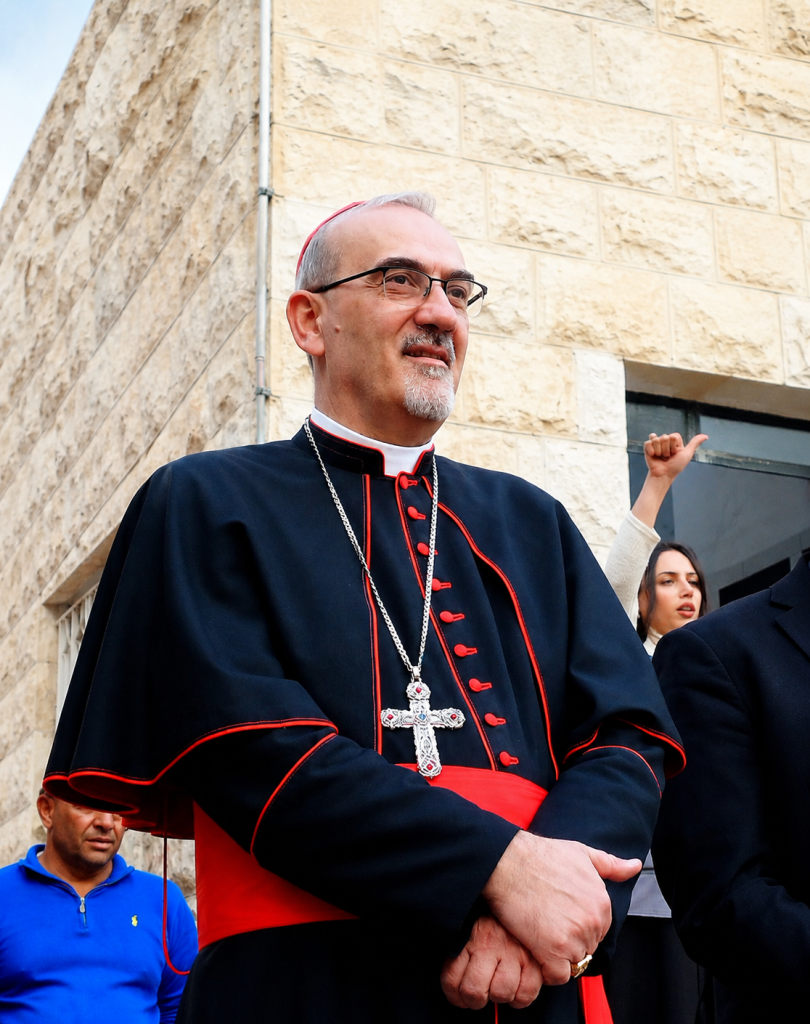
Cardinal Pizzaballa returns to Gaza with Patriarch Theophilos
Cardinal Pierbattista Pizzaballa has returned to Gaza alongside Patriarch Theophilos III in a fresh wartime visit to Holy Family parish Cardinal Pierbattista Pizzaballa has travelled to Gaza alongside the Greek Orthodox Patriarch of Jerusalem, Theophilos III, ahead of his departure for Rome to attend Pope Leo XIV’s second consistory. The Latin Patriarch of Jerusalem arrived in the territory on 22 June accompanied by Dr Josef Blotz, Grand Hospitaller of the Sovereign Military Order of Malta, and representatives of Malteser International, the Order’s humanitarian agency. In a statement issued the same day, the Latin Patriarchate of Jerusalem said the visit was intended to support both the Christian community and the wider population of Gaza as the war and humanitarian crisis continue. “The visit expresses the pastoral responsibility of the Churches of Jerusalem toward the local churches and toward the whole population of Gaza, where families continue to endure grave humanitarian suffering, fear, loss and uncertainty,” the Patriarchate said. It added that the presence of Patriarch Theophilos and Cardinal Pizzaballa carried the prayer of Jerusalem to Gaza’s wounded faithful and to all who suffer, in a ministry of consolation, mercy and steadfast Christian witness. According to the Patriarchate, the two Church leaders are meeting clergy, religious communities, local Christian families and others affected by the continuing conflict, hoping through “prayer, personal encounter and pastoral presence” to offer “spiritual strength, comfort and hope in the midst of deep suffering”. The Patriarchate described the mission as one aimed at bringing prayer, consolation and hope to those living through the continuing effects of war, displacement and uncertainty. The visit began at Holy Family parish, where Cardinal Pizzaballa and Patriarch Theophilos were welcomed by those sheltering within the church compound. The parish, led by Fr Gabriel Romanelli, has become a refuge for Christian and Muslim families since the outbreak of the war, providing shelter as well as access to food and water. After prayers led by Fr Romanelli, Cardinal Pizzaballa spoke briefly about the continuing hardships facing the population. “The situation is difficult,” he said, while assuring those present that Gaza remained a priority for the Churches of the Holy Land. He also said he was pleased to be able to return and meet the people of the territory in person, speaking of his joy at being able “to look into the eyes not only of the parishioners and those living around the church, but of all the inhabitants of this suffering city”. The Jerusalem patriarch has been among the most prominent Church leaders in the Middle East since the outbreak of the Israel-Hamas war and has repeatedly drawn international attention for his efforts to support Gaza’s small Christian community. His latest visit marks a return to a territory he has visited on several occasions during the conflict, despite the severe restrictions on access. In December 2025, Cardinal Pizzaballa travelled to Gaza shortly before Christmas and celebrated Mass at Holy Family parish, in what was regarded as an important sign of solidarity with local Christians trapped in the enclave. The current visit is also the second wartime journey to Gaza undertaken jointly by Cardinal Pizzaballa and Patriarch Theophilos. The two Church leaders previously travelled together following the Israeli strike on the Holy Family church compound in July last year, which killed three people and injured several others, including Fr Romanelli. In the aftermath, the two patriarchs made what was widely regarded as a historic visit to express solidarity with the victims and with Gaza’s Christian community, while also appealing for an end to the conflict and for a process of healing and reconciliation across the Holy Land.
Jun. 24, 2026
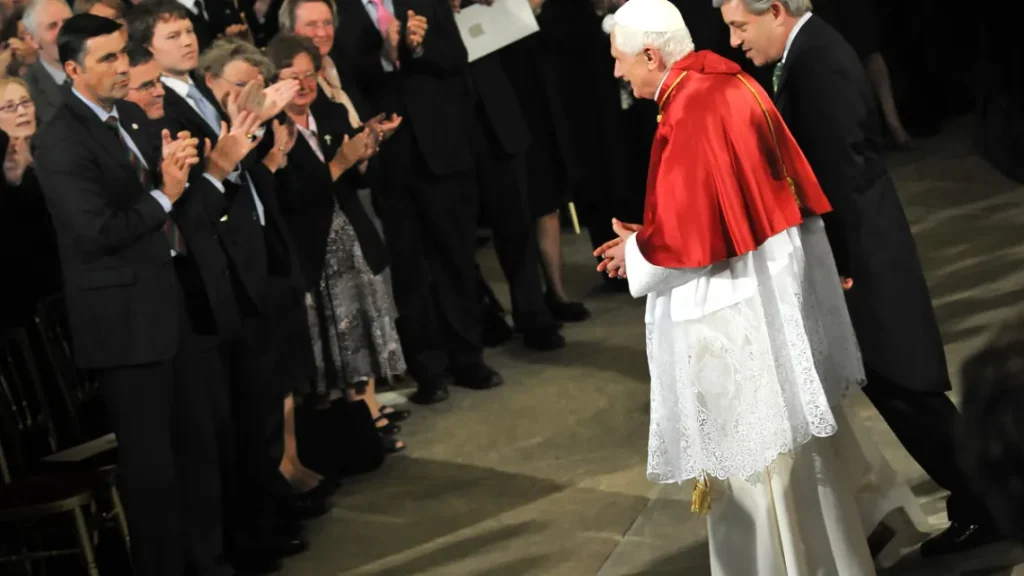
A novena of Benedict XVI’s greatest homilies and addresses, day 4: the Westminster Hall address
Day four of our novena marking the 75th anniversary of Pope Benedict XVI’s priestly ordination features his Westminster Hall address, delivered during his 2010 Apostolic Journey to the United Kingdom To mark the 75th anniversary of Pope Benedict XVI’s priestly ordination, AdVaticanum is publishing a nine-day novena of some of the most important homilies and addresses of his public life. Today we publish Pope Benedict XVI’s address to Westminster Hall, delivered during his Apostolic Journey to the United Kingdom on 17 September 2010. Speaking in the historic chamber where Saint Thomas More was condemned for refusing to act against his conscience, Benedict examined the relationship between faith and politics, the moral foundations of democracy and the place of religion in public life. The address is one of the clearest expressions of Benedict’s political thought, setting out his conviction that reason and faith are not rivals but partners in the search for truth and justice. Mr Speaker, Thank you for your words of welcome on behalf of this distinguished gathering. As I address you, I am conscious of the privilege afforded me to speak to the British people and their representatives in Westminster Hall, a building of unique significance in the civil and political history of the people of these islands. Allow me also to express my esteem for the Parliament which has existed on this site for centuries and which has had such a profound influence on the development of participative government among the nations, especially in the Commonwealth and the English-speaking world at large. Your common law tradition serves as the basis of legal systems in many parts of the world, and your particular vision of the respective rights and duties of the state and the individual, and of the separation of powers, remains an inspiration to many across the globe. As I speak to you in this historic setting, I think of the countless men and women down the centuries who have played their part in the momentous events that have taken place within these walls and have shaped the lives of many generations of Britons, and others besides. In particular, I recall the figure of Saint Thomas More, the great English scholar and statesman, who is admired by believers and non-believers alike for the integrity with which he followed his conscience, even at the cost of displeasing the sovereign whose “good servant” he was, because he chose to serve God first. The dilemma which faced More in those difficult times, the perennial question of the relationship between what is owed to Caesar and what is owed to God, allows me the opportunity to reflect with you briefly on the proper place of religious belief within the political process. This country’s Parliamentary tradition owes much to the national instinct for moderation, to the desire to achieve a genuine balance between the legitimate claims of government and the rights of those subject to it. While decisive steps have been taken at several points in your history to place limits on the exercise of power, the nation’s political institutions have been able to evolve with a remarkable degree of stability. In the process, Britain has emerged as a pluralist democracy which places great value on freedom of speech, freedom of political affiliation and respect for the rule of law, with a strong sense of the individual’s rights and duties, and of the equality of all citizens before the law. While couched in different language, Catholic social teaching has much in common with this approach, in its overriding concern to safeguard the unique dignity of every human person, created in the image and likeness of God, and in its emphasis on the duty of civil authority to foster the common good. And yet the fundamental questions at stake in Thomas More’s trial continue to present themselves in ever-changing terms as new social conditions emerge. Each generation, as it seeks to advance the common good, must ask anew: what are the requirements that governments may reasonably impose upon citizens, and how far do they extend? By appeal to what authority can moral dilemmas be resolved? These questions take us directly to the ethical foundations of civil discourse. If the moral principles underpinning the democratic process are themselves determined by nothing more solid than social consensus, then the fragility of the process becomes all too evident – herein lies the real challenge for democracy. The inadequacy of pragmatic, short-term solutions to complex social and ethical problems has been illustrated all too clearly by the recent global financial crisis. There is widespread agreement that the lack of a solid ethical foundation for economic activity has contributed to the grave difficulties now being experienced by millions of people throughout the world. Just as “every economic decision has a moral consequence” (Caritas in Veritate, 37), so too in the political field, the ethical dimension of policy has far-reaching consequences that no government can afford to ignore. A positive illustration of this is found in one of the British Parliament’s particularly notable achievements – the abolition of the slave trade. The campaign that led to this landmark legislation was built upon firm ethical principles, rooted in the natural law, and it has made a contribution to civilization of which this nation may be justly proud. The central question at issue, then, is this: where is the ethical foundation for political choices to be found? The Catholic tradition maintains that the objective norms governing right action are accessible to reason, prescinding from the content of revelation. According to this understanding, the role of religion in political debate is not so much to supply these norms, as if they could not be known by non-believers – still less to propose concrete political solutions, which would lie altogether outside the competence of religion – but rather to help purify and shed light upon the application of reason to the discovery of objective moral principles. This “corrective” role of religion vis-à-vis reason is not always welcomed, though, partly because distorted forms of religion, such as sectarianism and fundamentalism, can be seen to create serious social problems themselves. And in their turn, these distortions of religion arise when insufficient attention is given to the purifying and structuring role of reason within religion. It is a two-way process. Without the corrective supplied by religion, though, reason too can fall prey to distortions, as when it is manipulated by ideology, or applied in a partial way that fails to take full account of the dignity of the human person. Such misuse of reason, after all, was what gave rise to the slave trade in the first place and to many other social evils, not least the totalitarian ideologies of the twentieth century. This is why I would suggest that the world of reason and the world of faith – the world of secular rationality and the world of religious belief – need one another and should not be afraid to enter into a profound and ongoing dialogue, for the good of our civilization. Religion, in other words, is not a problem for legislators to solve, but a vital contributor to the national conversation. In this light, I cannot but voice my concern at the increasing marginalization of religion, particularly of Christianity, that is taking place in some quarters, even in nations which place a great emphasis on tolerance. There are those who would advocate that the voice of religion be silenced, or at least relegated to the purely private sphere. There are those who argue that the public celebration of festivals such as Christmas should be discouraged, in the questionable belief that it might somehow offend those of other religions or none. And there are those who argue – paradoxically with the intention of eliminating discrimination – that Christians in public roles should be required at times to act against their conscience. These are worrying signs of a failure to appreciate not only the rights of believers to freedom of conscience and freedom of religion, but also the legitimate role of religion in the public square. I would invite all of you, therefore, within your respective spheres of influence, to seek ways of promoting and encouraging dialogue between faith and reason at every level of national life. Your readiness to do so is already implied in the unprecedented invitation extended to me today. And it finds expression in the fields of concern in which your Government has been engaged with the Holy See. In the area of peace, there have been exchanges regarding the elaboration of an international arms trade treaty; regarding human rights, the Holy See and the United Kingdom have welcomed the spread of democracy, especially in the last sixty-five years; in the field of development, there has been collaboration on debt relief, fair trade and financing for development, particularly through the International Finance Facility, the International Immunization Bond, and the Advanced Market Commitment. The Holy See also looks forward to exploring with the United Kingdom new ways to promote environmental responsibility, to the benefit of all. I also note that the present Government has committed the United Kingdom to devoting 0.7% of national income to development aid by 2013. In recent years it has been encouraging to witness the positive signs of a worldwide growth in solidarity towards the poor. But to turn this solidarity into effective action calls for fresh thinking that will improve life conditions in many important areas, such as food production, clean water, job creation, education, support to families, especially migrants, and basic healthcare. Where human lives are concerned, time is always short: yet the world has witnessed the vast resources that governments can draw upon to rescue financial institutions deemed “too big to fail”. Surely the integral human development of the world’s peoples is no less important: here is an enterprise, worthy of the world’s attention, that is truly “too big to fail”. This overview of recent cooperation between the United Kingdom and the Holy See illustrates well how much progress has been made, in the years that have passed since the establishment of bilateral diplomatic relations, in promoting throughout the world the many core values that we share. I hope and pray that this relationship will continue to bear fruit, and that it will be mirrored in a growing acceptance of the need for dialogue and respect at every level of society between the world of reason and the world of faith. I am convinced that, within this country too, there are many areas in which the Church and the public authorities can work together for the good of citizens, in harmony with this Parliament’s historic practice of invoking the Spirit’s guidance upon those who seek to improve the conditions of all mankind. For such cooperation to be possible, religious bodies – including institutions linked to the Catholic Church – need to be free to act in accordance with their own principles and specific convictions based upon the faith and the official teaching of the Church. In this way, such basic rights as religious freedom, freedom of conscience and freedom of association are guaranteed. The angels looking down on us from the magnificent ceiling of this ancient Hall remind us of the long tradition from which British Parliamentary democracy has evolved. They remind us that God is constantly watching over us to guide and protect us. And they summon us to acknowledge the vital contribution that religious belief has made and can continue to make to the life of the nation. Mr Speaker, I thank you once again for this opportunity briefly to address this distinguished audience. Let me assure you and the Lord Speaker of my continued good wishes and prayers for you and for the fruitful work of both Houses of this ancient Parliament. Thank you and God bless you all!
Jun. 24, 2026
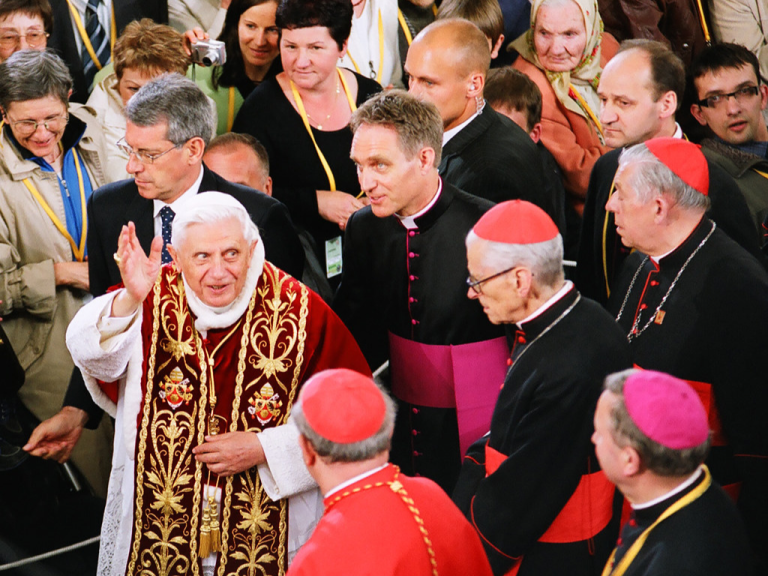
A novena of Benedict XVI’s greatest homilies and addresses, day 3: the Regensburg address
For day three of AdVaticanum’s novena of Benedict XVI’s greatest homilies and addresses, we publish in full his Regensburg address, one of the defining texts of his pontificate To mark the 75th anniversary of Pope Benedict XVI’s priestly ordination, AdVaticanum is publishing a nine-day novena of some of the most important homilies and addresses of his public life. For day three, we turn to the Regensburg address, delivered by Benedict XVI on 12 September 2006 during his apostolic journey to Bavaria. Formally titled Faith, Reason and the University: Memories and Reflections , the lecture was given at the University of Regensburg, where Joseph Ratzinger had taught dogmatic theology from 1969 to 1977. The address became a defining text of Benedict’s pontificate. Its central argument was that faith and reason belong together, and that Christianity is diminished when reason is reduced to the merely empirical or technical. Benedict warned against both the “dehellenisation” of Christianity and the narrowing of reason within modern secular culture, insisting instead that the Christian understanding of God is inseparable from the conviction that acting against reason is contrary to God’s nature. Published here in full, it is the natural place to continue a novena of Benedict XVI’s greatest homilies and addresses. It is a moving experience for me to be back again in the university and to be able once again to give a lecture at this podium. I think back to those years when, after a pleasant period at the Freisinger Hochschule, I began teaching at the University of Bonn. That was in 1959, in the days of the old university made up of ordinary professors. The various chairs had neither assistants nor secretaries, but in recompense there was much direct contact with students and in particular among the professors themselves. We would meet before and after lessons in the rooms of the teaching staff. There was a lively exchange with historians, philosophers, philologists and, naturally, between the two theological faculties. Once a semester there was a dies academicus, when professors from every faculty appeared before the students of the entire university, making possible a genuine experience of universitas – something that you too, Magnificent Rector, just mentioned – the experience, in other words, of the fact that despite our specializations which at times make it difficult to communicate with each other, we made up a whole, working in everything on the basis of a single rationality with its various aspects and sharing responsibility for the right use of reason – this reality became a lived experience. The university was also very proud of its two theological faculties. It was clear that, by inquiring about the reasonableness of faith, they too carried out a work which is necessarily part of the “whole” of the universitas scientiarum, even if not everyone could share the faith which theologians seek to correlate with reason as a whole. This profound sense of coherence within the universe of reason was not troubled, even when it was once reported that a colleague had said there was something odd about our university: it had two faculties devoted to something that did not exist: God. That even in the face of such radical scepticism it is still necessary and reasonable to raise the question of God through the use of reason, and to do so in the context of the tradition of the Christian faith: this, within the university as a whole, was accepted without question. I was reminded of all this recently, when I read the edition by Professor Theodore Khoury (Münster) of part of the dialogue carried on – perhaps in 1391 in the winter barracks near Ankara – by the erudite Byzantine emperor Manuel II Paleologus and an educated Persian on the subject of Christianity and Islam, and the truth of both. It was presumably the emperor himself who set down this dialogue, during the siege of Constantinople between 1394 and 1402; and this would explain why his arguments are given in greater detail than those of his Persian interlocutor. The dialogue ranges widely over the structures of faith contained in the Bible and in the Qur’an, and deals especially with the image of God and of man, while necessarily returning repeatedly to the relationship between – as they were called – three “Laws” or “rules of life”: the Old Testament, the New Testament and the Qur’an. It is not my intention to discuss this question in the present lecture; here I would like to discuss only one point – itself rather marginal to the dialogue as a whole – which, in the context of the issue of “faith and reason”, I found interesting and which can serve as the starting-point for my reflections on this issue. In the seventh conversation (διάλεξις – controversy) edited by Professor Khoury, the emperor touches on the theme of the holy war. The emperor must have known that surah 2, 256 reads: “There is no compulsion in religion”. According to some of the experts, this is probably one of the suras of the early period, when Mohammed was still powerless and under threat. But naturally the emperor also knew the instructions, developed later and recorded in the Qur’an, concerning holy war. Without descending to details, such as the difference in treatment accorded to those who have the “Book” and the “infidels”, he addresses his interlocutor with a startling brusqueness, a brusqueness that we find unacceptable, on the central question about the relationship between religion and violence in general, saying: “Show me just what Mohammed brought that was new, and there you will find things only evil and inhuman, such as his command to spread by the sword the faith he preached.” The emperor, after having expressed himself so forcefully, goes on to explain in detail the reasons why spreading the faith through violence is something unreasonable. Violence is incompatible with the nature of God and the nature of the soul. “God”, he says, “is not pleased by blood – and not acting reasonably (σὺν λόγω) is contrary to God’s nature. Faith is born of the soul, not the body. Whoever would lead someone to faith needs the ability to speak well and to reason properly, without violence and threats… To convince a reasonable soul, one does not need a strong arm, or weapons of any kind, or any other means of threatening a person with death…”. The decisive statement in this argument against violent conversion is this: not to act in accordance with reason is contrary to God’s nature. The editor, Theodore Khoury, observes: For the emperor, as a Byzantine shaped by Greek philosophy, this statement is self-evident. But for Muslim teaching, God is absolutely transcendent. His will is not bound up with any of our categories, even that of rationality. Here Khoury quotes a work of the noted French Islamist R. Arnaldez, who points out that Ibn Hazm went so far as to state that God is not bound even by his own word, and that nothing would oblige him to reveal the truth to us. Were it God’s will, we would even have to practise idolatry. At this point, as far as understanding of God and thus the concrete practice of religion is concerned, we are faced with an unavoidable dilemma. Is the conviction that acting unreasonably contradicts God’s nature merely a Greek idea, or is it always and intrinsically true? I believe that here we can see the profound harmony between what is Greek in the best sense of the word and the biblical understanding of faith in God. Modifying the first verse of the Book of Genesis, the first verse of the whole Bible, John began the prologue of his Gospel with the words: “In the beginning was the λόγος”. This is the very word used by the emperor: God acts, σὺν λόγω, with logos. Logos means both reason and word – a reason which is creative and capable of self-communication, precisely as reason. John thus spoke the final word on the biblical concept of God, and in this word all the often toilsome and tortuous threads of biblical faith find their culmination and synthesis. In the beginning was the logos, and the logos is God, says the Evangelist. The encounter between the Biblical message and Greek thought did not happen by chance. The vision of Saint Paul, who saw the roads to Asia barred and in a dream saw a Macedonian man plead with him: “Come over to Macedonia and help us!” (cf. Acts 16:6-10) – this vision can be interpreted as a “distillation” of the intrinsic necessity of a rapprochement between Biblical faith and Greek inquiry. In point of fact, this rapprochement had been going on for some time. The mysterious name of God, revealed from the burning bush, a name which separates this God from all other divinities with their many names and simply asserts being, “I am”, already presents a challenge to the notion of myth, to which Socrates’ attempt to vanquish and transcend myth stands in close analogy. Within the Old Testament, the process which started at the burning bush came to new maturity at the time of the Exile, when the God of Israel, an Israel now deprived of its land and worship, was proclaimed as the God of heaven and earth and described in a simple formula which echoes the words uttered at the burning bush: “I am”. This new understanding of God is accompanied by a kind of enlightenment, which finds stark expression in the mockery of gods who are merely the work of human hands (cf. Ps 115). Thus, despite the bitter conflict with those Hellenistic rulers who sought to accommodate it forcibly to the customs and idolatrous cult of the Greeks, biblical faith, in the Hellenistic period, encountered the best of Greek thought at a deep level, resulting in a mutual enrichment evident especially in the later wisdom literature. Today we know that the Greek translation of the Old Testament produced at Alexandria – the Septuagint – is more than a simple (and in that sense really less than satisfactory) translation of the Hebrew text: it is an independent textual witness and a distinct and important step in the history of revelation, one which brought about this encounter in a way that was decisive for the birth and spread of Christianity. A profound encounter of faith and reason is taking place here, an encounter between genuine enlightenment and religion. From the very heart of Christian faith and, at the same time, the heart of Greek thought now joined to faith, Manuel II was able to say: Not to act “with logos” is contrary to God’s nature. In all honesty, one must observe that in the late Middle Ages we find trends in theology which would sunder this synthesis between the Greek spirit and the Christian spirit. In contrast with the so-called intellectualism of Augustine and Thomas, there arose with Duns Scotus a voluntarism which, in its later developments, led to the claim that we can only know God’s voluntas ordinata. Beyond this is the realm of God’s freedom, in virtue of which he could have done the opposite of everything he has actually done. This gives rise to positions which clearly approach those of Ibn Hazm and might even lead to the image of a capricious God, who is not even bound to truth and goodness. God’s transcendence and otherness are so exalted that our reason, our sense of the true and good, are no longer an authentic mirror of God, whose deepest possibilities remain eternally unattainable and hidden behind his actual decisions. As opposed to this, the faith of the Church has always insisted that between God and us, between his eternal Creator Spirit and our created reason there exists a real analogy, in which – as the Fourth Lateran Council in 1215 stated – unlikeness remains infinitely greater than likeness, yet not to the point of abolishing analogy and its language. God does not become more divine when we push him away from us in a sheer, impenetrable voluntarism; rather, the truly divine God is the God who has revealed himself as logos and, as logos, has acted and continues to act lovingly on our behalf. Certainly, love, as Saint Paul says, “transcends” knowledge and is thereby capable of perceiving more than thought alone (cf. Eph 3:19); nonetheless it continues to be love of the God who is Logos. Consequently, Christian worship is, again to quote Paul – “λογικη λατρεία”, worship in harmony with the eternal Word and with our reason (cf. Rom 12:1). This inner rapprochement between Biblical faith and Greek philosophical inquiry was an event of decisive importance not only from the standpoint of the history of religions, but also from that of world history – it is an event which concerns us even today. Given this convergence, it is not surprising that Christianity, despite its origins and some significant developments in the East, finally took on its historically decisive character in Europe. We can also express this the other way around: this convergence, with the subsequent addition of the Roman heritage, created Europe and remains the foundation of what can rightly be called Europe. The thesis that the critically purified Greek heritage forms an integral part of Christian faith has been countered by the call for a dehellenization of Christianity – a call which has more and more dominated theological discussions since the beginning of the modern age. Viewed more closely, three stages can be observed in the programme of dehellenization: although interconnected, they are clearly distinct from one another in their motivations and objectives. Dehellenization first emerges in connection with the postulates of the Reformation in the sixteenth century. Looking at the tradition of scholastic theology, the Reformers thought they were confronted with a faith system totally conditioned by philosophy, that is to say an articulation of the faith based on an alien system of thought. As a result, faith no longer appeared as a living historical Word but as one element of an overarching philosophical system. The principle of sola scriptura, on the other hand, sought faith in its pure, primordial form, as originally found in the biblical Word. Metaphysics appeared as a premise derived from another source, from which faith had to be liberated in order to become once more fully itself. When Kant stated that he needed to set thinking aside in order to make room for faith, he carried this programme forward with a radicalism that the Reformers could never have foreseen. He thus anchored faith exclusively in practical reason, denying it access to reality as a whole. The liberal theology of the nineteenth and twentieth centuries ushered in a second stage in the process of dehellenization, with Adolf von Harnack as its outstanding representative. When I was a student, and in the early years of my teaching, this programme was highly influential in Catholic theology too. It took as its point of departure Pascal’s distinction between the God of the philosophers and the God of Abraham, Isaac and Jacob. In my inaugural lecture at Bonn in 1959, I tried to address the issue, and I do not intend to repeat here what I said on that occasion, but I would like to describe at least briefly what was new about this second stage of dehellenization. Harnack’s central idea was to return simply to the man Jesus and to his simple message, underneath the accretions of theology and indeed of hellenization: this simple message was seen as the culmination of the religious development of humanity. Jesus was said to have put an end to worship in favour of morality. In the end he was presented as the father of a humanitarian moral message. Fundamentally, Harnack’s goal was to bring Christianity back into harmony with modern reason, liberating it, that is to say, from seemingly philosophical and theological elements, such as faith in Christ’s divinity and the triune God. In this sense, historical-critical exegesis of the New Testament, as he saw it, restored to theology its place within the university: theology, for Harnack, is something essentially historical and therefore strictly scientific. What it is able to say critically about Jesus is, so to speak, an expression of practical reason and consequently it can take its rightful place within the university. Behind this thinking lies the modern self-limitation of reason, classically expressed in Kant’s “Critiques”, but in the meantime further radicalized by the impact of the natural sciences. This modern concept of reason is based, to put it briefly, on a synthesis between Platonism (Cartesianism) and empiricism, a synthesis confirmed by the success of technology. On the one hand it presupposes the mathematical structure of matter, its intrinsic rationality, which makes it possible to understand how matter works and use it efficiently: this basic premise is, so to speak, the Platonic element in the modern understanding of nature. On the other hand, there is nature’s capacity to be exploited for our purposes, and here only the possibility of verification or falsification through experimentation can yield decisive certainty. The weight between the two poles can, depending on the circumstances, shift from one side to the other. As strongly positivistic a thinker as J. Monod has declared himself a convinced Platonist/Cartesian. This gives rise to two principles which are crucial for the issue we have raised. First, only the kind of certainty resulting from the interplay of mathematical and empirical elements can be considered scientific. Anything that would claim to be science must be measured against this criterion. Hence the human sciences, such as history, psychology, sociology and philosophy, attempt to conform themselves to this canon of scientificity. A second point, which is important for our reflections, is that by its very nature this method excludes the question of God, making it appear an unscientific or pre-scientific question. Consequently, we are faced with a reduction of the radius of science and reason, one which needs to be questioned. I will return to this problem later. In the meantime, it must be observed that from this standpoint any attempt to maintain theology’s claim to be “scientific” would end up reducing Christianity to a mere fragment of its former self. But we must say more: if science as a whole is this and this alone, then it is man himself who ends up being reduced, for the specifically human questions about our origin and destiny, the questions raised by religion and ethics, then have no place within the purview of collective reason as defined by “science”, so understood, and must thus be relegated to the realm of the subjective. The subject then decides, on the basis of his experiences, what he considers tenable in matters of religion, and the subjective “conscience” becomes the sole arbiter of what is ethical. In this way, though, ethics and religion lose their power to create a community and become a completely personal matter. This is a dangerous state of affairs for humanity, as we see from the disturbing pathologies of religion and reason which necessarily erupt when reason is so reduced that questions of religion and ethics no longer concern it. Attempts to construct an ethic from the rules of evolution or from psychology and sociology, end up being simply inadequate. Before I draw the conclusions to which all this has been leading, I must briefly refer to the third stage of dehellenization, which is now in progress. In the light of our experience with cultural pluralism, it is often said nowadays that the synthesis with Hellenism achieved in the early Church was an initial inculturation which ought not to be binding on other cultures. The latter are said to have the right to return to the simple message of the New Testament prior to that inculturation, in order to inculturate it anew in their own particular milieux. This thesis is not simply false, but it is coarse and lacking in precision. The New Testament was written in Greek and bears the imprint of the Greek spirit, which had already come to maturity as the Old Testament developed. True, there are elements in the evolution of the early Church which do not have to be integrated into all cultures. Nonetheless, the fundamental decisions made about the relationship between faith and the use of human reason are part of the faith itself; they are developments consonant with the nature of faith itself. And so I come to my conclusion. This attempt, painted with broad strokes, at a critique of modern reason from within has nothing to do with putting the clock back to the time before the Enlightenment and rejecting the insights of the modern age. The positive aspects of modernity are to be acknowledged unreservedly: we are all grateful for the marvellous possibilities that it has opened up for mankind and for the progress in humanity that has been granted to us. The scientific ethos, moreover, is – as you yourself mentioned, Magnificent Rector – the will to be obedient to the truth, and, as such, it embodies an attitude which belongs to the essential decisions of the Christian spirit. The intention here is not one of retrenchment or negative criticism, but of broadening our concept of reason and its application. While we rejoice in the new possibilities open to humanity, we also see the dangers arising from these possibilities and we must ask ourselves how we can overcome them. We will succeed in doing so only if reason and faith come together in a new way, if we overcome the self-imposed limitation of reason to the empirically falsifiable, and if we once more disclose its vast horizons. In this sense theology rightly belongs in the university and within the wide-ranging dialogue of sciences, not merely as a historical discipline and one of the human sciences, but precisely as theology, as inquiry into the rationality of faith. Only thus do we become capable of that genuine dialogue of cultures and religions so urgently needed today. In the Western world it is widely held that only positivistic reason and the forms of philosophy based on it are universally valid. Yet the world’s profoundly religious cultures see this exclusion of the divine from the universality of reason as an attack on their most profound convictions. A reason which is deaf to the divine and which relegates religion into the realm of subcultures is incapable of entering into the dialogue of cultures. At the same time, as I have attempted to show, modern scientific reason with its intrinsically Platonic element bears within itself a question which points beyond itself and beyond the possibilities of its methodology. Modern scientific reason quite simply has to accept the rational structure of matter and the correspondence between our spirit and the prevailing rational structures of nature as a given, on which its methodology has to be based. Yet the question why this has to be so is a real question, and one which has to be remanded by the natural sciences to other modes and planes of thought – to philosophy and theology. For philosophy and, albeit in a different way, for theology, listening to the great experiences and insights of the religious traditions of humanity, and those of the Christian faith in particular, is a source of knowledge, and to ignore it would be an unacceptable restriction of our listening and responding. Here I am reminded of something Socrates said to Phaedo. In their earlier conversations, many false philosophical opinions had been raised, and so Socrates says: “It would be easily understandable if someone became so annoyed at all these false notions that for the rest of his life he despised and mocked all talk about being – but in this way he would be deprived of the truth of existence and would suffer a great loss”. The West has long been endangered by this aversion to the questions which underlie its rationality, and can only suffer great harm thereby. The courage to engage the whole breadth of reason, and not the denial of its grandeur – this is the programme with which a theology grounded in Biblical faith enters into the debates of our time. “Not to act reasonably, not to act with logos, is contrary to the nature of God”, said Manuel II, according to his Christian understanding of God, in response to his Persian interlocutor. It is to this great logos, to this breadth of reason, that we invite our partners in the dialogue of cultures. To rediscover it constantly is the great task of the university.
Jun. 23, 2026
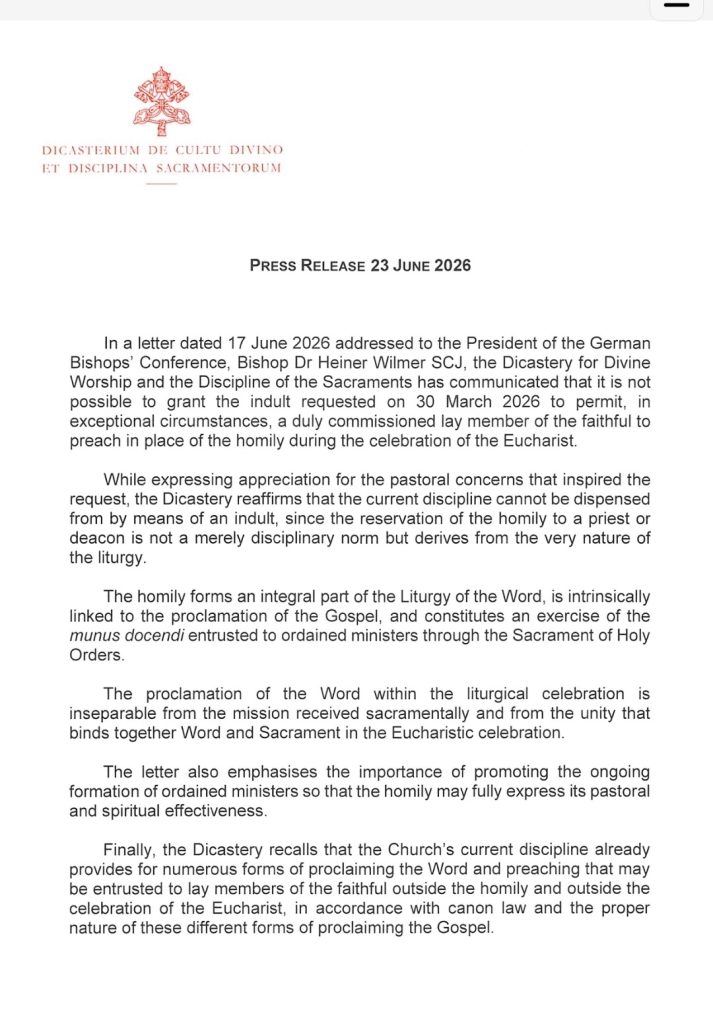
Vatican letter rules on German bishops’ request for lay preaching at Mass
A Vatican letter has ruled on a request from the German bishops to allow lay people to preach the homily during Mass The Vatican has rejected a request from the German Bishops’ Conference to permit lay people to preach the homily during Mass. In a letter dated 17 June to Bishop Heiner Wilmer SCJ, president of the German Bishops’ Conference, the Dicastery for Divine Worship and the Discipline of the Sacraments said it was “not possible to grant the indult requested” by the bishops on 30 March. The request sought permission for “a duly commissioned lay member of the faithful to preach in place of the homily during the celebration of the Eucharist” in exceptional circumstances. The decision was made public by the dicastery on 23 June. While expressing appreciation for the pastoral concerns behind the request, the Vatican department said that “the current discipline cannot be dispensed from by means of an indult”. It added: “The reservation of the homily to a priest or deacon is not a merely disciplinary norm but derives from the very nature of the liturgy.” The dicastery said the homily “forms an integral part of the Liturgy of the Word”, is “intrinsically linked to the proclamation of the Gospel”, and “constitutes an exercise of the munus docendi entrusted to ordained ministers through the Sacrament of Holy Orders”. It further stated that “the proclamation of the Word within the liturgical celebration is inseparable from the mission received sacramentally and from the unity that binds together Word and Sacrament in the Eucharistic celebration”. The Holy See also used the letter to underline the importance of priestly formation, saying that ongoing formation should enable homilies to express their “pastoral and spiritual effectiveness”. At the same time, the dicastery noted that Church law already provides opportunities for lay Catholics to proclaim the Gospel and preach in settings other than the homily during Mass. The statement said: “The Church’s current discipline already provides for numerous forms of proclaiming the Word and preaching that may be entrusted to lay members of the faithful outside the homily and outside the celebration of the Eucharist, in accordance with canon law and the proper nature of these different forms of proclaiming the Gospel.” The request was submitted amid continuing discussions in Germany concerning the role of lay people within the life of the Church, with questions relating to lay ministry, governance and preaching featuring prominently in recent years, particularly during the Synodal Way process, which brought together bishops and lay representatives to debate a range of issues affecting the Church in Germany. The preaching of the homily during Mass has long been reserved to bishops, priests and deacons. Canon 767 of the Code of Canon Law states that, among the forms of preaching, “the homily is pre-eminent” and that it is reserved to a priest or deacon. The discipline was reaffirmed in the 1997 Vatican instruction Ecclesiae de Mysterio , issued with the approval of St John Paul II, which stated that the homily “must be reserved to the sacred minister, priest or deacon”, excluding “non-ordained members of the faithful” from preaching it during the Eucharistic celebration. The dicastery’s rejection directly addresses a formal request submitted by the German Bishops’ Conference following its spring plenary assembly, held from 23 to 26 February 2026 in Würzburg. At that meeting, the newly elected conference president, Bishop Heiner Wilmer SCJ, announced that the bishops had discussed and adopted a regulatory framework to govern lay preaching at Mass. The roots of the initiative go back to 10 March 2023, during the final plenary assembly of the Synodal Way in Frankfurt, where participants including bishops and lay delegates approved a text on the proclamation of the Gospel. That text called on the German bishops to “draw up a particular norm and obtain permission from the Holy See” allowing theologically and spiritually qualified lay faithful, commissioned by the bishop, to deliver the homily during Eucharistic celebrations on Sundays and feast days. This is not the first such rejection. After the 2023 Synodal Way vote, Cardinal Arthur Roche, then prefect of the Dicastery for Divine Worship and the Discipline of the Sacraments, responded negatively in a detailed letter dated 29 March 2023 to the then president of the German Bishops’ Conference, Bishop Georg Bätzing. Cardinal Roche rejected the proposal for regular lay preaching in place of the homily at Mass, warning that it could create “misunderstandings about the figure and identity of the priest” in the minds of the faithful. He stressed the inseparability of Word and Sacrament as expressions of sacra potestas conferred by Holy Orders, rather than merely functional tasks, and pointed to Pope Francis’s 2021 expansion of the instituted ministries of lector and acolyte to women and lay people as a more appropriate avenue for lay liturgical involvement. Despite that earlier rejection, the German bishops proceeded with their February 2026 decision to formalise and resubmit the request. The letter is reproduced in full below:
Jun. 23, 2026