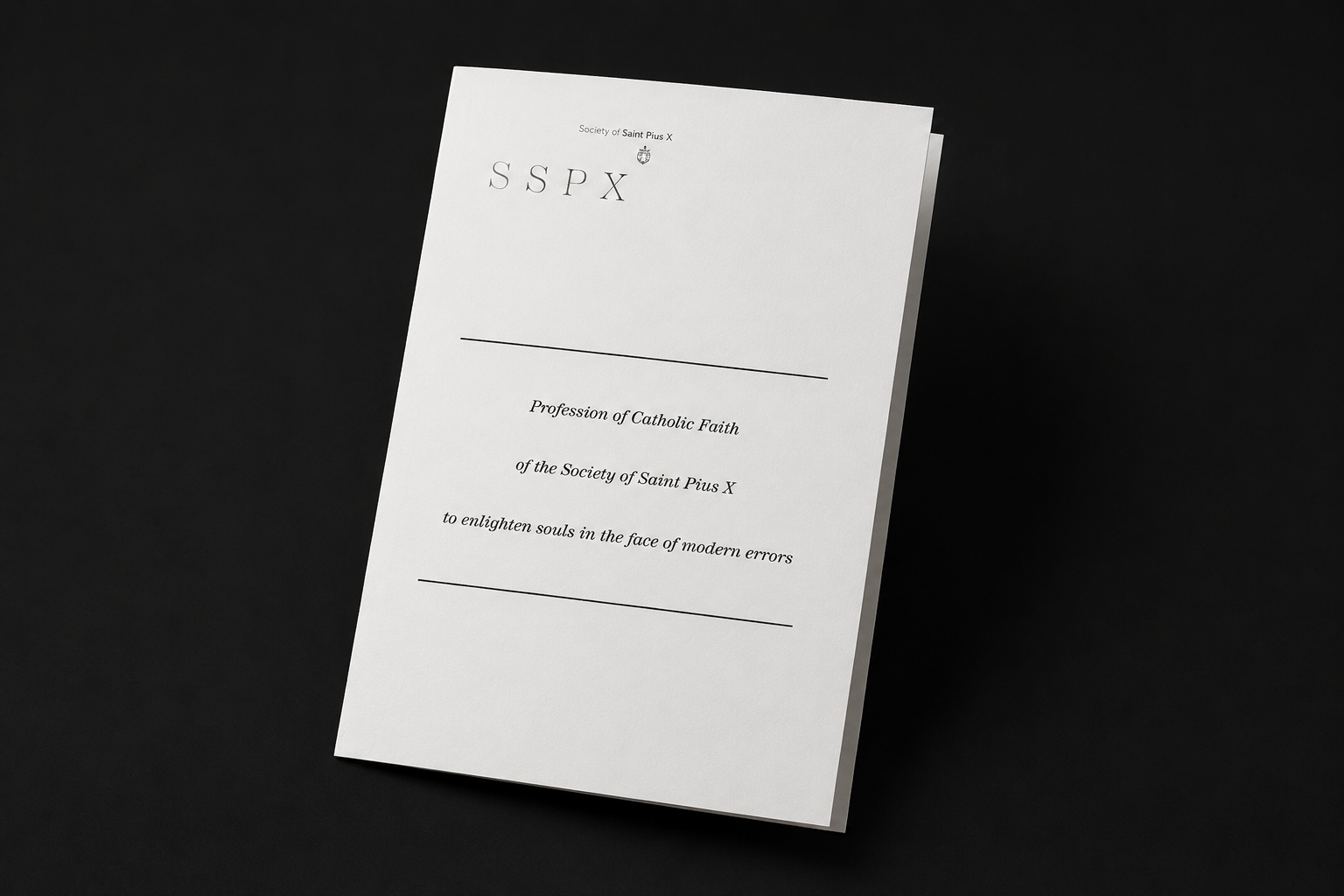
The Society of Saint Pius X has issued an open letter to Pope Leo XIV and the College of Cardinals during the week of the Extraordinary Consistory at the Vatican, releasing a 28-page Profession of Faith just days before its planned episcopal consecrations at Ecône on 1 July.
The letter, dated 24 June, the Feast of the Nativity of St John the Baptist, is signed by SSPX Superior General Fr Davide Pagliarani, First Assistant Bishop Alfonso de Galarreta, Second Assistant Fr Christian Bouchacourt, former Superior General Bishop Bernard Fellay and former Superior General Fr Franz Schmidberger.
The documents were first published in Italian by the traditionalist website Messa in Latino, which said it had received them from “sources at the highest levels”. AdVaticanum later obtained the full text of the Profession of Faith through SSPX sources.
Addressing Pope Leo XIV and the cardinals directly, the Society said it believed the time had come to make “an integral profession of the Catholic faith” and place it before the Church’s highest authorities.
“On the eve of the Consistory scheduled for the end of this month, and only days before the episcopal consecrations planned for 1 July at Ecône, it seems to us that the time has come for the Priestly Fraternity of Saint Pius X to make an integral profession of the Catholic faith, which we wish to place into the hands of Your Holiness and of each of the Cardinals,” the letter states.
The SSPX said the Church was facing grave difficulties and that it could not remain silent. “Today the Church suffers under the pressure of new forces, arising both from within and from without, which are driving her in every possible direction except, so it seems to us, the right one. Faced with such suffering, we cannot remain indifferent.”
The Society said the answer to the Church’s present problems was not to be found in new solutions but in fidelity to Tradition.
“It does not belong to the Priestly Fraternity of Saint Pius X to indicate the path to be followed, but rather to the Church’s bimillennial Tradition, faithfully preserved and handed down by the Apostolic See throughout the centuries, and which many now regard, in practice, as an outdated reality, subject to continual evolution.”
The letter says the accompanying Profession of Faith was written “in the face of the principal errors and the gravest dangers of our time” and argues that Catholic Tradition contains the remedies for the Church’s present crisis.
“We are convinced that Tradition contains all the remedies for the deepest evils from which the Church and the world suffer, and for which solutions are sought in vain outside it.” The Society also expressed the hope that the text could become the basis for future discussions with the Holy See. “We hope that one day this doctrinal text may serve as the basis for a frank discussion with the Holy See, in a peaceful, fraternal, and charitable spirit.”
Describing the declaration as a positive affirmation of Catholic belief rather than a protest document, the SSPX added: “The text that we present to you is not the sterile litany of a group of nostalgics, but the necessary expression, peaceful yet resolute, of our faith.”
The Profession of Faith itself is a detailed restatement of traditional Catholic doctrine and includes explicit rejections of a number of theological and philosophical currents which the Society says have contributed to confusion within the Church.
Early in the document, the authors argue that current circumstances require a complete presentation of Catholic teaching. “In the present confusion, it is no longer sufficient to recall a few isolated truths. It has become indispensable to set in full light the entire order of Catholic doctrine, in its supernatural coherence and luminous harmony, omitting no dogma, diminishing no truth.”
The text goes on to state: “I consequently reject all errors contrary to this Faith, and in particular those of liberalism, indifferentism, modernism, ecumenism, and laicism, condemned by Popes Pius IX, Leo XIII, Saint Pius X, Pius XI, and Pius XII.”
Among the themes addressed are grace, original sin, redemption, the Church, the liturgy and the social kingship of Christ. Rejecting what it describes as modern attempts to redefine faith, the declaration states: “I consequently reject the error of modernism, as it still rages today, which reduces faith to an interior experience, to a sensible aspiration, or to a progressive realisation in the believing community.”
On original sin, it says: “In Adam, however, the nature of man was not destroyed, but only wounded,” before adding: “I likewise reject all doctrines which, in a senseless optimism, minimise original sin, naively exalt the native goodness of man.”
The document also reaffirms traditional teaching on Christ’s redemptive sacrifice. “I therefore reject every doctrine which would reduce the Redemption to a simple manifestation of God’s love. The Cross is not merely a sign: it is the altar of the redemptive Sacrifice.”
The text follows this with a rejection of what it calls “false ecumenism”. “I therefore reject false ecumenism, which rests upon the idea that the Holy Ghost would not refuse to use separated communities as means of salvation.”
One of the longest sections concerns the Social Kingship of Christ, a doctrine strongly associated with pre-conciliar Catholic social teaching. “I profess that Our Lord Jesus Christ is King not only of individuals, but also of families, institutions, peoples, and nations.”
The declaration adds that Christ’s reign “must extend to the external forum, to laws, morals, education, culture, and public life”. The final section deals with the liturgy and offers a defence of the traditional Roman Mass while criticising the reforms introduced after the Second Vatican Council.
“I profess that the traditional Roman Mass expresses with incomparable clarity the Catholic doctrine of Sacrifice.” The text continues: “I observe with sorrow that the contemporary liturgical reforms have departed considerably from the traditional liturgy, and thereby contributed preponderantly to the loss of the sense of the sacred.”
The letter concludes with the words of St Paul, “For we can do nothing against the truth, but only for the truth,” before adding: “We too believe; therefore we speak.”
As the Extraordinary Consistory convenes this Friday, with the Vatican expected to bring all the cardinals to Rome, including those beyond voting age, one senior cardinal speaking off the record to AdVaticanum earlier this week acknowledged that the impending 1 July SSPX episcopal consecrations remain a “looming topic” among the princes of the Church, even if they will not feature in any public discussion.
“We are reminded by the statements from Cardinal Fernández earlier this year and more recently,” the senior cardinal said, “and we are intellectually aware of the episcopal consecrations.”
The cardinal added: “As the consistory is only this Friday, we think about it, about the implications for unity and for the Church’s witness in a fractured age.”