The Vatican has rejected a request from the German Bishops’ Conference to permit lay people to preach the homily during Mass.
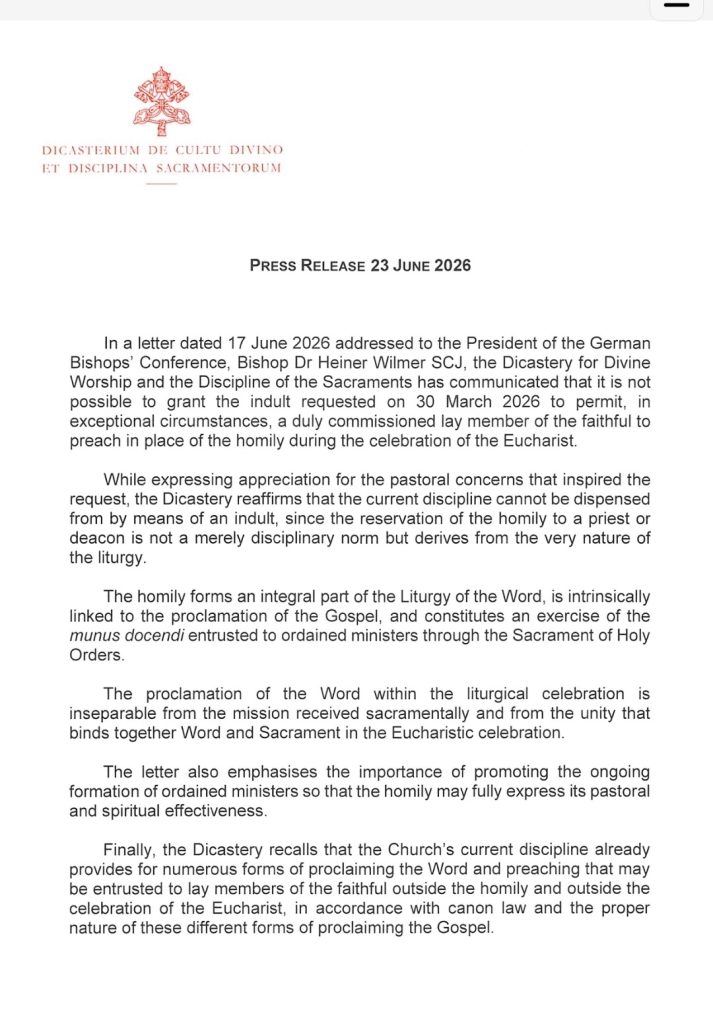
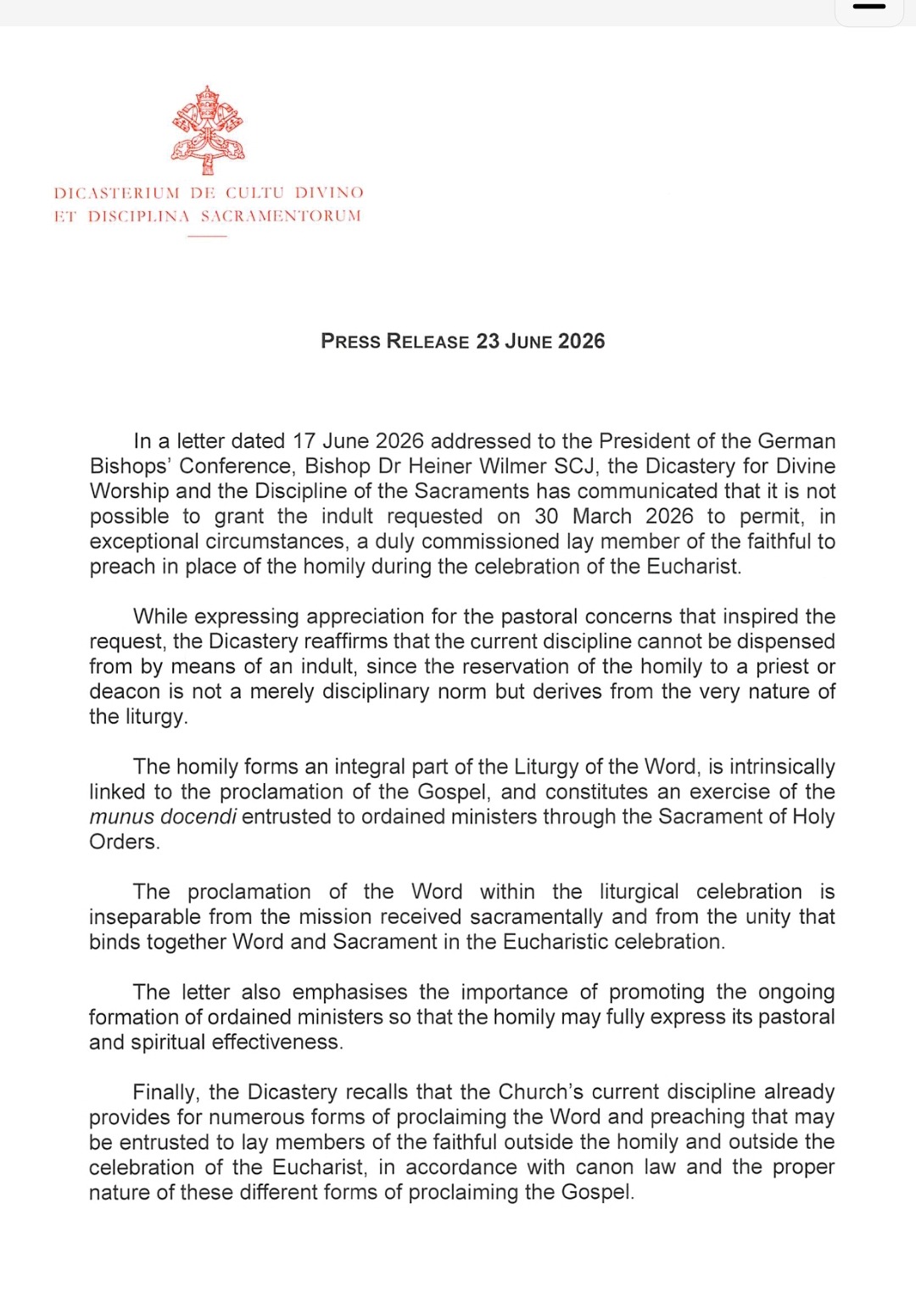
In a letter dated 17 June to Bishop Heiner Wilmer SCJ, president of the German Bishops’ Conference, the Dicastery for Divine Worship and the Discipline of the Sacraments said it was “not possible to grant the indult requested” by the bishops on 30 March. The request sought permission for “a duly commissioned lay member of the faithful to preach in place of the homily during the celebration of the Eucharist” in exceptional circumstances. The decision was made public by the dicastery on 23 June.
While expressing appreciation for the pastoral concerns behind the request, the Vatican department said that “the current discipline cannot be dispensed from by means of an indult”. It added: “The reservation of the homily to a priest or deacon is not a merely disciplinary norm but derives from the very nature of the liturgy.” The dicastery said the homily “forms an integral part of the Liturgy of the Word”, is “intrinsically linked to the proclamation of the Gospel”, and “constitutes an exercise of the munus docendi entrusted to ordained ministers through the Sacrament of Holy Orders”. It further stated that “the proclamation of the Word within the liturgical celebration is inseparable from the mission received sacramentally and from the unity that binds together Word and Sacrament in the Eucharistic celebration”.
The Holy See also used the letter to underline the importance of priestly formation, saying that ongoing formation should enable homilies to express their “pastoral and spiritual effectiveness”. At the same time, the dicastery noted that Church law already provides opportunities for lay Catholics to proclaim the Gospel and preach in settings other than the homily during Mass. The statement said: “The Church’s current discipline already provides for numerous forms of proclaiming the Word and preaching that may be entrusted to lay members of the faithful outside the homily and outside the celebration of the Eucharist, in accordance with canon law and the proper nature of these different forms of proclaiming the Gospel.”
The request was submitted amid continuing discussions in Germany concerning the role of lay people within the life of the Church, with questions relating to lay ministry, governance and preaching featuring prominently in recent years, particularly during the Synodal Way process, which brought together bishops and lay representatives to debate a range of issues affecting the Church in Germany. The preaching of the homily during Mass has long been reserved to bishops, priests and deacons. Canon 767 of the Code of Canon Law states that, among the forms of preaching, “the homily is pre-eminent” and that it is reserved to a priest or deacon. The discipline was reaffirmed in the 1997 Vatican instruction Ecclesiae de Mysterio, issued with the approval of St John Paul II, which stated that the homily “must be reserved to the sacred minister, priest or deacon”, excluding “non-ordained members of the faithful” from preaching it during the Eucharistic celebration.
The dicastery’s rejection directly addresses a formal request submitted by the German Bishops’ Conference following its spring plenary assembly, held from 23 to 26 February 2026 in Würzburg. At that meeting, the newly elected conference president, Bishop Heiner Wilmer SCJ, announced that the bishops had discussed and adopted a regulatory framework to govern lay preaching at Mass. The roots of the initiative go back to 10 March 2023, during the final plenary assembly of the Synodal Way in Frankfurt, where participants including bishops and lay delegates approved a text on the proclamation of the Gospel. That text called on the German bishops to “draw up a particular norm and obtain permission from the Holy See” allowing theologically and spiritually qualified lay faithful, commissioned by the bishop, to deliver the homily during Eucharistic celebrations on Sundays and feast days.
This is not the first such rejection. After the 2023 Synodal Way vote, Cardinal Arthur Roche, then prefect of the Dicastery for Divine Worship and the Discipline of the Sacraments, responded negatively in a detailed letter dated 29 March 2023 to the then president of the German Bishops’ Conference, Bishop Georg Bätzing. Cardinal Roche rejected the proposal for regular lay preaching in place of the homily at Mass, warning that it could create “misunderstandings about the figure and identity of the priest” in the minds of the faithful. He stressed the inseparability of Word and Sacrament as expressions of sacra potestas conferred by Holy Orders, rather than merely functional tasks, and pointed to Pope Francis’s 2021 expansion of the instituted ministries of lector and acolyte to women and lay people as a more appropriate avenue for lay liturgical involvement. Despite that earlier rejection, the German bishops proceeded with their February 2026 decision to formalise and resubmit the request.
The letter is reproduced in full below: