

Latest
Florida bishops appeal to DeSantis to halt execution of Edward James Spencer
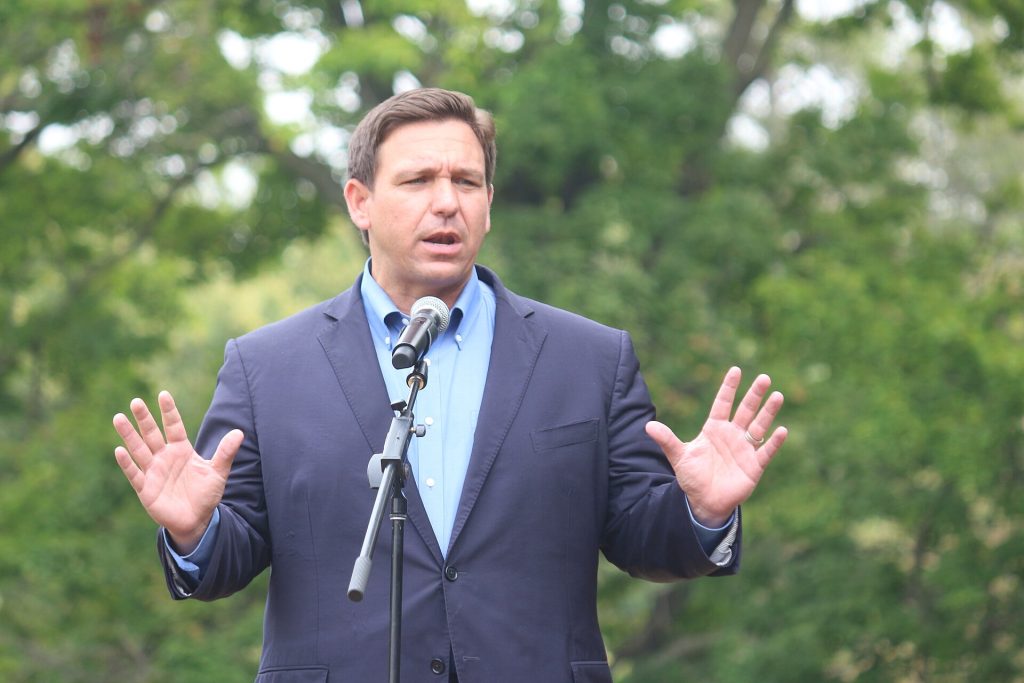
Florida’s Catholic bishops have appealed to Gov. Ron DeSantis to halt the execution of Edward James Spencer Florida’s Catholic bishops have appealed to Gov. Ron DeSantis to halt the execution of a condemned prisoner. In a letter to the governor, Michael Sheedy, executive director of the Florida Conference of Catholic Bishops (FCCB), asked that the sentence of Edward James Spencer be commuted to life imprisonment without the possibility of parole. Spencer is due to be executed at 6 p.m. on 25 June at Florida State Prison in Raiford, between Jacksonville and Gainesville, after DeSantis signed his death warrant on 26 May. Writing on behalf of all the Catholic bishops of Florida, Sheedy acknowledged the gravity of the crime while urging the governor to exercise mercy. “We mourn the tragic and horrific death of Karen Spencer, and we feel sorrow for the terrible suffering her son, other relatives and all who loved her have had to live with ever since,” he wrote. “May they find comfort in God. Indeed, the Church remains available to assist them with pastoral care.” The letter stressed that the Church’s opposition to the death penalty did not diminish the seriousness of the offence. “Mr Spencer’s crime was truly grave and merits a severe punishment by the state,” Sheedy wrote. Nevertheless, the bishops argued that clemency remained appropriate, citing Spencer’s age and the Church’s teaching on the dignity of every human person. “We ask that you exercise mercy and spare the life of Mr Spencer, who is elderly and no longer poses a threat to society,” the letter said. Quoting St John Paul II’s 1995 encyclical Evangelium Vitae , Sheedy added: “Not even a murderer loses his personal dignity.” The bishops further argued that life imprisonment without parole would constitute a severe punishment while avoiding the deliberate taking of life by the state. “To punish with lifelong imprisonment is not to minimise the heinousness of Mr Spencer’s crime,” the letter said. “It is rather to recognise with awe that God is the author of life, and to reserve to him the taking of human life except where it is otherwise impossible to maintain the common good.” Spencer was convicted of the 1992 murder of his wife, Karen. Prosecutors said he killed her in the backyard of her Orange County home using a brick and a knife. Karen’s 17-year-old son witnessed the attack and attempted to intervene. According to court proceedings, the killing took place after Spencer had been released from jail on bail. While defence lawyers argued that the murder was a crime of passion, prosecutors maintained that he had previously threatened to kill his wife and subsequently carried out those threats. Spencer will be 74 years old if the execution proceeds. According to data compiled by the Death Penalty Information Center, he would be among the ten oldest prisoners executed in the United States since 1976. The scheduled execution follows closely behind that of Andrew Lukehart, who was put to death by the State of Florida on 2 June after appeals for clemency were unsuccessful. Lukehart had been convicted of the first-degree murder of five-month-old Gabrielle Hanshaw in 1996. In a separate appeal before that execution, the Florida bishops similarly asked DeSantis to commute his sentence to life imprisonment without parole. In Florida, the bishops have regularly appealed for clemency in individual cases. Sheedy closed the latest letter with prayers for both the victim and those affected by the crime. “We pray for the repose of the soul of Karen Spencer and for the consolation of her loved ones,” he wrote. “We pray for you, too, as you consider this request.”
Jun. 25, 2026
Cardinal Ernest Simoni climbs Medjugorje’s Apparition Hill on eve of 44th anniversary
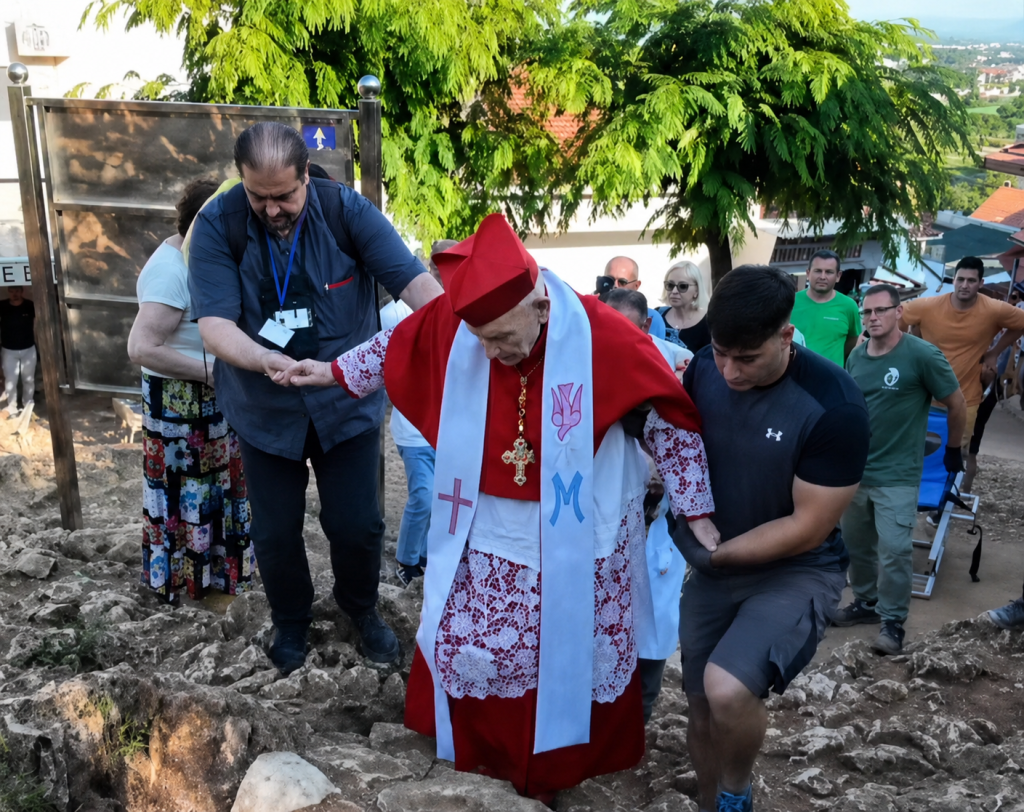
Cardinal Ernest Simoni climbed Medjugorje’s Apparition Hill while praying the Rosary on the eve of the 44th anniversary of the first reported apparitions. The 97-year-old Albanian cardinal, described by Pope Francis as a “living martyr”, was assisted up the hill as pilgrims gathered at the Bosnian shrine Yesterday, on the eve of the 44th anniversary of the first apparitions of Medjugorje, Cardinal Ernest Simoni climbed Apparition Hill while praying the Rosary. Videos from the event show the cardinal being assisted up Apparition Hill. At points where the ground became too rough, he was carried on a stretcher by the young men accompanying him. This year marks the 97-year-old Albanian prelate’s 70th anniversary of ordination to the priesthood and the 10th anniversary of his creation as a cardinal. Described as a “living martyr” by Pope Francis, Cardinal Simoni endured decades of persecution for his priesthood. Under Albania’s communist regime, the then Fr Simoni was arrested after he celebrated a Mass for the assassinated President John F. Kennedy. He was shown a death warrant and, as he told Reuters in a 2016 interview, “I was to hang because I had told the people we should die for Christ.” His persecutors tried to force him to abandon his faith and even offered him marriage to a “beautiful girl”. He was not executed, but instead sentenced to 18 years of forced labour, 12 of which he spent in a mine, for celebrating the Mass and for agitation against the regime. While in prison, he continued to preach to fellow prisoners. Once released, he worked as a manual labourer and ministered the sacraments in secret. He is the only surviving member of the clergy of Albania’s post-war communist regime to have survived the mass persecution of the authorities. His years in prison spanned the liturgical reforms of the 1960s, so he continued to celebrate the Traditional Latin Mass as best he could from memory during his imprisonment. When he met Pope Francis during the pontiff’s 2014 visit to Albania, Francis was so struck by his story that he made him a cardinal at the 2016 consistory. His appointment required a dispensation, since he was not a bishop. He also appeared alongside Pope Leo on Easter Sunday this year and met the pontiff again during a private audience on 27 April. Despite being 97, Cardinal Simoni has remained active in maintaining links with communities attached to the Traditional Latin Mass. He is a defender of the older liturgical form and has longstanding associations with traditionalist institutes, including regular visits to the International Seminary of the Institute of Christ the King Sovereign Priest at Gricigliano, near Florence. He has been present there for major liturgical celebrations, including the Feast of St Joseph, and has spent periods such as Holy Week with the community in recent years. During a pontifical Latin Mass for the Summorum Pontificum pilgrimage, celebrated by Cardinal Raymond Burke in St Peter’s Basilica on 25 October 2025, Cardinal Simoni recited the prayer to St Michael the Archangel, describing it as a reminder that “the Devil exists, and the Church continues to fight”.
Jun. 25, 2026
Vatican releases unpublished Benedict XVI homilies
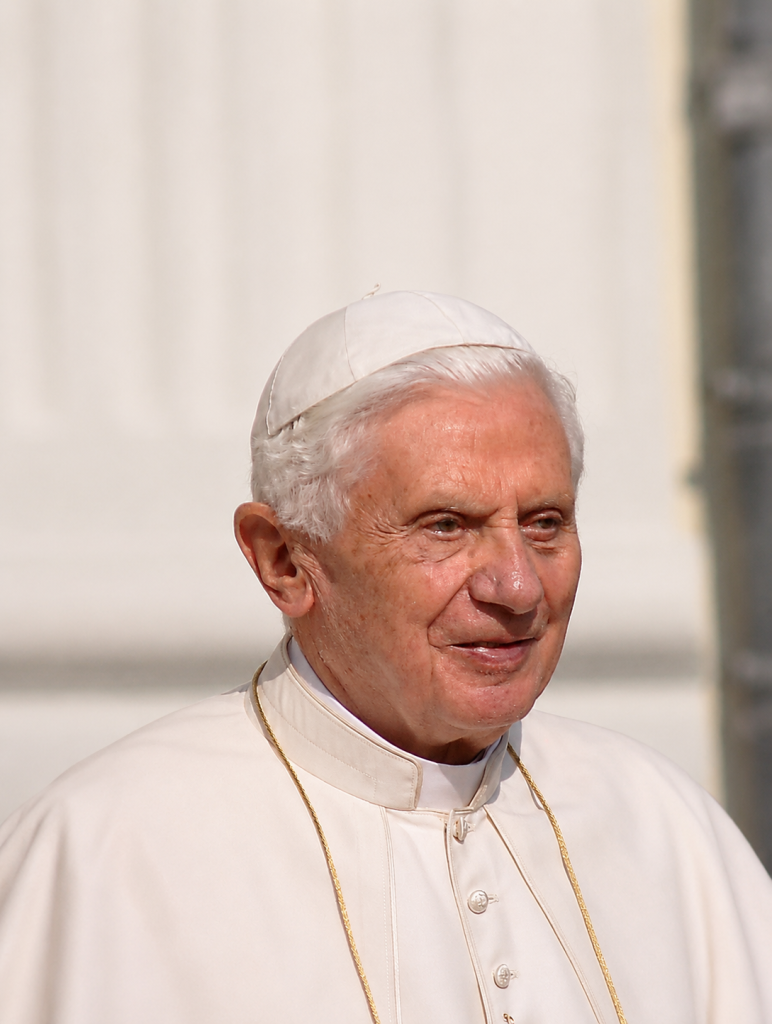
The Vatican has released a collection of previously unpublished homilies preached by Pope Benedict XVI during private Masses as pope and pope emeritus The Vatican has published an English edition of a collection of previously unpublished homilies by Pope Benedict XVI just days before the 75th anniversary of his ordination to the priesthood. The volume, The Lord Holds Us by the Hand , gathers homilies delivered during private Masses celebrated by Benedict between 2005 and 2017, both during his pontificate and after his resignation from the papacy. Published by the Vatican Publishing House, LEV, the book makes available to English-speaking readers for the first time a series of reflections preached during the liturgical seasons of Advent, Lent and Easter in the chapel of the Apostolic Palace and later at the Mater Ecclesiae Monastery, where Benedict lived as pope emeritus. The publication comes ahead of 29 June, which marks the 75th anniversary of Joseph Ratzinger’s ordination as a priest in 1951, a milestone in a ministry that would eventually see the Bavarian theologian become prefect of the Congregation for the Doctrine of the Faith, pope and, following his historic resignation in 2013, pope emeritus. According to Vatican News, the collection was first published in Italian in 2025 under the title Il Signore ci tiene per mano . The English edition has been edited by Riccardo Bollati, Luca Caruso and Fr Federico Lombardi SJ, president of the Joseph Ratzinger-Benedict XVI Vatican Foundation. The volume includes a preface by Archbishop Georg Gänswein, Benedict’s former personal secretary, and an introduction by Fr Lombardi. The homilies were preached during Masses attended by members of the papal household and invited guests. Some were delivered while Benedict occupied the Chair of St Peter, while others came after he withdrew from public life following his resignation and took up residence at the Mater Ecclesiae Monastery in the Vatican Gardens. Although delivered in private settings, the texts revisit themes that ran throughout Benedict’s theological and pastoral work. Vatican News said they show his ability to draw from Sacred Scripture “light for faith, prayer, and daily Christian life”. The collection also highlights the central place of Christ in Benedict’s thought. Throughout the homilies he returns to the theme of a personal relationship with Jesus Christ and the conviction that the Christian life is sustained by God’s presence and mercy. Vatican News said the title itself points to the reality that “the Christian life is not a solitary path, but a journey guided by the presence and mercy of God”. The publication offers readers a further glimpse into Benedict’s life after his resignation, when he largely disappeared from public view while continuing a quiet routine of prayer, study and the celebration of Mass within the Vatican. Though he rarely intervened publicly during those years, the homilies show that he continued to reflect on Scripture and the liturgical life of the Church until advancing age gradually curtailed his activities. Pope Benedict died on 31 December 2022 at the age of 95, almost a decade after becoming the first pope in nearly 600 years to resign from office. Since his death, interest in his theological legacy has remained strong, with publishers and foundations continuing to make previously unpublished material from his long ecclesiastical career available. The release of The Lord Holds Us by the Hand forms part of that wider effort. Vatican News reported that a second volume containing Benedict’s unpublished homilies from Ordinary Time is expected to follow. To mark the 75th anniversary of Pope Benedict XVI’s ordination to the priesthood on 29 June, AdVaticanum has published a special nine-day series featuring some of the most significant homilies, addresses and reflections from across his public ministry. Readers can follow the commemorative series throughout the novena period in this publication. Image credit: WDKrauseDerivate work: Художник992 (talk) – This file was derived from: Benedicto XVI, 2011.jpg:, CC BY-SA 3.0, https://commons.wikimedia.org/w/index.php?curid=191776416
Jun. 25, 2026
A novena of Benedict XVI’s greatest homilies and addresses, day 5: the Bundestag address
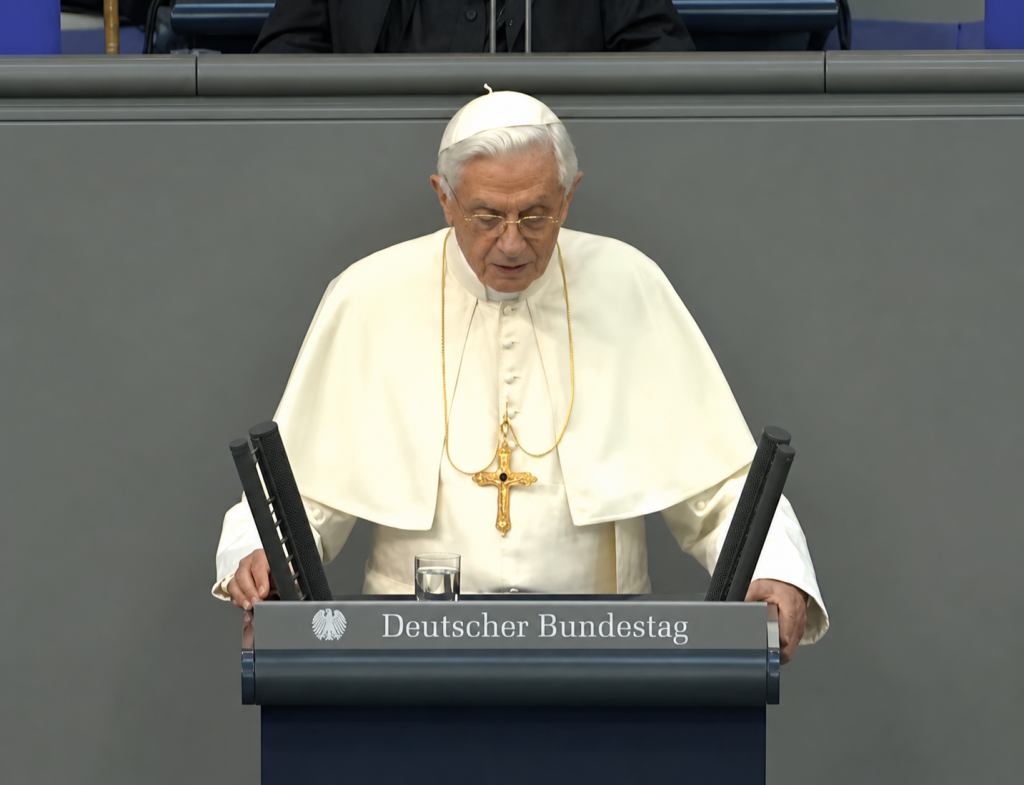
Day four of our novena marking the 75th anniversary of Pope Benedict XVI’s priestly ordination features his Westminster Hall address, delivered during his 2010 Apostolic Journey to the United Kingdom To mark the 75th anniversary of Pope Benedict XVI’s priestly ordination, AdVaticanum is publishing a nine-day novena of some of the most important homilies and addresses of his public life. Today we publish Pope Benedict XVI’s address to the German Bundestag, delivered during his Apostolic Journey to Germany on 22 September 2011. Addressing members of the German Parliament in Berlin, Benedict reflected on the foundations of law, the exercise of political authority and the responsibility of legislators to pursue justice rather than power. Drawing on Scripture, classical philosophy and the Western legal tradition, he argued that political life cannot be sustained by majority rule alone but must remain rooted in objective moral principles. It is one of the clearest statements of Benedict’s understanding of natural law and the relationship between faith, reason and public life. Mr President of the Federal Republic, Mr President of the Bundestag, Madam Chancellor, Madam President of the Bundesrat, Ladies and Gentlemen Members of the House, It is an honour and a joy for me to speak before this distinguished house, before the Parliament of my native Germany, that meets here as a democratically elected representation of the people, in order to work for the good of the Federal Republic of Germany. I should like to thank the President of the Bundestag both for his invitation to deliver this address and for the kind words of greeting and appreciation with which he has welcomed me. At this moment I turn to you, distinguished ladies and gentlemen, not least as your fellow-countryman who for all his life has been conscious of close links to his origins, and has followed the affairs of his native Germany with keen interest. But the invitation to give this address was extended to me as Pope, as the Bishop of Rome, who bears the highest responsibility for Catholic Christianity. In issuing this invitation you are acknowledging the role that the Holy See plays as a partner within the community of peoples and states. Setting out from this international responsibility that I hold, I should like to propose to you some thoughts on the foundations of a free state of law. Allow me to begin my reflections on the foundations of law [Recht] with a brief story from sacred Scripture. In the First Book of the Kings, it is recounted that God invited the young King Solomon, on his accession to the throne, to make a request. What will the young ruler ask for at this important moment? Success – wealth – long life – destruction of his enemies? He chooses none of these things. Instead, he asks for a listening heart so that he may govern God’s people, and discern between good and evil (cf. 1 Kg 3:9). Through this story, the Bible wants to tell us what should ultimately matter for a politician. His fundamental criterion and the motivation for his work as a politician must not be success, and certainly not material gain. Politics must be a striving for justice, and hence it has to establish the fundamental preconditions for peace. Naturally a politician will seek success, without which he would have no opportunity for effective political action at all. Yet success is subordinated to the criterion of justice, to the will to do what is right, and to the understanding of what is right. Success can also be seductive and thus can open up the path towards the falsification of what is right, towards the destruction of justice. “Without justice – what else is the State but a great band of robbers?”, as Saint Augustine once said. We Germans know from our own experience that these words are no empty spectre. We have seen how power became divorced from right, how power opposed right and crushed it, so that the State became an instrument for destroying right – a highly organized band of robbers, capable of threatening the whole world and driving it to the edge of the abyss. To serve right and to fight against the dominion of wrong is and remains the fundamental task of the politician. At a moment in history when man has acquired previously inconceivable power, this task takes on a particular urgency. Man can destroy the world. He can manipulate himself. He can, so to speak, make human beings and he can deny them their humanity. How do we recognize what is right? How can we discern between good and evil, between what is truly right and what may appear right? Even now, Solomon’s request remains the decisive issue facing politicians and politics today. For most of the matters that need to be regulated by law, the support of the majority can serve as a sufficient criterion. Yet it is evident that for the fundamental issues of law, in which the dignity of man and of humanity is at stake, the majority principle is not enough: everyone in a position of responsibility must personally seek out the criteria to be followed when framing laws. In the third century, the great theologian Origen provided the following explanation for the resistance of Christians to certain legal systems: “Suppose that a man were living among the Scythians, whose laws are contrary to the divine law, and was compelled to live among them … such a man for the sake of the true law, though illegal among the Scythians, would rightly form associations with like-minded people contrary to the laws of the Scythians.” [1] This conviction was what motivated resistance movements to act against the Nazi regime and other totalitarian regimes, thereby doing a great service to justice and to humanity as a whole. For these people, it was indisputably evident that the law in force was actually unlawful. Yet when it comes to the decisions of a democratic politician, the question of what now corresponds to the law of truth, what is actually right and may be enacted as law, is less obvious. In terms of the underlying anthropological issues, what is right and may be given the force of law is in no way simply self-evident today. The question of how to recognize what is truly right and thus to serve justice when framing laws has never been simple, and today in view of the vast extent of our knowledge and our capacity, it has become still harder. How do we recognize what is right? In history, systems of law have almost always been based on religion: decisions regarding what was to be lawful among men were taken with reference to the divinity. Unlike other great religions, Christianity has never proposed a revealed law to the State and to society, that is to say a juridical order derived from revelation. Instead, it has pointed to nature and reason as the true sources of law – and to the harmony of objective and subjective reason, which naturally presupposes that both spheres are rooted in the creative reason of God. Christian theologians thereby aligned themselves with a philosophical and juridical movement that began to take shape in the second century B.C. In the first half of that century, the social natural law developed by the Stoic philosophers came into contact with leading teachers of Roman Law. [2] Through this encounter, the juridical culture of the West was born, which was and is of key significance for the juridical culture of mankind. This pre-Christian marriage between law and philosophy opened up the path that led via the Christian Middle Ages and the juridical developments of the Age of Enlightenment all the way to the Declaration of Human Rights and to our German Basic Law of 1949, with which our nation committed itself to “inviolable and inalienable human rights as the foundation of every human community, and of peace and justice in the world”. For the development of law and for the development of humanity, it was highly significant that Christian theologians aligned themselves against the religious law associated with polytheism and on the side of philosophy, and that they acknowledged reason and nature in their interrelation as the universally valid source of law. This step had already been taken by Saint Paul in the Letter to the Romans, when he said: “When Gentiles who have not the Law [the Torah of Israel] do by nature what the law requires, they are a law to themselves … they show that what the law requires is written on their hearts, while their conscience also bears witness …” ( Rom 2:14f.). Here we see the two fundamental concepts of nature and conscience, where conscience is nothing other than Solomon’s listening heart, reason that is open to the language of being. If this seemed to offer a clear explanation of the foundations of legislation up to the time of the Enlightenment, up to the time of the Declaration on Human Rights after the Second World War and the framing of our Basic Law, there has been a dramatic shift in the situation in the last half-century. The idea of natural law is today viewed as a specifically Catholic doctrine, not worth bringing into the discussion in a non-Catholic environment, so that one feels almost ashamed even to mention the term. Let me outline briefly how this situation arose. Fundamentally it is because of the idea that an unbridgeable gulf exists between “is” and “ought”. An “ought” can never follow from an “is”, because the two are situated on completely different planes. The reason for this is that in the meantime, the positivist understanding of nature has come to be almost universally accepted. If nature – in the words of Hans Kelsen – is viewed as “an aggregate of objective data linked together in terms of cause and effect”, then indeed no ethical indication of any kind can be derived from it. [3] A positivist conception of nature as purely functional, as the natural sciences consider it to be, is incapable of producing any bridge to ethics and law, but once again yields only functional answers. The same also applies to reason, according to the positivist understanding that is widely held to be the only genuinely scientific one. Anything that is not verifiable or falsifiable, according to this understanding, does not belong to the realm of reason strictly understood. Hence ethics and religion must be assigned to the subjective field, and they remain extraneous to the realm of reason in the strict sense of the word. Where positivist reason dominates the field to the exclusion of all else – and that is broadly the case in our public mindset – then the classical sources of knowledge for ethics and law are excluded. This is a dramatic situation which affects everyone, and on which a public debate is necessary. Indeed, an essential goal of this address is to issue an urgent invitation to launch one. The positivist approach to nature and reason, the positivist world view in general, is a most important dimension of human knowledge and capacity that we may in no way dispense with. But in and of itself it is not a sufficient culture corresponding to the full breadth of the human condition. Where positivist reason considers itself the only sufficient culture and banishes all other cultural realities to the status of subcultures, it diminishes man, indeed it threatens his humanity. I say this with Europe specifically in mind, where there are concerted efforts to recognize only positivism as a common culture and a common basis for law-making, reducing all the other insights and values of our culture to the level of subculture, with the result that Europe vis-à-vis other world cultures is left in a state of culturelessness and at the same time extremist and radical movements emerge to fill the vacuum. In its self-proclaimed exclusivity, the positivist reason which recognizes nothing beyond mere functionality resembles a concrete bunker with no windows, in which we ourselves provide lighting and atmospheric conditions, being no longer willing to obtain either from God’s wide world. And yet we cannot hide from ourselves the fact that even in this artificial world, we are still covertly drawing upon God’s raw materials, which we refashion into our own products. The windows must be flung open again, we must see the wide world, the sky and the earth once more and learn to make proper use of all this. But how are we to do this? How do we find our way out into the wide world, into the big picture? How can reason rediscover its true greatness, without being sidetracked into irrationality? How can nature reassert itself in its true depth, with all its demands, with all its directives? I would like to recall one of the developments in recent political history, hoping that I will neither be misunderstood, nor provoke too many one-sided polemics. I would say that the emergence of the ecological movement in German politics since the 1970s, while it has not exactly flung open the windows, nevertheless was and continues to be a cry for fresh air which must not be ignored or pushed aside, just because too much of it is seen to be irrational. Young people had come to realize that something is wrong in our relationship with nature, that matter is not just raw material for us to shape at will, but that the earth has a dignity of its own and that we must follow its directives. In saying this, I am clearly not promoting any particular political party – nothing could be further from my mind. If something is wrong in our relationship with reality, then we must all reflect seriously on the whole situation and we are all prompted to question the very foundations of our culture. Allow me to dwell a little longer on this point. The importance of ecology is no longer disputed. We must listen to the language of nature and we must answer accordingly. Yet I would like to underline a point that seems to me to be neglected, today as in the past: there is also an ecology of man. Man too has a nature that he must respect and that he cannot manipulate at will. Man is not merely self-creating freedom. Man does not create himself. He is intellect and will, but he is also nature, and his will is rightly ordered if he respects his nature, listens to it and accepts himself for who he is, as one who did not create himself. In this way, and in no other, is true human freedom fulfilled. Let us come back to the fundamental concepts of nature and reason, from which we set out. The great proponent of legal positivism, Kelsen, at the age of 84 – in 1965 – abandoned the dualism of “is” and “ought”. (I find it comforting that rational thought is evidently still possible at the age of 84!) Previously he had said that norms can only come from the will. Nature therefore could only contain norms, he adds, if a will had put them there. But this, he says, would presuppose a Creator God, whose will had entered into nature. “Any attempt to discuss the truth of this belief is utterly futile”, he observed. [4] Is it really? – I find myself asking. Is it really pointless to wonder whether the objective reason that manifests itself in nature does not presuppose a creative reason, a Creator Spiritus? At this point Europe’s cultural heritage ought to come to our assistance. The conviction that there is a Creator God is what gave rise to the idea of human rights, the idea of the equality of all people before the law, the recognition of the inviolability of human dignity in every single person and the awareness of people’s responsibility for their actions. Our cultural memory is shaped by these rational insights. To ignore it or dismiss it as a thing of the past would be to dismember our culture totally and to rob it of its completeness. The culture of Europe arose from the encounter between Jerusalem, Athens and Rome – from the encounter between Israel’s monotheism, the philosophical reason of the Greeks and Roman law. This three-way encounter has shaped the inner identity of Europe. In the awareness of man’s responsibility before God and in the acknowledgment of the inviolable dignity of every single human person, it has established criteria of law: it is these criteria that we are called to defend at this moment in our history. As he assumed the mantle of office, the young King Solomon was invited to make a request. How would it be if we, the law-makers of today, were invited to make a request? What would we ask for? I think that, even today, there is ultimately nothing else we could wish for but a listening heart – the capacity to discern between good and evil, and thus to establish true law, to serve justice and peace. I thank you for your attention!
Jun. 25, 2026
Bishop of Northampton charged with two counts of rape of girl under 16
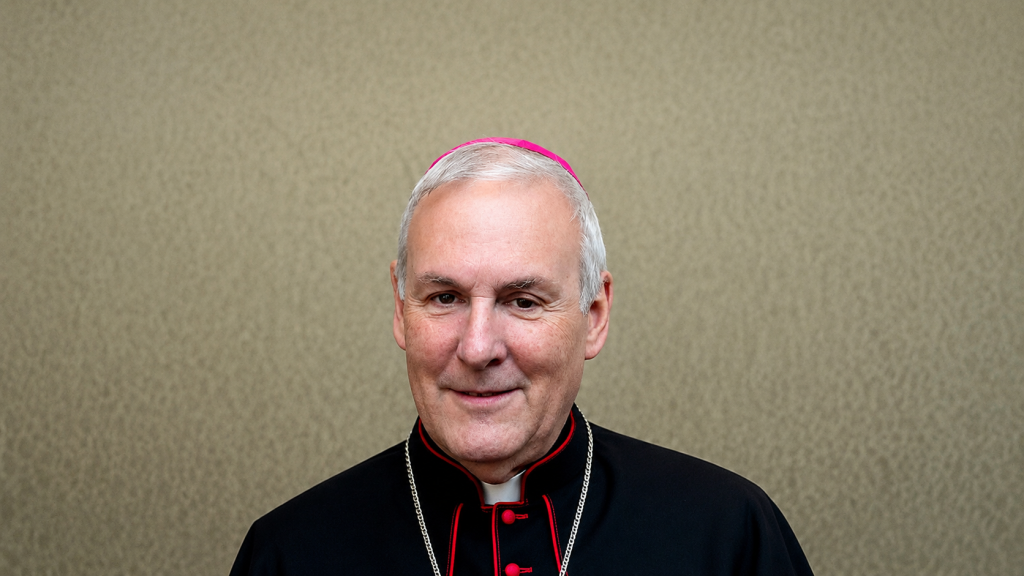
The Bishop of Northampton, David Oakley, has been charged with two counts of rape of a girl aged under 16. The alleged offences are said to have taken place between 2000 and 2001 in Staffordshire. He is due to appear at Cannock Magistrates’ Court on 14 August Bishop David Oakley has been charged with two counts of rape of a girl aged under 16. Bishop David Oakley, the Bishop of Northampton, has been charged with two counts of rape. In a statement, Staffordshire Police said: “Bishop David James Oakley, 70, who is White British, of Desborough, Kettering, has been charged with two counts of rape of a female under 16. It follows his arrest in September 2025 following an allegation made to police.” The statement added: “Oakley is due to appear at Cannock Magistrates’ Court on 14 August.” The offences are alleged to have taken place in Staffordshire between February 2000 and February 2001, the force said. Following the announcement, the Diocese of Northampton released its own statement, confirming that “Bishop David Oakley has been charged after an investigation into non-recent safeguarding allegations”. The statement continued by acknowledging that “this will be very distressing for all concerned” but said that it “cannot comment further on an active legal process”. Anyone with further safeguarding concerns is encouraged to contact the diocesan safeguarding team or the police directly. The diocese said that, beyond the statement, it would not be releasing any further information at this time. Bishop Oakley was ordained a priest in 1980 for the Archdiocese of Birmingham by Archbishop George Patrick Dwyer, then Archbishop of Birmingham. He served as rector of St Mary’s College, Oscott, the seminary of the Archdiocese of Birmingham and one of England’s two remaining diocesan seminaries, from 2013 to 2020. During his tenure as rector, controversy arose after a former formation tutor at the seminary wrote an open letter to the bishops of England, Wales and Scotland in which he claimed that he had been “fired from the college for striving to uphold the Church’s teaching on homosexuality”. Following the letter, published in 2018, the then Canon David Oakley told the Tablet : “Fr Marsden was asked to step down from the formation team for a number of reasons. As some of these are subject to legal review I am unable to comment at the moment.” The Archdiocese of Birmingham also released a statement saying: “The Archbishop of Birmingham, The Most Reverend Bernard Longley, and the seminary trustees, have full confidence in the Rector and his staff.” Bishop Oakley was appointed Bishop of Northampton on 8 January 2020 by Pope Francis and ordained bishop by Cardinal Vincent Nichols on 19 March that year. He withdrew from public ministry last year after the police investigation began, with Canon Michael Harrison, Vicar General, provisionally leading the governance of the diocese.
Jun. 24, 2026
German Synodal Way supporters vow to keep pushing for lay preaching at Mass after Vatican rejection
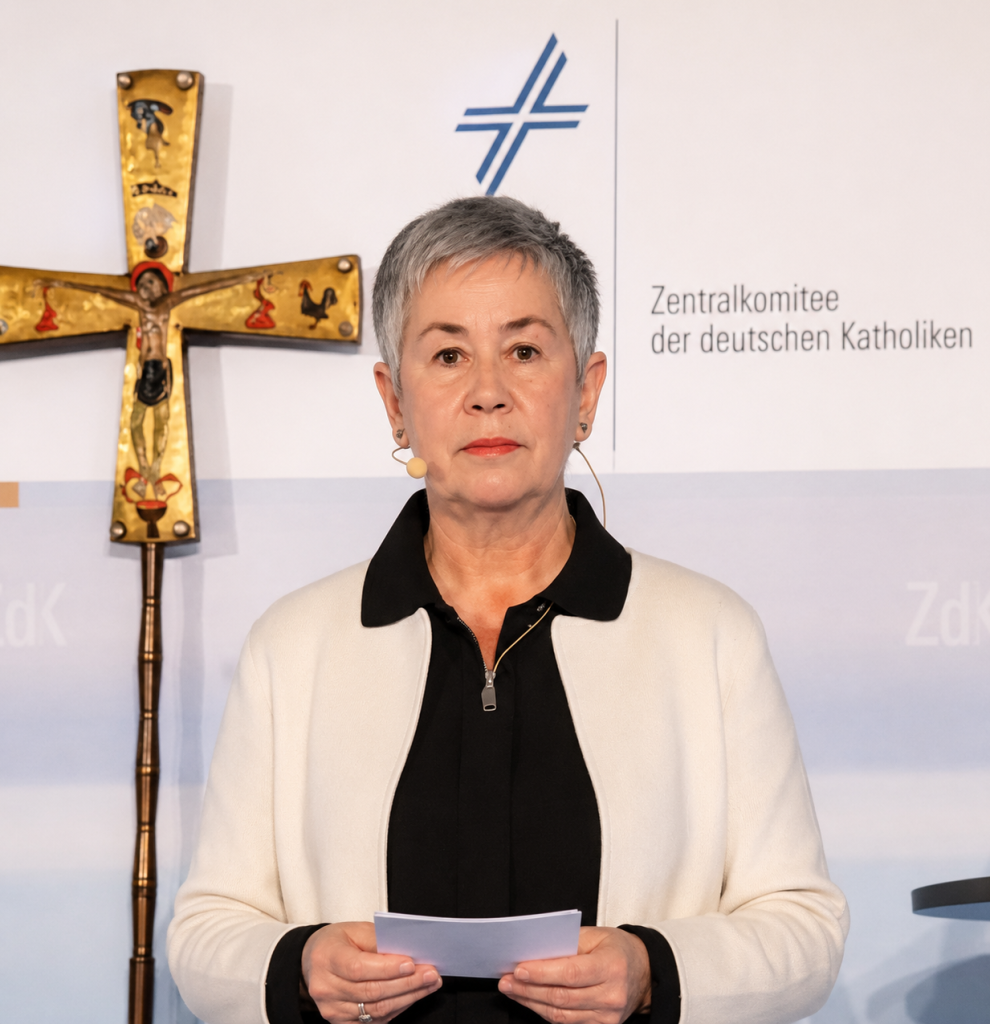
Supporters of Germany’s Synodal Way have vowed to keep pressing for lay people to preach the homily during Mass after the Vatican again rejected the proposal German supporters of the Synodal Way have vowed to continue pressing for lay people to preach the homily during Mass despite a fresh Vatican rejection of the proposal. The latest refusal marks the second time Rome has formally rejected the initiative since it was first approved by participants in the Synodal Way in 2023, with leading lay organisations now urging the German bishops not to abandon the issue. Among the most outspoken responses came from the Central Committee of German Catholics (ZdK), whose president, Irme Stetter-Karp, said that the latest intervention from Rome should not be viewed as the end of the matter. Although she noted that the ZdK had “not been involved” in the bishops’ most recent motion, she pointed to the broad support received by the Synodal Way text “Proclamation of the Gospel by Lay People in Word and Sacrament”, which was approved in March 2023 with the backing of bishops and lay delegates. “We therefore expect the German bishops to reaffirm their substantive position on this matter to Rome, strengthen their arguments, and under no circumstances interpret Cardinal Roche’s letter as discouraging,” Stetter-Karp said. Her remarks were echoed by other organisations associated with the reform movement in Germany. The Catholic Women’s Association of Germany (kfd), one of the country’s largest Catholic women’s organisations, described the Vatican’s decision as evidence of continuing inequalities within the Church. Ruth Fehlker, spiritual director of the kfd national association, said the response from Rome represented “further evidence of the lack of equality for women in the Catholic Church”. “As long as women remain excluded from key positions despite their competence, their vocation, and their commitment, the Church will continue to lose credibility,” she said. Fehlker argued that the decision exposed what she described as a disconnect between local pastoral realities and directives issued by the Holy See. “This decision once again demonstrates the vast gap between the pastoral realities of many local churches and the directives from Rome,” she said. “The question is no longer whether women are capable of preaching. The real question is why those in charge in Rome continue to ignore the charisms and vocations of both women and men.” The reform group Wir sind Kirche (“We Are Church”) also criticised the decision, describing it as “out of touch with reality” and argued that an ageing clergy and declining vocations were creating difficulties for pastoral ministry across many German parishes. The criticism comes after the publication of a letter from the Dicastery for Divine Worship and the Discipline of the Sacraments rejecting a request from the German Bishops’ Conference to permit lay people to preach the homily during Mass in exceptional circumstances. In the letter, dated 17 June and made public on 23 June, the Vatican department informed Bishop Heiner Wilmer SCJ, president of the German Bishops’ Conference, that it was “not possible to grant the indult requested”. The bishops had sought permission for “a duly commissioned lay member of the faithful to preach in place of the homily during the celebration of the Eucharist”. While acknowledging the pastoral concerns behind the proposal, the dicastery stated that “the current discipline cannot be dispensed from by means of an indult”. It added that “the reservation of the homily to a priest or deacon is not a merely disciplinary norm but derives from the very nature of the liturgy”. The Vatican further explained that the homily “forms an integral part of the Liturgy of the Word”, is “intrinsically linked to the proclamation of the Gospel”, and “constitutes an exercise of the munus docendi entrusted to ordained ministers through the Sacrament of Holy Orders”. According to the dicastery, “the proclamation of the Word within the liturgical celebration is inseparable from the mission received sacramentally and from the unity that binds together Word and Sacrament in the Eucharistic celebration”. The letter also rejected suggestions that practical pastoral circumstances could justify an exception to the Church’s universal discipline. Instead, the Vatican emphasised the importance of improving the quality of preaching through the continuing formation of priests and deacons. It said ongoing formation should help ensure the “pastoral and spiritual effectiveness” of homilies, a responsibility entrusted to diocesan bishops. At the same time, the dicastery stressed that the Church already provides numerous opportunities for lay Catholics to proclaim the Gospel outside the homily and outside the celebration of Mass. “The Church’s current discipline already provides for numerous forms of proclaiming the Word and preaching that may be entrusted to lay members of the faithful outside the homily and outside the celebration of the Eucharist, in accordance with canon law and the proper nature of these different forms of proclaiming the Gospel,” the letter stated. The request submitted by Bishop Wilmer followed discussions during the German Bishops’ Conference plenary assembly in Würzburg earlier this year and represented the latest attempt by the German Church to secure permission for lay preaching during the Eucharistic celebration. The proposal itself has its roots in the Synodal Way, the reform process launched by the Church in Germany that brought together bishops and lay representatives to debate questions relating to authority, ministry, sexual morality and the role of women within the Church. During the final assembly of the Synodal Way in Frankfurt in March 2023, participants approved a text entitled “Proclamation of the Gospel by Lay People in Word and Sacrament”. The document called upon the German bishops to establish a particular norm and seek permission from the Holy See allowing suitably qualified lay faithful, commissioned by the diocesan bishop, to deliver the homily during Sunday and feast-day Masses. The proposal was rejected by Rome shortly afterwards. In a letter dated 29 March 2023, Cardinal Arthur Roche, Prefect of the Dicastery for Divine Worship and the Discipline of the Sacraments, warned that permitting lay people to preach the homily could create “misunderstandings about the figure and identity of the priest”. He also stressed the inseparable connection between the proclamation of the Word and the celebration of the sacraments, arguing that the homily forms part of the ministry entrusted through Holy Orders rather than a role that can be delegated to the non-ordained. Despite that rejection, the German bishops returned to the issue and ultimately submitted a fresh request to Rome following their February 2026 assembly. Canon 767 of the Code of Canon Law states that the homily is pre-eminent among forms of preaching and is reserved to a priest or deacon. The same principle was reaffirmed in the 1997 Vatican instruction Ecclesiae de Mysterio , approved by St John Paul II, which stated that the homily during the Eucharistic celebration “must be reserved to the sacred minister, priest or deacon”.
Jun. 24, 2026