

Sspx
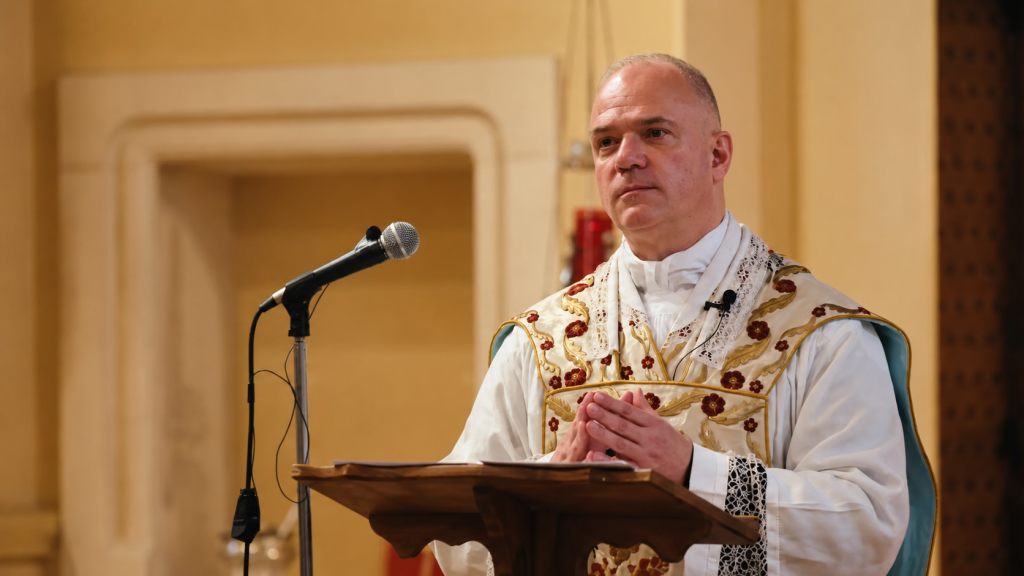
SSPX Superior General urges faithful to stand firm as canonical battle begins
The Superior General of the Society of Saint Pius X has issued his first direct appeal to the laity since the Vatican declared the Society’s bishops excommunicated. In an internal pastoral letter, Fr Davide Pagliarani tells the faithful to remain steadfast as the SSPX prepares for what it expects will be a lengthy canonical dispute with the Holy See The Society of Saint Pius X Superior General has urged the lay faithful attached to the society to remain steadfast as the society prepares for what is expected to be a prolonged canonical battle with the Holy See. In a pastoral letter, Father Davide Pagliarani thanked supporters for their loyalty following the consecration of four bishops at Écône on 1 July. He also portrayed the Vatican’s response as an unjust humiliation borne for the sake of preserving what the Society describes as the Church’s tradition. The letter is the SSPX leadership’s first direct appeal to the laity since the Holy See declared that the bishops involved had incurred automatic excommunication. Addressing the faithful directly, Father Pagliarani recalled the thousands who attended the consecrations at Écône where weather interrupted the liturgy. Quoting Psalm 17, the Superior General described the storm that swept across the ceremony as a moment that deepened rather than diminished his gratitude. “I was the privileged witness to a liturgy of exceptional beauty,” Father Pagliarani wrote, before turning to what he described as an even more moving sight: “a vast crowd of faithful who remained in their places throughout the storm and prayed to Our Lady for the new bishops, for the Church, and for the Pope.” The letter repeatedly returns to the role of the ordinary faithful, presenting them as the principal reason for the consecrations rather than the bishops themselves. “Ultimately, these consecrations were performed for each of you, dear faithful,” Father Pagliarani wrote. “Your souls are the true treasure entrusted to the Society.” Father Pagliarani’s letter leaves little doubt that the Society rejects both the legal and theological basis of the Vatican’s conclusions. “The consecrations have been condemned, and the severity of the sanctions imposed is unprecedented,” he wrote. While acknowledging that the bishops were the principal target of the decree, the Superior General argued that “even the faithful are affected.” Father Pagliarani called the condemnation “utterly unjust”, and said it represented “an immense humiliation for people whose sole aim is to defend the true faith and work for the salvation of souls.” The Superior General also suggested that the sanctions extend beyond individuals to the wider traditionalist cause itself. “Ultimately, it is Tradition itself, which we cherish above all else, that is excommunicated in all those who embody it,” the letter states. “It is obvious that, before God, such a condemnation cannot be valid.” “If Providence allows a crisis such that the teaching of the faith is mysteriously obscured, that same faith must continue to live in souls,” Father Pagliarani wrote. The Superior General added that “the small candle that each of you received on the day of your baptism must remain lit in your heart and mind until the very last day.” “The Fraternity will never abandon you,” Father Pagliarani concluded. “Your souls will never lose their value and worth in the eyes of its priests.” AdVaticanum understands that the message was read to congregations across SSPX chapels on Sunday and had been circulated internally beforehand as part of an embargoed circular letter sent throughout the Society. According to information obtained by the publication, the accompanying internal circular letter by Fr Le Roux, Secretary General, also sought to prepare superiors and members for the next stage of the dispute following the Society’s preliminary canonical recourse against the Vatican decree, outlining the movement’s intentions as it navigates the post-consecration fallout. Following the 1 July consecrations, the Dicastery for the Doctrine of the Faith issued a decree on 2 July declaring that Bishop Alfonso de Galarreta, Bishop Bernard Fellay as co-consecrator, and the four newly consecrated bishops had incurred latae sententiae excommunication under canons 1387 and 1364. The accompanying explanatory note extended well beyond the declaration concerning the bishops. It stated that all sacred ministers of the Society are in schism and subject to the same penalty, described their sacramental ministry as illicit, asserted that confessions heard by SSPX priests and marriages celebrated by them are invalid, and warned clergy and faithful against formal adherence to the movement, citing the criteria established by the Pontifical Council for Legislative Texts in 1996. The publication of the letter follows a series of increasingly detailed SSPX responses to the Vatican decree. In in-house SSPX articles published after the sanctions, including Invalid Punishments, Valid Sacraments , followed by Nuclear Excommunication and Hundreds of Thousands of Catholics Purportedly Excommunicated: How Should We See This? , the Society maintained that the penalties are canonically null because a state of necessity excuses any alleged offence. It further argued that neither bishops, priests nor lay faithful had incurred excommunication and insisted that confessions and marriages remain valid through the Church’s principles governing supplied jurisdiction and matrimonial consent. On 11 July, the SSPX General House lodged a preliminary recourse with the Dicastery for the Doctrine of the Faith. In a communiqué published two days later, the Society stated that the appeal had been submitted under canon 1734 and the following canons, adding that it “has the effect of suspending the execution of the decree, in accordance with canon 1353.” The appeal, the communiqué said, had been presented “in a spirit of respect for ecclesiastical authority and of faithful attachment to justice, truth and the good of the Church.” Whether that legal argument ultimately succeeds appears uncertain. In an interview published by AdVaticanum on 18 July, Archbishop Juan Ignacio Arrieta, the former Secretary of the Dicastery for Legislative Texts, offered a detailed canonical assessment of the Holy See’s position. Archbishop Arrieta described the decree as “an act owed”, arguing that the dicastery merely declared a penalty that had already been incurred automatically under canon 1387. The former Vatican official nevertheless distinguished between the declaration of excommunication and the faculties previously granted by Pope Francis. Regarding confessions, Archbishop Arrieta stated that the faculty had been granted by a pontifical act and therefore “an act of the same nature is required to revoke it.” Revocation, Archbishop Arrieta said, “requires direct authorisation from the Pope himself.” On marriages, however, Archbishop Arrieta concluded that the present circumstances make it improbable that diocesan bishops could lawfully grant the necessary delegation, meaning marriages celebrated by SSPX clergy would be canonically null for lack of canonical form. In the same article, a priest close to the Dicastery for the Doctrine of the Faith told AdVaticanum that the Society’s preliminary recourse was “unlikely to be granted”, arguing that the dicastery had not imposed a penalty but merely declared one already incurred for what was described as a well-known offence. Any lifting of the excommunications, the priest suggested, would require repentance by those involved. With the preliminary recourse now before the Dicastery for the Doctrine of the Faith, and internal correspondence indicating that the Society is preparing for the next phase of the confrontation, the pastoral appeal suggests that the SSPX expects the dispute to continue well beyond the coming months.
Jul. 20, 2026
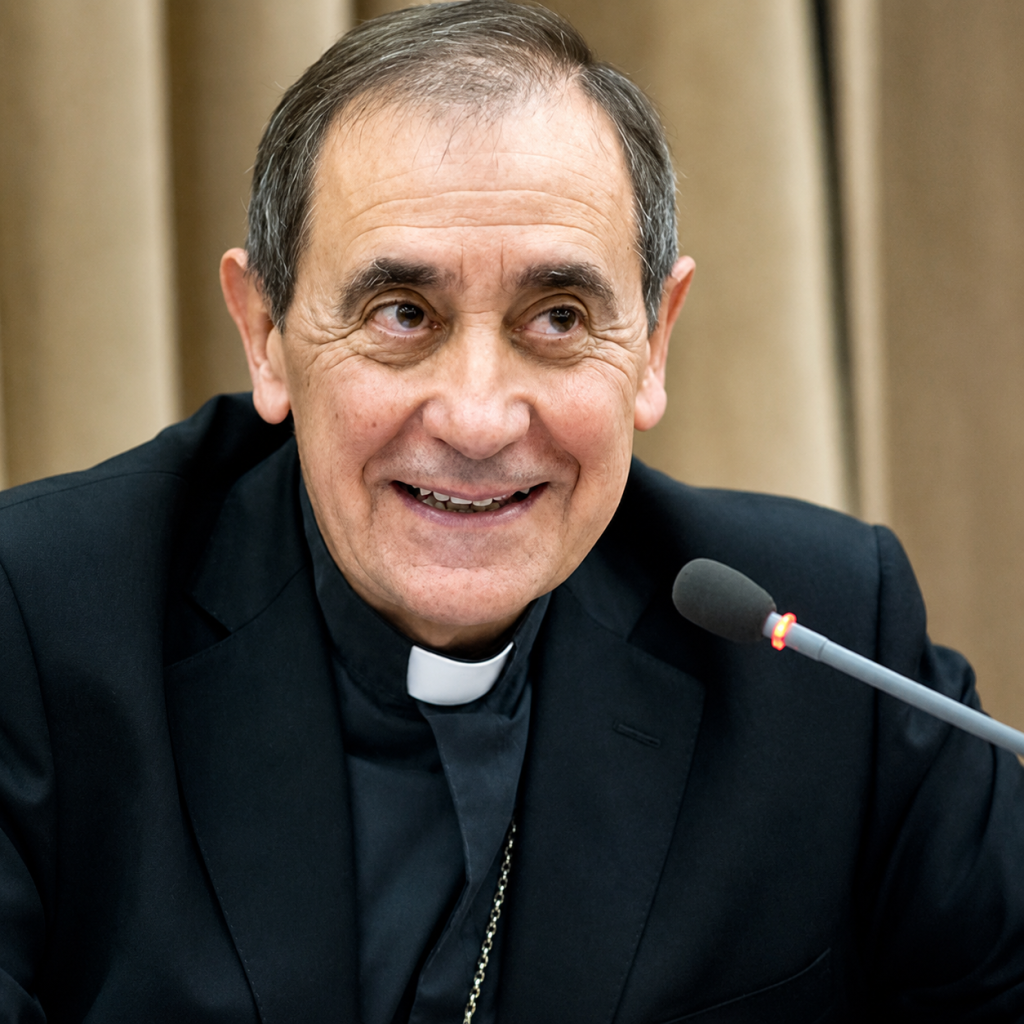
Canonist Archbishop Arrieta breaks down the Vatican’s response to the SSPX bishops
Archbishop Juan Ignacio Arrieta, former Secretary of the Pontifical Council for Legislative Texts and canon lawyer, speaks exclusively to AdVaticanum about the Vatican’s response to the SSPX’s latest episcopal consecrations, explaining what the recent decree means in practice for the Society, its clergy and the faithful, including the validity of SSPX confessions and marriages In an exclusive for AdVaticanum, Archbishop Arrieta, former Secretary of the Dicastery for Legislative Texts, has said that revoking the faculties necessary for the valid administration of the sacrament of Confession for the SSPX requires direct authorisation from the Pope himself. The veteran canon lawyer’s intervention follows the Holy See’s formal response to the Society’s latest illicit episcopal consecrations. The consecrations have led to the Dicastery for the Doctrine of the Faith to issue a decree declaring the bishops involved excommunicated and warning clergy and the faithful against adhering to what it describes as a “schismatic movement”. Arrieta told AdVaticanum that the recent consecrations are “a profound wound to the unity of the Church instituted by Christ”, echoing Pope Leo XIV’s warning issued shortly before the ceremony took place. He dismisses the Society’s longstanding justification that extraordinary circumstances created a “state of necessity” permitting episcopal consecrations without papal approval. “The argument of a ‘state of necessity’ invoked by them does not appear reasonable,” the Archbishop said, arguing that the consecration of bishops “is an extremely sensitive element of the very structure of the Church” and was carried out “in direct disobedience to the successor of the Apostle Peter”. For Archbishop Arrieta, the dispute extends beyond a single canonical offence. Arrieta told AdVaticanum that the latest consecrations reveal a deeper divergence in ecclesiology, saying they demonstrate that the Society’s reasoning “rests on a hierarchy of values and categories quite different from that taught by the Tradition of the Catholic Church”, making future doctrinal dialogue “highly problematic”. His assessment put the latest events within the historical pattern established in 1988, when Archbishop Marcel Lefebvre consecrated four bishops without papal mandate despite months of negotiations with Rome. Archbishop Arrieta recalled that Cardinal Édouard Gagnon had conducted a canonical visitation to the Society’s seminary at Écône while efforts were simultaneously underway to restore communion. He notes that the decisive negotiations were led by the then-Cardinal Joseph Ratzinger, Prefect of the Congregation for the Doctrine of the Faith, culminating in a protocol of agreement reached in early May 1988. According to Arrieta, Lefebvre subsequently withdrew from that agreement and refused to sign it, bringing the reconciliation effort to an end. Beyond the theological discussions, Archbishop Arrieta said Rome had also been examining possible canonical structures that could accommodate the Society within the framework of the 1983 Code of Canon Law should an agreement have been reached. When those negotiations collapsed, attention instead turned towards establishing what became the Pontifical Commission Ecclesia Dei to assist those wishing to remain attached to the older liturgy while staying in full communion with the Holy See. Archbishop Arrieta also pointed out to AdVaticanum that although the Holy See declared Lefebvre, Bishop Antônio de Castro Mayer and the four newly consecrated bishops excommunicated in 1988, it never questioned the validity of their episcopal ordinations, “not least because doing so would have reopened settled ecumenical questions”. The Archbishop also recalled that Pope John Paul II subsequently issued the motu proprio Ecclesia Dei, confirming that the consecrations constituted a schismatic act while establishing the Ecclesia Dei Commission. More than two decades later, in 2009, the Congregation for Bishops lifted the excommunications imposed upon the four surviving bishops consecrated by Archbishop Lefebvre, despite competence over such grave offences having already passed to the Congregation for the Doctrine of the Faith following Sacramentorum Sanctitatis Tutela. That transfer of competence, Arrieta argues, explains why the present case has been handled by the Dicastery for the Doctrine of the Faith rather than another Vatican department. Regarding the recent decree and explanatory note, Archbishop Arrieta first distinguishes carefully between the two documents recently published by the dicastery. The decree declaring the bishops excommunicated, he says, is what canon lawyers describe as “an act owed”. Rather than introducing a new penalty, it formally declares a juridical situation already established by canon law through the offence itself. “The two documents now issued by the Dicastery for the Doctrine of the Faith are of a different nature and scope. The decree now issued represents, on the part of the dicastery, what is usually called ‘an act owed’, in the sense that it was an act the dicastery was bound to perform; it is limited to carrying out what canon 1387 of the Code prescribes, declaring for general notice that the six bishops involved find themselves in a situation of excommunication.” Arrieta also notes that the co-consecrating bishop incurred the same automatic penalty, referring to a 2011 interpretative declaration issued by the Pontifical Council for Legislative Texts concerning illicit episcopal ordinations in China. In that case, questions existed over whether bishops had acted freely under pressure from the civil authorities, raising doubts about whether an automatic penalty had in fact been incurred. No such uncertainty exists in the present circumstances, he argues, making a formal decree necessary. He adds that the decree also contains a formal warning to clergy and the faithful against adherence to the schism. “In fact, unfortunately, even the co-consecrating bishop has incurred the automatic penal sanction of the aforementioned canon… In the present situation no such question arises, and so the dicastery had to issue a formal decree of excommunication… The current decree of the dicastery also contains a formal warning to clergy and the faithful not to adhere to the schism.” In reference to the explanatory doctrinal note, Archbishop Arrieta explains that this second document differs fundamentally in purpose. Rather than declaring penalties, it explores the possible canonical consequences for those who formally identify themselves with the Society following the latest developments. He pointed out that the note draws directly upon a 1996 explanatory document issued by the Pontifical Council for Legislative Texts, which examined the legal position of Catholics associated with the Lefebvrist movement after the 1988 consecrations. That earlier text concluded that the illicit episcopal ordinations had “constituted the culmination of a progressive overall situation of a schismatic nature” and stated that “until there are changes leading to the re-establishment of this necessary communion, the entire Lefebvrian movement is to be considered schismatic”. Arrieta stressed that the 1996 note carefully distinguished between the moral reality of schism and the canonical crime carrying legal penalties. It also established that formal adherence required both interior acceptance of schismatic positions and their external manifestation, criteria which apply differently to clergy and lay faithful. He cautions, however, that determining the legal position of individual members of the faithful remains considerably more complicated than assessing the status of the bishops themselves. Beyond the explanatory note, Archbishop Arrieta stated that many ordinary Catholics attached to the Society’s chapels may have acted in good faith, particularly those who have worshipped there for decades or were raised within those communities. The former Secretary argues that some could fall within the principles articulated by the Second Vatican Council’s decree Unitatis Redintegratio concerning baptised Christians raised within separated ecclesial communities. He also observes that genuine good faith could amount to a “state of necessity” sufficient to prevent the automatic application of canonical penalties under canon 1324. Canon law, he notes, requires grave personal culpability through malice or negligence before penalties can be imposed. At the same time, Archbishop Arrieta insists that this principle cannot be invoked indiscriminately. “Our conscience is not autonomous and must obey the teachings and authority of the Church,” he says, adding that personal responsibility ultimately depends upon each individual’s formation and knowledge. He also points out that, beyond the six bishops identified in the dicastery’s decree, accomplices “without whose assistance the offence would not have been committed” likewise incur the same automatic penalty under canon 1329. Perhaps the most practically significant part of Arrieta’s analysis concerns the validity of the sacraments administered by SSPX clergy following the latest schism. He states that, under present circumstances, the ministry exercised by priests of the Society is unlawful except in danger of death. Nevertheless, validity depends upon the sacrament concerned. Confession and marriage occupy a unique position because both require specific canonical faculties for validity. Regarding confession, Arrieta recalls that Pope Francis granted SSPX priests faculties to hear confessions validly during the Extraordinary Jubilee of Mercy in 2015 through Misericordiae Vultus. When the Jubilee concluded, Francis extended those faculties indefinitely through the apostolic letter Misericordia et Misera in November 2016. Because those faculties were granted directly by the Pope, Arrieta argues that only another papal act could withdraw them. “These priests received the faculty to hear confessions by a pontifical act, and an act of the same nature is required to revoke it,” he says, while observing what he describes as the paradox of priests exercising papally granted faculties while simultaneously acting in disobedience to the Roman Pontiff. AdVaticanum can also disclose that it contacted Archbishop John Joseph Kennedy, Secretary for the Disciplinary Section of the Dicastery for the Doctrine of the Faith, seeking clarification on whether any apostolic letter, pontifical mandate or other papal act had been issued revoking the faculties granted to SSPX priests to hear confessions validly. The dicastery declined to address the question, responding only with the words: “No comment.” Marriage, however, presents a different canonical situation. In 2017, Pope Francis instructed the Ecclesia Dei Commission to permit diocesan bishops to delegate SSPX priests the faculty to assist validly at marriages in individual cases, thereby safeguarding the canonical form required by the Church. Those faculties, Arrieta told this publication, depended upon delegation by local ordinaries rather than a universal faculty directly attached to every priest of the Society. In the aftermath of the latest episcopal consecrations, he considers it unlikely that diocesan bishops could now legitimately grant such faculties. “Present circumstances make it unlikely that a bishop could legitimately grant such a faculty,” he says, concluding that marriages witnessed by SSPX priests would therefore be “canonically null for lack of canonical form”. The six newly excommunicated bishops stand in an even more serious position. Arrieta notes that the declaration of excommunication bars them both from receiving the sacraments and from exercising ecclesiastical ministry, carrying further moral and canonical consequences should those prohibitions be disregarded. On more recent developments, the SSPX has formally challenged the Vatican’s 2 July decree. Archbishop Arrieta was not available to comment further because of his schedule, having filed his answers prior to the Society’s preliminary recourse. However, this publication can reveal that a priest close to the DDF told AdVaticanum that the appeal is unlikely to be granted, since it concerns a latae sententiae penalty based on a well-known offence. The dicastery did not “impose” the penalty, which is automatic, but simply “declared” it in the decree for the public knowledge of the faithful. The only way to lift a latae sententiae excommunication requires, as a starting point, the offender’s repentance for the act committed. Image credit: Pontificia Università della Santa Croce
Jul. 18, 2026
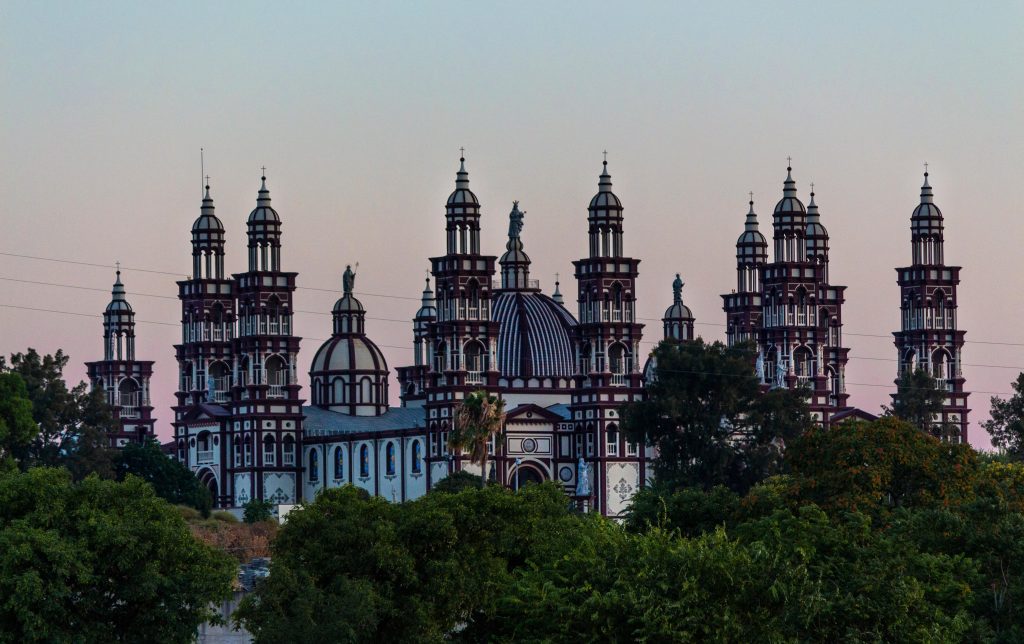
The Palmarian Church’s response to the SSPX and the story behind it
The Palmarian Church has responded to the SSPX excommunications by insisting that the true Catholic Church is not in Rome, but in El Palmar de Troya. Our latest explores the extraordinary history behind one of Catholicism’s most unusual schisms The Palmarian Church, a small sect based in Andalusia, Spain, which believes the true Pope resides among its members, has reacted to the excommunications of the Society of Saint Pius X. In a 14-minute message delivered by “Pope Peter III”, also known as Joseph Odermatt of Switzerland, the church’s position was set out across its various social media channels. Using the papal “We”, Odermatt introduced himself as the “Vicar of Christ and Successor of Saint Peter”, saying he wished to “address all Catholic faithful who are wandering through the spiritual desert after witnessing the collapse and the general excommunication of the followers of Marcel Lefebvre”. He began by claiming that the decree had no validity, since “Pope Gregory XVII”—the church’s founder, Clemente Domínguez y Gómez, who died in 2005—had already excommunicated the group decades earlier. He then turned to Archbishop Ngô Đình Thục, the Vietnamese prelate who illicitly ordained Gómez and his companions to the priesthood and episcopate in 1976. Odermatt claimed that “Archbishop Thục did not act on a whim. He visited the sacred apparition site of El Palmar de Troya and witnessed its mysteries and miracles with his own eyes.” He also described Thục’s later repudiation of the illicit consecrations and his decision to distance himself from the group as a “great falsehood repeated by his critics”. He went on to argue that Thục “recognised the grave crisis of the Church” and that obtaining the proper permission to ordain and consecrate Gómez was “a matter of human law, not divine law”. Odermatt also claimed that Archbishop Marcel Lefebvre, founder of the SSPX, was visited by the Blessed Virgin Mary and instructed to visit El Palmar de Troya, but refused because he “preferred political manoeuvring, pride, comfortable drawing rooms, and the applause of men over the direct intervention of Heaven”. He appears to be referring to Gómez’s request in the mid-1970s for Lefebvre to visit the group and ordain its members as bishops. It is generally understood that Lefebvre declined but recommended Archbishop Thục as a prelate who might be willing to do so. He was equally critical of Lefebvre’s dialogue with Cardinal Joseph Ratzinger before the 1988 episcopal consecrations, during which the two sought an agreement acceptable to both the Vatican and the SSPX. Odermatt claimed that, by signing the May 1988 protocol, Lefebvre “accepted the authority of the apostate Code of Canon Law, and recognised the modern Vatican antipopes as legitimate authorities.” Odermatt argued that the SSPX lives with an internal contradiction by recognising the Pope while telling its followers that they must “disobey him every day in order to save their souls.” His criticism of the SSPX, which extended to sedevacantists, whom he described as holding a “theological absurdity”, served as a segue into his presentation of the Palmarian church as the true Church. He urged Catholics to recognise that the “Holy See remains secure and undefiled at El Palmar de Troya”. He concluded his monologue by declaring that the “true Church—one, holy, catholic, apostolic and Palmarian—is at El Palmar de Troya with the true Pope, Peter III, Supreme Pontiff and Vicar of Christ by the grace of God.” The story of the Palmarian church dates back to 30 May 1968, when four schoolgirls in the small and newly established Andalusian town of El Palmar de Troya went to pick flowers. The girls claimed to see the Virgin Mary, leading to an explosion of reported religious experiences in the area, including stigmatas, solar visions, the Eucharist miraculously materialising on visionaries’ tongues, and pilgrims claiming to feel the Infant Jesus in their arms. People also claimed that Padre Pio appeared, decrying the loss of the traditional Catholic faith. In late 1969, Clemente Domínguez y Gómez emerged on the rapidly growing religious scene in the small town. Having been rejected by the local seminary, the Dominicans and the army, he was working as an office clerk. Gómez quickly established himself as the principal visionary, claiming to have received visions of more than sixty saints and angels, as well as Christ and the Virgin Mary. Under Gómez, the messages shifted from concern about the state of the modern Church to stark criticism of the Second Vatican Council and warnings of the End Times. The Archbishop of Seville, Cardinal José Bueno y Monreal, denounced the site and prohibited any Catholic rites from being celebrated there, making it clear that the movement had no ecclesiastical approval. In the early 1970s, the town became a melting pot for followers of various alleged apparitions and Catholics who took issue with the post-conciliar Church. The circulation and promotion of Gómez’s visions became a rallying point for these disaffected Catholics. A watershed moment came when the Second Baroness of Castillo de Chirel donated 16 million pesetas, enough to purchase the apparition site and send Gómez and his closest followers on missions around the world. The group then established itself as a religious order, the Carmelites of the Holy Face, adopting distinctive brown habits with large scapulars. Whilst harbouring some priests among their ranks, they failed to attract any bishops, and most of their members, including Gómez, remained laymen. Archbishop Ngô Đình Thục then arrived and illicitly ordained Gómez, his right-hand man and several others to the priesthood before consecrating them bishops shortly afterwards. Thục’s motivations are difficult to ascertain. Before arriving in El Palmar de Troya, he had celebrated the Novus Ordo Mass and, during the Second Vatican Council, had spoken in favour of the ordination of women. However, by the early 1980s, Thục declared that the Mass of St Pius V was the only Mass acceptable before God and came to believe that the See of Rome was vacant. Whatever his motivations, it appears that he arrived in part through the mediation of the Society of Saint Pius X. He later repented of his actions and was reconciled with Rome, only to continue illicitly consecrating bishops some years later. All those consecrated at El Palmar were excommunicated. For some time, Gómez had been preaching that Pope Paul VI was being drugged and held against his will by the Roman Curia, whom he claimed were secretly communists and Freemasons, and that one day the Pontiff would escape and arrive in El Palmar de Troya. According to Palmarian doctrine, Paul VI was instead murdered by poison administered by his Secretary of State before he could make the journey. Upon the Pope’s death in August 1978, Gómez declared himself his successor after claiming to have been crowned in a vision by Christ Himself, and that the Holy See had moved from Rome to El Palmar de Troya. Taking the name Gregory XVII, he created 24 cardinals and opted for a formal coronation using the papal tiara, in contrast to Pope John Paul I. This marked the creation of the Santa Iglesia Católica Apostólica y Palmariana (Holy Catholic Apostolic Palmarian Church). Gregory XVII became its supreme leader, exercising absolute authority over a hierarchy of cardinals, bishops, priests, nuns and lay faithful. The comparatively short history of the Palmarian church has been tumultuous. Gómez is said to have lived a playboy lifestyle alongside his closest cardinals, whilst those lower in the hierarchy endured lives of improvised penance. Notable events during his reign included the accusation that he kidnapped a 17-year-old Venezuelan girl in 1979, the registration of the church as a recognised religious entity in Spain in 1987, the canonisation of thousands of new saints including General Francisco Franco and Christopher Columbus, the abolition of the office of cardinal in 1995, and, in 2001, the banning of the Bible in favour of the Palmarian Bible, which includes episodes such as the Nativity and Immaculate Conception of St Joseph. The greatest challenge to his leadership came in 2000, when a group of priests and nuns formed a loose resistance movement against the increasingly severe and erratic rules imposed by Gómez. Robert McCormack, formerly Fr Gido Maria, was a central figure in this resistance. He has described how it grew from concern for younger priests and the Palmarian faithful, many of whom were suffering under Gómez’s dictates and becoming increasingly vulnerable to mental health problems. McCormack secretly introduced non-Palmarian books and ideas to support these members. Ultimately, he and 24 other professed religious were expelled from the church. When Gómez died in 2005, his right-hand man, Manuel Alonso Corral, became the Palmarian Pope without a conclave, as Gómez had already designated him as his successor. Taking the name Peter II, he continued his predecessor’s teachings with remarkable continuity. He proclaimed few new dogmas, seeing his role principally as defending the teaching of his close friend. However, he did dogmatically declare himself to be a descendant of St Ferdinand III of Castile. Corral was also an isolationist, urging members to sever ties with the outside world and, like the Red Hot Chili Peppers before him, encouraging Palmarians to throw away their televisions. If Corral was an isolationist, his successor, Ginés Jesús Hernández Martínez, who took the name Gregory XVIII, was an authoritarian. Formerly the church’s Secretary of State and Corral’s second-in-command, he further isolated the remaining members and ordered the faithful to shun relatives who had “apostasised”. Children over the age of 18 who had left the church were to be expelled from the family home, whilst younger children were to be spoken to as little as possible. Martínez was known for his temper, and members lived in fear of personal attacks. Palmarian Popes Gregory XVII, Gregory XVIII and Peter II In April 2016, he abdicated the Palmarian papacy and left the church with his girlfriend, herself a former Palmarian. Martínez then gave interviews to the Spanish media, prompting widespread coverage, including reports that he and his girlfriend were later tried by the Spanish authorities for armed robbery. Martínez remains a figure disliked by virtually everyone connected with the Palmarian church. Former members remember his harsh rules and merciless treatment of the faithful, whilst current members regard him as the apostate pope who dragged the church into public scandal. Joseph Odermatt, taking the name Peter III, immediately succeeded Martínez. He is presented as a calm and serene figure weighed down by the burden of his office. Odermatt has also done more than any previous Palmarian pope to present the church to the outside world. In 2018, under his leadership, multilingual websites, Instagram accounts and Facebook pages were launched. Today they showcase elaborate papal processions, defences of Palmarian teaching, and brief hagiographies of the church’s numerous saints. Today, the church is dwindling and is believed to have only several thousand members, a fraction of its peak membership. However, the 14-minute address delivered by Odermatt will be well received by Palmarians, who are likely to see any division within the Roman Catholic Church as vindication of their belief that they alone preserve the true faith.
Jul. 15, 2026
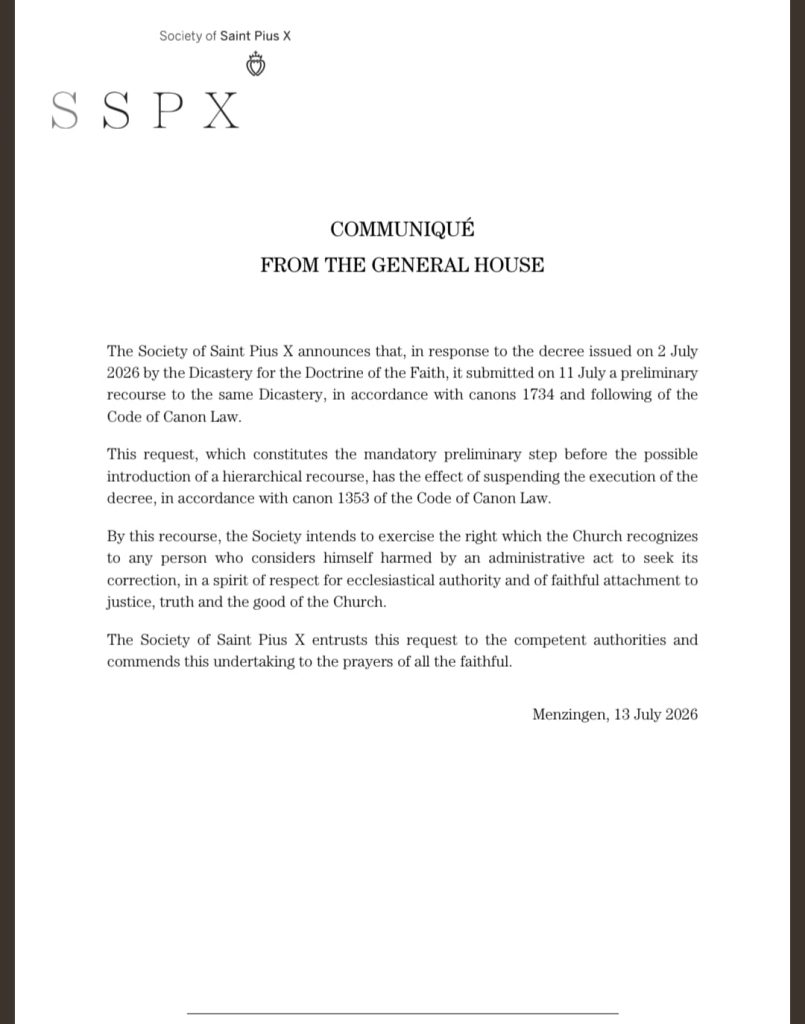
Analysis: The SSPX’s canonical challenge to Vatican excommunications
The SSPX has formally challenged the Vatican’s 2 July decree under the 1983 Code of Canon Law. Our analysis examines the Society’s legal arguments, how the recourse process works and what could happen next in its dispute with Rome The Society of Saint Pius X has taken its dispute with the Holy See into a new canonical phase after announcing that it has formally challenged the Dicastery for the Doctrine of the Faith’s decree of 2 July by means of a preliminary recourse under the 1983 Code of Canon Law. In a communiqué issued at 9 pm Central European time from its headquarters in Menzingen on 13 July, the SSPX confirmed that it had submitted the recourse petition on 11 July in accordance with canon 1734, arguing that the measure automatically suspends the penalties of the Vatican decree under canon 1353 while the matter is under review. The communiqué issued from SSPX headquarters in Menzingen on 13 July The move is the first formal procedural response by the SSPX since Rome declared that the episcopal consecration of four priests on 1 July without a pontifical mandate constituted “an act of a schismatic nature”, triggering the most serious confrontation between the Society and the Holy See since the 1988 excommunications. Rather than presenting the filing as an act of defiance, the Society described it as the exercise of a right recognised by the Church. “The Society intends to exercise the right which the Church recognizes to any person who considers himself harmed by an administrative act to seek its correction, in a spirit of respect for ecclesiastical authority and of faithful attachment to justice, truth and the good of the Church,” the communiqué states. The procedural significance of the filing lies in the canons cited by the Society. Canon 1734 requires anyone wishing to challenge an administrative decree first to request in writing that its author revoke or amend it before lodging a higher appeal. The petition must normally be filed within ten useful days of notification. Canon 1353 provides that recourse against decrees which inflict or declare a penalty has a suspensive effect, while canon 1736 confirms that where the law itself suspends execution, the preliminary petition produces the same effect. In practical terms, the SSPX argues that the penalties and declarations contained in the decree cannot be enforced while its request remains pending before the Dicastery for the Doctrine of the Faith. The canonical process does not end with this first submission. Under canon 1735, the Dicastery has thirty days to respond by revoking, correcting or rejecting the request. If it issues a new decree, or if it rejects the petition, the Society may then pursue a hierarchical recourse under canon 1737. That appeal would seek a review by the competent higher authority, with the superior possessing the authority to confirm, revoke or modify the original decree. The legal process creates a temporary pause while preserving the possibility of a fuller examination of the dispute. For the Society, however, the procedural arguments are only one part of a much broader disagreement with Rome over the character of the July consecrations themselves. In an extensive analysis published on 9 July, the SSPX rejected the Dicastery’s central conclusion that the consecrations were schismatic. Referring directly to the decree, the Society argued that “the decree claims that ‘Monsignor Alfonso de Galarreta’ committed ‘an act of a schismatic nature by the episcopal consecration of four priests, without a papal mandate and against the will of the Sovereign Pontiff.’ But such an assertion is hasty and reveals a flawed understanding of schism.” Drawing upon classical canonists and theologians, including Monsignor Raoul Naz and Cardinal Cajetan, the Society sought to distinguish schism from disobedience. It maintained that while the consecrations had taken place contrary to the wishes of Pope Leo XIV, they did not involve a rejection of the Roman Pontiff’s authority. “The Society of Saint Pius X and its Superior General have always affirmed that they recognize Leo XIV as their head. They address him as a subject addresses his superior, as a son addresses his father. … The Society has never claimed to constitute a parallel or autonomous Church.” In its view, schism requires the refusal of submission to the Roman Pontiff or separation from communion with the Church. The SSPX insists that it continues to recognise papal authority while disputing what it considers an unjust administrative act. From its perspective, the dispute concerns the lawfulness and necessity of the episcopal consecrations rather than communion with the Holy See itself. The Society also devoted considerable attention to the penalties declared by the Dicastery. It argued that canon law does not impose penalties automatically without regard to personal culpability, invoking the longstanding principle of nulla poena sine culpa . Citing canons 1323 and 1324, it maintained that a person acting out of necessity or under grave fear may not incur canonical penalties in the ordinary way. The document concludes that “these two canonical considerations are sufficient to affirm with certainty that neither the consecrating bishops nor the bishops consecrated on July 1, 2026, are excommunicated.” According to the SSPX, the necessity in question is not subjective but arises from what it describes as “the grave danger threatening the complete preservation of the faith and the ordinary means of sanctification”. That appeal to a state of necessity has formed the backbone of the Society’s canonical reasoning since Archbishop Marcel Lefebvre justified the 1988 episcopal consecrations on similar grounds. The Society’s decision to pursue a formal recourse also recalls another episode involving traditionalist Catholics. During the early 1990s, six Catholics in Hawaii who had been declared excommunicated by the local bishop because of their association with SSPX sacramental life sought hierarchical recourse to Rome. Following a review by the Congregation for the Doctrine of the Faith under Cardinal Joseph Ratzinger, the decrees were ultimately declared null, with the Vatican concluding that the actions in question did not amount to formal schism. While the factual circumstances differ substantially from the present dispute, the Hawaii case remains one of the clearest examples of the Holy See overturning canonical penalties after the recourse procedure. The comparison with 1988 is unavoidable, yet the present situation differs in one significant respect. Following Archbishop Lefebvre’s consecration of four bishops without papal approval, Rome declared that he and the newly consecrated bishops had incurred excommunication. The Society consistently maintained that those penalties had never been valid because of necessity but did not pursue the structured administrative recourse now available under the current procedural framework. Instead, the dispute evolved through years of theological dialogue until Pope Benedict XVI remitted the excommunications in 2009 without requiring the Society first to acknowledge that they had been validly incurred. The present case therefore combines continuity with a twist. Substantively, the SSPX continues to reject both the accusation of schism and the penalties attached to it. Procedurally, however, it is making full use of the mechanisms provided by the 1983 Code of Canon Law. The SSPX’s reservations concerning the post-conciliar reforms extended to the legal framework established after the Second Vatican Council. Yet by relying explicitly upon canons 1353 and 1734 to 1737, the Society is invoking the authority of the very Code promulgated by Pope John Paul II in 1983. Indeed, recognition of the validity of the 1983 Code appeared as the fifth point in the Memorandum of Understanding signed by Cardinal Joseph Ratzinger and Archbishop Lefebvre on 5 May 1988 before the agreement collapsed the following day. Beyond that, the SSPX readily acknowledges that the Dicastery has issued a decree and that the decree purports to impose canonical consequences. What it does not accept is that those consequences have been validly incurred. Its decision to file recourse therefore seeks simultaneously to suspend the decree’s effects, protect its apostolate and challenge the Vatican’s position using the Church’s own judicial mechanisms. The Dicastery for the Doctrine of the Faith will in theory make the next move. It may revoke or amend its decree, reject the petition outright or simply reaffirm its earlier conclusions. Should that occur, the Society would then be entitled to pursue hierarchical recourse within the Roman Curia under the timetable established by canon law. The competent authority would have the power to uphold, rescind or modify the decree, while the Pope himself could intervene personally at any stage, either by deciding the matter directly or by instructing the Dicastery to adopt a different course. For now, the dispute enters a new but no less consequential phase. The canonical process offers neither side an immediate victory. Instead, it places the latest confrontation between Rome and the Society of Saint Pius X within the legal structures of the Church.
Jul. 13, 2026
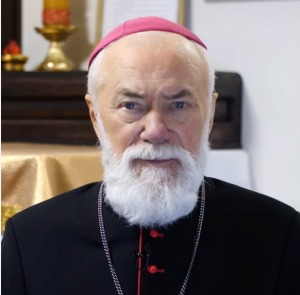
Controversial retired archbishop defends SSPX after excommunications
Controversial retired Archbishop Jan Paweł Lenga has publicly defended the SSPX following the excommunications over its episcopal consecrations The Society of St Pius X has received a public defence from the controversial Archbishop Jan Paweł Lenga, retired Archbishop Emeritus of Karaganda in Kazakhstan, following its 1 July episcopal consecration of four bishops without a papal mandate. In a lengthy statement published in English by SignoftheCross Media, Archbishop Lenga denounced the Holy See’s excommunication decree in uncompromising terms, describing it as evidence that the Vatican had “departed from Christ and from the faith”. His intervention is the first public endorsement of the Society by a bishop since the “maximalist” sanctions imposed on the SSPX following the illicit episcopal consecrations. Opening his statement, the retired archbishop contrasted the Society’s episcopal consecration with what he described as the state of the contemporary Church. “It was worth seeing the consecration of the bishops of the Society of St Pius X: what peace, what joy, what prayerful atmosphere, what solemnity!” the archbishop said. “Nothing like that can be seen in the post-conciliar Church anymore. In contrast, the Vatican is in chaos.” Archbishop Lenga argued that the Society had sought reconciliation with Rome for many years but claimed those efforts had failed because of those now holding senior positions within the Vatican. He went on to accuse senior Church leaders of abandoning their pastoral mission, alleging that they were more concerned with enforcing canon law than safeguarding the faith. “They appeal to canons – which were written to prevent heresies, to prevent schism – yet these cardinals and bishops themselves are in schism. They are the ones who should be excommunicated, because they no longer have anything at all in common with the Church of Christ.” The former Archbishop of Karaganda also rejected suggestions that the Society had broken communion with the Holy See, insisting instead that it remained faithful to the Petrine ministry. “They do not wish to be separated from the See of Peter,” he said. “They are not separating themselves from Peter; rather, the false Peter has separated himself from them.” His criticism extended directly to Pope Leo XIV, whom he referred to by his secular surname. “Prevost’s approval of the excommunication is proof that he no longer represents the Church that follows Jesus and leads people to salvation,” Archbishop Lenga declared. The retired archbishop repeatedly defended the Society’s founder, Archbishop Marcel Lefebvre, portraying him as a bishop who foresaw the dangers facing the Church after the Second Vatican Council. He argued that the Society’s attachment to the Church’s traditional liturgy and doctrine represented fidelity rather than rebellion, while describing the post-conciliar reforms as a departure from the Church’s authentic mission. Referring to the episcopal consecration itself, he praised both the liturgy and the homily delivered during the ceremony. “The homily at the ordination Mass of the new bishops was in the spirit of Cyril of Alexandria and in the spirit of those who suffered at the hands of people during their lives,” he said. “It was in the spirit of Saint Athanasius.” Archbishop Lenga concluded by insisting that the Vatican’s penalties had no spiritual effect on the Society and urged its members to remain steadfast despite the sanctions. “Remain faithful to Christ,” he said. “Some will call into question the sacraments you administer, but remain faithful to Christ, and whoever endures to the end will be saved.” While the archbishop’s statement is likely to be welcomed within SSPX circles, Archbishop Lenga has long occupied a controversial position within the wider Church because of his own disciplinary history. Following his retirement, the Diocese of Włocławek in Poland imposed restrictions on the retired archbishop after a series of public interventions directed against Pope Francis. The disciplinary measures prohibited him from preaching at Mass and speaking to the media, although Archbishop Lenga immediately rejected the sanctions by granting a televised interview in which he said he intended to continue speaking publicly. Fr Artur Niemira, chancellor of the Diocese of Włocławek, said at the time that Bishop Wiesław Mering had imposed the restrictions to prevent scandal among the faithful. According to the Polish Catholic news agency KAI, the sanctions followed Archbishop Lenga’s refusal to mention Pope Francis by name during Mass and were to remain in force pending a judgment by the Holy See. His criticism of Pope Francis had already become well known. The Polish journal Więź reported that he had described Pope Francis as a “usurper and heretic”, quoting him as saying: “Bergoglio preaches untruth, preaches sin, and does not preach a tradition that lasted so many years, 2,000 years… He proclaims the truth of this world and this is the truth of the devil.” The Polish bishops’ conference also distanced itself from his interventions after he appeared on Polish television in 2020. Its spokesman, Fr Paweł Rytel-Andrianik, emphasised that Archbishop Lenga was not a member of the conference and that “the statements of Archbishop Lenga cannot be identified in any way with the Polish episcopal conference. They cannot be treated as positions of Polish bishops.” Born in present-day Ukraine in 1950, he was ordained secretly in 1980 during Soviet persecution of the Church before serving as Apostolic Administrator of Kazakhstan following the collapse of the Soviet Union. He later became Archbishop of Karaganda, remaining in office until Pope Benedict XVI accepted his resignation in 2011.
Jul. 11, 2026
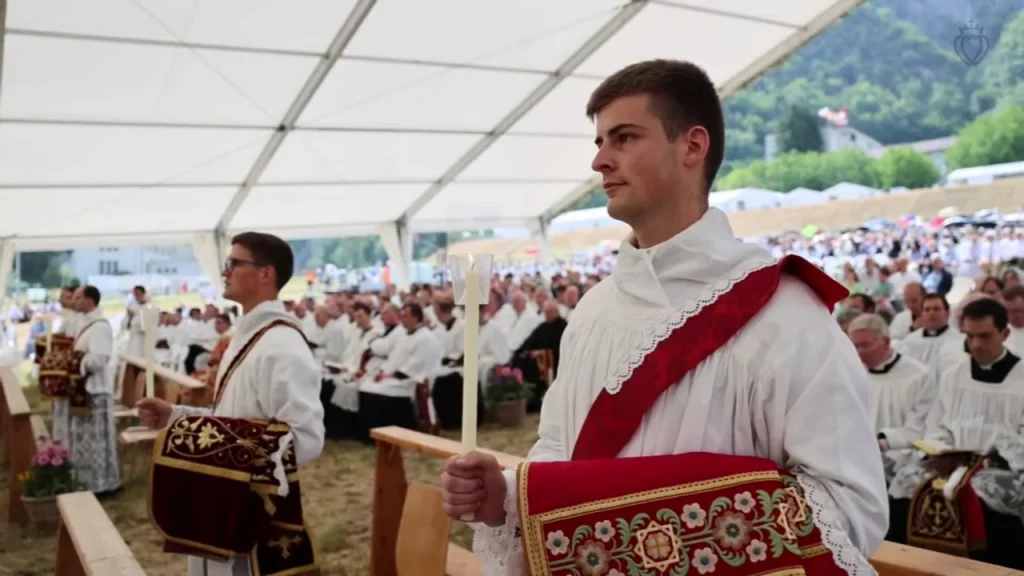
Belgian bishop offers prayers to newly ordained SSPX priest
The Bishop of Liège has offered prayers and encouragement to a newly ordained priest of the Society of Saint Pius X The Bishop of Liège has offered prayers and encouragement to a newly ordained priest of the Society of Saint Pius X (SSPX). In a statement issued after the priestly ordination of Fr Vincent Richter at the SSPX’s International Seminary of Écône in Switzerland on 29 June, the Solemnity of Saints Peter and Paul, Bishop Jean-Pierre Delville of Liège assured the new priest of his prayers and wished him well in the missionary work that now awaits him in Brazil. Fr Richter comes from Steffeshausen, a village within the Diocese of Liège. Although his priestly formation took place within the Society of Saint Pius X rather than under diocesan authority, Bishop Delville chose not to respond with criticism or public condemnation. Instead, his statement expressed personal goodwill towards the new priest, together with a reaffirmation of the Church’s understanding of the origins and present position of the SSPX. The bishop stated that he had been informed of Fr Richter’s ordination in Écône and assured him of his prayers, encouraging him to follow Christ in his future ministry in Brazil. His hope, he said, was that the newly ordained priest would carry out that mission “as an authentic disciple of the Gospel”. While Bishop Delville made no attempt to disguise the reasons for the division, his statement combined pastoral concern for one of his former diocesan faithful with a concise explanation of the theological and ecclesial issues that continue to separate the SSPX from full communion with Rome. The bishop explained that the Society of Saint Pius X brings together Catholics who, following Archbishop Marcel Lefebvre, refused to accept certain decisions of the Second Vatican Council. Importantly, Bishop Delville rejected the suggestion that the council itself abolished the Church’s older liturgical tradition. The declarations of the council, he said, “do not call into question the Latin liturgy in its ancient form”, adding that this was not the cause of the break between Rome and the Society. He also distinguished the SSPX from the Priestly Fraternity of Saint Peter, noting that the latter likewise celebrates the traditional Latin liturgy while fully accepting the teachings of the Second Vatican Council. Bishop Delville observed that Archbishop Lefebvre’s dissent was “not the first in the history of the Church”. Throughout history, he wrote, Catholics have sometimes struggled to understand that fidelity to tradition is not static but living and dynamic. To illustrate that point, the bishop turned to St John Henry Newman, citing the English cardinal’s understanding of the development of doctrine. Newman taught that the Church, “like every living organism, changes in order to remain the same”, while insisting that authentic Christian doctrine does not introduce new revelation but unfolds truths already contained within the deposit of faith. Drawing on Newman’s Essay on the Development of Christian Doctrine , Bishop Delville quoted the saint’s well-known observation that “to live is to change, and to be perfect is to have changed often”. The statement also referred to recent developments within the Society of Saint Pius X itself. Bishop Delville observed that, by ordaining four new bishops on 1 July 2026 without a papal mandate, the fraternity had further deepened what he described as its “dissidence” within the Catholic Church. Yet even in discussing that latest development, the bishop did not advocate isolation. Instead, he insisted that these actions should not prevent Catholics from continuing to seek dialogue with members of the fraternity. “This does not prevent us from seeking dialogue with it,” he wrote, nor from “challenging each other mutually and establishing fraternal relations.”
Jul. 9, 2026