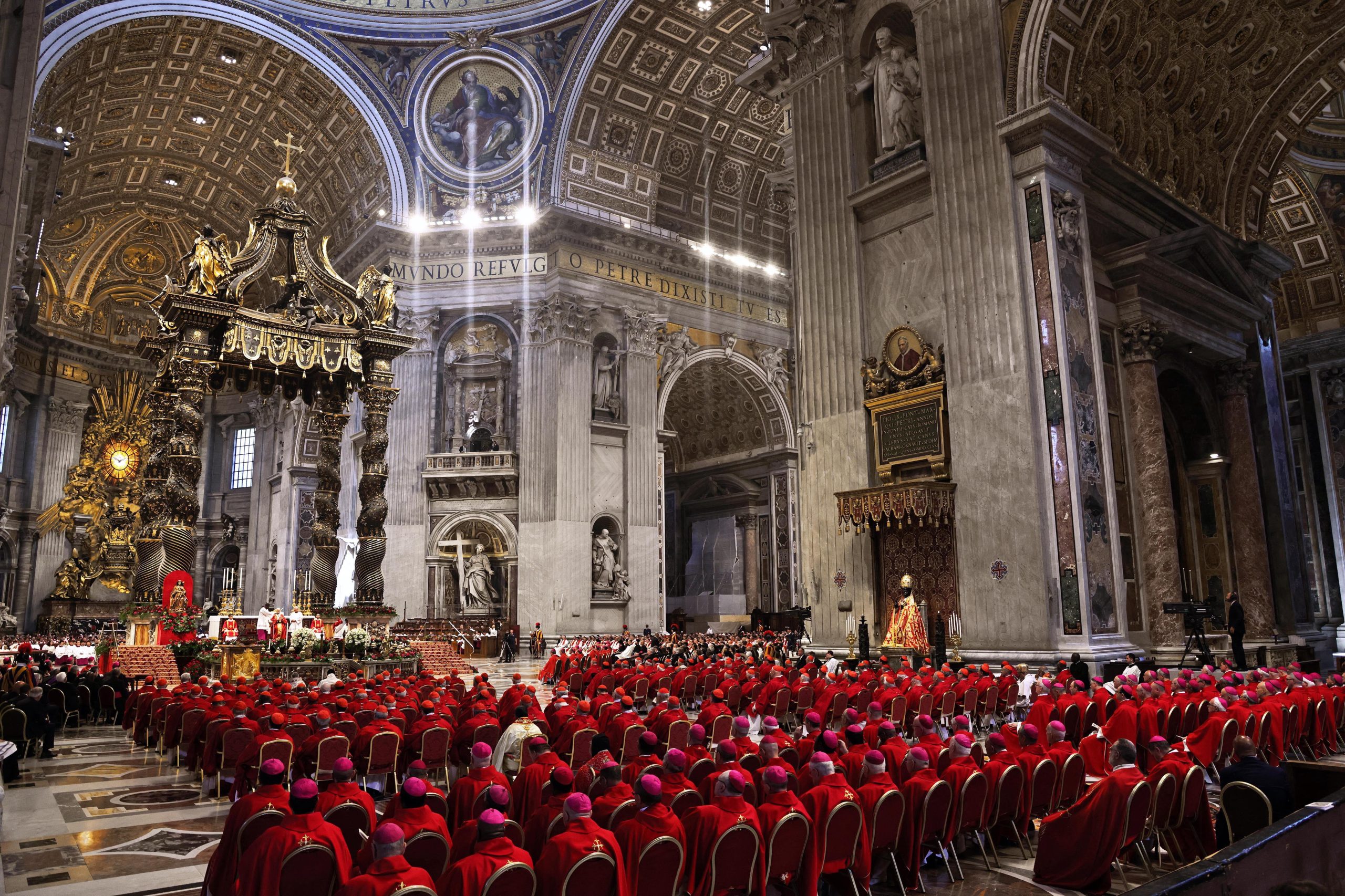
As Pope Leo XIV hands the Metropolitan Archbishops their palliums today, Monday 29 June, in St Peter’s Basilica, this exclusive feature presents the behind-the-scenes, unfiltered reflections of the Church’s Princes regarding the debates that took place during the Extraordinary Consistory on Friday 26 and Saturday 27 June.
Over the past week, AdVaticanum has engaged in in-depth conversations with several members of the College of Cardinals, some speaking on the record and others preferring to speak off the record, both before and after the Consistory. These senior voices offer a rare glimpse into what actually went on and what may yet unfold in the Church.
Compared to Pope Leo XIV’s inaugural Extraordinary Consistory in January, the atmosphere of this Consistory felt distinctly different from the very beginning. The January Consistory began with afternoon sessions. This time, however, the schedule was quietly revised in favour of intensive morning sessions. This change, which meant the first day began with Holy Mass at 7 a.m., required earlier arrivals and a tighter format that limited the usual interactions which had characterised the first Consistory.
Furthermore, the deliberate move away from the more open media engagement of January was immediately noticeable. During the first Consistory, daily press briefings and the occasional comment from a cardinal followed each day’s sessions. This time, however, journalists received only an official summary from the Holy See Press Office, creating the feeling of a media blackout.
This should not have come as a surprise, as Cardinal Giovanni Battista Re’s pre-Consistory letter had already set the tone for the entire gathering. In the letter sent to the College of Cardinals, the Dean, Cardinal Giovanni Battista Re, laid out clear expectations regarding the tone and conduct of the meeting. Under the heading “Confidentiality”, the document stated: “You are asked to maintain confidentiality regarding the proceedings and not to release any statements to the press during the Consistory. A press conference will be held at the end. It is recommended that you do not reveal the attribution of the speakers.”
Multiple cardinals, when contacted privately by several Vatican correspondents, sent almost identical cautious replies even before the Consistory: “We will wait… we can’t comment even after the Consistory… we’ll wait for the press conference.” Inadvertently, this media blackout created an atmosphere of mild tension in which journalists relied on behind-the-scenes conversations and anonymous reflections. Those conversations often carried more weight than the official meditations and statements issued by the Holy See Press Office, precisely because official Vatican channels had been so deliberately constrained.
Beyond the general atmosphere of the June Consistory, attendance was also noteworthy. Of the roughly 241 current members of the College of Cardinals, 178 participated. This marked a modest increase from the approximately 170 cardinals who attended the first Extraordinary Consistory in January. However, overshadowing this was reporting by Il Giornale Vatican correspondent Nico Spuntoni, who revealed that several prominent conservative voices were absent, including Cardinal Joseph Zen of Hong Kong, Cardinal Willem Jacobus Eijk of Utrecht, and Cardinal Péter Erdő of Esztergom-Budapest.
AdVaticanum also has been informed that certain Rome-based cardinals were not in attendance due to advanced age. For example, prominent figures such as Cardinal Stanisław Dziwisz, the longtime secretary to Pope John Paul II, did not attend the Consistory.
While some cardinals who had missed the first Consistory did attend the second, including Cardinal Christoph Schönborn, the Archbishop Emeritus of Vienna, after recovering from a health scare, other prelates, particularly those from regions further from the Vatican, were absent from both Consistories. Examples include Cardinal Leopoldo Brenes of Managua and Cardinal Ignatius Suharyo Hardjoatmodjo of Indonesia.
Prior to the Consistory, many cardinals offered measured and largely positive comments when speaking to AdVaticanum. Italian Cardinal Angelo Bagnasco, for instance, stated: “I am deeply grateful to Pope Leo for the Consistory in January and the one scheduled for June. Convening cardinals from around the world is an expression of the Pope’s pastoral concern.”
The Cardinal Emeritus of Genoa went on to say: “The cardinals’ specialty is to assist the Supreme Pontiff in his lofty task of governance. The Consistory is always an experience of ecclesial communion and a great enrichment: 200 men come from all over the world to pray and reflect with the Pope on selected themes. My hope is that the Holy Father will increasingly sense our fraternal closeness and filial support, both from us and, through us, from the entire Church.”
Papabile Cardinal Maung Bo said he was “really happy to be here” and that he “loved the Pope”, adding that he was thankful the Holy Father had invited them to Rome again “to discuss the real issues”. Cardinal Jean-Claude Hollerich similarly commented that the cardinals, united as the College of the Church, must “protect and represent the Church well in this Consistory.”
Yet this public-facing tone contrasted sharply with the private conversations AdVaticanum had with several cardinals in the days before the sessions began. Before even discussing this Consistory, many of the cardinals who wished to speak first reflected on the January gathering. A few praised it; however, the majority of those I spoke to did not. Speaking about the voting process used to determine the discussion topics, one conservative cardinal said: “There was this votation, but now we have a very wide program, no? This is not only one point, but one theme. And I don’t know how, at the end, it will work.”
However, a few cardinals begged to differ. Cardinal Napier told AdVaticanum that he was quite surprised by the complaints about the synodal-style voting at the discussion tables. “I went there with an open mind, and I thought, I accept—I accepted or expected, maybe even accepted, that everyone was doing the same.
“Pope Leo offered us an opportunity to deal with topics which we had been advised about beforehand, and we had time to prepare which ones we would like to deal with, and just put them in the order of priority that we’d want to deal with them.”
Similarly, a liberal cardinal from South America thought that the topics themselves were not necessarily rooted in the needs of every region: “Yeah, it’s just a question about the main needs for the Church today, but it’s not—it’s not, uh, absolutely strange. We have the great challenges in the world of today. Countries are different.”
Similarly, the conservative cardinal who spoke to AdVaticanum about the voting system later told us: “In Europe, we have these wrong ideas, ideologies, wrong ideas of human existence and essence, and the goal of human existence, the wrong anthropology, LGBT, and the destruction of the family, or of one’s own identity, of the importance of the body.”
Turning to the June Consistory itself, one issue some cardinals believed had been overlooked was the question of the liturgy. “No, but it’s not forbidden to speak about all these questions about the liturgy, because liturgy is in the Catholic faith, and life is the main mission of the Church, the veneration of God, the transmission of grace in the seven sacraments, in the prayers, and in the worship of God.”
However, a liberal cardinal told AdVaticanum: “I don’t think too many of us would have been overcome. Not all of us are upset about those not getting liturgy to the fore.”
Similarly, there was also concern among moderate and conservative cardinals regarding Cardinal Grech’s emphasis on synodality. A European moderate cardinal said: “Until now, he has not been able to give a definition of what synodality is. What can we implement? Synodality is not a revealed reality.”
A former Curial cardinal went further, saying: “It’s only a form of working together of everybody in the Church, but has nothing to do with the Synod of Bishops.”
Cardinal Müller told AdVaticanum before the Consistory: “The Synod of Bishops is a realisation of the collegiality of the bishops, but now when it is opened to laypeople and other priests, it has nothing to do with the synod in the classical sense. There’s no ecclesiastical basis, no?”
He continued: “Like in this working group, I think nine, where they introduced homosexuality as the same form of living together, like a sex matrimony of man and woman, no? And in another working group, they really devised the sacramentality of priesthood, no? And this is a very vile way to change the doctrine, the revealed doctrine of the Church, no? This is manipulation, no?”
However, it is important to note that this Consistory was not viewed by many as a litmus test of Pope Leo. As one conservative cardinal from Africa put it: “He has still not appointed cardinals, but some bishops, but it’s not at the highest level.”
He continued: “But in his homilies, and what he said in Spain, in the Parliament, for example, or the encyclical, it’s a higher level, no? Intellectual level, no? I think he understands it.”
More colourfully, a non-voting cardinal, who insisted that his remarks remain firmly off the record, remarked: “For the stupid people, it’s an invitation to present their stupidities. The past few years it’s been a little bit dangerous to speak out the Catholic truth, which was not wanted, no?”
As these pre-Consistory questions began to be answered, the Consistory itself commenced. AdVaticanum reported extensively on the official proceedings in previous coverage. However, what was said behind closed doors was another story.
Unsurprisingly, the first day was calm and largely uneventful, focusing on the meditative reflections delivered by Cardinal Ryś. One conservative cardinal commented simply: “I think they addressed the subject in a very thoughtful way.” Another moderate cardinal added: “I think it was a good meditation.”
Then came the bombshell intervention from Cardinal Müller. Nico Spuntoni of Il Giornale reported that Cardinal Gerhard Müller used his free intervention to address the SSPX directly. The cardinal called for a clear doctrinal response to the Fraternity’s recent open letter to the Pope and the College of Cardinals, while proposing the establishment of a new Pontifical Commission modelled on the former Ecclesia Dei to facilitate the return to full communion of those affected by the upcoming episcopal consecrations which have no papal mandate.
Prior to Cardinal Müller’s intervention, the German cardinal spoke exclusively to AdVaticanum about what he described as the grave danger of schism posed by the SSPX and the Church’s duty to address it.
“Cardinals cannot neglect this theme, because it’s a system. There’s a great number of, of course, faithful souls. Faithful, and they are going the wrong way,” His Eminence warned.
Cardinal Müller continued: “And the schism is always very bad for the Church. Saint Augustine had all his life questions with the Donatists, and this separation and these divisions was responsible.”
Drawing on historical examples, Müller added: “And later the Church was not able to resist Islam, no? And the Jansenists and the Old Catholics, these schisms, it’s all the type of wound of the Body of Jesus Christ, no?”
Cardinals who defended Cardinal Müller told AdVaticanum that, “Cardinals are not absolutely bound to the thematic.” After the Consistory, Cardinal Müller simply told AdVaticanum that “the best kings were always those who had the best counselors.” AdVaticanum was also told that there was “no verbal resonance” and “no pushback” and that the Pope did not react and remained stoic throughout the intervention.
A former Curial conservative cardinal defended Cardinal Müller, saying: “They were called for interventions, and I mean, at least I and a number of my brother cardinals were, were very concerned that this crisis is going on with regard to the SSPX, and we never addressed it. So I was happy that Cardinal Müller made his intervention.”
However, this isn’t the full story, as many moderate and liberal cardinals also had their grievances. A liberal cardinal told AdVaticanum: “My first thought when I heard him launching out on that was, ‘Here’s a man who’s not actually respecting the agenda, and the Pope has drawn up the agenda, or the other cardinals who’ve come here to discuss the agenda.'”
Even a conservative cardinal said: “He’s going off on a tangent. But I know Müller quite well, so I’m not terribly surprised that he took that angle.” A moderate added: “I must say I’m disappointed that, even at this stage, he was blaming Francis for everything that was going wrong in the Church. Now, already in these early days, it seems he’s pointing to Leo.”
AdVaticanum spoke to a table of cardinals, and one of them told us: “I must honestly say, at our table, most of us said, ‘Oh, there he goes again.’ That would have been the reaction because it’s not on the agenda.”
After this bombshell, there were a few discussions about the liturgy, albeit briefly. From what AdVaticanum understands, concerns were raised about liturgical reverence. One internal conversation between cardinals touched on liturgical abuse, with one saying: “There’s too many—too much freedom in people doing what they feel is right, but not necessarily following what the Church understands of that particular aspect of the liturgy.”
On the second day, things heated up following Cardinal Brislin’s meditation, which was generally praised. However, it was Cardinal Grech’s presentation on synodality that proved most divisive.
Speaking during the final sessions of Pope Leo XIV’s Extraordinary Consistory, Cardinal Grech argued that the Church had reached the point where synodality could no longer be regarded as a temporary initiative or isolated ecclesial project, but as a permanent dimension of Catholic life. Presenting his report on the implementation of the Synod, Cardinal Grech told the assembly that the Church was entering “a new stage in the reception of the Second Vatican Council”, moving beyond the Synod on Synodality itself towards the practical application of its conclusions in dioceses throughout the world. Rather than presenting synodality as a programme with a defined end, he proposed it as a lasting way of exercising ecclesial responsibility through listening, discernment and shared participation.
A conservative cardinal did not hold back, saying: “It was not acceptable. I don’t accept it. That final document is a document of the ordinary magisterium; that is not true. The Pope can only declare the ordinary magisterium on the basis of the doctrine of the deposit of the faith.”
Other interventions included that of Cardinal Rouco, Archbishop Emeritus of Madrid. He explained what synodality was and was not, criticising it by appealing to the ecclesiology of the Second Vatican Council. Summarising his speech, one cardinal said: “He pointed out that there is nothing in the tradition of canon law regarding synodality; yes, there is on synods, but synods were viewed as extraordinary events to seek consultation from the faithful, from the bishops, whoever it may be. But it certainly was never conceived as an essential mark of the Church, or as a way for the Church to conduct her life.”
This paved the way for the free interventions on the final day, when the Consistory reached its most intense point as Cardinal Burke decided to intervene against synodality. In an exclusive account compiled by AdVaticanum from multiple cardinals who listened attentively to his remarks, Cardinal Raymond Leo Burke delivered a substantive free intervention. In particular, addressing the Final Report of Study Group No. 9 concerning theological and methodological criteria for shared discernment on emerging doctrinal, pastoral and ethical questions, Burke focused significant attention on its section dealing with the “experiences of believing homosexual persons”. Numerous cardinals reported that he described the publication as manifesting “the very grave difficulty with the current direction and functioning of the Synod”.
Arguing that, even though it was presented as the work of a study group, its integration into the broader synodal direction gives it weight as part of the official “theological and methodological synodal criteria”.
Numerous sources told us that Cardinal Burke warned that the report, by invoking a so-called “paradigm shift”, takes a path divergent from the Church’s perennial moral teaching on the homosexual condition and corresponding acts. He defended the Courage apostolate, long supported by faithful Catholics seeking to live chastely, as a model pastoral response developed under a holy priest, while criticising the document for slandering such efforts and appearing to validate agendas in “open opposition to the traditional moral doctrine of the Church”.
His Eminence called for restoring the Synod’s proper integrity under the Successor of St Peter, ensuring authentic dialogue remained rooted in divine truth, the objective moral order and the inspirations of the Holy Spirit rather than individual inclinations or worldly ideologies. He concluded by invoking St John Paul II’s Veritatis Splendor in defence of immutable moral norms as a service to true freedom.
According to those familiar with the closed-door proceedings, Cardinal Burke’s intervention resonated strongly and garnered notable support even from several moderate cardinals. While a number of more progressive and Curial cardinals appeared visibly disgruntled, some reacting almost as if inebriated by discomfort at the direct challenge to prevailing synodal directions.
However, there were less contentious interventions as well. Cardinal Wilton Gregory spoke movingly about his forefathers being brought in chains as slaves to the United States, describing it as the “worst memory in the life of mankind that was possible.”
Furthermore, it was confirmed to AdVaticanum by a cardinal that the Traditional Latin Mass (TLM) was raised during a free intervention. The cardinal said: “I do believe that one or two of the cardinals, I think from North America in particular, have commented on how the numbers of young Catholics are coming back to the Eucharist, but coming precisely to those churches where the old liturgy is being celebrated.”
A liberal cardinal corroborated this, saying: “Now, whether it’s the language, I don’t know if it’s in Latin or whether it’s in English, but whether it’s also because the priests are observing the instructions more closely, they are talking about the old liturgy.” Furthermore, Cardinal Goh of Singapore also spoke publicly in defence of the Latin Mass during his intervention, AdVaticanum can reveal.
Looking ahead, attention is already turning to the next Consistory, which is expected to take place next year. After two Extraordinary Consistories, several cardinals indicated that liturgical questions are likely to be the next major subject for discussion, although plans could yet change. While there appeared to be broad appreciation among the cardinals for Pope Leo XIV’s leadership and willingness to foster open discussion, the synodal format remained a point of unease for some participants. Yet the overriding impression was that the atmosphere within the College of Cardinals had shifted. As one cardinal remarked: “I think with a new Pope, everybody feels free, and that’s absolutely clear.”