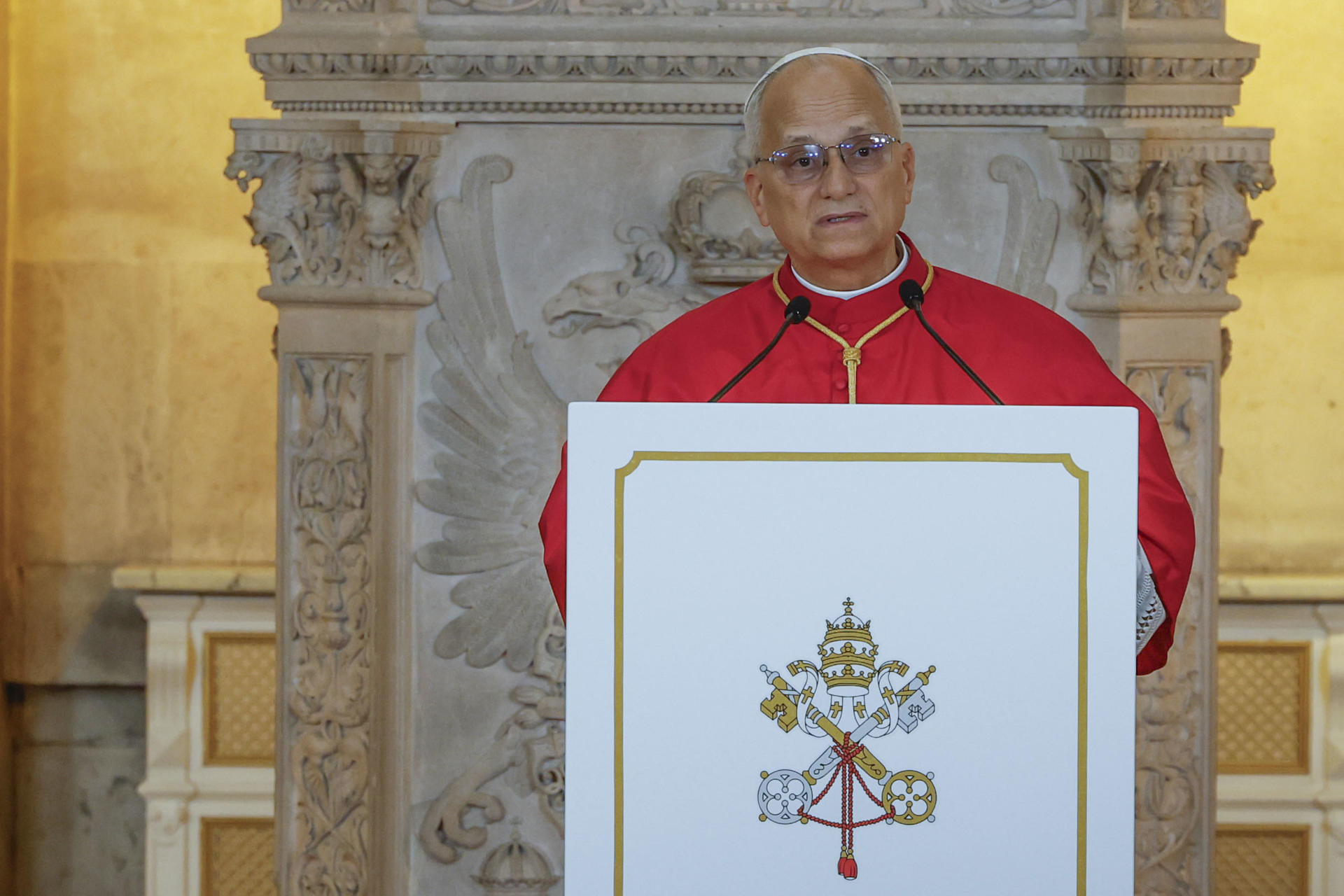
Pope Leo XIV arrived in Madrid on Saturday for the first day of his apostolic journey to Spain, a visit that will focus on evangelisation, youth, social outreach and the enduring Christian identity of one of Europe’s most historic Catholic nations.
The papal aircraft departed Rome at 8am bound for Madrid, with the Holy Father using the flight to speak with journalists travelling with him. One exchange quickly generated attention beyond the religious press when Elise Ann Allen of Crux asked whether he supported Real Madrid or Barcelona.
The Pope responded: “That’s easy… the Pope is for all teams, but Prevost is Real Madrid,” prompting an immediate reaction on social media.
The Pope also reflected on signs of renewed religious interest among younger generations when questioned by CNN’s Christopher Lamb. Noting that Puerto Rican music personality Bad Bunny was performing in Madrid on the same evening, Pope Leo acknowledged the competing attractions facing young people in modern society.
“If they are confronted with the question: do they want to see Bad Bunny or do they want to see the Pope, I think many will see Bad Bunny,” His Holiness said.
Yet the Pope suggested that the growing number of young people exploring Christianity pointed to a deeper spiritual search. Speaking about a generation that has often grown up without a strong religious foundation, he said many were beginning to recognise “an emptiness” and “a lack of a sense of meaning”, adding that his visit might help awaken questions they were still struggling to define.
The Holy Father touched down at Adolfo Suárez Madrid-Barajas Airport at 10.30am, where he was welcomed by Their Majesties King Felipe VI and Queen Letizia of Spain, His Eminence Cardinal José Cobo Cano, Archbishop of Madrid and Prime Minister Pedro Sánchez. Ahead of the arrival, Sánchez had issued a public message welcoming the pontiff to Spain, describing the country as “diverse” and “open” and expressing the hope that the papal visit would help strengthen “dialogue, understanding and hope”.
A Vatican press document distributed to journalists covering the trip, a so-called working booklet prepared by the Dicastery for Communication, included a favourable biographical profile of Socialist Prime Minister Sánchez, crediting him with having “revitalised economic growth and social rights in Spain”. Sánchez’s government has supported abortion and euthanasia legislation, and the working document made no mention of either issue. The Holy See Press Office noted that the publication was intended as a journalistic working tool rather than an official Vatican text.
From the airport, Pope Leo travelled to Madrid’s Royal Palace for the formal welcome ceremony in the Plaza de la Armería. Military honours were rendered and the national anthems of Spain and Vatican City State were performed before the pontiff proceeded to a private audience with King Felipe VI and Queen Letizia. He also met Princess Leonor, Princess of Asturias, and Infanta Sofía, continuing a tradition of cordial relations between the Spanish Crown and the Holy See that stretches back centuries.
The first major speech of the journey followed shortly afterwards during a gathering with political authorities, representatives of civil society and members of the diplomatic corps.
Addressing those assembled in the Royal Palace, Pope Leo said he had come to Spain “to affirm, encourage and instil a renewed fidelity to the Gospel among believers, as well as a deeper reconciliation and collaboration among the various elements of this nation”.
While praising Spain’s commitment to international cooperation, His Holiness also encouraged efforts to strengthen social cohesion within the country. He thanked Spain for its “faithful adherence to international law and multilateralism”, which he said was demonstrated through “an active commitment to peace and solidarity among peoples”.
The Pope’s remarks repeatedly returned to the themes of dialogue, unity and the common good. His Holiness called on Spaniards “to cultivate dialogue and civic friendship within your own country” and urged political and civic leaders to consider the perspectives of the poor and the young when shaping the future.
Referring to tensions that have periodically emerged over questions of regional autonomy and national identity, the Pope encouraged the nation “to harmonise the claims for autonomy and unity”, while also expressing support for European cooperation as a contribution to the wider human family.
Pope Leo also used the address to place his visit within the broader context of Spain’s Christian history. Describing the country as “a great country that, for nearly two millennia, has welcomed the Gospel”, he recalled the ancient tradition linking the evangelisation of the Iberian Peninsula to St James the Greater.
The reference carried particular significance in a nation whose spiritual heritage remains closely connected to the shrine of Santiago de Compostela, one of Christianity’s most important pilgrimage destinations. The Pope noted that the tradition expressed the Spanish Church’s awareness of its continuity with the apostolic mission entrusted to the first disciples of Christ.
After the official ceremonies and meetings in the centre of Madrid, the focus of the papal visit shifted towards the Church’s charitable mission. In the early evening, the Holy Father travelled to the CEDIA 24 Horas centre operated by Cáritas Madrid, a facility dedicated to serving people experiencing homelessness and social exclusion. The centre provides round-the-clock assistance and supported more than 2,500 people during the previous year while receiving dozens of visitors every day.
Before arriving at CEDIA, Pope Leo spent time with a group of around 40 people affected by disability and illness. He was then welcomed at the centre by Cardinal José Cobo Cano, Archbishop of Madrid, together with staff, volunteers and beneficiaries of the project. During the visit, he listened to testimonies from Niurka, a woman originally from Cuba, Khadri, a migrant from Senegal, and Alicia, a volunteer representing the many people involved in the Church’s charitable outreach. Each offered a personal account of hardship, support and renewal before presenting symbolic gifts to the Pope.
Responding to the testimonies, Pope Leo spoke warmly of the welcome he had received since arriving in Spain. Referring to a phrase used by Cardinal Cobo, he noted that “Anyone who is in Madrid is from Madrid” before adding: “And so I, too, am here among you as another Madrilenian.”
Thanking those present for making him feel part of “a large and wonderful family”, he described the centre as a concrete example of Christian fraternity in action.
“In this home, no one remains alone,” he said. “Here, each person’s joy and sorrow are the joy and sorrow of all.”
The Pope said the work carried out at CEDIA reflected Christ’s own identification with the poor, vulnerable and forgotten. Referring to a song performed during the gathering, he highlighted the words, “In every dream I sought you, and none was in vain”, suggesting that they captured both the experiences shared during the visit and the spirit that sustained the centre’s daily mission of service.
The final event of the Pope’s first day in Spain drew vast crowds to Madrid’s Plaza de Lima, where hundreds of thousands of young people gathered for an evening prayer vigil described by organisers as a festival of faith.
Following introductory remarks by Cardinal Cobo on the challenges facing young people in contemporary society, the Pope answered a series of questions posed by youth representatives. Asked about the figures who had most influenced his faith, he cited St John Chrysostom, St Thomas of Villanova and St Turibius of Mogrovejo, praising their commitment to truth, charity and justice. He also reflected on his years as a missionary in Peru, recalling how encounters with communities facing hardship had deepened both his faith and his understanding of the Gospel.
Throughout the encounter, Pope Leo encouraged young Catholics to cultivate prayer, silence and discernment in a noisy and distracted age. He urged them to seek God’s voice with sincerity, remain committed to truth and recognise that both marriage and religious life represent authentic Christian vocations.
The vigil concluded with Eucharistic adoration, bringing to an end a demanding opening day that saw Pope Leo move from the ceremonial grandeur of state occasions to encounters with the poor, the sick and the young.
(Photo credit: : J.J. Guillén/EFE)