

Outside the Walls
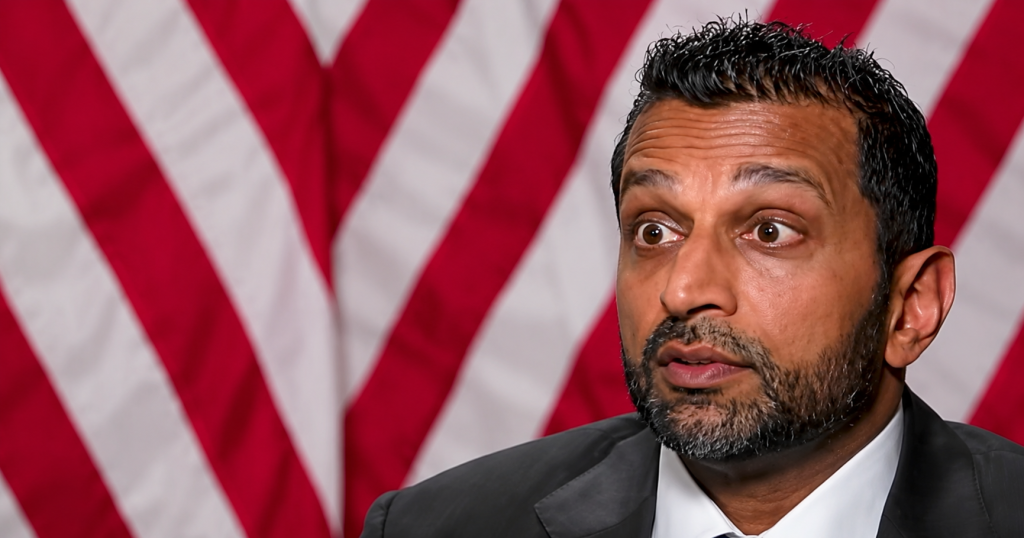
FBI dismisses five employees involved in controversial traditionalist Catholic memo
A controversial FBI memorandum on traditionalist Catholics has claimed more casualties, with five employees now dismissed from the bureau Five FBI employees involved in the production of a controversial memorandum on traditionalist Catholics have been dismissed by the bureau. The employees, reported to include four intelligence analysts and a supervisory analyst, were removed from their positions on 5 June under the leadership of FBI Director Kash Patel. Their lawyer, David Laufman, condemned the dismissals, describing them as “manifestly unjust” and “completely unsupported by the facts”. In a statement, he said: “This action is manifestly unjust, completely unsupported by the facts, and subverts standard FBI policy and procedure.” He added: “These individuals deserved far better for the exceptional and faithful public service they rendered to protect our country.” The firings relate to a January 2023 intelligence memorandum produced by the FBI’s Richmond field office which examined possible links between racially motivated violent extremists and individuals described in the document as “Radical Traditionalist Catholics”. The memorandum emerged from a domestic terrorism investigation involving a Richmond-area individual alleged to have neo-Nazi sympathies who attended traditional Catholic services. The controversy erupted after the memorandum was leaked to the public in February 2023. FBI leadership quickly withdrew the document and distanced itself from its conclusions. Then FBI Director Christopher Wray later told lawmakers he was “aghast” when he learned of the memorandum, while former Attorney General Merrick Garland said he was “appalled” by its contents. The document sought to identify what it described as potential connections between extremist movements and certain fringe traditionalist Catholic circles. It also suggested possible opportunities for intelligence gathering and source development, prompting concerns that practising Catholics could become the subject of inappropriate monitoring. The traditionalist groups referenced included the Society of St Pius X (SSPX) and the Priestly Fraternity of St Peter (FSSP). The memo explicitly noted SSPX-affiliated chapels in the Richmond area of responsibility (AOR) and an FSSP parish there as potential points of contact or locations for monitoring RMVE (Racially Motivated Violent Extremists) activity. Specific cases cited in the memo involved RMVEs attending SSPX-linked churches. One involved a Virginia man, later arrested with Molotov cocktails and other materials, who attended an SSPX chapel for about seven months, described himself as a “radical traditional Catholic clerical fascist”, and expressed neo-Nazi views. Another referenced individuals in California and elsewhere gravitating towards SSPX communities. An internal FBI review subsequently concluded that the memorandum failed to meet required analytical standards. According to findings later provided to Congress, officials involved in the drafting, review and approval of the document failed to provide sufficient evidence to support some of its conclusions and created the appearance that the bureau was conducting investigative activity on the basis of religious affiliation. The review stated: “One of the FBI’s most fundamental principles is that investigative activity may not be based solely on the exercise of rights guaranteed by the First Amendment.” Investigators found shortcomings in the analytical process but did not conclude that those responsible had acted with deliberate misconduct. Particular concern focused on the memorandum’s use of material from outside organisations that had categorised some traditionalist Catholic groups as extremist. At the time, Cardinal Timothy Dolan of New York, speaking on behalf of the United States Conference of Catholic Bishops, described the document as “troubling and offensive” and criticised what he called “religious profiling”. His Eminence also questioned the sources relied upon by the FBI while reaffirming the Church’s opposition to racism, hatred and violence. The fallout from the memorandum continued long after its withdrawal as congressional investigations, whistleblower disclosures and Freedom of Information Act litigation brought further details into the public domain. Subsequent disclosures by the House Judiciary Committee and Senator Chuck Grassley indicated that the document had circulated more widely within the FBI than initially understood. According to records released by congressional investigators, the memorandum was distributed to more than 1,000 FBI personnel before being withdrawn. The same disclosures indicated that officials discussed outreach to Catholic parishes and diocesan leaders as part of efforts to identify potential indicators of extremist activity.
Jun. 8, 2026
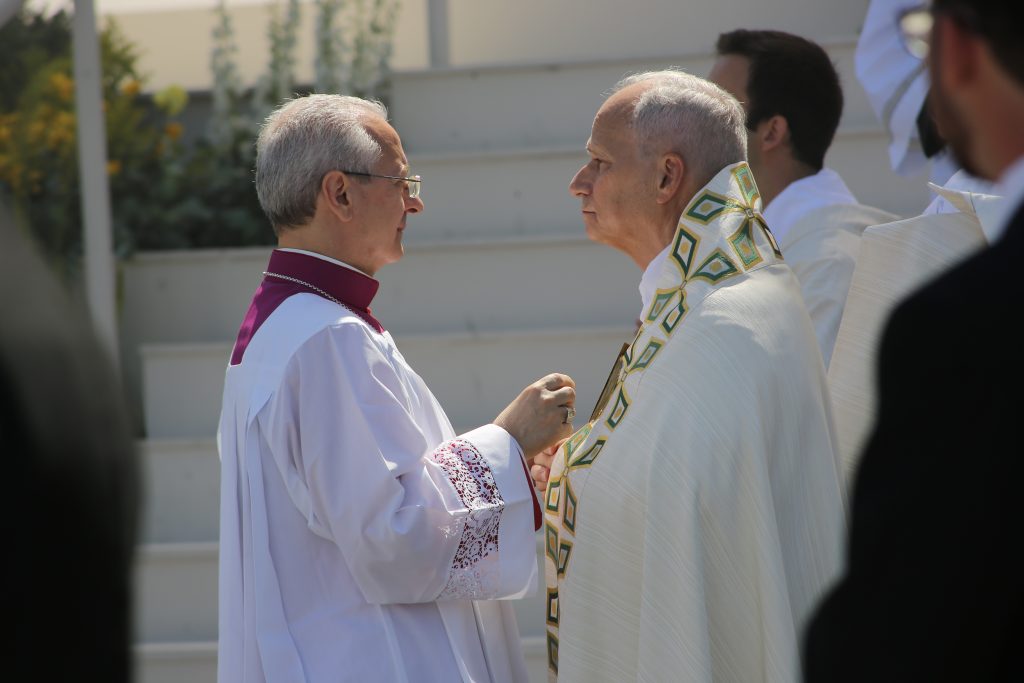
Day two of Pope Leo XIV’s visit to Spain sees one of Europe’s largest Catholic gatherings outside World Youth Day
An estimated 1.5 million people gathered in Madrid for Pope Leo XIV’s Corpus Christi Mass and procession on the second day of his apostolic visit to Spain. The crowd surpassed that of Saint John Paul II’s 2003 visit to Madrid and ranks among the largest Catholic gatherings in Europe outside World Youth Day Pope Leo’s second day of his apostolic visit to Spain began with Holy Mass for the feast of Corpus Christi. This year, Corpus Christi fell on Thursday 4 June. However, Spain, like many other countries, now transfers the solemnity to the following Sunday. Mass was celebrated in Plaza de Cibeles in central Madrid, with an estimated 1.5 million people in attendance. Earlier estimates had placed the number at 1.2 million, but as the day progressed a clearer picture emerged and the figures rose. The number is staggering. Indeed, excluding Saint John Paul II’s dramatic returns to Kraków during the Communist era, it might have been the largest European gatherings of Catholics outside a World Youth Day. By comparison, Pope John Paul II’s Mass in Ireland on 29 September 1979 attracted an estimated 1.25 million people. When he celebrated Mass in Madrid in 2003, around one million attended. Even accounting for Spain’s population growth since 2003, the figure represents a substantially larger proportion of the Spanish public coming out to see the Pope. The increase is in line with an apparent resurgence in Catholic identity in the country. A recent survey found that 45 per cent of Spaniards aged 15 to 29 identify as Catholic today, compared with 31.6 per cent in 2020. Spaniards often speak of there being “two Spains”. One is the conservative, Catholic Spain that takes pride in its saints, traditions and culture. The other seeks to sever those connections in the name of progressivism. It appears that, despite being governed by a socialist administration, the former remains vibrant. Panis Angelicus, music from the Taizé Community and the Tantum Ergo, Pange Lingua and Salve Regina all featured in a varied but traditionally inclined programme of liturgical music. Perhaps most notable for those looking for signs of tradition was the choir’s rendition of Verbum Supernum Prodiens, written by Saint Thomas Aquinas for the feast of Corpus Christi. Among the faithful were hundreds of children who had made their First Holy Communion this year and who, after Mass, took part in the Corpus Christi Eucharistic procession. There were also more than 150 bishops and some 1,600 priests in attendance. Their Majesties King Felipe VI and Queen Letizia of Spain, accompanied by Princess Leonor and Infanta Sofía, also attended the Mass. During his homily, Pope Leo XIV urged Spain’s Catholics not to allow their faith to become “a museum of the past”, but to remain a living source of charity, service and evangelisation. Reflecting on the Eucharist and Spain’s Catholic heritage, the Holy Father called on the faithful to become “builders of a new world” and to carry Christ’s presence into society, particularly through care for the poor, the suffering and those who have lost hope. For the Corpus Christi procession, a Galician artistic tradition was brought to Madrid, with more than 30,000 carnations transforming the city centre. This was made possible by the Asociación de Alfombristas del Corpus Christi de Ponteareas (Association of Corpus Christi Carpet Makers of Ponteareas). The decorations, known as floral carpets, covered more than 500 metres of Calle de Alcalá, one of Madrid’s longest streets. After the procession, the Holy Father took a short break from what has already been an exceptionally busy visit and held a private meeting with members of the Augustinian Order at the Apostolic Nunciature. As an Augustinian himself, Pope Leo has long been accustomed to community life and makes a point of visiting his religious brothers during his travels. Spain has historically had one of the largest Augustinian communities in the world, and Spanish Augustinians played a major role in the evangelisation of the Philippines, Latin America and parts of Africa. At 6pm, the Pope met representatives from the worlds of art, culture, business, labour and academia at Madrid’s Movistar Arena. The event, entitled “Weaving Networks with the Worlds of Culture, Art, the Economy and Sport”, aimed to encourage institutions and individuals to work together in taking responsibility for the human person amid rapid technological change. The gathering also highlighted Spain’s rich cultural heritage, with flamenco and classical guitar performances. Among those in attendance was the actor Antonio Banderas, who told the Pope he was “a victim of God’s spell” and described Jesus Christ as “the main protagonist of the movie of life”. Much like other events during the papal visit, the gathering placed considerable emphasis on Spain’s cultural heritage and its Catholic roots, bringing those traditions into public life. This theme was echoed in the words of the Holy Father, who asked those present: “What is it that we are sowing today, what exactly is flourishing and what is silently withering in our society; what values are we preserving and which are we allowing to die?” At the end of his second day, the papal visit appears to have so far been an outstanding success. Alongside the record attendance, another notable feature has been the absence of significant counter-protests. When Pope Benedict XVI visited Madrid for World Youth Day in 2011, there were loud and at times violent street protests demanding that his visit should not be funded by the state. Their absence is another indication that Catholicism in Spain is currently experiencing a period of renewed confidence.
Jun. 8, 2026
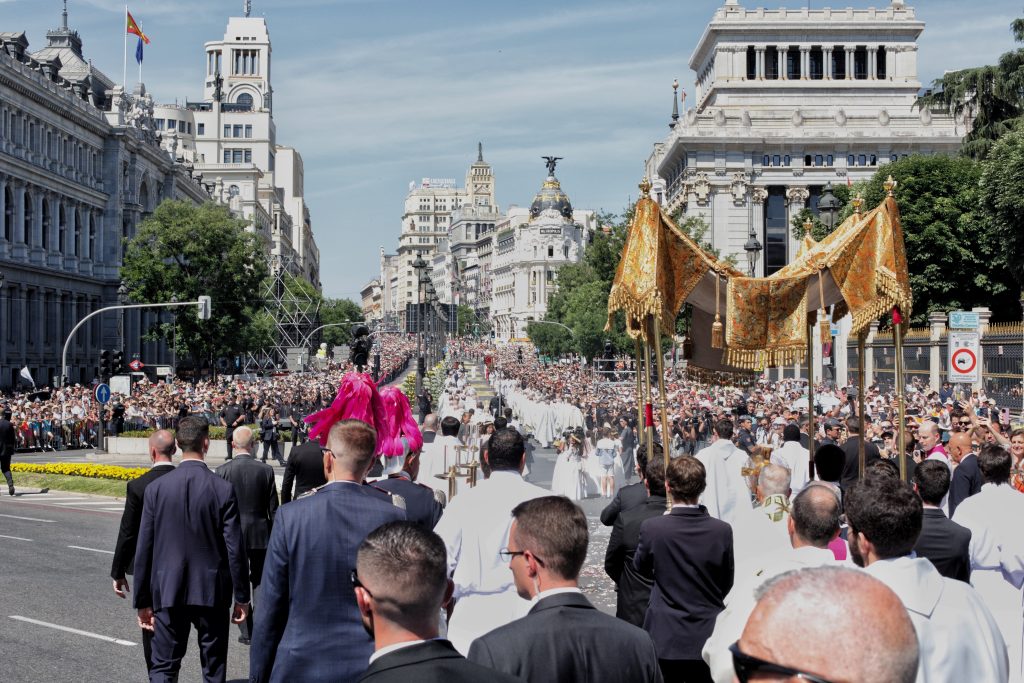
In pictures: Pope Leo XIV’s second day in Spain
Pope Leo XIV celebrated Corpus Christi before 1.2 million faithful in Madrid, led a Eucharistic procession through streets lined with 30,000 carnations, and met representatives of Spanish civil society. Here is day two of the Holy Father’s apostolic visit to Spain in pictures On the second day of his apostolic visit to Spain, Pope Leo XIV celebrated a Corpus Christi Mass before 1.2 million faithful gathered in Plaza de Cibeles in the heart of Madrid. Following the Mass, the Holy Father led a Eucharistic procession through the city centre, passing over elaborate floral carpets created from more than 30,000 carnations. Later, Pope Leo met representatives of Spanish civil society at Madrid’s Movistar Arena, where he addressed figures from the worlds of culture, business, education and charitable work, speaking about the importance of faith, human dignity and service to the common good in contemporary society. 1.2 million gather in Plaza de Cibeles, Madrid, for Holy Mass celebrated by Pope Leo XIV on the second day of his apostolic visit to Spain. (Photo credit: Luismagan) Among the faithful were hundreds of children who had made their First Holy Communion this year. After Mass, the children took part in the Corpus Christi Eucharistic procession. (Photo credit: Luismagan) Some 1,600 priests attend the Mass, many of whom distributed Holy Communion. (Photo credit: Luismagan) Pope Leo XIV delivers his homily during the Corpus Christi Mass in Madrid, where he called on Catholics to renew their faith in the Eucharist and become “builders of a new world” rooted in charity, hope and the Christian heritage of Spain.(Photo credit: Luismagan) Their Majesties King Felipe VI and Queen Letizia of Spain, accompanied by Princess Leonor and Infanta Sofía, attend the Corpus Christi Mass celebrated by Pope Leo XIV in Madrid. (Photo credit: EUROPA PRESS – JESÚS HELLÍN) A volunteer distributes water to pilgrims gathered for the Corpus Christi Mass celebrated by Pope Leo XIV in Madrid, where temperatures exceeded 30°C during the outdoor liturgy. (Photo credit: Gabriel Gonzalez-Andrío) More than 30,000 carnations transform the centre of Madrid as Pope Leo XIV led a Corpus Christi procession. The decoration was made possible by The Asociación de Alfombristas del Corpus Christi de Ponteareas (Association of Corpus Christi Carpet Makers of Ponteareas). (Photo credit: Marcos Nogales) The Blessed Sacrament is carried through the streets of Madrid. ( Photo credit: Luismagan ) Religious men and women arrive at Madrid’s Movistar Arena for Pope Leo XIV’s meeting with representatives of culture, art, business, labour and academia. (Photo credit: Marcos Nogales ) Flamenco dancers perform during Pope Leo XIV’s meeting with representatives of Spanish civil society at Madrid’s Movistar Arena. (Photo credit: Gabriel Gonzalez-Andrío) Pope Leo XIV imparts the final blessing at the conclusion of his meeting with representatives of Spanish civil society at Madrid’s Movistar Arena, accompanied by his personal secretary, Monsignor Edgard Iván Rimaycuna Inga, and Cardinal José Cobo Cano, Archbishop of Madrid. (Photo credit: Gabriel Gonzalez-Andrío) Feature image: Miguel Caireta Serra
Jun. 7, 2026
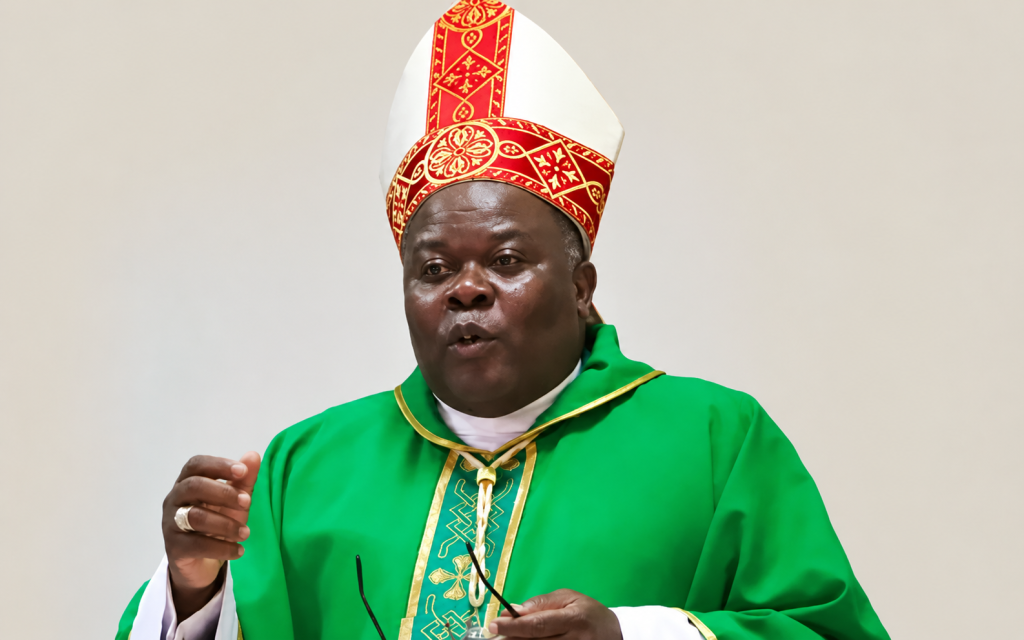
Bishop Citora Afonso shot dead in Mozambique
Bishop Citora Afonso, Bishop of Quelimane and Apostolic Administrator of Beira, has been found dead after being shot at his episcopal residence in Mozambique. Authorities have opened an investigation into the killing Bishop Citora Afonso, Bishop of Quelimane and Apostolic Administrator of Beira in Mozambique, was found dead on the morning of 6 June at his episcopal residence in Quelimane, having been fatally shot in the chest. He was 54. Fides News Agency reported that Mozambique’s National Criminal Investigation Service has opened an investigation, with no details or lines of enquiry regarding who is responsible having been released. A memorial Mass was celebrated on 6 June 2026 at 6pm at the Parish of Our Lady of Liberation, Quelimane Cathedral. Bishop Citora Afonso was the fourth bishop of the Diocese of Quelimane, established in 1954 under the patronage of Our Lady of Liberation. Born on 6 May 1972 in Ribaue, in the Diocese of Nampula, Bishop Afonso studied at the Christ the King Preparatory Seminary and Saint Augustine Major Seminary in Matola before undertaking theological studies at the Saint-Eugène de Mazenod Institute in Kinshasa, Democratic Republic of the Congo. While at seminary, he became a member of the Consolata Missionaries, taking perpetual vows on 17 June 2001 and being ordained a priest on 3 November 2002. His ministry saw him undertake further studies at the Hebrew University of Jerusalem, the École Biblique et Archéologique Française and obtain a licentiate in Sacred Scripture from the Pontifical Biblical Institute. He also held various leadership positions in the Democratic Republic of the Congo and Italy before being appointed an official of the Dicastery for Evangelization in 2017. On 21 September 2023, Pope Francis appointed him Auxiliary Bishop of the Archdiocese of Maputo. On 25 July 2025, Pope Leo XIV transferred him to the Diocese of Quelimane and appointed him diocesan bishop there. Since August 2025, he had served as secretary of the Episcopal Conference of Mozambique and, in April 2026, he was appointed by Pope Leo XIV as Apostolic Administrator of the Archdiocese of Beira. Commenting on the murder, Daniel Francisco Chapo stated that “the death of Bishop Osório represents an irreparable loss for Mozambican society and for the Christian community”, highlighting the bishop’s witness of humility, pastoral dedication and commitment to promoting the values of peace and reconciliation. The President of the Episcopal Conference of Mozambique, Inácio Saúre, said that Bishop Afonso “was found dead under unusual circumstances that are still to be clarified”. The archbishop also appealed for calm, saying: “At this very troubled moment, I appeal for serenity in faith and fraternal solidarity, in the hope that we will be able, in due course, to provide accurate and detailed information regarding this sad event.” While the motives behind the murder are unknown, Bishop Afonso was an outspoken critic of the Islamist insurgency in northern Mozambique, particularly in Cabo Delgado Province. Speaking to Fides News Agency, he said: “The situation seems out of control. The attacks continue, always in the same areas, and the population is terrified.”
Jun. 7, 2026
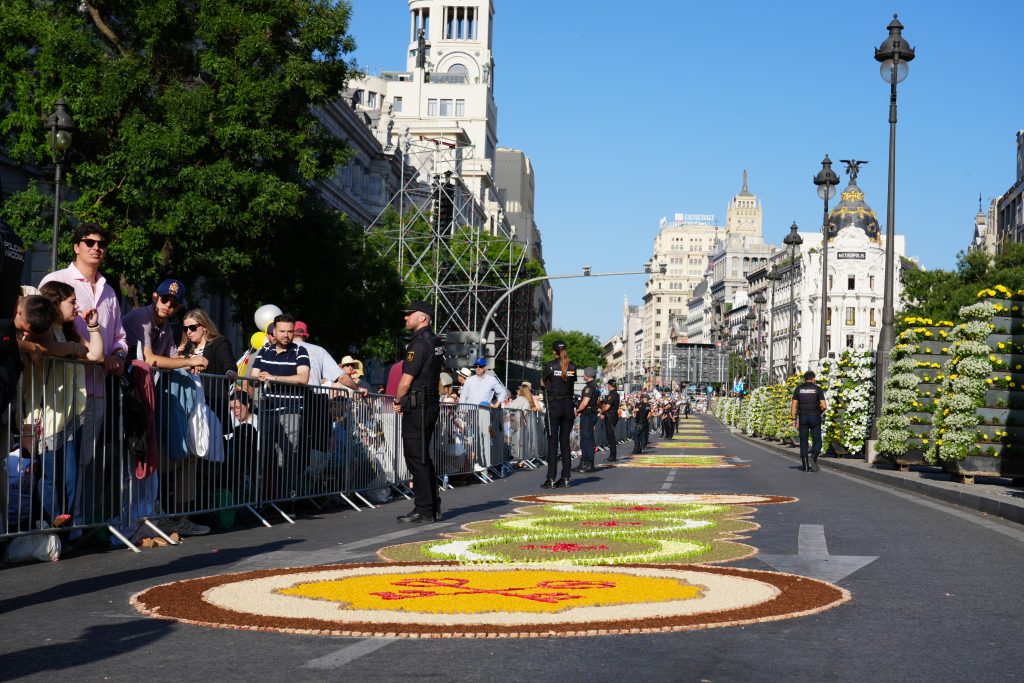
30,000 carnations line Madrid streets for Pope Leo XIV’s Corpus Christi procession
More than 30,000 carnations transformed the centre of Madrid as Pope Leo XIV led a Corpus Christi procession attended by an estimated 1.2 million people More than 30,000 carnations filled the centre of Madrid for the Corpus Christi procession led by the Holy Father during his apostolic visit to Spain. The Asociación de Alfombristas del Corpus Christi de Ponteareas (Association of Corpus Christi Carpet Makers of Ponteareas) was responsible for bringing the floral display to the Spanish capital. Located in the south of the province of Pontevedra, Ponteareas is internationally recognised for its Corpus Christi celebrations, a tradition that residents have maintained for more than 200 years by creating spectacular carpets made from flowers and natural plant materials for the procession of the Blessed Sacrament. This form of ephemeral floral art is considered one of the most important expressions of Galician cultural heritage. The celebration has been declared a Festival of International Tourist Interest and, in April 2024, was granted Cultural Interest status by the Xunta de Galicia. The decorations, known as floral carpets, covered more than 500 metres of Calle de Alcalá, one of Madrid’s longest streets. Miguel Ángel García of the Association of Corpus Christi Carpet Makers of Ponteareas explained: “The carpets of Ponteareas are much more than an artistic expression; they are a manifestation of faith passed down from generation to generation. The carpets are made in honour of the Blessed Sacrament. That this tradition can form part of the Corpus Christi celebrations in Madrid, coinciding with the visit of Pope Leo XIV, is a recognition of the work of hundreds of people who, for more than two hundred years, have kept this heritage alive.” Twenty-four carpet makers from Ponteareas worked alongside more than 160 volunteers to create the artwork in honour of the Blessed Sacrament. Accompanied by other clergy, including Cardinal Pietro Parolin, as well as children who made their First Holy Communion this year, the Pope processed from Plaza de Cibeles along Calle de Alcalá towards Gran Vía and the Church of San José before returning to Cibeles. An estimated 1.2 million people attended, a substantial crowd and around 20 per cent more than the number reported to have welcomed Saint John Paul II during his 2003 visit. Photo credit: Marcos Nogales
Jun. 7, 2026
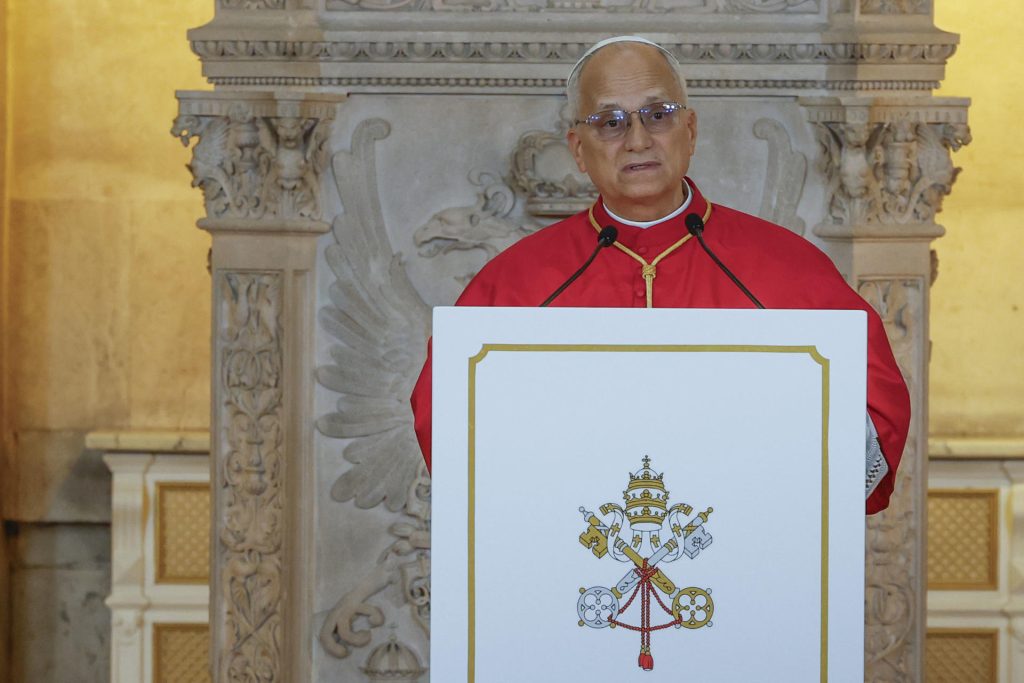
Day one of Pope Leo XIV’s apostolic journey to Spain
The Holy Father arrived in Madrid, met the Spanish Royal Family, called for unity and dialogue, visited a Catholic centre serving the homeless, and concluded the day with a youth prayer vigil attended by hundreds of thousands of people Pope Leo XIV arrived in Madrid on Saturday for the first day of his apostolic journey to Spain, a visit that will focus on evangelisation, youth, social outreach and the enduring Christian identity of one of Europe’s most historic Catholic nations. The papal aircraft departed Rome at 8am bound for Madrid, with the Holy Father using the flight to speak with journalists travelling with him. One exchange quickly generated attention beyond the religious press when Elise Ann Allen of Crux asked whether he supported Real Madrid or Barcelona. The Pope responded: “That’s easy… the Pope is for all teams, but Prevost is Real Madrid,” prompting an immediate reaction on social media. The Pope also reflected on signs of renewed religious interest among younger generations when questioned by CNN’s Christopher Lamb. Noting that Puerto Rican music personality Bad Bunny was performing in Madrid on the same evening, Pope Leo acknowledged the competing attractions facing young people in modern society. “If they are confronted with the question: do they want to see Bad Bunny or do they want to see the Pope, I think many will see Bad Bunny,” His Holiness said. Yet the Pope suggested that the growing number of young people exploring Christianity pointed to a deeper spiritual search. Speaking about a generation that has often grown up without a strong religious foundation, he said many were beginning to recognise “an emptiness” and “a lack of a sense of meaning”, adding that his visit might help awaken questions they were still struggling to define. The Holy Father touched down at Adolfo Suárez Madrid-Barajas Airport at 10.30am, where he was welcomed by Their Majesties King Felipe VI and Queen Letizia of Spain, His Eminence Cardinal José Cobo Cano, Archbishop of Madrid and Prime Minister Pedro Sánchez. Ahead of the arrival, Sánchez had issued a public message welcoming the pontiff to Spain, describing the country as “diverse” and “open” and expressing the hope that the papal visit would help strengthen “dialogue, understanding and hope”. A Vatican press document distributed to journalists covering the trip, a so-called working booklet prepared by the Dicastery for Communication, included a favourable biographical profile of Socialist Prime Minister Sánchez, crediting him with having “revitalised economic growth and social rights in Spain”. Sánchez’s government has supported abortion and euthanasia legislation, and the working document made no mention of either issue. The Holy See Press Office noted that the publication was intended as a journalistic working tool rather than an official Vatican text. From the airport, Pope Leo travelled to Madrid’s Royal Palace for the formal welcome ceremony in the Plaza de la Armería. Military honours were rendered and the national anthems of Spain and Vatican City State were performed before the pontiff proceeded to a private audience with King Felipe VI and Queen Letizia. He also met Princess Leonor, Princess of Asturias, and Infanta Sofía, continuing a tradition of cordial relations between the Spanish Crown and the Holy See that stretches back centuries. The first major speech of the journey followed shortly afterwards during a gathering with political authorities, representatives of civil society and members of the diplomatic corps. Addressing those assembled in the Royal Palace, Pope Leo said he had come to Spain “to affirm, encourage and instil a renewed fidelity to the Gospel among believers, as well as a deeper reconciliation and collaboration among the various elements of this nation”. While praising Spain’s commitment to international cooperation, His Holiness also encouraged efforts to strengthen social cohesion within the country. He thanked Spain for its “faithful adherence to international law and multilateralism”, which he said was demonstrated through “an active commitment to peace and solidarity among peoples”. The Pope’s remarks repeatedly returned to the themes of dialogue, unity and the common good. His Holiness called on Spaniards “to cultivate dialogue and civic friendship within your own country” and urged political and civic leaders to consider the perspectives of the poor and the young when shaping the future. Referring to tensions that have periodically emerged over questions of regional autonomy and national identity, the Pope encouraged the nation “to harmonise the claims for autonomy and unity”, while also expressing support for European cooperation as a contribution to the wider human family. Pope Leo also used the address to place his visit within the broader context of Spain’s Christian history. Describing the country as “a great country that, for nearly two millennia, has welcomed the Gospel”, he recalled the ancient tradition linking the evangelisation of the Iberian Peninsula to St James the Greater. The reference carried particular significance in a nation whose spiritual heritage remains closely connected to the shrine of Santiago de Compostela, one of Christianity’s most important pilgrimage destinations. The Pope noted that the tradition expressed the Spanish Church’s awareness of its continuity with the apostolic mission entrusted to the first disciples of Christ. After the official ceremonies and meetings in the centre of Madrid, the focus of the papal visit shifted towards the Church’s charitable mission. In the early evening, the Holy Father travelled to the CEDIA 24 Horas centre operated by Cáritas Madrid, a facility dedicated to serving people experiencing homelessness and social exclusion. The centre provides round-the-clock assistance and supported more than 2,500 people during the previous year while receiving dozens of visitors every day. Before arriving at CEDIA, Pope Leo spent time with a group of around 40 people affected by disability and illness. He was then welcomed at the centre by Cardinal José Cobo Cano, Archbishop of Madrid, together with staff, volunteers and beneficiaries of the project. During the visit, he listened to testimonies from Niurka, a woman originally from Cuba, Khadri, a migrant from Senegal, and Alicia, a volunteer representing the many people involved in the Church’s charitable outreach. Each offered a personal account of hardship, support and renewal before presenting symbolic gifts to the Pope. Responding to the testimonies, Pope Leo spoke warmly of the welcome he had received since arriving in Spain. Referring to a phrase used by Cardinal Cobo, he noted that “Anyone who is in Madrid is from Madrid” before adding: “And so I, too, am here among you as another Madrilenian.” Thanking those present for making him feel part of “a large and wonderful family”, he described the centre as a concrete example of Christian fraternity in action. “In this home, no one remains alone,” he said. “Here, each person’s joy and sorrow are the joy and sorrow of all.” The Pope said the work carried out at CEDIA reflected Christ’s own identification with the poor, vulnerable and forgotten. Referring to a song performed during the gathering, he highlighted the words, “In every dream I sought you, and none was in vain”, suggesting that they captured both the experiences shared during the visit and the spirit that sustained the centre’s daily mission of service. The final event of the Pope’s first day in Spain drew vast crowds to Madrid’s Plaza de Lima, where hundreds of thousands of young people gathered for an evening prayer vigil described by organisers as a festival of faith. Following introductory remarks by Cardinal Cobo on the challenges facing young people in contemporary society, the Pope answered a series of questions posed by youth representatives. Asked about the figures who had most influenced his faith, he cited St John Chrysostom, St Thomas of Villanova and St Turibius of Mogrovejo, praising their commitment to truth, charity and justice. He also reflected on his years as a missionary in Peru, recalling how encounters with communities facing hardship had deepened both his faith and his understanding of the Gospel. Throughout the encounter, Pope Leo encouraged young Catholics to cultivate prayer, silence and discernment in a noisy and distracted age. He urged them to seek God’s voice with sincerity, remain committed to truth and recognise that both marriage and religious life represent authentic Christian vocations. The vigil concluded with Eucharistic adoration, bringing to an end a demanding opening day that saw Pope Leo move from the ceremonial grandeur of state occasions to encounters with the poor, the sick and the young. (Photo credit: : J.J. Guillén/EFE)
Jun. 6, 2026