

Latest
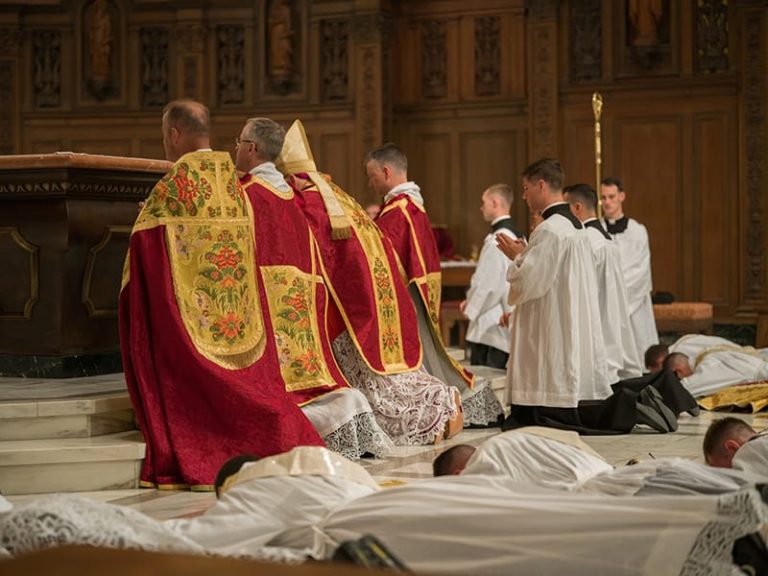
Archbishop Wenski ordains 12 priests for the FSSP
Twelve men have been ordained to the priesthood for the Priestly Fraternity of St Peter in Omaha, Nebraska. Archbishop Thomas Wenski told the new priests that they are called not to “burn out”, but to “burn yourself up” in the service of Christ and His Church Twelve men have been ordained to the priesthood for the Priestly Fraternity of St Peter in one of the larger ordination ceremonies for the fraternity in the United States. Archbishop Thomas Wenski of Miami ordained the men at St Cecilia Cathedral in Omaha, Nebraska, on 28 May before a congregation that included relatives, clergy and faithful from across the United States. The new priests are Fathers Andrew Daniels, Curtis Zuckerman, Shane Conlon, Marshall Harmon, Conán McGonagle, David Carte, Joseph Falciano, Anthony Ike, Daniel Kreilein, Daniel Mellino, Lai Nguyen and Peter O’Connor. Several of the newly ordained priests were already known to Archbishop Wenski in south Florida through their service at Miami’s Holy Face of Jesus Latin Mass Chaplaincy during Holy Week and feast days. In his homily, Archbishop Wenski thanked the families, friends and formators who had helped the candidates discern and pursue their vocations before expressing gratitude for what he described as the “yes” offered by the ordinands to God. “We thank God for the ‘yes’ given to God by these young men so generously and uncompromisingly today,” he said, adding that through the laying on of hands they would be “configured to Christ the eternal High Priest” and become “sharers in the very mission of Christ”. The archbishop reminded the new priests that their vocation would inevitably involve sacrifice. Recalling advice given by the mother of St John Bosco on the day of the saint’s ordination, he said priesthood meant not only drawing closer to Christ but also sharing in His sufferings. Quoting the saint’s mother, Archbishop Wenski said: “Giovanni, today you are a priest. You will begin saying Mass, so from henceforth, you will be closer to Jesus. Remember that to begin to celebrate Mass also means to begin to suffer.” The Archbishop of Miami told the ordinands that priests today minister in a culture of secularisation and indifference to religion, observing that “many have lost the sense of the transcendent”. “In such a world, the Church will always seem ‘out of step’ and irrelevant,” Archbishop Wenski said. “Such a Church will often be regarded, if not with scorn and ridicule, then with utter incomprehension.” At the same time, the archbishop reminded the new priests that their vocation was not to be lived in isolation from society. “Though we do not belong to the world, we are ‘in’ the world ‘for the life of the world’,” His Grace said. “We are not men ‘out for ourselves’ but men for others.” Archbishop Wenski also urged the new priests to exercise their ministry with charity and patience, drawing on the teaching of St Pius X, whose pontificate was dedicated to the restoration of all things in Christ. Referring to the saint’s first encyclical, E Supremi , the archbishop quoted St Pius X’s warning that “it is vain to hope to attract souls to God by a bitter zeal”, adding that excessive harshness often caused more harm than good. “A ‘bitter zeal’, rather than witnessing to the Truth, will undermine it,” Archbishop Wenski said. “And instead of restoring all things to Christ, who prayed that all his followers be one, bitter zeal will fracture the unity of His Body, the Church.” The archbishop encouraged the priests to remain close to those entrusted to their care, especially the poor, the sick and those struggling in their faith. “Do not shun the excluded or sinners but help them to turn, to convert, and return to the right path,” Archbishop Wenski said. “With simplicity and generosity, be close to the sick and the poor.” The archbishop also stressed the importance of the sacrament of penance, encouraging the newly ordained priests to make themselves readily available for confessions while regularly approaching the sacrament themselves. “I ask you to be generous with your time, making yourself readily available to hear the confessions of the people,” Archbishop Wenski said. “The Mercy of God is always greater than their — or our own — weakness and unworthiness.” Concluding his homily, Archbishop Wenski urged the priests to embrace the demands of their vocation with generosity while avoiding discouragement. “No one wants you to burn out — a candle that burns out leaves a sooty mess. A burned-out priest is a mess too,” he said. “But you are expected to work hard: you are not to burn out, but you are supposed to burn yourself up, to consume yourself in the service of Christ and His Church.” The newly ordained priests completed their formation at Our Lady of Guadalupe Seminary in Denton, Nebraska, the North American seminary of the FSSP. Founded in 2000, the seminary prepares candidates for the priesthood through studies in philosophy and theology alongside formation rooted in the traditional liturgical life of the Church. Established in 1988, the Priestly Fraternity of St Peter was founded by priests and seminarians who sought to preserve the Church’s traditional liturgical patrimony while remaining in full communion with Rome. According to the 2024 Annuario Pontificio , the fraternity had 567 members, including 375 priests, serving in 139 houses and apostolates around the world.
Jun. 10, 2026
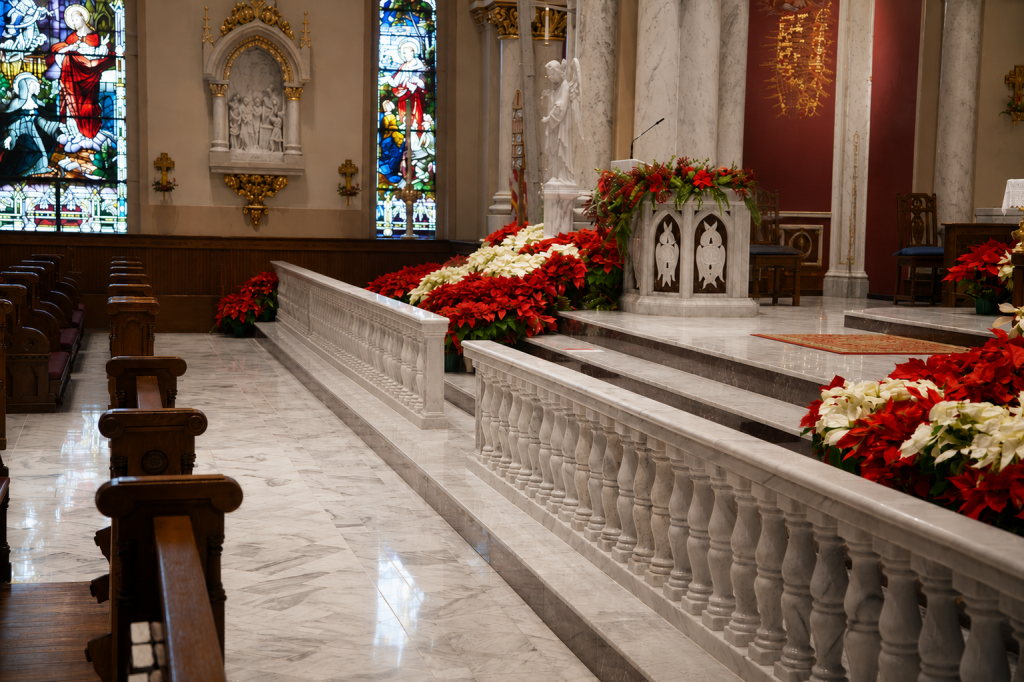
Archbishop Fisher orders return of kneelers across Sydney churches
Archbishop Anthony Fisher has called for kneelers to be restored in every Sydney church where they have been removed, describing kneeling as one of the clearest expressions of faith in Christ’s Real Presence Catholic churches across Sydney are to restore kneelers where they have been removed after Archbishop Anthony Fisher called for their return in a Corpus Christi pastoral letter aimed at strengthening Eucharistic devotion throughout the archdiocese. The Archbishop of Sydney made the appeal as he encouraged Catholics to rediscover traditional practices of reverence before the Blessed Sacrament and urged parish priests to expand opportunities for Eucharistic adoration ahead of the International Eucharistic Congress. “I also ask our parish clergy to restore kneelers in every church where they are missing,” Archbishop Fisher wrote in the letter issued on 3 June. The archbishop said kneeling remained one of the clearest outward expressions of faith in Christ’s Real Presence and reminded Catholics that receiving Holy Communion while kneeling remains fully permitted under the liturgical norms of the Church. “In most cases, this reverence is shown by bowing deeply; however, many people choose to receive Communion while kneeling,” His Grace said. “This is a perfectly valid option envisaged in the current Missal. Kneeling was the standard way of receiving Holy Communion in the Latin Church for many centuries.” There has been renewed attention on Eucharistic worship in the Church and a growing effort in a number of dioceses worldwide to encourage Eucharistic adoration, Benediction and public processions. In the letter, the Australian prelate challenged clergy, religious and laity to deepen their devotion to the Eucharist through regular attendance at Mass, frequent Confession, prayer before the Blessed Sacrament and participation in parish devotions. “To find time and enthusiasm to adore the Eucharistic Lord in Mass and outside of Mass,” the Archbishop urged the faithful. He also called on priests to increase access to churches for private prayer and Eucharistic adoration. “To offer at least one holy hour each week in each parish, and to collaborate with adjoining parishes to increase availability of prayer before the Blessed Sacrament, including a Perpetual Adoration chapel in each deanery,” Archbishop Anthony Fisher wrote. The archbishop said the physical gestures adopted by Catholics during worship were not merely matters of custom but reflected fundamental beliefs about God. “Of the various physical postures, kneeling most clearly reveals our beliefs about God and our relationship with Him,” he said. While acknowledging that prayer postures can vary between cultures and traditions, Archbishop Fisher noted that kneeling has formed part of Western Christian prayer for centuries and remains deeply rooted in Sacred Scripture. Citing examples from both the Old and New Testaments, he pointed to figures including Moses, Solomon, Daniel, the Magi and the Apostles, all of whom knelt or bowed before God in worship, thanksgiving or supplication. He rejected suggestions that kneeling is incompatible with modern Christian life, observing that some people regard it as “the grovelling of a slave” or inconsistent with a culture that wishes to “bow to no-one”. “Yet kneeling has a history for us,” he wrote. “We kneel to recognise Him and then we rise to make Him known,” the Archbishop wrote. The Archbishop ended the letter by stating: “Lord, grant us the grace to receive you reverently, worship you truly and serve you with hearts renewed.” Archbishop Fisher’s call for the restoration of kneelers also echoes the approach taken by his predecessor, Cardinal George Pell, who repeatedly defended traditional postures of reverence during Mass. In 2005, while serving as Archbishop of Sydney, Cardinal Pell issued a directive reminding clergy and faithful that kneeling during key moments of the liturgy remained the norm within the archdiocese. Responding to suggestions that standing should replace kneeling during parts of the Eucharistic Prayer, Cardinal Pell wrote that he had “no enthusiasm for this practice [standing during these times] and in fact the archdiocese does not have a policy in favour of standing”. His Eminence added: “The practice of kneeling after the Sanctus until the end of the Eucharistic Prayer and also before Communion when the priest says ‘This is the Lamb of God’ is to be retained in the Archdiocese of Sydney.” The late cardinal further instructed that “the practice of requiring people to stand during the Eucharistic Prayer may not be introduced without my permission”, citing the General Instruction of the Roman Missal in support of maintaining the established practice. Specifically, the General Instruction of the Roman Missal states that the faithful may receive Communion kneeling or standing, according to the norms established by individual bishops’ conferences, while also calling for an act of reverence before reception of the Blessed Sacrament. In countries such as the United States, the approved adaptation to the General Instruction provides that Holy Communion is ordinarily received standing, while preserving the right of individual communicants to kneel. The norm states: “Holy Communion is to be received standing, unless an individual member of the faithful wishes to receive Communion while kneeling.” The right of Catholics to receive Holy Communion while kneeling was reaffirmed by the Holy See in the 2004 instruction Redemptionis Sacramentum. “Therefore, it is not licit to deny Holy Communion to any of Christ’s faithful solely on the grounds, for example, that the person wishes to receive the Eucharist kneeling or standing,” the document states. The instruction remains one of the clearest statements from Rome on the question and has frequently been cited in discussions concerning the manner in which Holy Communion is received.
Jun. 10, 2026
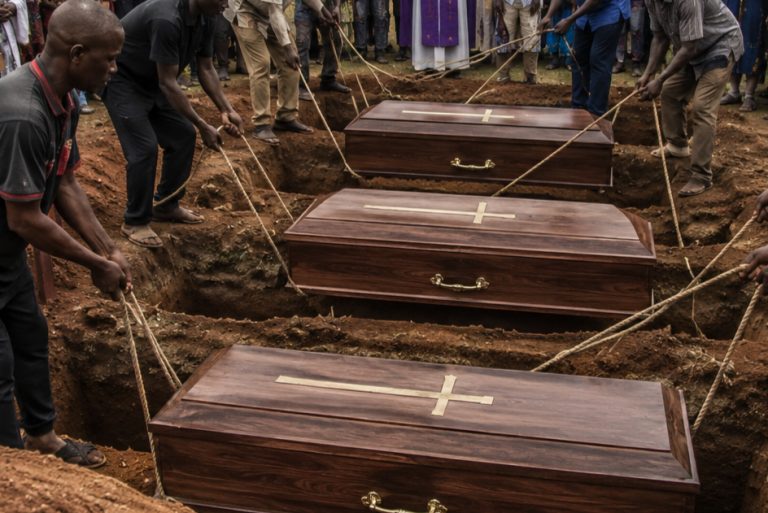
Four sentenced to death over 2022 massacre of 41 Catholics at Nigerian church
Four men have been sentenced to death for the 2022 attack on St Francis Xavier Catholic Church in Owo, Nigeria, in which 41 worshippers were killed during a Pentecost Mass. The ruling comes almost four years after one of the deadliest attacks on Christians in the country’s recent history Four men have been sentenced to death for the massacre of 41 worshippers at a Catholic church in Nigeria in a landmark ruling, almost four years after one of the country’s deadliest attacks on Christians. The Federal High Court in Abuja found Idris Abdulmalik Omeiza, Al Qasim Idris, Jamiu Abdulmalik and Abdulhaleem Idris guilty of terrorism offences connected to the Pentecost Sunday attack on St Francis Xavier Catholic Church in Owo, Ondo State, on 5 June 2022. The gunmen stormed the church during Mass and opened fire on the congregation before detonating explosives, leaving dozens dead and more than 100 people injured in scenes that horrified Catholics across Africa and beyond. Delivering judgment, Justice Emeka Nwite said the evidence against the four men was “neither shaken nor contradicted during cross-examination”. “Hence this court finds the first to fourth defendants guilty of all nine counts,” he said. The court imposed death sentences for the killings and handed down additional prison terms for terrorism-related offences, including membership of a terrorist organisation. A fifth defendant, Momoh Otuho Abubakar, was acquitted after the court ruled that prosecutors had failed to prove their case against him. The attack on Owo sent shockwaves through Nigeria because it took place in the predominantly Christian south-west, a region that had largely escaped the scale of violence experienced in other parts of the country. Worshippers had gathered to celebrate Pentecost when the attackers struck. Witnesses described hearing gunfire and explosions as panic spread through the packed church. Among those killed were children. One of the most harrowing testimonies heard during the trial came from a survivor who lost both legs below the knee and an eye after an explosive device detonated during the assault. The prosecution argued that the four convicted men had planned and carried out the attack as members of a terrorist network. Prosecutor Ayodeji Adedipe welcomed the verdict, telling the court: “Justice has been served. Justice has been done to the deceased who were murdered in cold blood.” Defence lawyers said the convictions would be appealed. The massacre drew condemnation from political and religious leaders around the world. Then-President Muhammadu Buhari described it as a “dastardly act”, saying that “only fiends from the nether region” could have carried out such a crime. Ondo State Governor Rotimi Akeredolu, who visited the scene shortly after the attack, called it a “vile and satanic attack” on innocent worshippers. Pope Francis also remembered the victims in his prayers, expressing his closeness to those who had been “painfully stricken in a moment of celebration”. The killings became a symbol of Nigeria’s worsening security crisis, which has seen churches, schools, villages and transport links targeted by armed groups across the country. At the time of the attack, no group immediately claimed responsibility, although Nigerian authorities later linked the atrocity to Islamist extremists operating in the region. The assault came amid growing concern among Christian leaders over attacks on clergy and worshippers. In the weeks surrounding the Owo massacre, kidnappings of priests and other church leaders were reported in several parts of the country, while armed gangs continued to terrorise communities through abductions and raids. Although Nigeria’s government rejects claims that Christians are being systematically targeted, church leaders have repeatedly called for stronger action to protect vulnerable communities and places of worship. The convictions are among the most significant secured by Nigerian authorities in relation to a major terrorist attack on a church. Under Nigerian law, the death sentences will require further legal processes before they can be carried out, and appeals are expected to follow. Another deadly incident was the coordinated Christmas Day church attacks in 2011, primarily the bombing at St Theresa’s Catholic Church in Madalla, near Abuja. On 25 December, Boko Haram carried out multiple strikes on Christian worshippers, with the Madalla attack killing at least 37 to 40 people and injuring dozens more as congregants left Mass. Bombings and shootings also targeted churches in Jos, Gadaka and Damaturu that day, contributing to a total death toll of around 40 to 50 across the affected sites. Another major massacre occurred in Yelewata, Benue State, in mid-June 2025, when Fulani militants attacked a displacement camp sheltering Christians. Reports indicate that around 200 people were killed in a single night, with attackers storming storefronts that had been converted into temporary shelters and using guns and other weapons against men, women and children.
Jun. 10, 2026
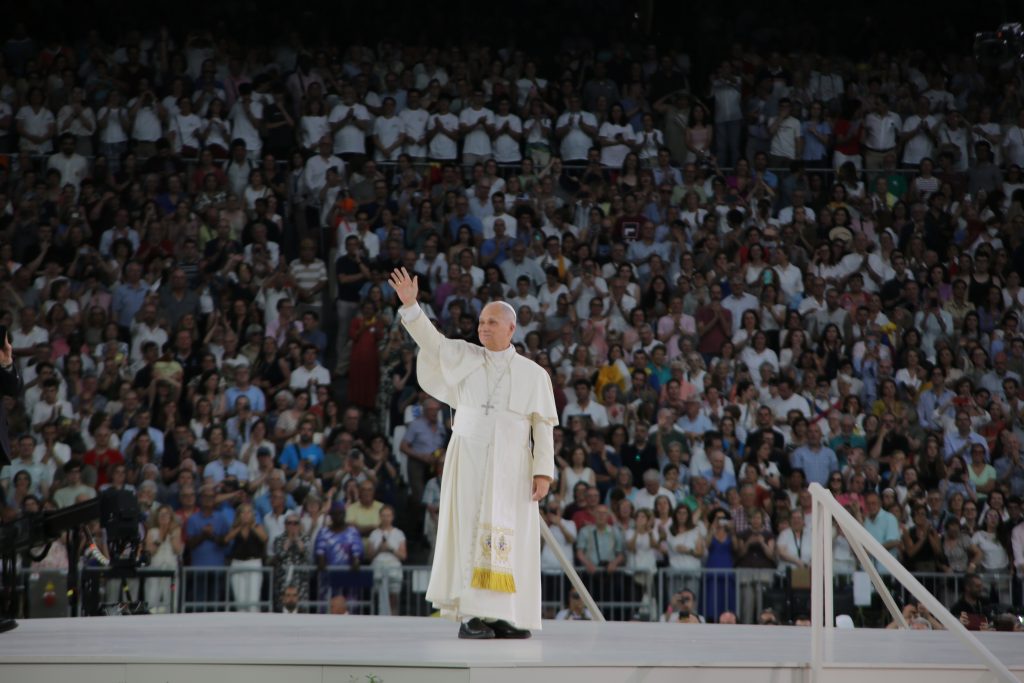
In pictures: Pope Leo XIV’s third day in Madrid
Pope Leo XIV’s third day in Madrid saw him address the Spanish Parliament, meet the country’s bishops, present the Golden Rose to Our Lady of Almudena and join more than 70,000 Catholics at Santiago Bernabéu Stadium. Here are the images from a day that combined politics, prayer, Marian devotion and a celebration of the Church in Spain The third day of Pope Leo’s apostolic visit to Spain began with a historic address to a joint session of the Spanish Parliament, the first ever delivered by a Pope, in which Leo XIV defended the dignity of every human person from conception to natural death, spoke about migration, religious freedom and artificial intelligence, and called on public life to be marked by dialogue and service. The Holy Father later met with Spain’s bishops at the headquarters of the Spanish Episcopal Conference, urging them to safeguard unity, heal divisions, accompany those entrusted to their care and continue the Church’s commitment to listening, justice, reparation and safeguarding. In the evening, he paid homage to Our Lady of Almudena, presenting the Golden Rose to Madrid’s patron saint and calling on the faithful to tear down the “walls” that divide people and societies. The day concluded with a vast diocesan celebration at Santiago Bernabéu Stadium, where more than 70,000 Catholics from Madrid, Alcalá de Henares and Getafe gathered to welcome the Pope. There, Leo XIV described the Church of Madrid as having “scored a truly memorable goal” and encouraged the faithful to live the joy of the Gospel with confidence and hope. Pope Leo XIV addresses a joint session of the Spanish Congress and Senate in Madrid on 8 June 2026, becoming the first Pope to speak before the Spanish Parliament. In his address, the Holy Father defended the dignity of every human person from conception to natural death, calling for protection of the unborn, support for the family, respect for religious freedom, and a renewed commitment to peace and social harmony. (Photo credit: Ballesteros/EFE) Attendees listen to Pope Leo XIV’s address. Pictured are Basque nationalist politician Mertxe Aizpurua (third from left, front row), Catalan pro-independence politician Gabriel Rufián (centre, front row), Senate spokesperson Alicia García Rodríguez (far right, back row) and former Deputy Prime Minister Cristina Narbona (centre, back row). (Photo credit: Ballesteros/EFE) Former Spanish Prime Minister José María Aznar (left) speaks with Catalan regional president Salvador Illa following Pope Leo XIV’s historic address. (Photo credit: Ballesteros/EFE) Francina Armengol, President of the Congress of Deputies, addresses the chamber. (Photo credit: Ballesteros/EFE) Pope Leo XIV Pope Leo XIV meets members of the Spanish Episcopal Conference at its headquarters in Madrid on 10 June 2026. Addressing the bishops during the 60th anniversary year of the conference, the Holy Father urged them to safeguard unity, promote dialogue, heal divisions and accompany the people entrusted to their care, while calling for continued commitment to truth, justice, reparation and prevention in response to abuse. (Photo credit: J.J. Guillén/EFE) Crowds gather outside the Royal Palace of Madrid as Pope Leo XIV passes in the popemobile during his visit to the Spanish capital on 8 June 2026. (Photo: Á. Pérez Meca/Europa Press) Pope Leo XIV celebrates a prayer service in Madrid’s Almudena Cathedral on 8 June 2026. During the gathering, the Holy Father paid homage to Our Lady of Almudena, presented the Golden Rose to the patron saint of Madrid, and called on the faithful to “tear down the walls” that divide people and societies in order to build communion, fraternal love and concord. (Photo: Á. Pérez Meca/Europa Press) A statue of Our Lady of Almudena is presented before more than 70,000 pilgrims gathered at Madrid’s Santiago Bernabéu Stadium during a diocesan celebration with Pope Leo XIV on 8 June 2026. The event brought together Catholics from the dioceses of Madrid, Alcalá de Henares and Getafe in a celebration of faith, family and ecclesial communion. (Photo credit: Gabriel Gonzalez-Andrío) Pope Leo XIV greets the faithful as he arrives at Madrid’s Santiago Bernabéu Stadium, later telling the crowd that “the Church of Madrid has scored a truly memorable goal.” (Photo credit: Gabriel Gonzalez-Andrío) Pope Leo XIV addresses pilgrims. In his remarks, the Holy Father described joy as a defining mark of Christian life and encouraged the faithful to become “an open Bible” for others, so that the Word of God might be visible in their faces and daily lives. (Photo credit: Gabriel Gonzalez-Andrío)
Jun. 9, 2026
The biggest loser from Pope Leo XIV’s trip to Madrid: Pedro Sánchez
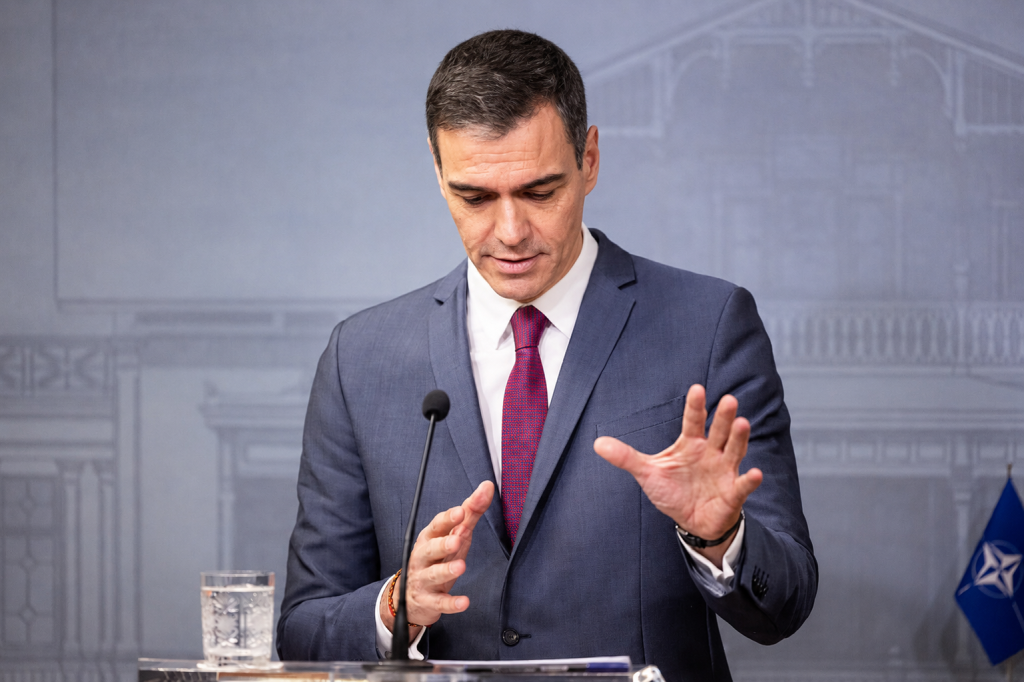
Madrid delivered vast crowds, Spanish flags, a packed Bernabéu and one of Europe’s largest Catholic gatherings outside World Youth Day. For Pedro Sánchez, Pope Leo XIV’s visit may have been a reminder that the Spain he opposes remains very much alive Pedro Sánchez has been noticeably absent during the papal visit to Madrid. He made the trip to the airport to greet the Holy Father and had a private audience before the Pope’s speech at the Spanish parliament, but apart from that, Spain’s prime minister has kept away. With the papal convoy heading to Barcelona, where the apostolic visit will take a turn for the Catalan, that absence will likely continue. However, he is due to make appearances in the third leg of the trip, in the Canary Islands. It is fair to assume that Sánchez is decidedly unhappy with the whole Madrid part of the event. Much of the secular media have covered the papal visit as an endorsement of the leader of the Spanish Socialist Workers’ Party, as he happens to hold views on migrants which are broadly similar to the Holy Father’s. But when one realises that the status of migrants is, shockingly, not the only issue popes and prime ministers can hold opinions on, the situation becomes more complex and, particularly in Madrid, decidedly less favourable for Sánchez. To understand this, it is important to know how Spanish society sees itself. Spaniards will often speak of there being two Spains. There is the socially conservative Spain which is proud of its cultural heritage. Bullfighting, saints and festivals, costumes and pageantry all exist in this Spain, where Catholicism takes pride of place. The Franco era is not openly celebrated, unless you take a turn to the fringes, but in this Spain it is understood, albeit quietly, as not being all bad. The royal family are beyond reproach, unless in favour of the Carlist pretender. The socially conservative Spain finds Madrid as its motherland, with the famous cities of Andalucía, Seville, Granada and Málaga, as its summerhouses. It holds the regions pushing for independence in disdain, with Catalonia being particularly offensive. Dressing smartly, or having a la Rojigualda, the nickname of the Spanish flag, bracelet is generally considered a sign of belonging to this Spain. The other Spain is equally definable, partly because it defines itself as being the opposite of the other. It abhors bullfighting, finds pomp unbearable and is still deeply troubled by the Spanish Civil War and indeed the entire Franco period. The monarchy is either tolerated or actively opposed. Severing the Church from Spanish life is a principal aim. All semblance of the morality of the Church should first be ridiculed and then removed. The unborn have no rights and assisted suicide is the way to sanitise suffering, since suffering is Catholic and therefore bad. Pedro Sánchez comfortably sits within the second Spain. For many, he is the poster boy of left-wing politics and has made it surprisingly appealing. He looks well put together and polished, a far cry from the purple-haired radical left. Under his administration, the second Spain has launched one of its most aggressive attacks on the first. In 2019, after more than four decades of burial at the vast basilica, the remains of Franco were removed from the Valley of the Fallen and, in 2022, the Democratic Memory Law redesignated the Valley of the Fallen as the Valley of Cuelgamuros. The law also accelerated the removal of Franco-era symbols from public life, and abolished a number of noble titles granted during the dictatorship. In 2021, Sánchez introduced assisted suicide, making the apparently Catholic Spain one of the few countries in Europe to permit state-sanctioned suicide. In the same year, LOMLOE, the Celaá Law, was introduced, removing Religious Education from pupils’ grade averages. The law also removed public funding from single-sex schools. Based on no credible pedagogical research, the move was seen as an intentional attempt to harm the country’s hundreds of Opus Dei schools, which are predominantly single-sex. The Pope’s Madrid leg of his trip has been a true celebration of everything the first Spain holds dear. There has been an entire event held to showcase Spanish art and culture, where the Pope asked the Spanish to consider: “What is it that we are sowing today, what exactly is flourishing and what is silently withering in our society; what values are we preserving and which are we allowing to die?” He also delivered a forceful address at the Spanish parliament. In it, he asked: “Can a community that casts into the shadows the unborn child, the elderly, the sick, those who suffer in silence or those who depend entirely on the care of others be called fully just?” Sánchez, who has shown a considerable disinterest in the unborn and elderly through his political opinions, would have been distinctly deterred by the Pope’s question. At Madrid’s Santiago Bernabéu Stadium, he attended a gathering of the dioceses of Madrid, Alcalá de Henares and Getafe in celebration of faith, family and ecclesial communion. He was given a rock star-like welcome, with crowds chanting, “Contigo, León, un solo corazón” (“With you, Leo, one heart”). It was the kind of reception Sánchez could only dream of receiving. The numbers will also be a shock to a prime minister who has no love for the Church. Some 1.5 million attended the Pope’s Corpus Christi Mass, making it one of the largest gatherings of Catholics outside World Youth Day. Sánchez was absent, but with a crowd equivalent to almost half of Madrid gathered, waving Spanish flags and partaking in one of the most ancient solemnities of the Church, the first Spain was out in force. When Sánchez joins the Pope in the Canary Islands, he will be relieved to be reunited on the issue of migration, which will dominate the final leg of his journey. But the magnitude of Madrid will stick with him. A celebration of all things Catholic and traditionally Spanish will likely not have been well received. The numbers will also be a concern, as few could have predicted such a gigantic turnout. The crowds are in line with an apparent resurgence in Catholic identity in the country, with a recent survey finding that 45 per cent of Spaniards aged 15 to 29 identify as Catholic today, compared with 31.6 per cent in 2020. For a socialist, that is a very bad thing.
Jun. 9, 2026
SSPX superior says he is ‘astonished’ by Pope Leo XIV’s silence over bishop consecrations
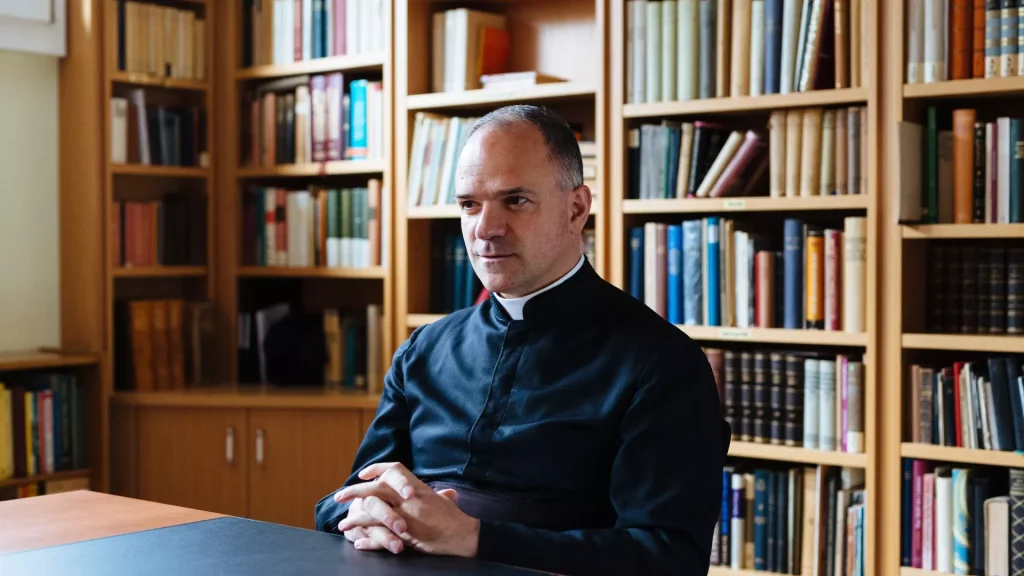
The Superior General of the SSPX has said he is “astonished” that Pope Leo XIV has not personally responded to the society’s request for talks ahead of planned episcopal consecrations on 1 July. Fr Davide Pagliarani also said he still hopes to meet the Pope before consecrations The Superior General of the Society of Saint Pius X has said he is “astonished” that Pope Leo XIV has yet to respond personally to the group’s request for talks ahead of planned episcopal consecrations next month. In an interview with in-house SSPX News, Fr Davide Pagliarani said he still hoped to meet the Pope before four SSPX priests are consecrated bishops at Écône, Switzerland, on 1 July, but admitted he was struggling to understand the Vatican’s silence on the matter. “Of course, that corresponds to my most sincere desire,” Fr Pagliarani said when asked whether he still hoped for a meeting with the Pontiff. “I am nevertheless astonished that, from the Holy Father, there has been no response or personal reaction up to now.” The remarks come days after the SSPX announced the names of the four priests who will be consecrated bishops. In a communiqué issued from the society’s General House in Menzingen, Fr Pagliarani said the names had been presented to Pope Leo “together with certain explanations necessary for a proper understanding of this step”. The planned consecrations pose a significant challenge to the relatively new pontificate. In February, the Vatican warned that episcopal consecrations carried out without papal approval would constitute “a decisive rupture of ecclesial communion” and urged the SSPX to suspend its plans while theological discussions continued. Despite that warning, Fr Pagliarani indicated that he believed direct engagement from the Pope was still possible. “Before perhaps declaring schismatic a society that counts more than a thousand members, and which constitutes a point of reference for hundreds of thousands of faithful around the world, it might be desirable to personally know those who are to be judged,” he said. “The sanction envisaged does not only affect an institution, which, moreover, does not exist in the eyes of the Holy See; it affects people, and people deeply attached to the Pope and to the Church.” He added: “I confess that I struggle to understand this silence, even as we are often reminded of the need to listen to the cry of the poor, that of the peripheries, and even that of the Earth.” The interview also contained a striking assessment of the late Pope Francis, whose pontificate saw a number of practical concessions granted to the SSPX despite the society’s continued criticism of the post-conciliar Church. “The programme that Pope Francis imposed on the universal Church is sufficiently well known and has been widely commented on by the FSSPX,” Fr Pagliarani said. “I believe that, unfortunately, the word ‘disaster’ is the most appropriate to sum up the legacy he has left.” Yet the SSPX superior also spoke warmly of his personal dealings with Francis, saying the late Pope had recognised the good carried out by the society and had shown him considerable kindness. “Pope Francis knew how to recognise, in his own way, the good that the FSSPX does for souls,” he said. Furthermore, “when I asked to meet him at the Vatican, I obtained an audience with him within twenty-four hours, and he proved particularly affable.” The 26 May communiqué which announced the names of the future bishops said the episcopal consecrations would take place “in a spirit of respect towards the supreme authority of the universal Church” and insisted that the move did not represent “a denial of, refusal of, or challenge to the supreme, full, and immediate power of jurisdiction of the Vicar of Christ over the universal Church”. “The ceremony of 1 July will have no other purpose than to ensure the continued administration of the sacraments of Holy Orders and Confirmation, together with those sacramentals reserved to bishops, according to the traditional rite of the Holy Roman Church and the immemorial Faith,” the communiqué said. The four priests named for consecration are Fr Pascal Schreiber, rector of the SSPX seminary in Zaitzkofen, Germany; Fr Michael Goldade, rector of St Thomas Aquinas Seminary in Dillwyn, Virginia; Fr Michel Poinsinet de Sivry, Superior of the Benelux District; and Fr Marc Hanappier, professor of theology at the society’s American seminary. Photo credit: SSPX.org
Jun. 9, 2026