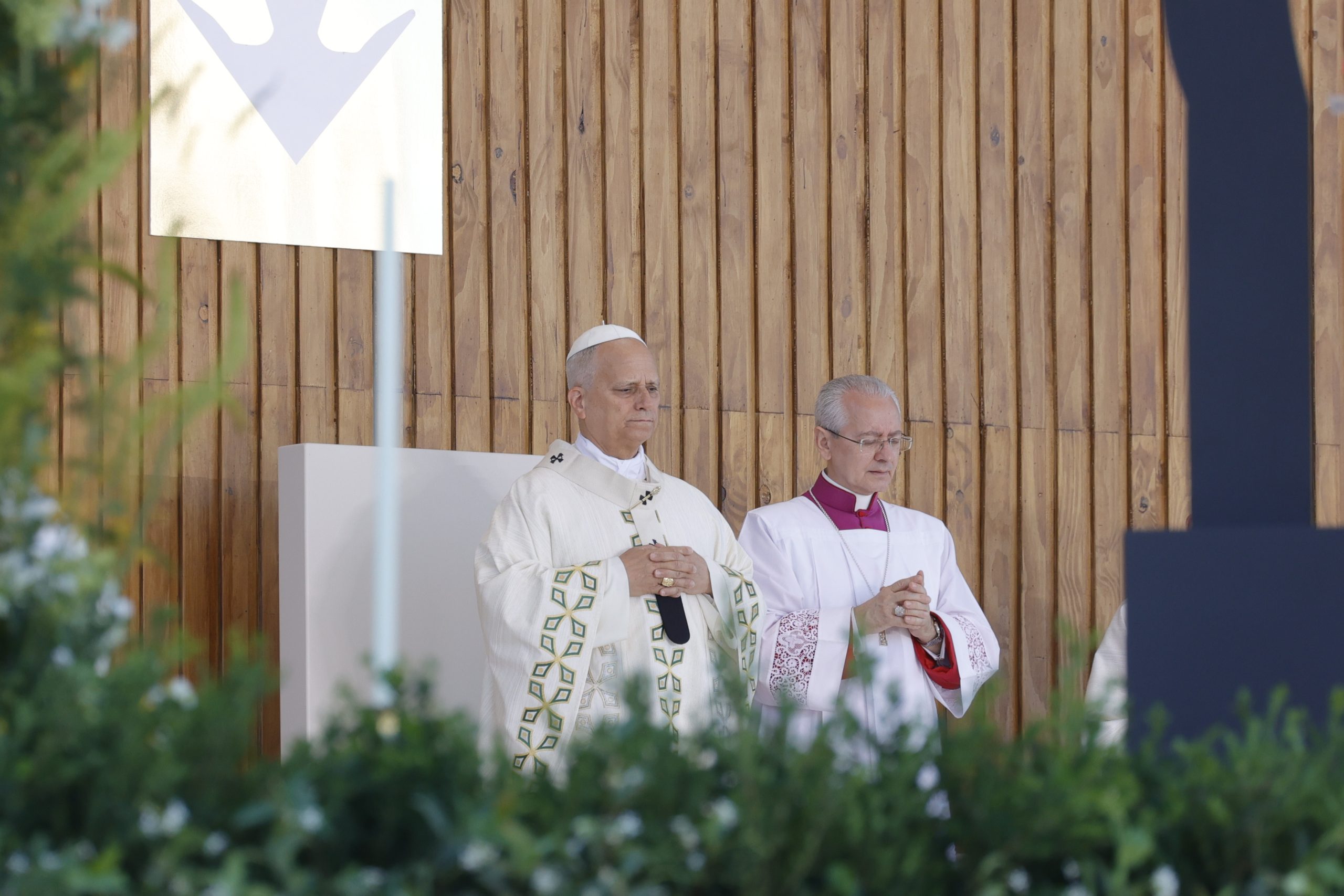
On the second day of his apostolic visit to Spain, the Holy Father, Pope Leo XIV, delivered an impassioned homily before 1.2 million faithful gathered in the centre of the nation’s capital.
Speaking on the Solemnity of Corpus Christi, the Pope said that on this day Catholics celebrate that Jesus “does not remain enclosed within the church, but comes out to meet us”.
He also exhorted Spain’s Catholics not to let their faith “become a museum”, but to be recognised as “a school that teaches us to kneel before God and before our neighbour, because no one can kneel before the Lord and despise a brother or sister”.
Spain’s history is one of deep Catholic devotion, but it has also been marked by periods of anti-clerical socialism, leading many to speak of “two Spains”. Under Prime Minister Pedro Sánchez, the country has been subject to particularly aggressive secular and anti-Catholic legislation, notably laws limiting religious education in Catholic schools and introducing assisted suicide. Although the Holy Father has remained clear of political debate, his call for Spain to return to its Catholic roots struck a notably different tone from Sánchez’s secularism, which seeks to remove the Church’s presence in public life.
The Holy Father concluded by praying for those present, imploring Jesus that “a full and abundant life may spring forth for you, for your families and for your country”.
The full text is reproduced below:
Dear priests, religious brothers and sisters, Your Majesties, brothers and sisters,
With my heart filled with joy at the beginning of this journey to Spain, I preside over this celebration on the Solemnity of Corpus Christi.
We are gathered around the Eucharist, the gift of Christ’s living presence among us. He who wished to offer us his life in order to bring us into communion with the Father and make us his children is here as the living bread come down from heaven, who nourishes us with the very life of God, with a love stronger than death.
This remembrance of the Lord present in the Eucharistic bread is at the heart of your faith and of the history of your people. Here in Madrid, but also in so many other places throughout Spain, Corpus Christi is not merely another feast in the calendar, but a return to the roots of faith in order to renew love and fidelity to God.
The solemn processions of this day have embodied for centuries the piety, the art, the music, the architecture and the life of the Spanish people, and even today they express and manifest the spiritual sentiment of this country, also through the beauty and elegance of the floral carpets, of the altars in the streets, the care devoted to the monstrances and displays, the hymns and the ornaments.
This is not a matter of an external display, a folkloric survival, or a simple aesthetic adornment. Rather, it is faith in the presence of the Risen Lord, who is alive and continues to pass among us, who becomes bread for our hunger for life and visits the corners of our hearts and of our history, even the darkest ones.
Thus, if in the Eucharistic celebration Christ gives himself as food, the procession proclaims that he does not remain enclosed within the church, but comes out to meet us. Jesus walks through the streets, crosses the squares, visits our neighbourhoods, and dwells in the places of our daily life. He is the God who is near and who walks with his people, the Lord of history, comfort for the weak, light for families, hope for the sick, peace for those who suffer.
The Christ who passes through the streets in the monstrance is the same Christ who identifies himself with the poor, the downcast, those who are alone and abandoned. It is no coincidence that here in Spain the Church has for many years linked the Solemnity of Corpus Christi with the Day of Charity.
It is not simply a matter of carrying the monstrance through the streets, but of allowing ourselves to be drawn out of selfishness, indifference, and a comfortable and private faith, in order to respond to his invitation to conversion, to change our way of seeing, and to open ourselves to his presence, a presence that transforms us and makes us builders of a new world.
For this reason, the historical memory of the Corpus Christi processions cannot be imprisoned by nostalgic remembrance. Rather, it becomes an invitation for today, for our personal lives, for our relationships, for society, and for the building of the future.
It is in this light that we must understand the invitation to remember that we heard in the first reading. “Remember the whole journey that the Lord your God made you travel during these forty years in the desert.” “Remember how, when you were hungry, he fed you with manna.”
It is a matter of remembering precisely so as not to forget who the Lord is, so as not to fall into the temptation of trusting in other idols and feeding ourselves on a bread that does not satisfy.
Therefore, here is a task entrusted to the Spain of today and tomorrow: that the religious faith which has animated this country for centuries may not become a museum of the past to be visited, but rather a school of faith from which people may still drink today.
A school that teaches us to kneel before God and before our neighbour, because no one can kneel before the Lord and despise a brother or sister. A school that teaches us gratitude, the love that becomes a gift so that it may circulate among us and break the chains of every form of selfishness.
A school in which we learn that God is truly present, and that we too are called to be present amid the situations and challenges of society, not to flee from them, but to commit ourselves personally to the building of the common good.
Brothers and sisters, I wish to recall here Saint Manuel González, the bishop of the abandoned tabernacles. His life reminds us that the Eucharist cannot be honoured only during great celebrations or in an occasional way, but also through the silent fidelity of those who accompany the Lord with a humble and discreet friendship nourished day by day.
I would also like to recall the poetic verses of Saint John of the Cross: “I know well the fountain that flows and runs, though it is night.”
In the convent prison of Toledo, where he was imprisoned under extremely harsh conditions, precisely around Corpus Christi in the year 1578, he recognised, from within the darkness of that prison, the hidden presence of the Lord, from whom springs a light that never fails and a life that is never exhausted.
Jesus in the Eucharist is that eternal fountain which remains hidden, a fountain that flows and quenches thirst, yet without dazzling, without imposing itself through outward power, without presenting itself in a spectacular manner.
Let us return to him with sincere love. Let us open ourselves to an encounter with him. Let us allow him to refresh the dryness of our hearts so that we may then go out onto the roads of life and history carrying among people this stream of fresh water, a stream of love, peace, justice and joy.
Let us drink once more from this Eucharistic fountain, which does not enclose us within a private devotion, but sends us out to our brothers and sisters, to families, to the poor, to those who suffer, to those who have lost hope.
The grace of the Eucharist transforms us, but it also makes us protagonists in the transformation of history and signs of hope for those whom we encounter.
May the Lord Jesus, present in the Eucharist, make you bread broken, given and offered, so that a full and abundant life may spring forth for you, for your families and for your country.
Image credit: EUROPA PRESS – JESÚS HELLÍN