O Lord, our Sovereign, how glorious is your name throughout all the earth! (Psalm 8:2,10)
With the words of this psalm, so full of joy and wonder, I greet all of you, dear brothers and sisters.
I express my gratitude to Their Majesties, and I thank Cardinal Juan José Omella, Archbishop of Barcelona, as well as the other brother bishops and all those who join us in prayer: priests, deacons, religious brothers and sisters.
On this festive evening for the whole city of Barcelona and for the Spanish people, particularly the Catalan people, I extend my grateful greeting to the public authorities, as well as to members of other Christian communities and other religions who are taking part in our thanksgiving.
Today the Basilica of the Sagrada Família welcomes us in this beautiful city, opening its doors as if they were its arms, inviting each one of us to this altar to hear the Word of God.
It is a temple that makes us a family loved by the Lord, nourished by his very life in the Eucharist. Thus, the city of Barcelona and all of Catalonia gather in this temple, which is also a sign of unity and concord for the whole of Spain. They lift up their gaze to encounter the face of God the Father, shining forth in his Son made man, Jesus Christ. As we give thanks to the Lord for his love towards us, we praise him for what he accomplishes in our lives.
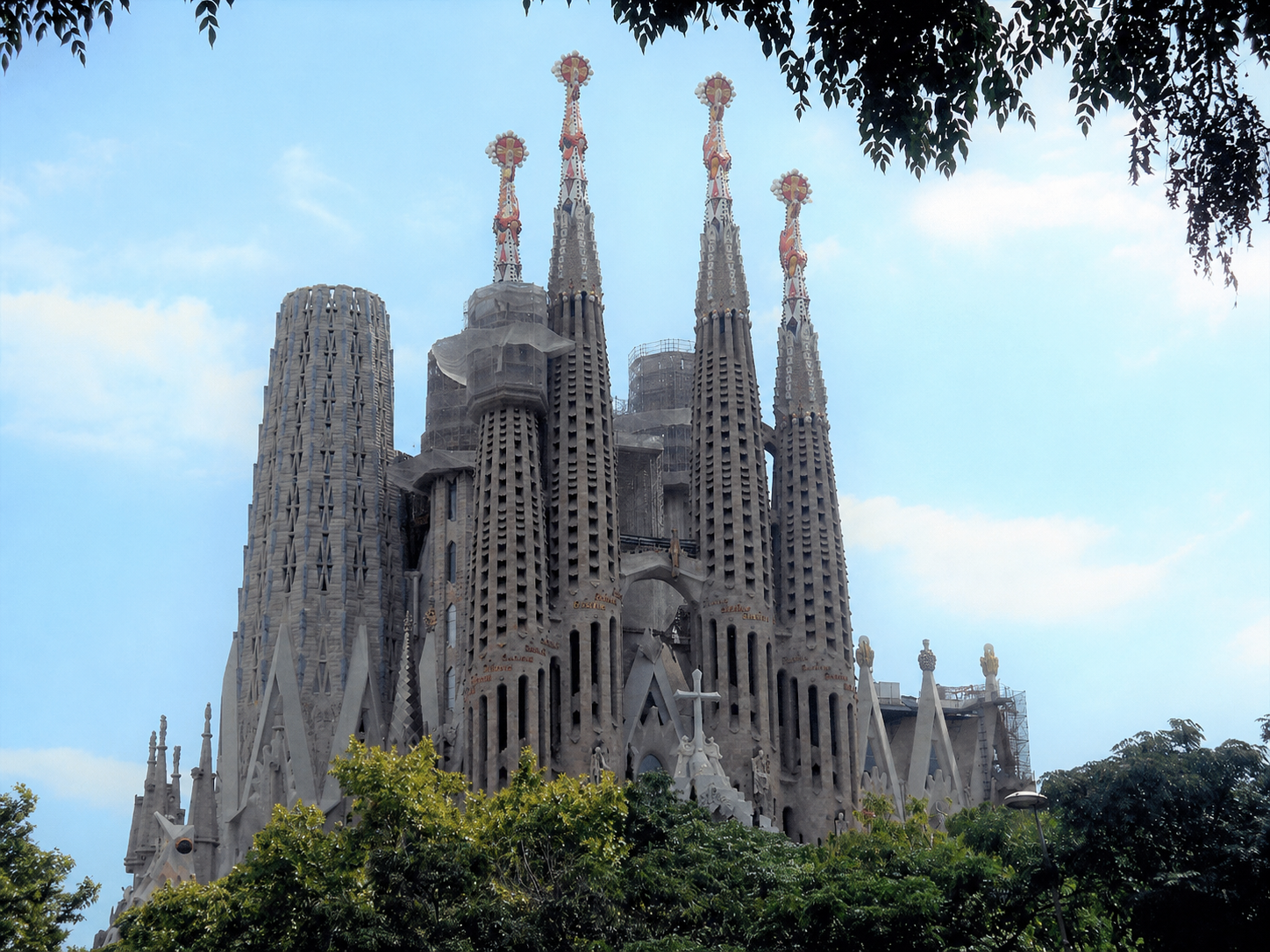
We give thanks in a particular way for this extraordinary basilica, which Pope Benedict XVI consecrated in 2010, recalling that it is a visible sign of the invisible God, for whose glory its towers rise heavenward (cf. Homily for the Consecration, 7 November 2010). In continuity with the prayer of my predecessor, in a few moments I will bless its highest tower, the Tower of Jesus Christ.
This church is a single building, composed of many stones. It is a house that has grown steadily over the years, following one unified plan. All of us are the living stones of this work, which has Christ as its foundation and summit, its beginning and its end. Far more than a monument, the Basilica of the Sagrada Família remains today a work under construction, reminding us that the Christian life is always a journey, because it is a project that God himself carries out.
Let us not inhabit, then, an unfinished work, but rather a temple that is still under construction. Its imperfection is not a defect, because it bears witness to a desire. It does not signify a lack; rather, it expresses a promise that we wish to honour with fidelity. Our gratitude thus becomes a commitment, as we cooperate in God’s plan, that is, in the building work to which he himself calls us. Since we are temples of the Holy Spirit (cf. 1 Corinthians 6:15, 19), this work coincides with our own lives, which God conceives as a masterpiece that we are to accomplish together. He calls us to collaborate with him (cf. 1 Corinthians 3:9).
In this regard, we keep in our hearts the words that the Lord addressed to King David: “Would you build me a house to dwell in?” (2 Samuel 7:5). On the contrary, “The Lord declares to you that the Lord himself will establish a house for you” (v. 11). Through this announcement, Scripture teaches us that it is not we who provide God with a dwelling place; rather, it is God who gives us a place. And the place he gives us is his own heart: the place of the Son for us who were strangers, the place of the beloved for us who are sinners.
His will is fulfilled through Jesus. We can therefore understand the meaning of what we have heard in the Gospel, when the Lord says to the Pharisees: “If you do not believe that I am he, you will die in your sins” (John 8:24). These are strong words, but they are by no means threats or blackmail. They are an invitation to salvation, that is, a call to freedom from Christ, who desires for us the ultimate and eternal good.
In the face of the threat of evil, the Lord is always with us, always on our side. “I Am”: this is the most holy name that God entrusted to Moses from the burning bush, revealing his unshakable fidelity. Made man, he becomes for us Emmanuel, the source of grace and forgiveness, of salvation and new life.
Dear brothers and sisters, we cannot believe in Jesus and promote war. We cannot believe in Jesus and kill the innocent. We cannot believe in Jesus and abandon those who suffer, those who weep, or those who flee from misery.
Tonight, then, the Cross of Christ, which crowns this basilica, is the cross of the last who become first, of sinners who become saints, of the dead who rise again. The three façades of the Sagrada Família bear witness to this: the First became the Last for us at Christmas; through his sacrifice he redeemed us in the Passion; and his death gives us eternal life, making us sharers in divine glory.
As we admire the Tower of Jesus Christ, let us raise our eyes to him, to the One who reveals to us the truth about God and the truth about ourselves. Looking at Christ, we can see the world with renewed eyes. The tower of the Cross then becomes a banner of charity, because God loves us in this way, transforming an instrument of death into a sign of hope.
In the Cross of Jesus, our faith reaches its summit, as the inscription at the base of the spire proclaims: “Tu solus Sanctus, tu solus Dominus, tu solus Altissimus” (“You alone are Holy, you alone are Lord, you alone are the Most High”). This Cross shines by day, reflecting the light of the sun, and shines by night, illuminating the city like a beacon open to the Mediterranean.
Although the light of Christ shines in the darkness, the darkness has not welcomed it (cf. John 1:5, 11). Yet this rejection does not cause God’s love to fail. “When you have lifted up the Son of Man,” the Lord says, “then you will know that I am he, and that I do nothing on my own authority, but speak just as the Father has taught me” (John 8:28).
It is necessary to pass through the Passion of the Crucified in order to be illuminated by the glory of the Risen One. From all eternity, the Father teaches the gift of life, and the Son, who receives that life from him, gives it to all through the power of the Holy Spirit. This is why the Cross is the radiant sign of his love. When Christ is lifted up, his magnificent humanity shines forth, and our works give glory to God. These are the works of faith, and among them art holds a special place.
It is precisely faith that gives form to the stones and meaning to the building that we inhabit together. In our prayer, therefore, we discover the original bond of all things with God, Creator of heaven and earth. He is the artist who has imprinted his splendour upon the cosmos. Created in his image, man responds to God’s work through his own ingenuity. Thus the artist transforms talent into praise and creativity into a witness to creation itself.
As an architect aflame with faith, the Venerable Antoni Gaudí conceived these spaces with the desire to tell the story of the mysteries of the Lord’s life. In this way, he has proposed to us a spiritual pilgrimage that leads to an encounter with Christ, born, dead and risen for us. Together with Gaudí, whose death we commemorate on the centenary of his passing, we remember and give thanks this evening for all the promoters and benefactors, the artists and the workers who have contributed to the construction of an architectural masterpiece that is also an eloquent catechesis made of stone, colour and light.
In her wisdom, the Church thus renews the Biblia pauperum of the ancient cathedrals, which are themselves rich messages of evangelisation. In this age of images, it becomes even more evident that art and beauty are outstanding channels of evangelisation.
Dear brothers and sisters, the beauty of this temple encourages us to learn ever more from our Master and Lord the art of living according to his Gospel. As we lift our eyes to him, the crucified and risen Lord, let us commit ourselves to raising up the faces of those who lie in the dust (cf. 1 Samuel 2:8). Let us thus show that the Sagrada Família is the tallest church in the world, not in order to stand out in worldly rankings, but to guide the steps of the People of God who journey through this land of Catalonia, with the Cross lighting the way like a lamp kept burning as we await the return of the Bridegroom.
May God be blessed forever!
Photo credit: Canaan – Own work, CC BY-SA 4.0, https://commons.wikimedia.org/w/index.php?curid=71031111