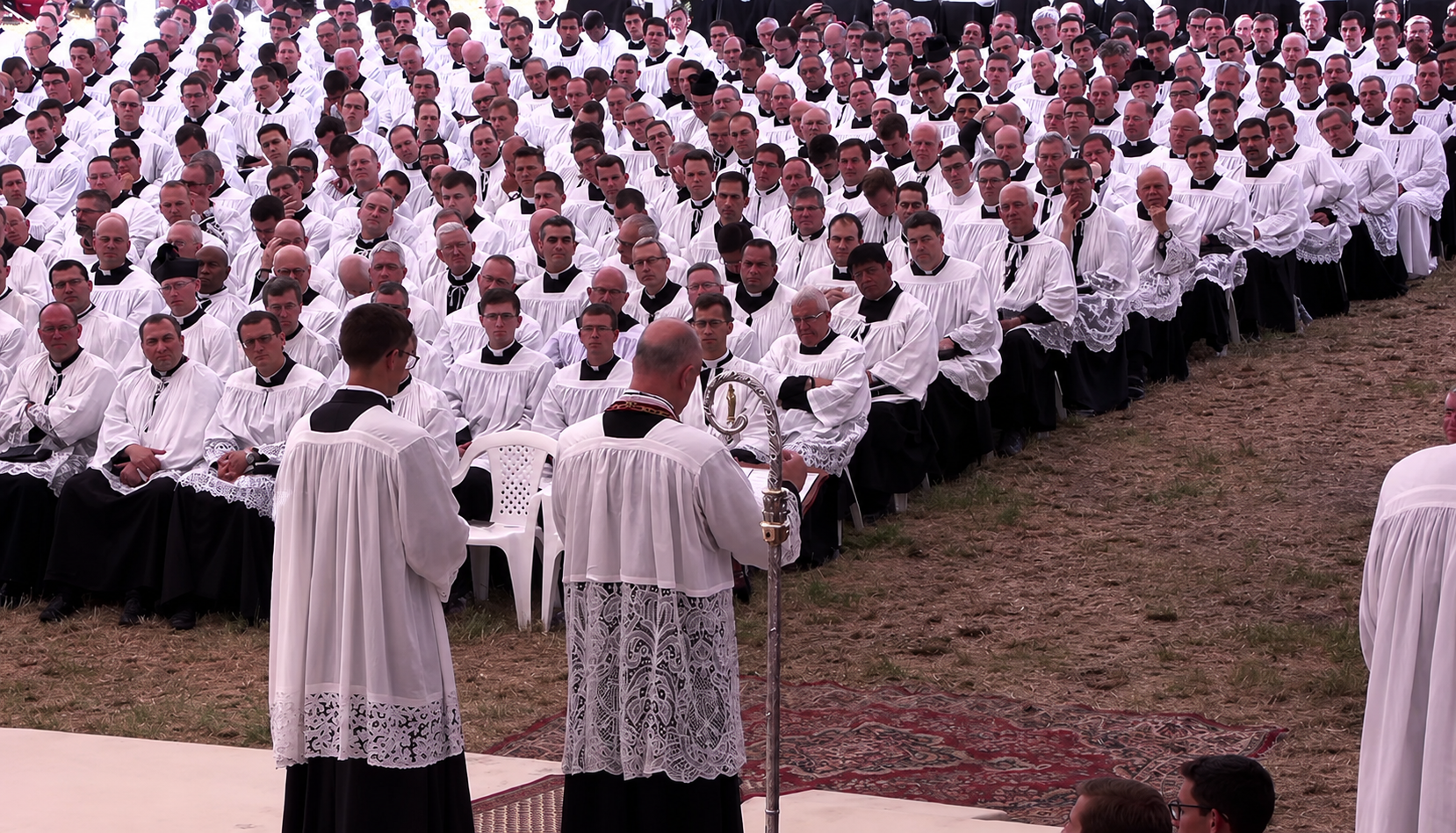
The ceremony in which the Society of Saint Pius X consecrated four new bishops has taken place, lasting more than four hours. AdVaticanum can now release excerpts from the sermon delivered by the Superior General of the Society of Saint Pius X, Fr Davide Pagliarani.
Fr Pagliarani presents the consecrations as a necessity rather than a choice, justified by what he described as the need to preserve and transmit the Faith.
He also urged the four new bishops to remain steadfast and never to yield to “the spirit of the world” or adapt Catholic teaching to contemporary cultural pressures.
At last, this day has arrived. A historic day. Why are we here? How should we understand these episcopal consecrations? This is a divisive event before which it is impossible to remain indifferent. What does it mean for us? This ceremony must be a manifestation of faith. We do not choose what we believe or do not believe. We cannot reinterpret or reconsider it. We simply have the duty to preserve the faith that the Church has always taught. We must love it, live it and hand it on. If we truly love Our Lord, we have the duty to share the treasures that come to us through the faith. Anyone who has no desire to transmit the faith shows that he himself is not living by faith. The more the faith is attacked and disappears, the more urgent this duty becomes. Without faith it is impossible to please God, to live well or to be saved. Today we are taking exceptional measures proportionate to this necessity.
Some might therefore think we are facing a dilemma. We choose the fullness of the faith, but separate ourselves from the Church. We are choosing between faith and the Church. In preserving the faith, are we breaking with the Church? This is a false dilemma. We belong to the Church first of all through the faith, just as one belongs to a nation by sharing the same language, identity and culture, or to a family by bearing the same name and living in the same home. We belong to the Church because we profess the same faith. Therefore we cannot choose between faith and the Church. We want the faith of the Church in order to remain in the Church, and we want the Church through the faith and in the faith. It is important to understand this, even if those facing us refuse to do so. This is not an opinion, a preference or an option. It is a necessity.
We are accused of not loving the Pope and of not respecting him. But it is precisely because we sincerely love the Pope as the Vicar of Christ and head of the Church that we no longer want to see him humiliated alongside false shepherds representing false religions. We have seen this happen so many times over the years. Because we love the Vicar of Christ, we no longer want this humiliation for the Pope, a humiliation that falls upon the whole Church, treating her as though she were on an equal footing with false religions. We have explained this countless times, almost in every language on earth. Yet why are we still not understood?
At heart, we are speaking two different languages. We speak the language of faith. We want it in all its simplicity. It is the language of Tradition. Those on the other side speak another language altogether: the language of inclusion, listening, dialogue and accompaniment. We want the faith, and then within the faith we accompany people. We listen to them in order to lead them to the faith and convert them. But we must stop talking simply for the sake of talking, or accompanying for the sake of accompanying. That is not what souls need. Souls need Our Lord, and we reach Him through the full Catholic faith. There is only one faith. That is why there is this difficulty: two languages that continue to drift further apart over time.
We live these consecrations in hope, not in tension, controversy, bitterness or resentment. We live them in joy and hope. In 1988 those who condemned the Society of Saint Pius X predicted its disappearance. God has not abandoned us and He will not do so. All these years have shown it, and these consecrations show it again. Why? Because God has only one will: to save souls. Whoever applies the principles that save souls is acting according to God’s own law. That is why, contrary to all human expectations, God sent His Son and asked Him to sacrifice Himself on the Cross. He will therefore never abandon us and will always provide means proportionate to our needs. The more we suffer, the more we struggle and strive to remain faithful, the more He is with us and makes His presence known.
Above all, these consecrations must be understood and lived in a spirit of charity towards souls and especially towards the Church. The more souls are confused and disorientated, the more we must seek them out and support them. The more the Church is insulted, the more we must love and serve her. We must be ready to pay any price to serve the Church. The greatest sacrifice is to be treated as rebels when all we want is to serve and love the Church as a mother: a mother in difficulty, burdened, suffering and sometimes betrayed, a mother who needs and deserves our help in return for everything she has given us. Could we remain indifferent and do nothing? Could the Society? No. That would be to betray the Church.
Today’s feast providentially expresses and summarises the meaning of these consecrations. It brings everything back to one point: the Precious Blood of Our Lord, the remedy for every evil of humanity. All evil comes from sin, and above all from one sin that has always remained the same: the exaltation of man. We are saturated with it. We are told that man is marvellous, perfect and possesses infinite dignity. All this feeds pride and, in time, contempt for God and silent apostasy. The more man is encouraged in this obsession with himself, the further he is led from God. Man, full of himself, refuses to turn towards God. He cannot recognise that he is wounded by sin and needs redemption through the Blood of Christ. This plague penetrates deeply, even into the Church. It blinds and paralyses souls. It is not this that brings souls back to God.
Through these consecrations we wish to continue preaching the Precious Blood of Our Lord and continue pouring it out upon souls. It is in this Blood that Our Lord founded His Church, the New and Eternal Covenant. There is only one. Whoever believes there are several covenants no longer truly believes in the unique and infinite value of the Blood of Our Lord. Everything revolves around Our Lord because everything revolves around the faith.
That is what you, future bishops, must preach. What a responsibility and what an honour. What advice can one give you? Your mission is so delicate, so important and so great that I would rather let Our Lord Himself speak through the Gospel: “Behold, I send you out as lambs among wolves.” To be lambs means perfect docility and submission to the will of God, just as Our Lord was subject to the will of His Father. But never forget that the Lamb of God is also the Lion of Judah. As perfectly obedient as He is to the Father’s will, He never bows before the spirit of the world. To serve God is to come into conflict with that spirit. A bishop must proclaim the rights of Our Lord, not the rights of man. A lion does not retreat, nor does it bow. Never bow before the spirit of the world. Do not move. Do not retreat. These consecrations will give you an irresistible strength. From today, people throughout the world will watch you and listen to you. In thirty or forty years’ time they must be able to say: “They never bowed before the spirit of the world, but only before Our Lord the King.” That is the finest legacy you can leave.
Our Lord also said: “Be simple as doves and prudent as serpents.” This is so that you may recognise the duplicity, ambiguity and cunning that exist in the world and among the enemies of the Cross. Your greatest enemies will not confront you openly. They will try to draw you gradually towards a more fashionable understanding of the Christian life and of the Church’s relationship with the world. When you sense that danger, step back, pray and remain still before reacting, like a serpent. Then, when you do act, act decisively—and never go back.