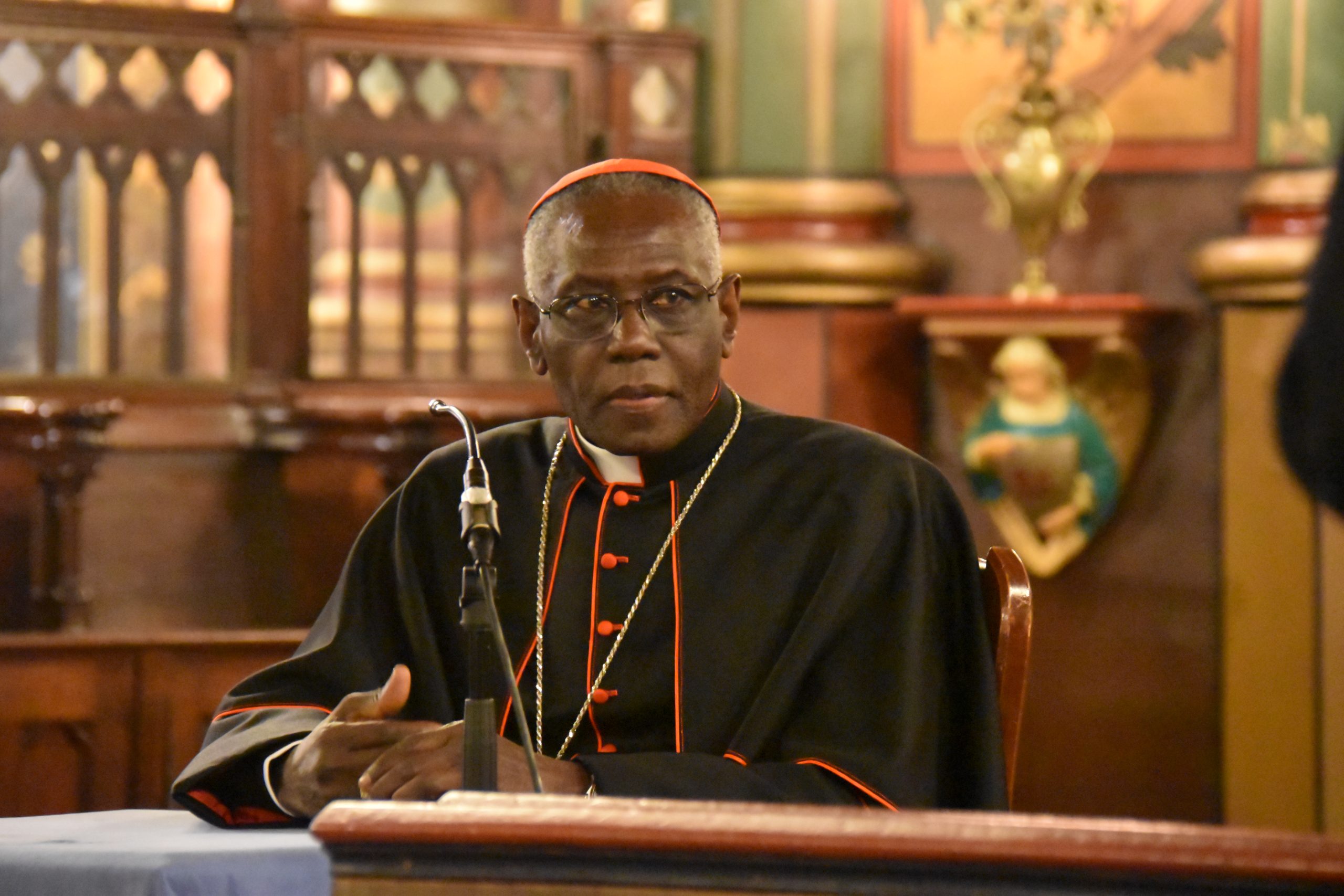
Cardinal Robert Sarah has warned that any episcopal consecrations carried out by the Society of St Pius X (SSPX) without papal approval would further damage the unity of the Church and further separate the traditionalist society from hierarchical communion with Rome.
In an interview with the French Catholic publication La Nef, the former prefect of the Congregation for Divine Worship and the Discipline of the Sacraments addressed reports that the SSPX intends to consecrate bishops on 1 July despite objections from the Holy See.
Speaking about the prospect of new episcopal consecrations, Cardinal Sarah said the situation remained “objectively serious” and was a source of “deep grief”.
“Sources close to the Society have announced new episcopal consecrations for July 1, 2026, and the Holy See has reportedly warned that such an act would constitute a decisive break with ecclesial communion,” Cardinal Sarah said.
The Guinean cardinal noted that canon law provides that both a bishop who consecrates another bishop without a papal mandate and the recipient incur automatic excommunication.
“Here, the act would be even more serious since it would involve ordaining a bishop against a formal request from the Apostolic See,” he said. The cardinal warned that attachment to Catholic tradition could never be divorced from ecclesial obedience, saying that “fidelity to Tradition cannot be separated from hierarchical communion”.
His Eminence stressed that concern for ecclesial unity should not obscure the doctrinal concerns raised by members of the society.
“And hierarchical communion, for its part, must never disregard the suffering or the doctrinal questions that have accumulated,” the former prefect said. “Truth and charity must go hand in hand. I believe we need to fast and pray so that the irreparable can be avoided.”
Cardinal Sarah has consistently spoken against the SSPX’s planned episcopal consecrations without a papal mandate, scheduled for 1 July 2026. In his public statement, Before It Is Too Late! A Call to Unity, he expressed grave concern over the decision, warning that such disobedience risks an irreversible rupture in the Church.
Cardinal Sarah stated: “For this reason, I wish to express my grave concern and my profound sorrow upon learning of the announcement by the Priestly Fraternity of Saint Pius X, founded by Archbishop Lefebvre, of its intention to proceed with episcopal ordinations without pontifical mandate.”
His Eminence added: “We are told that this decision to disobey the law of the Church is motivated by the supreme law of the salvation of souls: suprema lex, salus animarum. But salvation is Christ, and He gives Himself only within the Church. How can one claim to lead souls to salvation by paths other than those He Himself has indicated to us?”
Beyond the SSPX, Cardinal Sarah made remarks about the state of the Church and Western society, the legacy of Pope Francis, the interpretation of the Second Vatican Council and the challenges facing the pontificate of Pope Leo XIV.
Cardinal Sarah also expressed concern about what he described as the return of paganism within the Church. “Paganism is not merely the worship of visible idols; it is also the loss of the meaning of worship itself,” His Eminence said.
He warned that when faith is reduced to “sociological language”, liturgy becomes entertainment and morality a matter of perpetual negotiation, meaning that “something of paganism returns”. The cardinal added that the Church must resist adapting herself to the spirit of the age, warning that “permeability to the spirit of the world is the great heresy of our time”.
“The world does not expect the Church to repeat its words; it expects it to open Heaven to it,” Cardinal Sarah said.
Speaking about the late Pope Francis, Cardinal Sarah said it was legitimate for Church leaders to exercise discernment regarding a previous pontificate, provided it was done with reverence and fidelity. “It is not only permissible, but sometimes necessary, to exercise discernment regarding a period in the life of the Church,” the cardinal said, adding that “a cardinal is not a courtier” but “a servant of truth and a collaborator of the Apostolic See”.
“If this pontificate helps the Church to regain more doctrinal clarity, liturgical depth, inner peace and sense of God, then it will render a great service to the faithful,” he said.
While rejecting what he described as “worldly assessments” of a papacy, the former prefect acknowledged that pontificates could leave behind “areas of unease or confusion”. The Guinean cardinal argued that “it would be unjust to attribute to a single man a crisis that predates him by a considerable margin”, while also recognising that an era can leave “wounds of confusion”.
During the Francis pontificate, Cardinal Sarah emphasised fidelity to the Successor of Peter and rejected any narrative of personal opposition. As prefect of the Congregation for Divine Worship, he met regularly with the Pope as part of his curial responsibilities throughout his seven-year tenure.
In a 2021 interview following his resignation as prefect, Cardinal Sarah stated: “Even though some journalists continually repeat the same nonsense, I have never opposed the pope. … Some people insinuate without reason … that we were enemies. It’s not true! Pope Francis likes frankness. We have always worked together with simplicity, despite the fantasies of journalists.”
Turning to the Second Vatican Council, Cardinal Sarah argued that some conciliar texts would benefit from greater clarification, while rejecting suggestions that the council itself should be repudiated. “I would speak first of clarifications rather than corrections,” the former prefect said, insisting that “a council must be read within the continuity of the faith as it has always been”.
He identified religious liberty, ecumenism, collegiality and the relationship between the Church and the modern world as among the subjects that have generated differing interpretations since the council.
“Where certain texts have given rise to divergent, even opposing, interpretations, it is legitimate to call for a deeper examination in order to avoid readings that represent a break with the faith,” Cardinal Sarah said.
The cardinal also criticised forms of democracy detached from objective moral truth. While defending democracy as a legitimate political system, he warned that it becomes relativistic when it claims that majorities can determine good and evil.
“No procedure can create truth,” Cardinal Sarah said, warning that “a democracy that does not recognize an objective and transcendent limit to its power becomes a dictatorship of relativism”.
Despite his concerns about the condition of the Church and wider society, Cardinal Sarah pointed to signs of renewal, including growing interest among young Catholics in Eucharistic adoration, confession and traditional forms of prayer.
He also highlighted reports of increasing adult baptisms in parts of Europe as evidence of a renewed search for God amid cultural uncertainty. Looking ahead to the pontificate of Pope Leo XIV, Cardinal Sarah suggested that peace, unity and doctrinal clarity were already emerging as defining priorities. He expressed hope that the new pontificate would help the Church regain “more doctrinal clarity, liturgical depth, inner peace and sense of God”, which would render “a great service to the faithful”.