The full testament of Cardinal Camillo Ruini has been published after people close to the late cardinal expressed concern that parts of the document might never be made public.
The disclosure followed the late cardinal’s death and Pope Leo XIV’s citation of the testament during his homily at Ruini’s Requiem Mass. The testament was exclusively published by Messa in Latino, which released the complete spiritual text and stated that it was doing so to prevent the document from being “cut” or amended.
The revelation has taken on additional significance as AdVaticanum can reveal that there were concerns the testament would not be published in its entirety. To date, neither the Holy See Press Office nor the Vatican has done so.
On good authority, this publication can reveal that people close to the late cardinal wanted the complete testament published, particularly those sections dealing with the post-Second Vatican Council Church and Pope Francis.
Reflecting on the last pontificate, Cardinal Ruini expressed gratitude for what he described as the late Pope’s “extraordinary evangelising drive”, but also acknowledged a struggle with some of the directions taken by the Church in recent years.
“When Pope Francis was elected, I rejoiced and, to the extent I could, immediately supported him,” the late cardinal wrote. “Even today, I rejoice and thank him for his extraordinary evangelising drive.”
Yet the cardinal continued with a note of candour unusual in a spiritual testament: “I must confess, however, that I find myself in a state of unease, certainly not for personal reasons, but because I struggle to understand certain orientations that seem to reopen wounds that have barely healed since the Council. I humbly ask the Lord to convince me inwardly that the Church is His and that He Himself cares for it, beyond our human views.”
Long regarded as one of the most influential churchmen of the post-war Italian Church, Cardinal Ruini was a steadfast supporter of the Second Vatican Council while also becoming one of the most prominent critics of what he viewed as distortions in its implementation.
That dual concern is visible throughout the testament. Reflecting on his years as a priest in Reggio Emilia, Cardinal Ruini gave thanks for the Council itself, writing that he was grateful “for the Second Vatican Council, for having experienced it and helped others experience it joyfully in Reggio Emilia, and also for having given me the clarity and strength to oppose the post-conciliar excesses”.
The cardinal presented himself as a defender of the Council who believed that some developments undertaken in its name had gone beyond the intentions of the Fathers who gathered in Rome between 1962 and 1965.
The testament also sheds fresh light on Ruini’s relationship with the last three pontificates.
He described St John Paul II as “a very special grace”, recalling more than two decades of close collaboration after becoming one of the Polish Pope’s most trusted advisers.
“In John Paul II, I experienced your presence, Lord,” Cardinal Ruini wrote. “I was able to touch firsthand the union in prayer, the inseparability of prayer, life and apostolate, the courage of faith that guides history, and the capacity to love and forgive.”
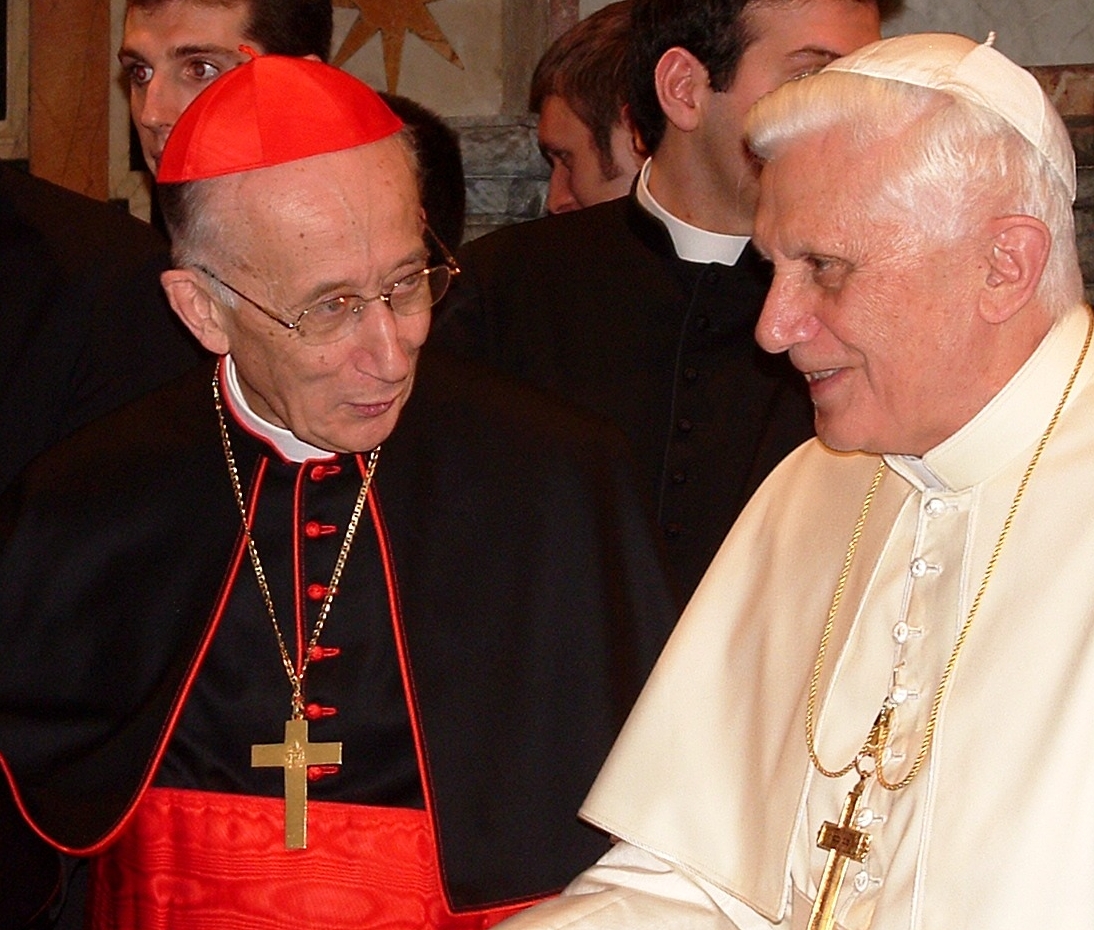
His words concerning Pope Benedict XVI were similarly affectionate. “After John Paul II, I collaborated for three years with Benedict XVI, and I thank him wholeheartedly, also for the affection he continues to show me,” the late cardinal wrote.
Yet despite his immense ecclesiastical influence, the testament is notable for its intensely personal and penitential tone. Cardinal Ruini repeatedly asks forgiveness for failures, weaknesses and sins, presenting himself not as a prince of the Church but as a Christian preparing for judgement.
“I confess first of all the weakness of my faith,” the former Cardinal Archpriest of St John Lateran wrote. “Despite all this, however, in the depths of my heart I have always been sustained by faith, even though, by the grace of God, I believe I have never succumbed to temptation.”
The testament also reveals a recurring theme of gratitude. Cardinal Ruini meticulously recalled family members, friends, priests, collaborators and colleagues who shaped his life, from his childhood in Sassuolo to his years at the Gregorian University and the Almo Collegio Capranica, and later his service as President of the Italian Bishops’ Conference and Cardinal Vicar of Rome.
At the same time, he acknowledged that the authority he exercised could sometimes be accompanied by severity. “I recognise and confess, however, that I have at times acted with substantial harshness,” he wrote, before asking forgiveness from those whom he had caused pain.
In the end, however, the testament is less a political statement than a spiritual examination of conscience. Its final pages are occupied not by ecclesiastical disputes but by an appeal for mercy and perseverance. “Lord, faithful God, never tire of loving me, calling me, and converting me,” Cardinal Ruini wrote. “Father, rich in mercy, grant me and all my brothers and sisters in humanity the grace of final perseverance.”