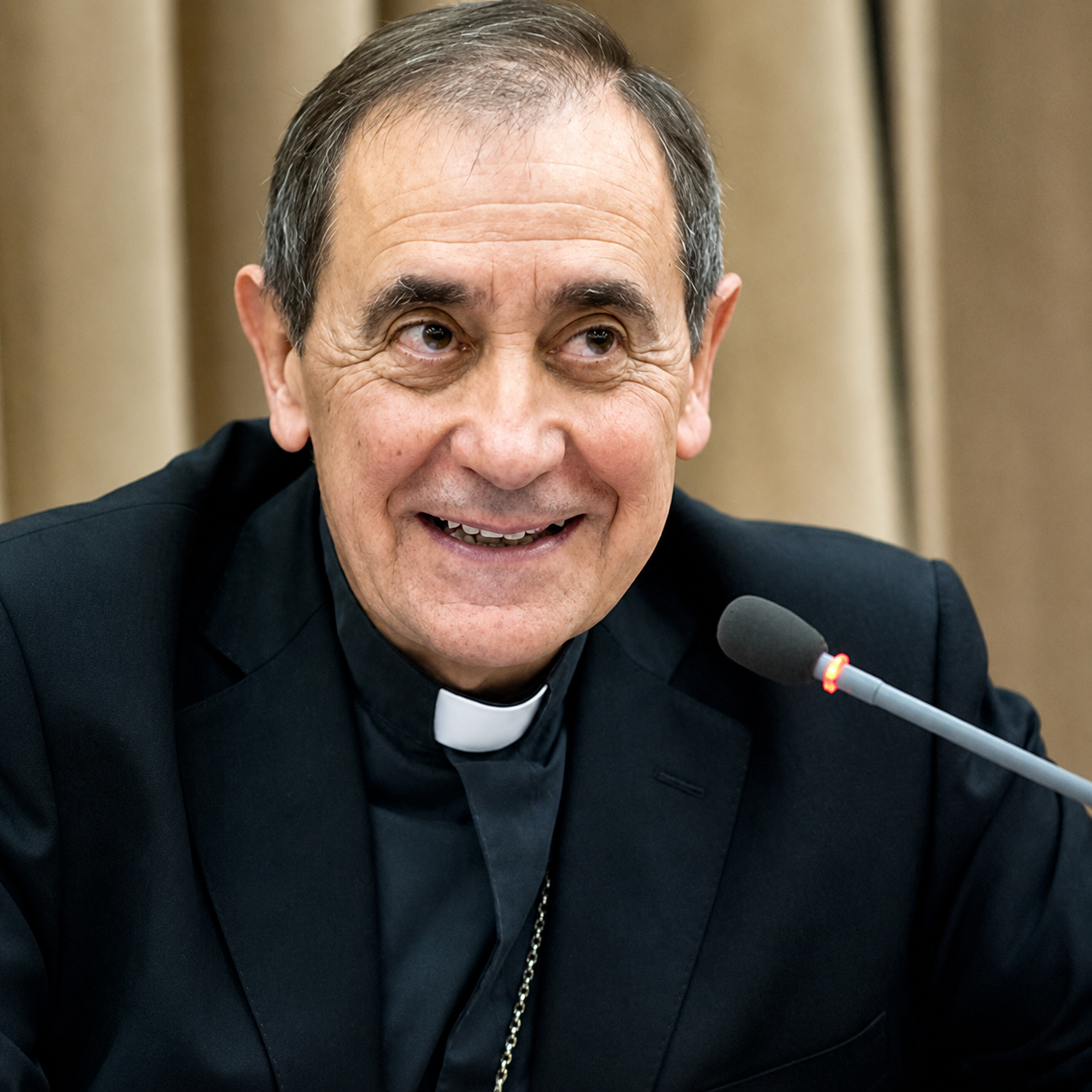
In an exclusive for AdVaticanum, Archbishop Arrieta, former Secretary of the Dicastery for Legislative Texts, has said that revoking the faculties necessary for the valid administration of the sacrament of Confession for the SSPX requires direct authorisation from the Pope himself.
The veteran canon lawyer’s intervention follows the Holy See’s formal response to the Society’s latest illicit episcopal consecrations. The consecrations have led to the Dicastery for the Doctrine of the Faith to issue a decree declaring the bishops involved excommunicated and warning clergy and the faithful against adhering to what it describes as a “schismatic movement”.
Arrieta told AdVaticanum that the recent consecrations are “a profound wound to the unity of the Church instituted by Christ”, echoing Pope Leo XIV’s warning issued shortly before the ceremony took place. He dismisses the Society’s longstanding justification that extraordinary circumstances created a “state of necessity” permitting episcopal consecrations without papal approval.
“The argument of a ‘state of necessity’ invoked by them does not appear reasonable,” the Archbishop said, arguing that the consecration of bishops “is an extremely sensitive element of the very structure of the Church” and was carried out “in direct disobedience to the successor of the Apostle Peter”.
For Archbishop Arrieta, the dispute extends beyond a single canonical offence. Arrieta told AdVaticanum that the latest consecrations reveal a deeper divergence in ecclesiology, saying they demonstrate that the Society’s reasoning “rests on a hierarchy of values and categories quite different from that taught by the Tradition of the Catholic Church”, making future doctrinal dialogue “highly problematic”.
His assessment put the latest events within the historical pattern established in 1988, when Archbishop Marcel Lefebvre consecrated four bishops without papal mandate despite months of negotiations with Rome. Archbishop Arrieta recalled that Cardinal Édouard Gagnon had conducted a canonical visitation to the Society’s seminary at Écône while efforts were simultaneously underway to restore communion.
He notes that the decisive negotiations were led by the then-Cardinal Joseph Ratzinger, Prefect of the Congregation for the Doctrine of the Faith, culminating in a protocol of agreement reached in early May 1988. According to Arrieta, Lefebvre subsequently withdrew from that agreement and refused to sign it, bringing the reconciliation effort to an end.
Beyond the theological discussions, Archbishop Arrieta said Rome had also been examining possible canonical structures that could accommodate the Society within the framework of the 1983 Code of Canon Law should an agreement have been reached.
When those negotiations collapsed, attention instead turned towards establishing what became the Pontifical Commission Ecclesia Dei to assist those wishing to remain attached to the older liturgy while staying in full communion with the Holy See.
Archbishop Arrieta also pointed out to AdVaticanum that although the Holy See declared Lefebvre, Bishop Antônio de Castro Mayer and the four newly consecrated bishops excommunicated in 1988, it never questioned the validity of their episcopal ordinations, “not least because doing so would have reopened settled ecumenical questions”.
The Archbishop also recalled that Pope John Paul II subsequently issued the motu proprio Ecclesia Dei, confirming that the consecrations constituted a schismatic act while establishing the Ecclesia Dei Commission. More than two decades later, in 2009, the Congregation for Bishops lifted the excommunications imposed upon the four surviving bishops consecrated by Archbishop Lefebvre, despite competence over such grave offences having already passed to the Congregation for the Doctrine of the Faith following Sacramentorum Sanctitatis Tutela.
That transfer of competence, Arrieta argues, explains why the present case has been handled by the Dicastery for the Doctrine of the Faith rather than another Vatican department.
Regarding the recent decree and explanatory note, Archbishop Arrieta first distinguishes carefully between the two documents recently published by the dicastery. The decree declaring the bishops excommunicated, he says, is what canon lawyers describe as “an act owed”. Rather than introducing a new penalty, it formally declares a juridical situation already established by canon law through the offence itself.
“The two documents now issued by the Dicastery for the Doctrine of the Faith are of a different nature and scope. The decree now issued represents, on the part of the dicastery, what is usually called ‘an act owed’, in the sense that it was an act the dicastery was bound to perform; it is limited to carrying out what canon 1387 of the Code prescribes, declaring for general notice that the six bishops involved find themselves in a situation of excommunication.”
Arrieta also notes that the co-consecrating bishop incurred the same automatic penalty, referring to a 2011 interpretative declaration issued by the Pontifical Council for Legislative Texts concerning illicit episcopal ordinations in China. In that case, questions existed over whether bishops had acted freely under pressure from the civil authorities, raising doubts about whether an automatic penalty had in fact been incurred. No such uncertainty exists in the present circumstances, he argues, making a formal decree necessary.
He adds that the decree also contains a formal warning to clergy and the faithful against adherence to the schism.
“In fact, unfortunately, even the co-consecrating bishop has incurred the automatic penal sanction of the aforementioned canon… In the present situation no such question arises, and so the dicastery had to issue a formal decree of excommunication… The current decree of the dicastery also contains a formal warning to clergy and the faithful not to adhere to the schism.”
In reference to the explanatory doctrinal note, Archbishop Arrieta explains that this second document differs fundamentally in purpose. Rather than declaring penalties, it explores the possible canonical consequences for those who formally identify themselves with the Society following the latest developments.
He pointed out that the note draws directly upon a 1996 explanatory document issued by the Pontifical Council for Legislative Texts, which examined the legal position of Catholics associated with the Lefebvrist movement after the 1988 consecrations.
That earlier text concluded that the illicit episcopal ordinations had “constituted the culmination of a progressive overall situation of a schismatic nature” and stated that “until there are changes leading to the re-establishment of this necessary communion, the entire Lefebvrian movement is to be considered schismatic”.
Arrieta stressed that the 1996 note carefully distinguished between the moral reality of schism and the canonical crime carrying legal penalties. It also established that formal adherence required both interior acceptance of schismatic positions and their external manifestation, criteria which apply differently to clergy and lay faithful.
He cautions, however, that determining the legal position of individual members of the faithful remains considerably more complicated than assessing the status of the bishops themselves.
Beyond the explanatory note, Archbishop Arrieta stated that many ordinary Catholics attached to the Society’s chapels may have acted in good faith, particularly those who have worshipped there for decades or were raised within those communities.
The former Secretary argues that some could fall within the principles articulated by the Second Vatican Council’s decree Unitatis Redintegratio concerning baptised Christians raised within separated ecclesial communities. He also observes that genuine good faith could amount to a “state of necessity” sufficient to prevent the automatic application of canonical penalties under canon 1324. Canon law, he notes, requires grave personal culpability through malice or negligence before penalties can be imposed.
At the same time, Archbishop Arrieta insists that this principle cannot be invoked indiscriminately. “Our conscience is not autonomous and must obey the teachings and authority of the Church,” he says, adding that personal responsibility ultimately depends upon each individual’s formation and knowledge.
He also points out that, beyond the six bishops identified in the dicastery’s decree, accomplices “without whose assistance the offence would not have been committed” likewise incur the same automatic penalty under canon 1329.
Perhaps the most practically significant part of Arrieta’s analysis concerns the validity of the sacraments administered by SSPX clergy following the latest schism.
He states that, under present circumstances, the ministry exercised by priests of the Society is unlawful except in danger of death. Nevertheless, validity depends upon the sacrament concerned. Confession and marriage occupy a unique position because both require specific canonical faculties for validity.
Regarding confession, Arrieta recalls that Pope Francis granted SSPX priests faculties to hear confessions validly during the Extraordinary Jubilee of Mercy in 2015 through Misericordiae Vultus. When the Jubilee concluded, Francis extended those faculties indefinitely through the apostolic letter Misericordia et Misera in November 2016.
Because those faculties were granted directly by the Pope, Arrieta argues that only another papal act could withdraw them.
“These priests received the faculty to hear confessions by a pontifical act, and an act of the same nature is required to revoke it,” he says, while observing what he describes as the paradox of priests exercising papally granted faculties while simultaneously acting in disobedience to the Roman Pontiff.
AdVaticanum can also disclose that it contacted Archbishop John Joseph Kennedy, Secretary for the Disciplinary Section of the Dicastery for the Doctrine of the Faith, seeking clarification on whether any apostolic letter, pontifical mandate or other papal act had been issued revoking the faculties granted to SSPX priests to hear confessions validly. The dicastery declined to address the question, responding only with the words: “No comment.”
Marriage, however, presents a different canonical situation.
In 2017, Pope Francis instructed the Ecclesia Dei Commission to permit diocesan bishops to delegate SSPX priests the faculty to assist validly at marriages in individual cases, thereby safeguarding the canonical form required by the Church. Those faculties, Arrieta told this publication, depended upon delegation by local ordinaries rather than a universal faculty directly attached to every priest of the Society.
In the aftermath of the latest episcopal consecrations, he considers it unlikely that diocesan bishops could now legitimately grant such faculties.
“Present circumstances make it unlikely that a bishop could legitimately grant such a faculty,” he says, concluding that marriages witnessed by SSPX priests would therefore be “canonically null for lack of canonical form”.
The six newly excommunicated bishops stand in an even more serious position. Arrieta notes that the declaration of excommunication bars them both from receiving the sacraments and from exercising ecclesiastical ministry, carrying further moral and canonical consequences should those prohibitions be disregarded.
On more recent developments, the SSPX has formally challenged the Vatican’s 2 July decree. Archbishop Arrieta was not available to comment further because of his schedule, having filed his answers prior to the Society’s preliminary recourse. However, this publication can reveal that a priest close to the DDF told AdVaticanum that the appeal is unlikely to be granted, since it concerns a latae sententiae penalty based on a well-known offence. The dicastery did not “impose” the penalty, which is automatic, but simply “declared” it in the decree for the public knowledge of the faithful. The only way to lift a latae sententiae excommunication requires, as a starting point, the offender’s repentance for the act committed.
Image credit: Pontificia Università della Santa Croce