

Dicastery For The Doctrine Of The Faith
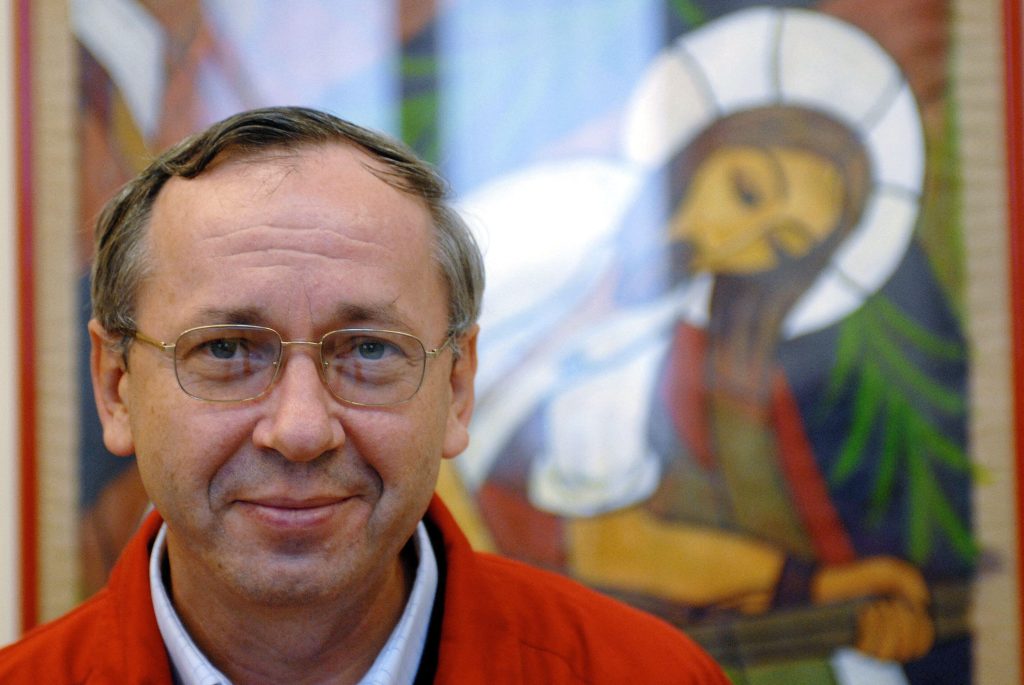
Father Marko Rupnik acquitted in canonical trial, sources say
MessainLatino and AdVaticanum sources indicate that Father Marko Rupnik has been acquitted in the canonical criminal proceedings relating to allegations involving violence. The Holy See has not publicly confirmed the reported ruling or released the sentence MessainLatino has reported that Father Marko Ivan Rupnik has been acquitted in his canonical criminal trial. According to the pulication, after corroborating “persistent and highly authoritative sources”, it concluded that the verdict was in favour of Father Rupnik. While the reported outcome has not been confirmed publicly by the Holy See, AdVaticanum has corroborated MessainLatino’s reporting through its own sources, which have also confirmed the ruling. AdVaticanum has spoken to Vatican sources who would like the Holy See to publish the sentence publicly. Many, however, believe the Vatican will be reluctant to do so. From this publication’s understanding, the trial centred on whether the alleged abuse involved violence. The judges ruled in favour of Father Rupnik, citing insufficient certainty. This publication has also learned that a further case is likely being prepared. The sentence itself has not been released publicly, and no official statement has been issued by the Dicastery for the Doctrine of the Faith. The absence of any formal Vatican announcement has renewed questions about transparency in the handling of high-profile canonical cases. As this publication understands, the reported acquittal concerns only the specific canonical criminal proceedings relating to allegations involving violence. It does not necessarily bring every aspect of the wider Rupnik affair to a conclusion. The formal judicial process has always been conducted under canon law rather than through the secular courts. Unlike civil criminal proceedings, canonical trials before the Dicastery for the Doctrine of the Faith are confidential by their nature, with evidence, witness testimony and judicial deliberations ordinarily remaining sealed unless the Holy See decides otherwise. Consequently, little official information has emerged since the case was reopened. Father Rupnik, born in Slovenia in 1954, rose to international prominence as both a theologian and an artist. His mosaics adorn churches, shrines and chapels across the Catholic world, including the Vatican, Lourdes and Fatima, while his theological reflections on sacred art earned him considerable influence in ecclesiastical circles. The allegations that later emerged fundamentally altered that reputation. Multiple women accused Father Rupnik of sexual, psychological, spiritual and abuse-of-authority offences spanning several decades, with many of the earliest complaints originating from former members of the Loyola Community. Further accusations later involved women connected with Centro Aletti and his wider ministry. Before the current proceedings, Father Rupnik had already faced another canonical process concerning the crime of absolving in confession a woman with whom he had engaged in sexual activity. That offence carries an automatic excommunication under canon law. In 2020, the then Congregation for the Doctrine of the Faith declared that excommunication after external judges unanimously confirmed the offence. The penalty was subsequently lifted in the same month after Father Rupnik admitted the facts, expressed repentance and fulfilled the conditions required by the Holy See. Restrictions on his ministry followed. Attention later shifted to the wider allegations relating to members of the Loyola Community. After further complaints reached both the Society of Jesus and the Vatican, an investigation was conducted and forwarded to the Dicastery for the Doctrine of the Faith with a recommendation that a penal process should begin. The dicastery ultimately concluded in 2022 that the alleged offences were barred by the applicable statute of limitations then in force under canon law. That decision attracted widespread criticism after details of the allegations entered the public domain. In October 2023, Pope Francis waived the canonical statute of limitations, allowing the case to proceed despite the passage of time. The move was interpreted as a sign of the seriousness with which the Holy See intended to address the allegations and followed concerns expressed by the Pontifical Commission for the Protection of Minors regarding aspects of the case’s handling. Meanwhile, Father Rupnik’s relationship with the Society of Jesus deteriorated. The Jesuits ultimately dismissed him, citing a persistent refusal to obey legitimate instructions. The order stated that he had declined opportunities to acknowledge his conduct publicly, seek forgiveness and undertake a process of rehabilitation. Father Rupnik was subsequently incardinated into the Diocese of Koper in his native Slovenia. On 13 October 2025, the Dicastery for the Doctrine of the Faith disclosed that five judges had been appointed to hear the case, explaining that the panel consisted of women and clerics who neither belonged to the dicastery nor held office within the Roman Curia. The Holy See stated that the arrangement was intended to guarantee the tribunal’s autonomy and independence. The Vatican did not publish the identities of the judges, nor did it provide details regarding their backgrounds or expertise. The confidentiality surrounding the process has led to criticism from some representing the alleged victims, who argue that they received little information regarding the tribunal’s progress despite repeated requests for clarification. Those concerns persisted throughout the trial. Lawyer Laura Sgrò, who represents several of the women bringing allegations against Father Rupnik, repeatedly stated publicly that she had sought procedural information from the Dicastery for the Doctrine of the Faith but had received no substantive response. The Society of Jesus has itself publicly acknowledged shortcomings in its handling of the affair. Father Johan Verschueren SJ, acting on behalf of the order in Rome, apologised to those who said they had suffered because of Father Rupnik’s actions and announced efforts aimed at reparation and healing. Jesuit Superior General Father Arturo Sosa later admitted that the order had failed to recognise warning signs and described that failure as a form of institutional blindness.
Jul. 20, 2026
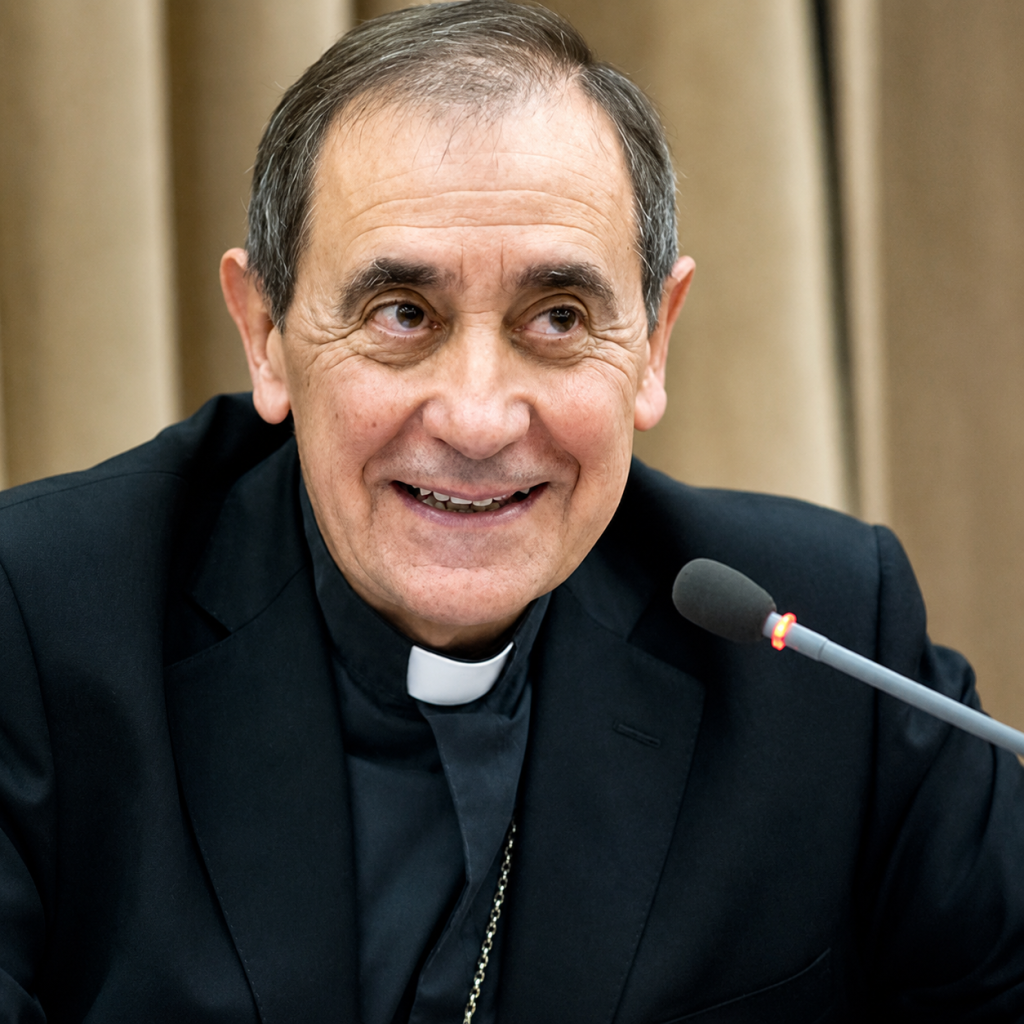
Canonist Archbishop Arrieta breaks down the Vatican’s response to the SSPX bishops
Archbishop Juan Ignacio Arrieta, former Secretary of the Pontifical Council for Legislative Texts and canon lawyer, speaks exclusively to AdVaticanum about the Vatican’s response to the SSPX’s latest episcopal consecrations, explaining what the recent decree means in practice for the Society, its clergy and the faithful, including the validity of SSPX confessions and marriages In an exclusive for AdVaticanum, Archbishop Arrieta, former Secretary of the Dicastery for Legislative Texts, has said that revoking the faculties necessary for the valid administration of the sacrament of Confession for the SSPX requires direct authorisation from the Pope himself. The veteran canon lawyer’s intervention follows the Holy See’s formal response to the Society’s latest illicit episcopal consecrations. The consecrations have led to the Dicastery for the Doctrine of the Faith to issue a decree declaring the bishops involved excommunicated and warning clergy and the faithful against adhering to what it describes as a “schismatic movement”. Arrieta told AdVaticanum that the recent consecrations are “a profound wound to the unity of the Church instituted by Christ”, echoing Pope Leo XIV’s warning issued shortly before the ceremony took place. He dismisses the Society’s longstanding justification that extraordinary circumstances created a “state of necessity” permitting episcopal consecrations without papal approval. “The argument of a ‘state of necessity’ invoked by them does not appear reasonable,” the Archbishop said, arguing that the consecration of bishops “is an extremely sensitive element of the very structure of the Church” and was carried out “in direct disobedience to the successor of the Apostle Peter”. For Archbishop Arrieta, the dispute extends beyond a single canonical offence. Arrieta told AdVaticanum that the latest consecrations reveal a deeper divergence in ecclesiology, saying they demonstrate that the Society’s reasoning “rests on a hierarchy of values and categories quite different from that taught by the Tradition of the Catholic Church”, making future doctrinal dialogue “highly problematic”. His assessment put the latest events within the historical pattern established in 1988, when Archbishop Marcel Lefebvre consecrated four bishops without papal mandate despite months of negotiations with Rome. Archbishop Arrieta recalled that Cardinal Édouard Gagnon had conducted a canonical visitation to the Society’s seminary at Écône while efforts were simultaneously underway to restore communion. He notes that the decisive negotiations were led by the then-Cardinal Joseph Ratzinger, Prefect of the Congregation for the Doctrine of the Faith, culminating in a protocol of agreement reached in early May 1988. According to Arrieta, Lefebvre subsequently withdrew from that agreement and refused to sign it, bringing the reconciliation effort to an end. Beyond the theological discussions, Archbishop Arrieta said Rome had also been examining possible canonical structures that could accommodate the Society within the framework of the 1983 Code of Canon Law should an agreement have been reached. When those negotiations collapsed, attention instead turned towards establishing what became the Pontifical Commission Ecclesia Dei to assist those wishing to remain attached to the older liturgy while staying in full communion with the Holy See. Archbishop Arrieta also pointed out to AdVaticanum that although the Holy See declared Lefebvre, Bishop Antônio de Castro Mayer and the four newly consecrated bishops excommunicated in 1988, it never questioned the validity of their episcopal ordinations, “not least because doing so would have reopened settled ecumenical questions”. The Archbishop also recalled that Pope John Paul II subsequently issued the motu proprio Ecclesia Dei, confirming that the consecrations constituted a schismatic act while establishing the Ecclesia Dei Commission. More than two decades later, in 2009, the Congregation for Bishops lifted the excommunications imposed upon the four surviving bishops consecrated by Archbishop Lefebvre, despite competence over such grave offences having already passed to the Congregation for the Doctrine of the Faith following Sacramentorum Sanctitatis Tutela. That transfer of competence, Arrieta argues, explains why the present case has been handled by the Dicastery for the Doctrine of the Faith rather than another Vatican department. Regarding the recent decree and explanatory note, Archbishop Arrieta first distinguishes carefully between the two documents recently published by the dicastery. The decree declaring the bishops excommunicated, he says, is what canon lawyers describe as “an act owed”. Rather than introducing a new penalty, it formally declares a juridical situation already established by canon law through the offence itself. “The two documents now issued by the Dicastery for the Doctrine of the Faith are of a different nature and scope. The decree now issued represents, on the part of the dicastery, what is usually called ‘an act owed’, in the sense that it was an act the dicastery was bound to perform; it is limited to carrying out what canon 1387 of the Code prescribes, declaring for general notice that the six bishops involved find themselves in a situation of excommunication.” Arrieta also notes that the co-consecrating bishop incurred the same automatic penalty, referring to a 2011 interpretative declaration issued by the Pontifical Council for Legislative Texts concerning illicit episcopal ordinations in China. In that case, questions existed over whether bishops had acted freely under pressure from the civil authorities, raising doubts about whether an automatic penalty had in fact been incurred. No such uncertainty exists in the present circumstances, he argues, making a formal decree necessary. He adds that the decree also contains a formal warning to clergy and the faithful against adherence to the schism. “In fact, unfortunately, even the co-consecrating bishop has incurred the automatic penal sanction of the aforementioned canon… In the present situation no such question arises, and so the dicastery had to issue a formal decree of excommunication… The current decree of the dicastery also contains a formal warning to clergy and the faithful not to adhere to the schism.” In reference to the explanatory doctrinal note, Archbishop Arrieta explains that this second document differs fundamentally in purpose. Rather than declaring penalties, it explores the possible canonical consequences for those who formally identify themselves with the Society following the latest developments. He pointed out that the note draws directly upon a 1996 explanatory document issued by the Pontifical Council for Legislative Texts, which examined the legal position of Catholics associated with the Lefebvrist movement after the 1988 consecrations. That earlier text concluded that the illicit episcopal ordinations had “constituted the culmination of a progressive overall situation of a schismatic nature” and stated that “until there are changes leading to the re-establishment of this necessary communion, the entire Lefebvrian movement is to be considered schismatic”. Arrieta stressed that the 1996 note carefully distinguished between the moral reality of schism and the canonical crime carrying legal penalties. It also established that formal adherence required both interior acceptance of schismatic positions and their external manifestation, criteria which apply differently to clergy and lay faithful. He cautions, however, that determining the legal position of individual members of the faithful remains considerably more complicated than assessing the status of the bishops themselves. Beyond the explanatory note, Archbishop Arrieta stated that many ordinary Catholics attached to the Society’s chapels may have acted in good faith, particularly those who have worshipped there for decades or were raised within those communities. The former Secretary argues that some could fall within the principles articulated by the Second Vatican Council’s decree Unitatis Redintegratio concerning baptised Christians raised within separated ecclesial communities. He also observes that genuine good faith could amount to a “state of necessity” sufficient to prevent the automatic application of canonical penalties under canon 1324. Canon law, he notes, requires grave personal culpability through malice or negligence before penalties can be imposed. At the same time, Archbishop Arrieta insists that this principle cannot be invoked indiscriminately. “Our conscience is not autonomous and must obey the teachings and authority of the Church,” he says, adding that personal responsibility ultimately depends upon each individual’s formation and knowledge. He also points out that, beyond the six bishops identified in the dicastery’s decree, accomplices “without whose assistance the offence would not have been committed” likewise incur the same automatic penalty under canon 1329. Perhaps the most practically significant part of Arrieta’s analysis concerns the validity of the sacraments administered by SSPX clergy following the latest schism. He states that, under present circumstances, the ministry exercised by priests of the Society is unlawful except in danger of death. Nevertheless, validity depends upon the sacrament concerned. Confession and marriage occupy a unique position because both require specific canonical faculties for validity. Regarding confession, Arrieta recalls that Pope Francis granted SSPX priests faculties to hear confessions validly during the Extraordinary Jubilee of Mercy in 2015 through Misericordiae Vultus. When the Jubilee concluded, Francis extended those faculties indefinitely through the apostolic letter Misericordia et Misera in November 2016. Because those faculties were granted directly by the Pope, Arrieta argues that only another papal act could withdraw them. “These priests received the faculty to hear confessions by a pontifical act, and an act of the same nature is required to revoke it,” he says, while observing what he describes as the paradox of priests exercising papally granted faculties while simultaneously acting in disobedience to the Roman Pontiff. AdVaticanum can also disclose that it contacted Archbishop John Joseph Kennedy, Secretary for the Disciplinary Section of the Dicastery for the Doctrine of the Faith, seeking clarification on whether any apostolic letter, pontifical mandate or other papal act had been issued revoking the faculties granted to SSPX priests to hear confessions validly. The dicastery declined to address the question, responding only with the words: “No comment.” Marriage, however, presents a different canonical situation. In 2017, Pope Francis instructed the Ecclesia Dei Commission to permit diocesan bishops to delegate SSPX priests the faculty to assist validly at marriages in individual cases, thereby safeguarding the canonical form required by the Church. Those faculties, Arrieta told this publication, depended upon delegation by local ordinaries rather than a universal faculty directly attached to every priest of the Society. In the aftermath of the latest episcopal consecrations, he considers it unlikely that diocesan bishops could now legitimately grant such faculties. “Present circumstances make it unlikely that a bishop could legitimately grant such a faculty,” he says, concluding that marriages witnessed by SSPX priests would therefore be “canonically null for lack of canonical form”. The six newly excommunicated bishops stand in an even more serious position. Arrieta notes that the declaration of excommunication bars them both from receiving the sacraments and from exercising ecclesiastical ministry, carrying further moral and canonical consequences should those prohibitions be disregarded. On more recent developments, the SSPX has formally challenged the Vatican’s 2 July decree. Archbishop Arrieta was not available to comment further because of his schedule, having filed his answers prior to the Society’s preliminary recourse. However, this publication can reveal that a priest close to the DDF told AdVaticanum that the appeal is unlikely to be granted, since it concerns a latae sententiae penalty based on a well-known offence. The dicastery did not “impose” the penalty, which is automatic, but simply “declared” it in the decree for the public knowledge of the faithful. The only way to lift a latae sententiae excommunication requires, as a starting point, the offender’s repentance for the act committed. Image credit: Pontificia Università della Santa Croce
Jul. 18, 2026
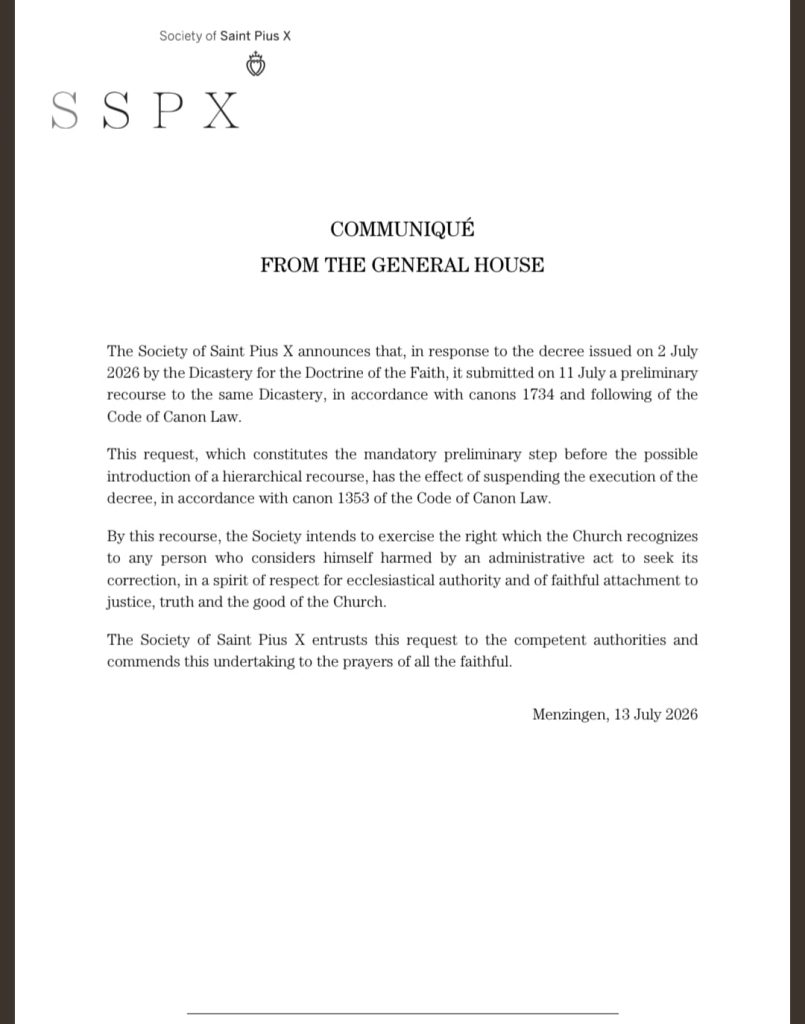
Analysis: The SSPX’s canonical challenge to Vatican excommunications
The SSPX has formally challenged the Vatican’s 2 July decree under the 1983 Code of Canon Law. Our analysis examines the Society’s legal arguments, how the recourse process works and what could happen next in its dispute with Rome The Society of Saint Pius X has taken its dispute with the Holy See into a new canonical phase after announcing that it has formally challenged the Dicastery for the Doctrine of the Faith’s decree of 2 July by means of a preliminary recourse under the 1983 Code of Canon Law. In a communiqué issued at 9 pm Central European time from its headquarters in Menzingen on 13 July, the SSPX confirmed that it had submitted the recourse petition on 11 July in accordance with canon 1734, arguing that the measure automatically suspends the penalties of the Vatican decree under canon 1353 while the matter is under review. The communiqué issued from SSPX headquarters in Menzingen on 13 July The move is the first formal procedural response by the SSPX since Rome declared that the episcopal consecration of four priests on 1 July without a pontifical mandate constituted “an act of a schismatic nature”, triggering the most serious confrontation between the Society and the Holy See since the 1988 excommunications. Rather than presenting the filing as an act of defiance, the Society described it as the exercise of a right recognised by the Church. “The Society intends to exercise the right which the Church recognizes to any person who considers himself harmed by an administrative act to seek its correction, in a spirit of respect for ecclesiastical authority and of faithful attachment to justice, truth and the good of the Church,” the communiqué states. The procedural significance of the filing lies in the canons cited by the Society. Canon 1734 requires anyone wishing to challenge an administrative decree first to request in writing that its author revoke or amend it before lodging a higher appeal. The petition must normally be filed within ten useful days of notification. Canon 1353 provides that recourse against decrees which inflict or declare a penalty has a suspensive effect, while canon 1736 confirms that where the law itself suspends execution, the preliminary petition produces the same effect. In practical terms, the SSPX argues that the penalties and declarations contained in the decree cannot be enforced while its request remains pending before the Dicastery for the Doctrine of the Faith. The canonical process does not end with this first submission. Under canon 1735, the Dicastery has thirty days to respond by revoking, correcting or rejecting the request. If it issues a new decree, or if it rejects the petition, the Society may then pursue a hierarchical recourse under canon 1737. That appeal would seek a review by the competent higher authority, with the superior possessing the authority to confirm, revoke or modify the original decree. The legal process creates a temporary pause while preserving the possibility of a fuller examination of the dispute. For the Society, however, the procedural arguments are only one part of a much broader disagreement with Rome over the character of the July consecrations themselves. In an extensive analysis published on 9 July, the SSPX rejected the Dicastery’s central conclusion that the consecrations were schismatic. Referring directly to the decree, the Society argued that “the decree claims that ‘Monsignor Alfonso de Galarreta’ committed ‘an act of a schismatic nature by the episcopal consecration of four priests, without a papal mandate and against the will of the Sovereign Pontiff.’ But such an assertion is hasty and reveals a flawed understanding of schism.” Drawing upon classical canonists and theologians, including Monsignor Raoul Naz and Cardinal Cajetan, the Society sought to distinguish schism from disobedience. It maintained that while the consecrations had taken place contrary to the wishes of Pope Leo XIV, they did not involve a rejection of the Roman Pontiff’s authority. “The Society of Saint Pius X and its Superior General have always affirmed that they recognize Leo XIV as their head. They address him as a subject addresses his superior, as a son addresses his father. … The Society has never claimed to constitute a parallel or autonomous Church.” In its view, schism requires the refusal of submission to the Roman Pontiff or separation from communion with the Church. The SSPX insists that it continues to recognise papal authority while disputing what it considers an unjust administrative act. From its perspective, the dispute concerns the lawfulness and necessity of the episcopal consecrations rather than communion with the Holy See itself. The Society also devoted considerable attention to the penalties declared by the Dicastery. It argued that canon law does not impose penalties automatically without regard to personal culpability, invoking the longstanding principle of nulla poena sine culpa . Citing canons 1323 and 1324, it maintained that a person acting out of necessity or under grave fear may not incur canonical penalties in the ordinary way. The document concludes that “these two canonical considerations are sufficient to affirm with certainty that neither the consecrating bishops nor the bishops consecrated on July 1, 2026, are excommunicated.” According to the SSPX, the necessity in question is not subjective but arises from what it describes as “the grave danger threatening the complete preservation of the faith and the ordinary means of sanctification”. That appeal to a state of necessity has formed the backbone of the Society’s canonical reasoning since Archbishop Marcel Lefebvre justified the 1988 episcopal consecrations on similar grounds. The Society’s decision to pursue a formal recourse also recalls another episode involving traditionalist Catholics. During the early 1990s, six Catholics in Hawaii who had been declared excommunicated by the local bishop because of their association with SSPX sacramental life sought hierarchical recourse to Rome. Following a review by the Congregation for the Doctrine of the Faith under Cardinal Joseph Ratzinger, the decrees were ultimately declared null, with the Vatican concluding that the actions in question did not amount to formal schism. While the factual circumstances differ substantially from the present dispute, the Hawaii case remains one of the clearest examples of the Holy See overturning canonical penalties after the recourse procedure. The comparison with 1988 is unavoidable, yet the present situation differs in one significant respect. Following Archbishop Lefebvre’s consecration of four bishops without papal approval, Rome declared that he and the newly consecrated bishops had incurred excommunication. The Society consistently maintained that those penalties had never been valid because of necessity but did not pursue the structured administrative recourse now available under the current procedural framework. Instead, the dispute evolved through years of theological dialogue until Pope Benedict XVI remitted the excommunications in 2009 without requiring the Society first to acknowledge that they had been validly incurred. The present case therefore combines continuity with a twist. Substantively, the SSPX continues to reject both the accusation of schism and the penalties attached to it. Procedurally, however, it is making full use of the mechanisms provided by the 1983 Code of Canon Law. The SSPX’s reservations concerning the post-conciliar reforms extended to the legal framework established after the Second Vatican Council. Yet by relying explicitly upon canons 1353 and 1734 to 1737, the Society is invoking the authority of the very Code promulgated by Pope John Paul II in 1983. Indeed, recognition of the validity of the 1983 Code appeared as the fifth point in the Memorandum of Understanding signed by Cardinal Joseph Ratzinger and Archbishop Lefebvre on 5 May 1988 before the agreement collapsed the following day. Beyond that, the SSPX readily acknowledges that the Dicastery has issued a decree and that the decree purports to impose canonical consequences. What it does not accept is that those consequences have been validly incurred. Its decision to file recourse therefore seeks simultaneously to suspend the decree’s effects, protect its apostolate and challenge the Vatican’s position using the Church’s own judicial mechanisms. The Dicastery for the Doctrine of the Faith will in theory make the next move. It may revoke or amend its decree, reject the petition outright or simply reaffirm its earlier conclusions. Should that occur, the Society would then be entitled to pursue hierarchical recourse within the Roman Curia under the timetable established by canon law. The competent authority would have the power to uphold, rescind or modify the decree, while the Pope himself could intervene personally at any stage, either by deciding the matter directly or by instructing the Dicastery to adopt a different course. For now, the dispute enters a new but no less consequential phase. The canonical process offers neither side an immediate victory. Instead, it places the latest confrontation between Rome and the Society of Saint Pius X within the legal structures of the Church.
Jul. 13, 2026
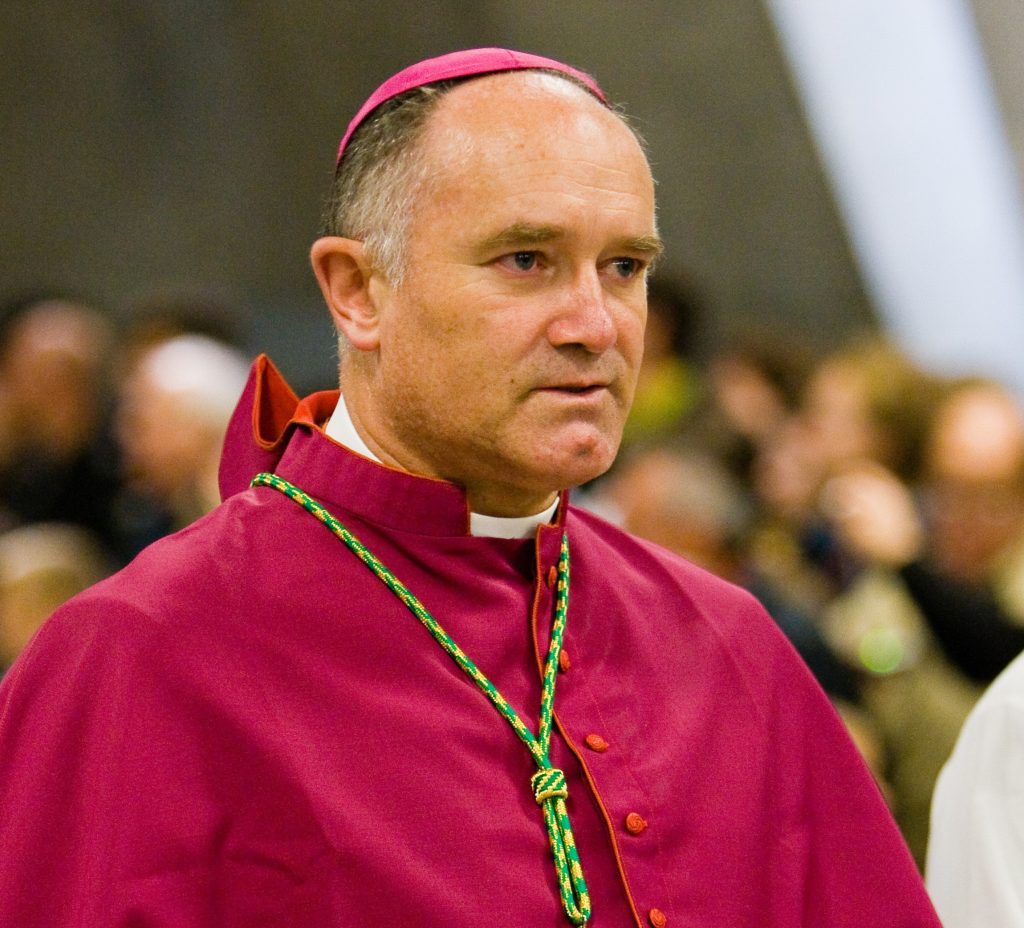
Fellay warns of SSPX faithful excommunication as Rome prepares its response to episcopal consecrations
Bishop Bernard Fellay has warned that the faithful may face excommunication, as indications from Rome suggest a response is being prepared to possible episcopal consecrations without papal mandate In a surprise turn, the former superior general of the Society of Saint Pius X has warned that the faithful may face excommunication, as indications emerge that Rome has prepared a response to possible episcopal consecrations without a papal mandate. In an exclusive sermon transcript obtained by Advaticanum , Bishop Bernard Fellay told those present at confirmations on Good Shepherd Sunday at the Immaculata in St Mary’s, Kansas, that such a development was increasingly likely. “I prefer not to be a prophet here, but I’m pretty sure that there is an enormous probability that all of you, we included, may be excommunicated, declared schismatic, there is a very high probability because they already said it in public. So, they are so to say forcing themselves to do it. But whatever, God can do miracles. It’s not the end.” He continued by framing the homily in spiritual terms, telling the congregation that “our history shows that God wants us to be a sign of contradiction, a sign that reveals hearts. And a sign of contradiction means the Cross. We must be ready to carry it.” Beyond his warning on possible excommunication, Bishop Fellay used the homily to deliver an extended meditation on the nature of the Church, drawing repeatedly on the theme of Good Shepherd Sunday and the Gospel’s declaration that there shall be “one shepherd and one fold”. He began by stressing that the Church, like the human person, possesses both a visible and an invisible dimension, cautioning against what he described as a tendency to remain at the surface. “God has created us with both body and soul,” he said. “There is a visible part and an invisible part, and both are absolutely real. Indeed, the invisible part, the soul, is far more important. Yet we must not set them in opposition. To separate body and soul is to have death, nothing more.” Developing the point, he compared the Faith to a lake whose depths are often ignored. “Many people are content to admire its beautiful surface and believe they know everything about it. But if you truly wish to understand the lake, you must look beneath the surface.” The same, he said, applies to the Church, which cannot be reduced to outward appearances alone. He referred to the longstanding principle Ecclesia de internis non judicat , that the Church does not judge interior dispositions, and linked this to the sacraments, explaining that while matter and form are visible, intention remains hidden and is presumed when the rites are followed. Faith itself, he continued, is likewise interior, but must be outwardly professed. Citing Scripture, he warned: “These people honour me with their lips, but their hearts are far from me.” Turning to the liturgy, Bishop Fellay urged the faithful to deepen their engagement with the prayers of the Holy Mass, recommending that they be read in advance so that participation would not remain merely external. He drew on Archbishop Marcel Lefebvre’s Spiritual Journey, describing the liturgy as “the breathing of the soul” when properly united to interior prayer. He contrasted two approaches to worship, saying that one could remain at “the beautiful surface” or “dive deeper”, and insisted that this distinction applied to all aspects of Christian life. Even ordinary daily actions, he said, could be transformed if consciously offered to God: “If, every morning, we offer our entire day to God, all our actions, joys, and sufferings, then everything becomes an act of charity, praise, and glory to God.” The bishop also employed a more pointed comparison when speaking about the liturgy, likening it to a vessel containing grace. “The surface is important. Consider a glass: the liquid inside is more valuable, but without the glass the liquid is lost,” he said, before adding: “This is precisely what has happened with the new liturgy. They have made holes in the vessel of grace. The Traditional Mass is like a full-flowing river of graces, while the new rite often yields only a few drops.” He went on to describe what he called three pillars of the Church’s visible unity: unity of faith, unity of liturgy and unity of government. Each, he argued, had been “severely struck”. On the unity of faith, he claimed that belief had diminished significantly in various parts of the Church, asserting that outward profession did not always correspond to interior conviction. “They may still recite the Creed outwardly, but interiorly the faith is dead. Whoever denies even one truth of the faith has lost the faith entirely.” The homily was delivered in relation to the question of episcopal consecrations and possible sanctions. According to this publication’s Vatican correspondent, Niwa Limbu, officials within the Dicastery for the Doctrine of the Faith are preparing for the possibility of a formal declaration of excommunication not only of bishops but also of priests belonging to the Society. Vatican correspondent Nico Spuntoni, writing for Il Giornale, relayed that “as far as I know, the Dicastero for the Doctrine of the Faith is already prepared for the possibility of excommunicating the SSPX following the ordinations.” The Holy See has already set out its position in clear terms. In a statement issued following a meeting between the prefect of the Dicastery for the Doctrine of the Faith and the superior general of the Society, it reiterated that episcopal ordinations carried out without pontifical mandate would have grave consequences. The statement said that “the ordination of Bishops without a mandate from the Holy Father, who possesses supreme, full, universal, immediate and direct ordinary power (cf. CIC, can. 331; Dogmatic Constitution Pastor aeternus, chapters I and III), would imply a decisive rupture of ecclesial communion (schism) with grave consequences for the Fraternity as a whole.” Other less official reporting suggests that a similar course may now be under consideration. The blog Rorate Caeli, citing anonymous Roman sources, reported on April 25 that Pope Leo XIV has “decided to follow the ‘1988 jurisprudence’” in relation to any forthcoming consecrations by the Society. According to the report, a decree has already been prepared “similar in tone and content to the one promulgated by Pope John Paul II through Cardinal Bernardin Gantin … on 1 July 1988.” For now, both the warnings from the Holy See and the words of the Society’s leadership indicate that a decisive point may be approaching.
Apr. 26, 2026