Traditional Latin Mass
Bishop of Aberdeen expands TLM by appointing former Papa Stronsay priests
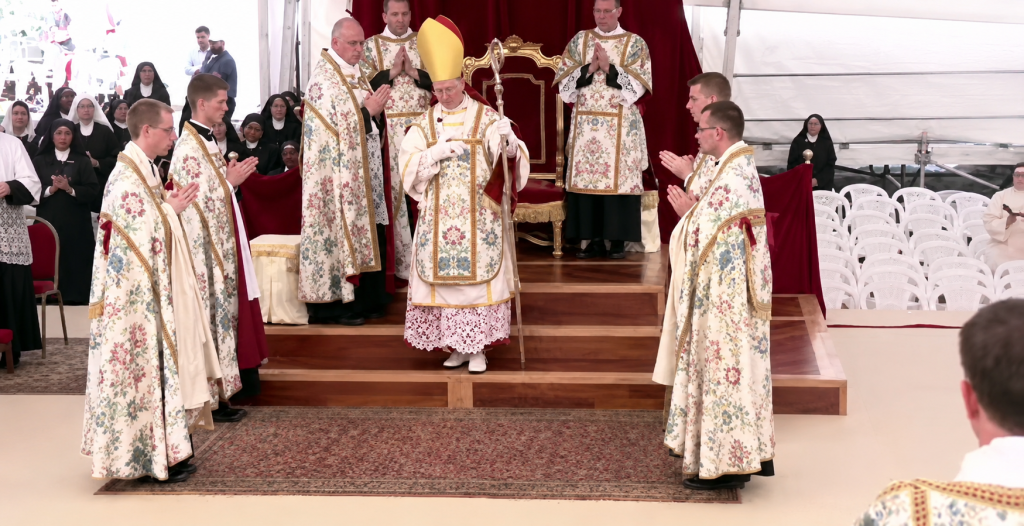
Bishop Hugh Gilbert has expanded Sunday provision for the Traditional Latin Mass in the Diocese of Aberdeen by appointing former Papa Stronsay priests to the apostolate, while continuing to oppose the community’s planned episcopal consecration without papal mandate and urging Catholics not to attend Bishop Hugh Gilbert OSB of Aberdeen has expanded provision for the Traditional Latin Mass across his diocese while simultaneously strengthening his opposition to the planned episcopal consecration of the founder of the Sons of the Most Holy Redeemer. The decision means the Traditional Latin Mass will now be celebrated every Sunday at the Church of Our Lady of the Garioch and St John the Evangelist in Fetternear, Aberdeenshire, replacing the previous monthly schedule. The liturgies will be offered by Fr Yousef Marie, F.SS.R., and Fr Peter Mary, F.SS.R., priests of the Sons of the Most Holy Redeemer who have dissociated themselves from the direction taken by the leadership based on Papa Stronsay over the planned episcopal consecration without papal mandate. The Masses had previously been celebrated by members of the Papa Stronsay community. However, after its leadership began issuing statements rejecting recent papal documents and asserting that the popes elected since the Second Vatican Council were illegitimate, Bishop Gilbert removed responsibility for the apostolate from the community, initially asking the diocesan priest Fr Bruno Murphy to continue celebrating the liturgy before approving the new arrangement. The expansion of the Traditional Latin Mass comes less than a week before Fr Michael Mary, F.SS.R., the 72-year-old founder and Superior General of the community, is due to receive episcopal consecration on Papa Stronsay. The ceremony, scheduled for 25 July, is expected to be carried out by three sedevacantist bishops with Canadian sedevacantist bishop Pierre Roy as the principal consecrator. Ahead of the planned consecration, Bishop Gilbert instructed priests throughout the Diocese of Aberdeen to celebrate Masses using the Roman Missal’s prayers “For the Unity of the Church”. In a pastoral letter read in parishes over the weekend of 18–19 July, the bishop said the forthcoming ceremony represented a direct rupture with the Catholic Church. “Recently, the Society of St Pius X chose to ordain four new bishops without the permission (or mandate) of the pope. This constitutes an act of schism,” Bishop Gilbert wrote. “Next Saturday, July 25, something similar is scheduled to occur in Orkney when the Superior of the Sons of the Most Holy Redeemer intends to be ordained bishop by three unauthorised bishops from the Americas. This likewise constitutes an act of schism and will place those engaged in it outside the Catholic Church.” The bishop noted that both developments had particular significance for his own diocese. “Both of these actions, and especially the latter, touch our own Diocese of Aberdeen, and not in a good way,” he wrote. “Objectively, we are dealing with a break from the unity of the Church.” The bishop’s pastoral letter followed an earlier diocesan statement issued after news of the planned consecration emerged. Because the ceremony is expected to take place within the geographical boundaries of the Diocese of Aberdeen, Bishop Gilbert said he was obliged to make the Church’s position unmistakably clear. “This ordination would be celebrated without a papal mandate, by a group of bishops who deny that Our Holy Father Pope Leo XIV is actually the pope,” the bishop said. Bishop Gilbert added: “Since this consecration is due to take place within the geographical boundaries of the Diocese of Aberdeen, I am obliged to make clear to the faithful of the diocese that any such episcopal ordination would be unlawful and a grave act of disobedience, separating those taking part from communion with the Catholic Church.” The bishop also urged Catholics not to attend the ceremony, saying: “No member of the faithful should attend. This action is not ‘for the good of the Catholic Church’ as is falsely claimed.” The Benedictine bishop also launched an erudite defence of the papacy. “It is not by chance that every Catholic Mass throughout the world names the current pope,” the bishop wrote. “It is a sign that every diocese, parish or community is not just a gathering of ‘chums’, but part of something wider and greater.” “The papacy saves us from a Christianity in our own image, a Christianity merely reflecting our own pet ideas or the current cultural ‘take’ on things. The papacy connects our ‘here’ to everywhere the Gospel has taken root and will, and our ‘now’ with the lasting will of Christ for his Church.” The bishop concluded with a warning about the consequences of breaking communion with the Roman Pontiff. “With the papacy we are spared the fate of becoming a merely national Church or a sect, or followers of some self-appointed authority. We are kept open to the fullness of the faith and the full breadth of the call to charity. With Peter the mission flourishes; without him it withers. And to refuse communion with him is spiritual suicide.” The consecration was announced by Bishop Pierre Roy in June. Explaining his decision, the Canadian bishop argued that the community’s growing apostolate required its own bishop, pointing to its houses in Scotland, New Zealand and the United States, and its missionary work elsewhere in Oceania. “The Redemptorists have houses in Scotland, New Zealand, and the United States,” Bishop Roy wrote. “From these houses, they visit Samoa, Australia, and other places.” The sedevacantist bishop argued that it had become increasingly difficult for him to provide episcopal oversight personally and that it was therefore “reasonable and necessary to give the Redemptorists a bishop who could properly care for a flock that already knew the sound of his fatherly voice”. Bishop Roy also acknowledged that the consecration would proceed “in the absence of an apostolic mandate”, maintaining that such authorisation could not be sought because those currently occupying the Holy See were not legitimate popes. The community was founded by Fr Michael Mary in 1988. Distinct from the worldwide Redemptorist congregation founded by St Alphonsus Liguori, the Sons of the Most Holy Redeemer established themselves first in Kent, then on the remote island of Papa Stronsay. The election of Pope Benedict XVI opened a path to reconciliation for several traditionalist communities. The Sons of the Most Holy Redeemer entered into full communion with the Holy See in 2008, and four years later Bishop Gilbert granted the institute canonical recognition as a clerical religious institute of diocesan right. In October 2025, the community issued an open letter declaring: “We repudiate the Synodal Church as distinct from the Divinely constituted Catholic Church.” The break widened further on 26 May 2026 when the community published a declaration describing the popes elected since the Second Vatican Council as “papal pretenders”. The statement also expressed regret over the community’s reconciliation with Rome, arguing that even after returning to full communion it had remained “forced by faith to resist the Conciliar authorities, although in a different manner.”
Jul. 21, 2026
“The process has to be stopped” Cardinal Burke on synodality
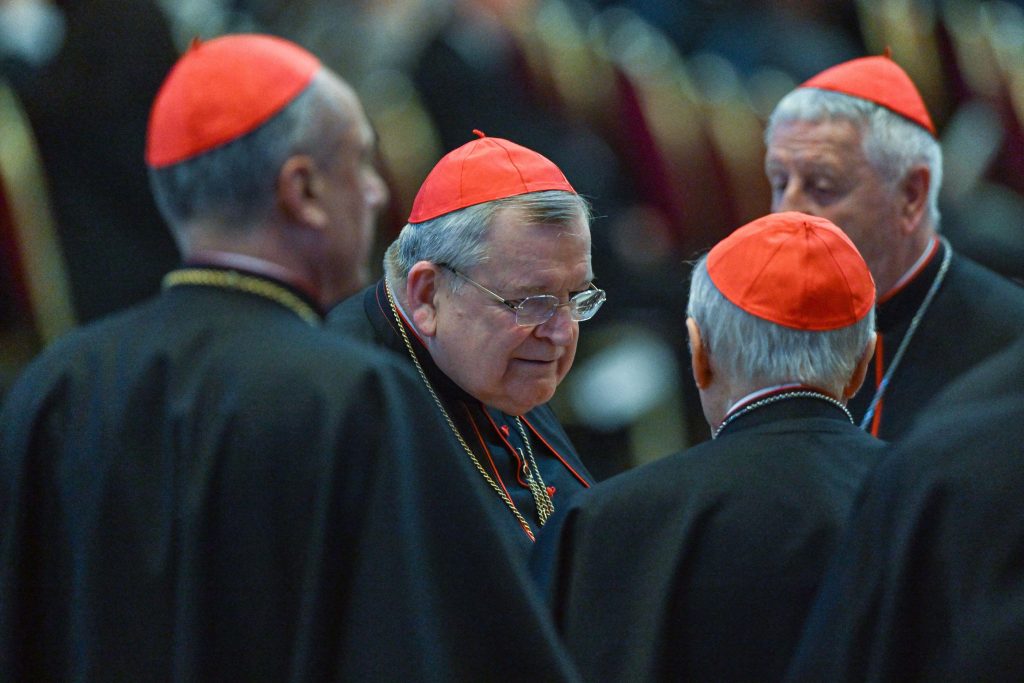
In an interview with The College of Cardinals Report, Cardinal Raymond Burke calls for the Synod on Synodality to be stopped and completely reoriented. He also comments on Study Group 9, the SSPX and the future of the Traditional Latin Mass Cardinal Raymond Burke has called for synodality to be stopped. Speaking in an interview with The College of Cardinals Report on 28 June, the day after the close of the Extraordinary Consistory, the 78-year-old Cardinal said that there “is no history of synodality” in the Church. He further insisted that “this whole synodality business be stopped” and that “a very serious study be done on the whole matter” because “we are talking about the salvation of souls.” When asked about a Cardinal who had spoken out against synodality, Cardinal Burke said there was “more than one”. He said the crux of the criticism was that “in all the documents that come out, there is no definition of synodality”. In response to these criticisms, Cardinal Burke said that one Cardinal at the consistory remarked, “You know it by doing it”, which he described as “irrational” and “not the Catholic Faith”. He also warned that synodality carried the danger of “conforming to the world”. He said that those arguing in favour of the approach consistently spoke of a “change in paradigm”, to which the Cardinal responded that the Church does not undergo paradigm shifts because it is “one, holy, Catholic and apostolic”. He acknowledged that, whilst synodality may have good motives in its desire to address the problems of the world, “it is fundamentally flawed” because it neglects the Church’s tradition by failing to give proper emphasis to how “the Church in the past has addressed the world and the situation of the world”. When asked about his own participation at the consistory, Cardinal Burke said he had used his intervention to address the controversy surrounding Synod Study Group 9, one of the ten study groups established by Pope Francis in March 2024 as part of the implementation phase of the Synod on Synodality. The group was tasked with listening to controversial doctrinal, pastoral and ethical questions, but was criticised for appearing to air views that deviated from Church teaching, particularly through testimonies criticising Courage International, an apostolate for Catholics who experience same-sex attraction and seek to live chaste lives. Cardinal Burke said the group had “calumniated Courage, this great apostolate founded by Cardinal Cooke”. He continued: “I’ve known Courage since the 1980s,” adding that the report “accuses Courage of something that I know is false”. He further defended the apostolate, saying: “Courage is a… wonderful apostolate that helps people who suffer from these attractions to live a chaste life.” He described the decision to send Study Group 9’s report to dioceses as “iniquitous”. Recalling his intervention at the consistory, he said he had told the Cardinals that the “process must be stopped” and “completely reoriented”. Cardinal Burke also addressed Cardinal Mario Grech’s use of the final session of the consistory to tell Cardinals that the implementation of synodality represents “a new stage in the reception of the Second Vatican Council”. He said that whilst “some spoke enthusiastically about what he was saying”, others raised “very serious questions”. His Eminence also questioned the omission of the Sacred Liturgy from the agenda of the consistory when “we had this whole crisis brewing” with the Society of Saint Pius X. Referring to the Pontifical Commission Ecclesia Dei , founded in the wake of the 1988 Écône consecrations, he said there was a need for a modern-day equivalent to help those “who do not want to be associated with a schismatic act” to be received into full communion with the Church while continuing to attend the older form of the Roman Rite. He said such a commission would assure the faithful that this form of worship is “guaranteed” to them. Cardinal Burke’s comments are not unexpected, as he is one of the most forthright conservative voices within the Church. What is perhaps surprising, however, is the directness and openness with which they are expressed. The American prelate has openly called for a process that has received a great deal of the Vatican’s time and energy in recent years to be halted. He has also called for a pragmatic approach to the question of the Society of Saint Pius X and suggested a way forward linked to the Traditional Latin Mass. This pithy and realistic manifesto for traditionalist aspirations stands in contrast to the more open-ended proposals of the liberal wing. That approach often speaks in broad terms about listening and adapting or, as in the case of the German Synodal Way, seeks to advance policies that the Church could never promulgate without risking large-scale schism. Whether Cardinal Burke’s comments will result in concrete action remains to be seen, but they provide an erudite and clear explanation of the changes the conservative wing of the Church would like to see.
Jul. 16, 2026
Bishop of Oslo offers more Traditional Latin Masses after SSPX excommunications
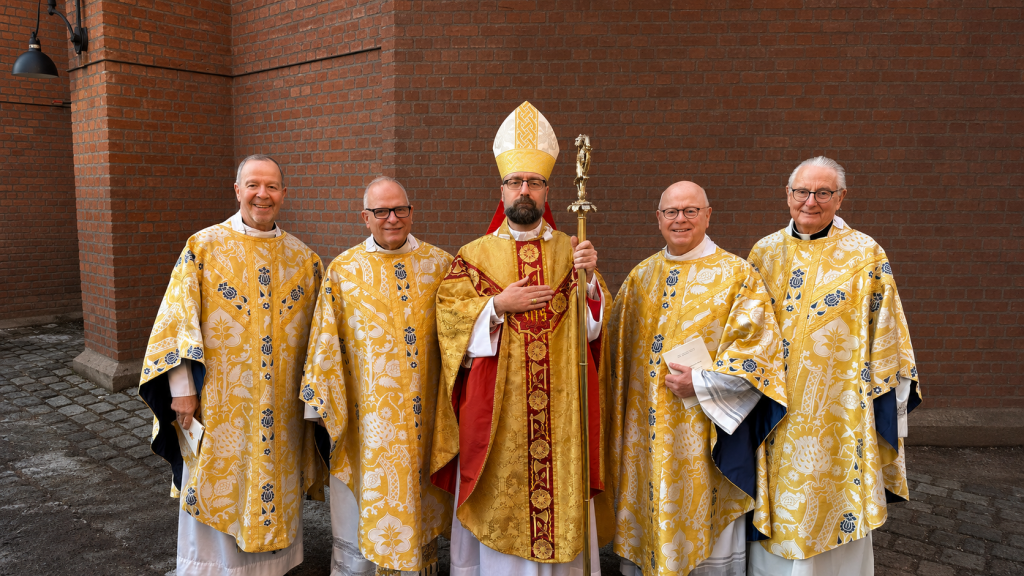
Following the excommunications of the SSPX bishops, Bishop Fredrik Hansen of Oslo has appealed to Catholics attached to the Traditional Latin Mass to remain in communion with Rome. He also said he is willing to expand provision for the 1962 Missal in the Diocese of Oslo Bishop Fredrik Hansen, the Bishop of Oslo in Norway, has offered to expand provision for the Traditional Latin Mass in his diocese following the excommunications of the bishops of the Society of Saint Pius X. The 47-year-old prelate, who has served as bishop since July last year, explained that the “four bishops who were ordained removed themselves from ecclesial communion and from unity with the Pope” by taking part in the consecrations without papal mandate. He further said that the bishops had “incurred the most grave ecclesiastical penalty: latae sententiae excommunication”. The bishop also addressed one of the most significant consequences of the consecrations: whether SSPX priests can validly hear confessions and grant absolution. He stated that the “priests belonging to the Society, now marked by the schismatic act and its consequences, can no longer validly grant absolution in the sacrament of confession.” This is a contested point among SSPX priests and faithful, who argue that canon law, which exists for the salvation of souls, still allows them to validly administer absolution. Towards the end of the letter, the bishop turned his attention to “the Catholics of our diocese who feel a draw toward and affection for the pre-conciliar liturgy and its associated spirituality, and who have therefore attended Masses celebrated in our diocese by priests from the Society”. He acknowledged that “these are difficult and distressing days for you” and that “you may find yourselves pulled in different directions.” His first instruction to these Catholics is “to hold fast to unity with our Holy Father, the Bishop of Rome, and with me as Bishop of Oslo.” In response to their attraction to the pre-conciliar liturgy, the bishop wrote: “I understand this,” and advised them that “Masses according to the 1962 Missal are celebrated every Sunday at St. Joseph Church in Oslo”. He further assured them that “if there is a need for it, and if it would be for the good of the Church and of souls, I will also expand this form of Mass celebration in our local Church.” The Society of Saint Pius X currently celebrates two Masses each week in Oslo, both at a Society chapel in the Ullern borough, in the western part of the city. The Society also has a presence in Stavanger, a city in southwestern Norway, and Bergen, also in the southwest of the country. The Masses are generally celebrated by Fr Raivo Kokis, an Estonian priest of the Society, and Fr Håkan Lindström, a Swedish SSPX priest. Just 3 per cent of Norway’s population is estimated to be Catholic. The country has one diocese, the Diocese of Oslo, which Bishop Hansen leads, and two missionary territorial prelatures, both led by Bishop Erik Varden. Both bishops are notably young, are converts to Catholicism, and studied in England. They have also had a noticeable impact across the wider Church, with Bishop Varden being chosen to lead the annual Lenten Spiritual Exercises for Pope Leo XIV and the Roman Curia this year. Bishop Hansen’s letter is reproduced in full below: Announcement from Bishop Fredrik Hansen on the “SSPX” and the Excommunications Diocese of Oslo July 3, 2026 Dear brothers in priestly ministry, Dear faithful, (1) “By unity with the bishop of Rome, in fellowship and in the profession of the true faith, the Church of Christ is one flock under the supreme shepherd. This is the teaching of Catholic truth, and no one can depart from it without endangering his own faith and salvation” (Vatican I, Pastor Æternus, ch. III). (2) Our unity with the bishop of the Roman Church, with the Pope, is a concrete expression of our belonging to the one, holy, catholic and apostolic Church, which Our Lord Jesus Christ founded to “spread the truth” to all people (Vatican II, Lumen Gentium, 8). (3) On July 1st — contrary to Pope Leo XIV’s earnest and fatherly appeal, and without the required pontifical mandate — four priests belonging to the Society of Saint Pius X (also known as the “St. Pius X Fraternity” or the SSPX) were consecrated as bishops at Écône in Switzerland. The consecrating bishop and one co-consecrating bishop also belong to this society. (4) The two consecrating bishops and the four bishops who were ordained removed themselves from ecclesial communion and from unity with the Pope by this act (ipso facto). They thereby incurred the most grave ecclesiastical penalty: latae sententiae excommunication reserved to the Apostolic See (CIC, can. 1387). (5) The Church and her unity have been dealt a serious wound. This is sad, painful, and calls us to prayer and penance. As a concrete expression of this, I urge you all to pray the Rosary for the unity of the Church on the Feast of Saint Sunniva, July 8, 2026. (6) The Apostolic See has defined the episcopal consecration at Écône as a “schismatic act” (Explanatory Note from the Dicastery for the Doctrine of the Faith, July 2, 2026). The same document also points out that the priests belonging to the Society, now marked by the schismatic act and its consequences, can no longer validly grant absolution in the sacrament of confession. (7) In order not to spread and further aggravate the consequences of this schismatic act, the Holy See’s appeal is clear: stand firm and stand secure in unity with the Pope and with the bishops in communion with him. This means that Catholics should refrain from participating in Masses and other activities organized by the Society of Saint Pius X. (8) A word to the Catholics of our diocese who feel a draw toward and affection for the pre-conciliar liturgy and its associated spirituality, and who have therefore attended Masses celebrated in our diocese by priests from the Society: I understand that these are difficult and distressing days for you. You may find yourselves pulled in different directions, and perhaps stand bewildered before all that has now come to pass. Some of you may be experiencing uncertainty about the future. (9) As your shepherd, I therefore offer you an encouragement and some words about what lies ahead. The encouragement is simple: hold fast to unity with our Holy Father, the Bishop of Rome, and with me as Bishop of Oslo. (10) As for the future: You wish to be able to take part in the liturgical celebration according to the 1962 Missal. Many of you also look to a spiritual expression and a spirituality shaped by the pre-conciliar liturgy. I understand this. Masses according to the 1962 Missal are celebrated every Sunday at St. Joseph Church in Oslo. This will continue. If there is a need for it, and if it would be for the good of the Church and of souls, I will also expand this form of Mass celebration in our local Church. (11) In closing: Pray for unity in the Church. Pray for the Pope. And pray that those who have now placed themselves outside ecclesial communion will repent and return.
Jul. 6, 2026
Keep Trad and carry on!
Following the Vatican’s declaration that the SSPX bishops have excommunicated themselves, Dom Alcuin Reid calls for renewed work for Catholic unity + Ad te Domine, clamabo, Deus meus, ne sileas a me; ne quando taceas a me, et assimilabor descendentibus in lacum, the Church sings the Introit of this Holy Mass. “To thee, O Lord, I call; my rock, be not deaf to me, lest, if thou be silent to me, I become like those who go down to the Pit.” With these first words of Psalm 27 the Sacred Liturgy aptly expresses the distress of many souls in the light of ecclesial events of recent days. Whether or not one accepts that conscientious disobedience to positive (i.e. man-made, not divine) law (in respect of the consecration of bishops) is or was justified in current circumstances, and can therefore tolerate material but not formal (i.e. in fact gravely sinful) disobedience to ecclesiastical authority, we now face a new crisis—one of the pastoral order, whereby the faithful whose sole desire is to be faithful to the Church and save their souls and those of their families are menaced by the threat of the sin of schism and of the penalty of excommunication. Their distress is real and it is compounded by commentary that is often far from accurate and is lacking in the necessary pastoral precision. Rightly, they feel that this is all simply too much. With just cause do many cry out this morning: “To thee, O Lord, I call; my rock, be not deaf to me, lest, if thou be silent to me, I become like those who go down to the Pit.” So let us be clear: there is no sin (of schism or of any other sort) in simply seeking the salvation of one’s soul through the traditional liturgical rites of the Church, as the prayers for the Pope and the Diocesan Bishop which they contain attest. These prayers in fact bear witness the exact opposite of schism. They are public manifestations at the very heart of our public worship of Catholic unity and of communion, not of sectarian division. And one is not excommunicated because one’s access to the older liturgical rites is sometimes or usually through a community who, before God, believed that they had no choice other than to engage in conscientious material disobedience to Church law in order to survive and remain faithful to their vocation and mission. Whatever of the culpability of clerics—and this is not the occasion to discuss that—even the official documents cited by the Holy See in recent days make it clear that the lay faithful simply seeking to worship Almighty God and receive the sacraments do not incur the penalty of excommunication thereby. (see: Explanatory Note, Pontifical Council for Legislative Texts, 24 August 1996) In the face of the ongoing brouhaha, one might well say: ‘Keep trad and carry on.’ For it remains true that “what earlier generations held as sacred, remains sacred and great for us too, and it cannot be all of a sudden entirely forbidden or even considered harmful.” (Benedict XVI, Letter to the Bishops, 7 July 2007) Of course, this truth was subjected to an orchestrated attack through that scandalous back-room ideological plot fuelled by the paranoia of ageing ecclesiastical liberals and based on downright lies that shamelessly manipulated the will of world’s bishops that we know only too well: the pastoral, liturgical and ecclesial disaster Traditiones Custodes (16 July 2021) that sought to end the peaceful worship of God according to the older rites that increasing numbers had grown fruitfully to love, driving faithful Catholics underground or away from parishes and dioceses and at times even outside of the visible communion of the Church. That orchestrators of this scandal and the high priests of its heartless implementation remain at the centre of power to this day is a cause of very deep concern. It may also go some way to explain the technocratic severity with which the Vatican has acted in recent days. That Traditiones Custodes has not yet been set aside—quietly or otherwise—and that diocesan bishops continue to use it to forbid the celebration of the older liturgical rites cries out to heaven for justice. Rightly, this morning, do we sing: “To thee, O Lord, I call; my rock, be not deaf to me, lest, if thou be silent to me, I become like those who go down to the Pit.” The matter-of-fact severity with which the Vatican has responded to the events of recent days, and indeed the silence of the Holy Father in their wake, is indeed another source of serious concern. For some time now we have been repeating the words of Pope Benedict XVI—a pope who worked earnestly and fruitfully for ecclesial unity and liturgical peace: “Looking back over the past, to the divisions which in the course of the centuries have rent the Body of Christ, one continually has the impression that, at critical moments when divisions were coming about, not enough was done by the Church’s leaders to maintain or regain reconciliation and unity. One has the impression that omissions on the part of the Church have had their share of blame for the fact that these divisions were able to harden. This glance at the past imposes an obligation on us today: to make every effort to enable for all those who truly desire unity to remain in that unity or to attain it anew.” (Letter to the Bishops, 7 July 2007) This morning, unfortunately, his words, are all the more pertinent. More could and should have been done in recent months, weeks and days. More must be done to build bridges and to open doors. The teaching of the Parable of the Lost Sheep (Mt 18:12-14) applies no matter what one thinks of the sheep concerned or how obstinate one believes it or they to be. In his pursuit of Church unity, in 2008 Pope Benedict XVI lifted the excommunications from the (then) four bishops of the Society of St Pius X. In his own words, “the quiet gesture of extending a hand gave rise to a huge uproar, and thus became exactly the opposite of a gesture of reconciliation.” So much so that the Pope found it necessary to write an unprecedented apologia to the bishops of the world. The questions he raised therein are more than pertinent in these days: “Was it, and is it, truly wrong in this case to meet half-way the brother who ‘has something against you’ (cf. Mt 5:23ff.) and to seek reconciliation? … Can it be completely mistaken to work to break down obstinacy and narrowness, and to make space for what is positive and retrievable for the whole? …Can we be totally indifferent about a community which has 733 priests, 264 seminarians, 5 seminaries, 94 schools, 2 university-level institutes, 144 religious brothers, 250 religious sisters and thousands of lay faithful? Should we casually let them drift farther from the Church? I think for example of the 733 priests…I do not think that they would have chosen the priesthood if…they did not have a love for Christ and a desire to proclaim him and, with him, the living God. Can we simply exclude them, as representatives of a radical fringe, from our pursuit of reconciliation and unity? What would then become of them? [statistics updated to those published in 2025] Certainly, for some time now, and once again on this specific occasion, we have heard from some representatives of that community many unpleasant things – arrogance and presumptuousness, an obsession with one-sided positions, etc… But should not the great Church also allow herself to be generous in the knowledge of her great breadth, in the knowledge of the promise made to her? Should not we, as good educators, also be capable of overlooking various faults and making every effort to open up broader vistas? And should we not admit that some unpleasant things have also emerged in Church circles? …During the days when I first had the idea of writing this letter, by chance, during a visit to the Roman Seminary, I had to interpret and comment on Galatians 5:13-15. I was surprised at the directness with which that passage speaks to us about the present moment: “Do not use your freedom as an opportunity for the flesh, but through love be servants of one another. For the whole law is fulfilled in one word: ‘You shall love your neighbour as yourself’. But if you bite and devour one another, take heed that you are not consumed by one another.” …sad to say, this “biting and devouring” also exists in the Church today, as expression of a poorly understood freedom. Should we be surprised that we too are no better than the Galatians? That at the very least we are threatened by the same temptations? That we must always learn anew the proper use of freedom? And that we must always learn anew the supreme priority, which is love?” (Letter to the Bishops, 10 March 2009) The purpose of these observations is not to declare for or against any group or person, let alone to judge them or to seek to exclude them. Let us not forget that whilst the prodigal son sinned shamelessly, his self-righteous elder brother did so also. (cf. Lk 15:11-32) Both were guilty of grave matter of which they needed to repent. And this is most certainly not an attack on our Holy Father—we do know his motivations or intentions, and even if his silence leaves a significant vacuum, we own him the patience that is part of filial respect. Let us pray earnestly for the Holy Father in these days! The purpose of these observations is solely to recall some fundamental truths and to insist that we are all called to pray and work in whatever way we can for their recognition and for reconciliation and Catholic unity. Even as we may share the distress and fear of the psalmist that all may be lost and that we are descending ever more rapidly into the Pit (or that we have already been cast into it) the Sacred Liturgy now takes us up to the Altar of God, where, by the infinite merits of Christ’s Sacrifice on the Cross, all that seems lost can be found again, and all that was dead can rise to new life (cf. Lk 15:32). Much as our hearts may be heavy, and much as we may feel wounded and distressed and even abandoned, let us never doubt that if we are faithful the Lord shall hear our plea and save us. For the grace of that fidelity and for an increase of the grace of supernatural hope in ourselves and in others, let us pray earnestly in this Holy Mass. +
Jul. 5, 2026
Vatican releases reconciliation procedure for SSPX priests and faithful
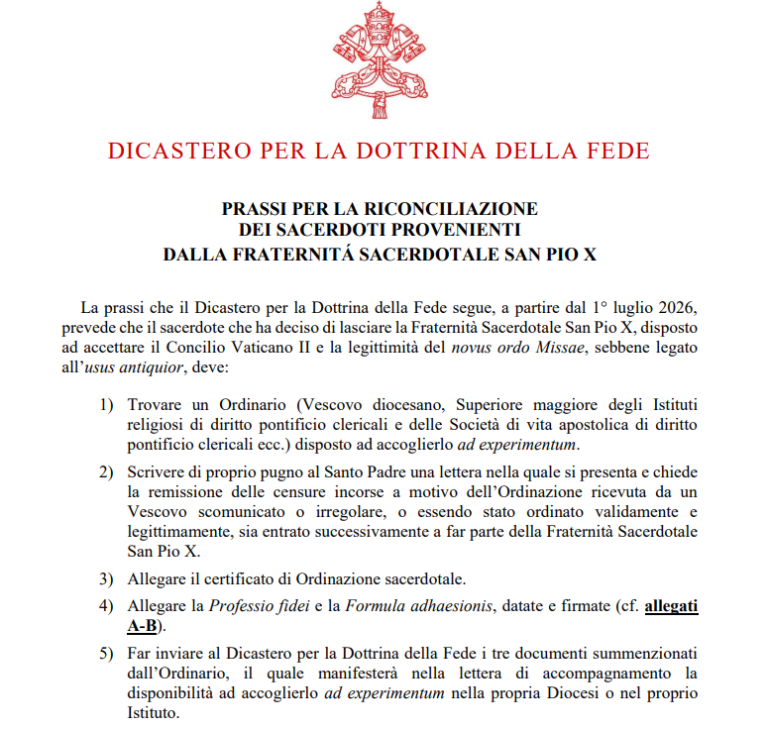
After declaring the SSPX bishops excommunicated, the Vatican has published a document outlining how priests and certain lay faithful associated with the Society can be reconciled with the Catholic Church The Dicastery for the Doctrine of the Faith has released a document entitled the “Procedure for the Reconciliation of Priests from the Society of Saint Pius X”, outlining the process of reconciliation for priests attached to the Society of Saint Pius X. The move comes after the consecrations of four new bishops for the Society and a decree which declared that the four bishops, alongside Bishop Alfonso de Galarreta, the principal consecrator, and Bishop Bernard Fellay, had “incurred the ipso facto penalty of latae sententiae excommunication”. The document is intended to help bishops understand what must be done to facilitate a person being fully reconciled with Rome after being aligned with the SSPX. The document states that “a priest who has decided to leave the Priestly Society of Saint Pius X” and is “willing to accept the Second Vatican Council and the legitimacy of the Novus Ordo Missae”, even though he might be “bound by the usus antiquior”, must go through a certain process for reconciliation. For an SSPX priest to be reconciled, he must first find an Ordinary and then write a “handwritten letter to the Holy Father in which he introduces himself and requests the remission of the censures incurred as a result of ordination received from an excommunicated or irregular Bishop, or, having been validly and legitimately ordained, subsequently entered the Priestly Fraternity of Saint Pius X.” He should then attach his certificate of priestly ordination together with a dated and signed copy of a Professio fidei and the Formula Adhaesionis , which is attached to the document and outlines the necessary theological convictions for reconciliation. The documents are then sent to the DDF by the Ordinary, “who will express in the accompanying letter his willingness to accept him ad experimentum in his diocese or his institute.” The Professio fidei document which the priest must sign begins with the Nicene Creed, and continues with a declaration that the priest believes “all those things which are contained in the written or handed-down Word of God and which are proposed by the Church—either by solemn judgment or by the ordinary and universal Magisterium—to be believed as divinely revealed”. The document continues with the priest agreeing that he “firmly embraces and holds all and everything regarding the doctrine of faith or morals that is definitively taught by the same Church”. It concludes with him agreeing that, with “a religious submission of will and intellect”, he adheres “to the teachings which either the Roman Pontiff or the College of Bishops enunciate when they exercise the authentic Magisterium, even if they do not intend to proclaim them by a definitive act.” The final document which the priest must sign, entitled Formula Adhaesionis , asks the priest to agree that he accepts “the doctrine taught in no. 25 of the Dogmatic Constitution Lumen Gentium of the Second Vatican Council regarding the Magisterium of the Church and the adherence due to it.” With regard to “certain doctrines taught by the Second Vatican Council, or regarding subsequent reforms—whether of the Liturgy or of Canon Law—which some find difficult to reconcile with previous declarations of the Magisterium”, he agrees to “follow a positive approach in interpreting the doctrine”. He is further asked to accept “the validity of the Sacrifice of the Mass and of the Sacraments celebrated with the intention of doing what the Church does, and in accordance with the rites found in the typical editions of the Roman Missal as well as the Rituals promulgated by the Supreme Pontiffs Paul VI and John Paul II.” And finally, he must “promise to adhere to the common discipline of the Church and to its laws, especially those contained in the Code of Canon Law promulgated by the Supreme Pontiff John Paul II.” This part of the document is essentially asking the priest to renounce his criticism of the Second Vatican Council and parts of Church teaching which he finds objectionable. This is a requirement which arguably goes further than what is required for priests in normal circumstances to be in good standing with the Catholic Church, with many drawing parallels between the requirements imposed on the Society’s priests and the apparent lack of censure afforded to groups such as the German Synodal Way. The document is understood to have already been in place for priests in similar situations before the 1 July consecrations took place. It is not known at present whether any priests have taken the opportunity for reconciliation. The document also makes provision for “Laypeople who are members of the Third Order of the Priestly Fraternity of St. Pius X; 2. Laypeople who habitually participate in the celebrations of the Priestly Fraternity of St. Pius X, formally sharing its doctrinal positions.” Reconciliation is not needed for those who “have attended the Priestly Fraternity of St. Pius X solely for liturgical or spiritual reasons”, or for faithful who “while aware of the tensions with the Holy See, do not reject the Magisterium or the authority of the Roman Pontiff”. The faithful who are in need of reconciliation must also sign the Professio fidei and the Formula Adhaesionis . They then present themselves to their Ordinary, who should “welcome the lay faithful member in the manner and within the timeframe he deems most appropriate, using, for example, the Rite of Admission to Full Communion with the Catholic Church for Those Who Have Already Been Validly Baptized, duly adapted.” Speaking to the SSPX faithful on the ground, the reaction was defiant. William Waith from Australia stated he “suspected this was not a valid excommunication”, with another pilgrim stating he believed it was a “war against tradition”. When questioned on the possible excommunication of those attending the event at Écône, Abbé Michel Rion, spokesperson for the consecrations, stated that “all the parishioners who are here are certain to be in the Church” and that they are “hurt and so sad that they may be considered that way”.
Jul. 2, 2026