Outside the Walls
How bishops across the world have responded to the SSPX episcopal consecrations
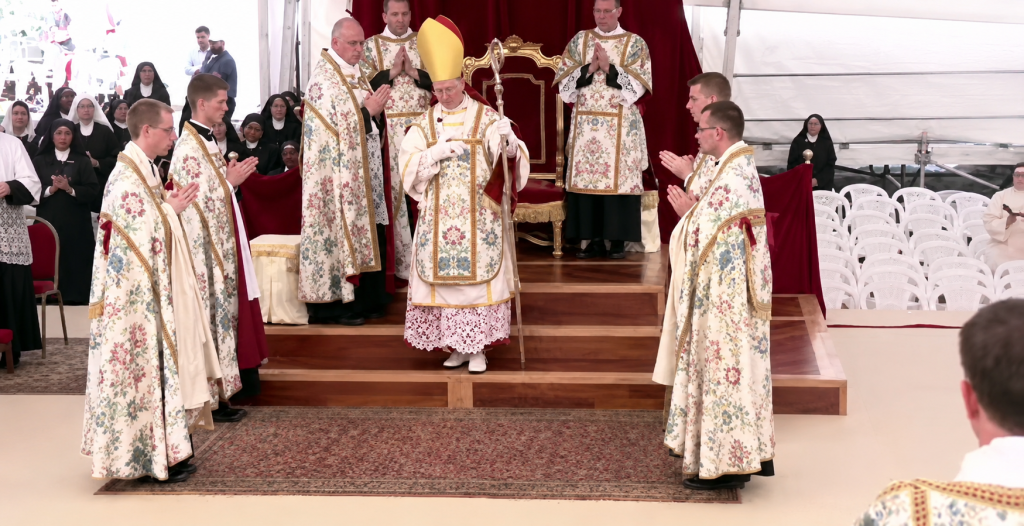
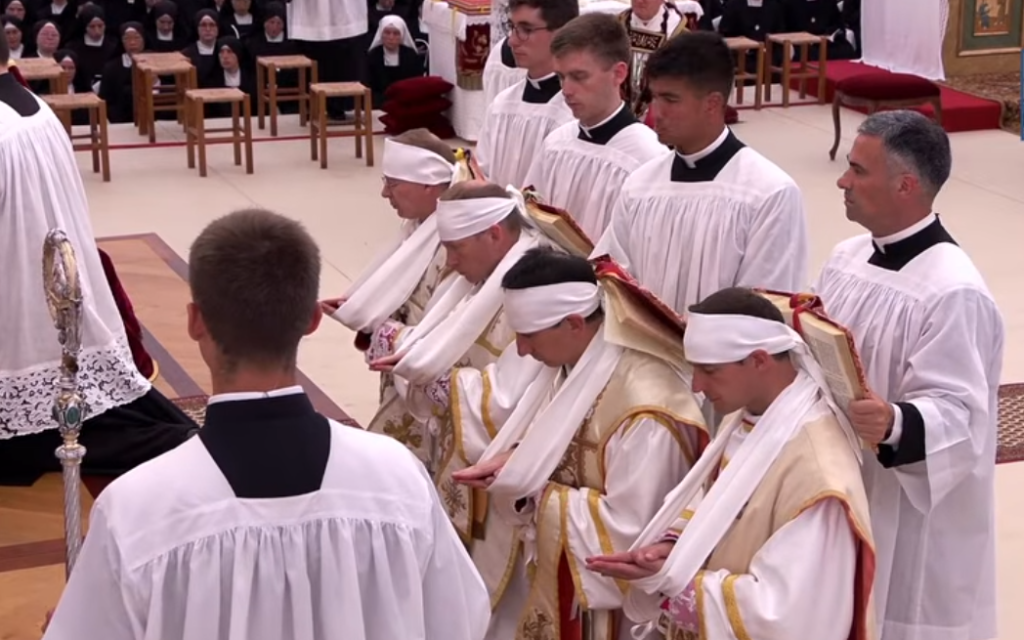
Following the Vatican’s declaration that the Society of St Pius X has entered into schism, bishops across the US and Europe have begun issuing guidance to clergy and faithful. AdVaticanum has compiled the key statements Following the Society of St Pius X’s episcopal consecrations on 1 July 2026, carried out without papal mandate, the Dicastery for the Doctrine of the Faith issued a decree on 2 July declaring the act a schismatic offence and excommunicating the six bishops. The accompanying explanatory note emphasised that, despite decades of dialogue since the time of Pope Paul VI, the SSPX’s rejection of papal authority and Vatican II teachings had now been aggravated by these unauthorised consecrations, declaring SSPX clergy schismatic, their sacraments (especially Penance and Matrimony) invalid, and warning the faithful against formal adherence under penalty of excommunication. There have been many statements from bishops regarding the SSPX since the decree. AdVaticanum has compiled what the bishops are doing and what they have said so far, with public statements from diocesan leaders across the US and Europe expressing sorrow over the division. Bishop Terry R. LaValley of Ogdensburg, New York, was among the first to issue a pastoral letter. In it, he declared that the Priestly Fraternity of St Pius X was in “final schism with the Roman Catholic Church due to today’s unauthorised episcopal ordinations of four bishops without papal mandate”. He instructed Catholics in his diocese not to participate in SSPX liturgies or receive sacraments from its clergy, directing them instead to approved locations offering the Traditional Latin Mass in full communion. “It is with great sadness that I must share with you that the Society of St Pius X (SSPX) is in final schism,” Bishop LaValley wrote. He noted that the action constituted “a formal separation from the Church’s communion” and made it “illicit and forbidden for Roman Catholics to participate in and receive the Sacraments from bishops and priests associated with the Society of St Pius X, including Baptism, Confirmation, the Holy Eucharist, Penance, Marriage, and Holy Orders”. The only exception, he recalled, citing canons 976 and 1752, was the Sacrament of Penance in danger of death. The bishop urged those attached to the SSPX to seek nourishment at St Mary’s Church in Potsdam or St Mary’s in Evans Mills, while extending an open invitation to any SSPX priests wishing to return to unity. Bishop Douglas J. Lucia of Syracuse, New York, issued one of the earliest statements on 2 July, expressing “much sadness” and forbidding participation in SSPX sacraments or activities except in danger of death. He rescinded permissions for the SSPX to use diocesan property. “I must make it very clear that today’s announcement without a doubt forbids Roman Catholics of good standing to participate in and to receive the Sacraments from bishops and priests associated” with the SSPX, the bishop said, listing the seven sacraments. Continued participation would constitute “formal adherence” to the schismatic state, he warned. In Missouri, where the SSPX has its United States headquarters, Bishop James V. Johnston of Kansas City-St Joseph described the ordinations as “unfortunate and indeed, a source of grief”. In a 2 July statement, he announced he would prepare guidance for clergy and laity, particularly those worshipping at St Vincent de Paul in Kansas City. “Despite the fruitful efforts of past decades from the Holy See and our local Church to move towards a fully restored ecclesial communion, the schism which has occurred will impact those who choose to formally adhere to the Society of St Pius X,” Bishop Johnston wrote. He stressed that valid reception of Matrimony and Penance would no longer be possible within the SSPX, while reassuring SSPX members of his “pastoral concern as a shepherd”. Archbishop McKnight, whose archdiocese includes the largest SSPX-built church in the world, the Immaculata, spoke of “profound sorrow” for the wound to visible unity. He recalled years of reconciliation efforts, including the lifting of excommunications by Pope Benedict XVI and faculties granted by Pope Francis. “The actions taken by the Society’s leadership stand in contrast to our repeated efforts at reconciliation,” Archbishop McKnight said. The canonical penalties were “medicinal measures” ordered towards repentance. He warned the faithful that SSPX sacraments were illicit, with Penance and Matrimony invalid, and that participation expressed separation from the Church’s communion. “Fidelity to Sacred Tradition is never opposed to fidelity to the Successor of Peter,” McKnight added. Bishop Donald J. Hying of Madison, Wisconsin, detailed the canonical violations, in particular canon 1013 on the need for papal mandate and canon 1387 on the penalty of excommunication. “Schism, which is ‘the refusal of submission to the Supreme Pontiff or of communion with the members of the Church subject to him’, also carries the penalty,” he wrote. The Wisconsin bishop urged Catholics to refrain from attending Mass at SSPX chapels, including St Therese in Waunakee, and to seek licit and valid sacraments elsewhere. The SSPX’s actions had “harmed these discussions and wounded the path to unity”, he noted, calling for prayer that all might be one. In Texas, Archbishop Gustavo García-Siller of San Antonio notified the faithful of the “schismatic actions” and announced he would no longer grant delegations for weddings or ministry. “The actions taken by bishops Alfonso de Galarreta and Bernard Fellay of the SSPX in ordaining Fathers Pascal Schreiber, Michael Goldade, Michel Poinsinet de Sivry, and Marc Hanappier to the episcopacy without the necessary papal mandate… have deeply wounded the unity of the Church,” he wrote. The Archbishop instructed Catholics to stop attending St Joseph Chapel and encouraged attendance at approved Traditional Latin Mass locations. Furthermore, the Archdiocese of Denver updated its guidance on “so-called Catholic Masses”, explicitly listing SSPX chapels as illicit. It named St Isidore in Watkins and Annunciation Chapel in Fort Collins, stating that Catholics should not participate in their liturgies or receive Holy Communion there, as such services did not fulfil the Sunday obligation. The statement reiterated the Vatican’s declaration of schism and excommunication for formal adherence. Archbishop Bernard A. Hebda of St Paul and Minneapolis expressed “great sadness” at the SSPX’s rejection of Pope Leo’s pleas. He mentioned the impact on sincere families and noted the availability of the 1962 Missal at six locations in the archdiocese. “I am confident that those who prefer the Traditional Latin Mass could find a home here,” Archbishop Hebda said. He recalled the ancient principle, “Ubi Petrus, ibi ecclesia” — “Where Peter is, there is the Church” — and prayed for those affected to remain united to the Successor of Peter. Bishop Frank J. Caggiano of Bridgeport wrote yesterday with “deep sadness” about the invalidity of SSPX confessions and marriages from that point forward. He acknowledged the devotion of families attached to the SSPX but invited them home to approved traditional liturgies in Norwalk, Bridgeport, and Georgetown. “What the Church now asks is straightforward: knowing the situation as it now stands, the faithful of the Catholic Church can no longer take part in the liturgies of the Society,” Bishop Caggiano stated. In Europe, Bishop Fredrik Hansen of Oslo condemned the schismatic act and urged no participation in SSPX activities. “This is sad, painful, and calls us to prayer and penance,” he said. Addressing traditionalists directly, he acknowledged their attachment to the 1962 Missal and pledged to expand its celebration if beneficial: “If there is a need for it, and if it would be for the good of the Church and of souls, I will also expand this form of Mass celebration in our local Church.” Bishop Fredrik Hansen stood out as the only bishop to announce plans to expand the Traditional Latin Mass in his diocese in response to the crisis. The Bishops’ Conference of France issued a collective statement signed by Cardinal Jean-Marc Aveline, Archbishop of Marseille and its president, along with vice-presidents Archbishop Vincent Jordy and Bishop Benoît Bertrand. “We have received with sadness and sorrow the choice of the Priestly Fraternity of Saint Pius X, and we take note of its canonical consequences,” they wrote. Acknowledging the Fraternity’s presence in France and its impact on families, they expressed paternal solicitude and encouraged a return to full communion. “We invite all the Catholics of France to pray for this intention, and to deploy the charity necessary to welcome those who will make the courageous choice of unity and fidelity to the Successor of Peter.” Bishop Luc Crepy of Versailles associated himself with the conference statement. “I share the sorrow and sadness at this choice of the Priestly Fraternity of Saint Pius X, which gravely wounds ecclesial communion,” he wrote. He invited prayer for unity and expressed goodwill towards local SSPX priests and faithful, assuring them of a welcome in parishes celebrating the ancient liturgy.
Jul. 7, 2026
Bishop of Oslo offers more Traditional Latin Masses after SSPX excommunications
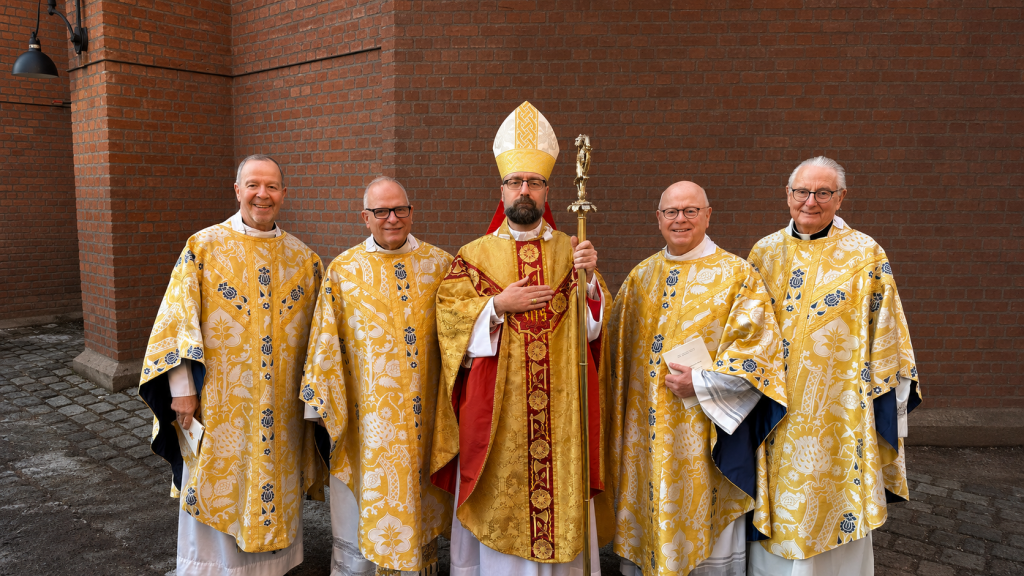
Following the excommunications of the SSPX bishops, Bishop Fredrik Hansen of Oslo has appealed to Catholics attached to the Traditional Latin Mass to remain in communion with Rome. He also said he is willing to expand provision for the 1962 Missal in the Diocese of Oslo Bishop Fredrik Hansen, the Bishop of Oslo in Norway, has offered to expand provision for the Traditional Latin Mass in his diocese following the excommunications of the bishops of the Society of Saint Pius X. The 47-year-old prelate, who has served as bishop since July last year, explained that the “four bishops who were ordained removed themselves from ecclesial communion and from unity with the Pope” by taking part in the consecrations without papal mandate. He further said that the bishops had “incurred the most grave ecclesiastical penalty: latae sententiae excommunication”. The bishop also addressed one of the most significant consequences of the consecrations: whether SSPX priests can validly hear confessions and grant absolution. He stated that the “priests belonging to the Society, now marked by the schismatic act and its consequences, can no longer validly grant absolution in the sacrament of confession.” This is a contested point among SSPX priests and faithful, who argue that canon law, which exists for the salvation of souls, still allows them to validly administer absolution. Towards the end of the letter, the bishop turned his attention to “the Catholics of our diocese who feel a draw toward and affection for the pre-conciliar liturgy and its associated spirituality, and who have therefore attended Masses celebrated in our diocese by priests from the Society”. He acknowledged that “these are difficult and distressing days for you” and that “you may find yourselves pulled in different directions.” His first instruction to these Catholics is “to hold fast to unity with our Holy Father, the Bishop of Rome, and with me as Bishop of Oslo.” In response to their attraction to the pre-conciliar liturgy, the bishop wrote: “I understand this,” and advised them that “Masses according to the 1962 Missal are celebrated every Sunday at St. Joseph Church in Oslo”. He further assured them that “if there is a need for it, and if it would be for the good of the Church and of souls, I will also expand this form of Mass celebration in our local Church.” The Society of Saint Pius X currently celebrates two Masses each week in Oslo, both at a Society chapel in the Ullern borough, in the western part of the city. The Society also has a presence in Stavanger, a city in southwestern Norway, and Bergen, also in the southwest of the country. The Masses are generally celebrated by Fr Raivo Kokis, an Estonian priest of the Society, and Fr Håkan Lindström, a Swedish SSPX priest. Just 3 per cent of Norway’s population is estimated to be Catholic. The country has one diocese, the Diocese of Oslo, which Bishop Hansen leads, and two missionary territorial prelatures, both led by Bishop Erik Varden. Both bishops are notably young, are converts to Catholicism, and studied in England. They have also had a noticeable impact across the wider Church, with Bishop Varden being chosen to lead the annual Lenten Spiritual Exercises for Pope Leo XIV and the Roman Curia this year. Bishop Hansen’s letter is reproduced in full below: Announcement from Bishop Fredrik Hansen on the “SSPX” and the Excommunications Diocese of Oslo July 3, 2026 Dear brothers in priestly ministry, Dear faithful, (1) “By unity with the bishop of Rome, in fellowship and in the profession of the true faith, the Church of Christ is one flock under the supreme shepherd. This is the teaching of Catholic truth, and no one can depart from it without endangering his own faith and salvation” (Vatican I, Pastor Æternus, ch. III). (2) Our unity with the bishop of the Roman Church, with the Pope, is a concrete expression of our belonging to the one, holy, catholic and apostolic Church, which Our Lord Jesus Christ founded to “spread the truth” to all people (Vatican II, Lumen Gentium, 8). (3) On July 1st — contrary to Pope Leo XIV’s earnest and fatherly appeal, and without the required pontifical mandate — four priests belonging to the Society of Saint Pius X (also known as the “St. Pius X Fraternity” or the SSPX) were consecrated as bishops at Écône in Switzerland. The consecrating bishop and one co-consecrating bishop also belong to this society. (4) The two consecrating bishops and the four bishops who were ordained removed themselves from ecclesial communion and from unity with the Pope by this act (ipso facto). They thereby incurred the most grave ecclesiastical penalty: latae sententiae excommunication reserved to the Apostolic See (CIC, can. 1387). (5) The Church and her unity have been dealt a serious wound. This is sad, painful, and calls us to prayer and penance. As a concrete expression of this, I urge you all to pray the Rosary for the unity of the Church on the Feast of Saint Sunniva, July 8, 2026. (6) The Apostolic See has defined the episcopal consecration at Écône as a “schismatic act” (Explanatory Note from the Dicastery for the Doctrine of the Faith, July 2, 2026). The same document also points out that the priests belonging to the Society, now marked by the schismatic act and its consequences, can no longer validly grant absolution in the sacrament of confession. (7) In order not to spread and further aggravate the consequences of this schismatic act, the Holy See’s appeal is clear: stand firm and stand secure in unity with the Pope and with the bishops in communion with him. This means that Catholics should refrain from participating in Masses and other activities organized by the Society of Saint Pius X. (8) A word to the Catholics of our diocese who feel a draw toward and affection for the pre-conciliar liturgy and its associated spirituality, and who have therefore attended Masses celebrated in our diocese by priests from the Society: I understand that these are difficult and distressing days for you. You may find yourselves pulled in different directions, and perhaps stand bewildered before all that has now come to pass. Some of you may be experiencing uncertainty about the future. (9) As your shepherd, I therefore offer you an encouragement and some words about what lies ahead. The encouragement is simple: hold fast to unity with our Holy Father, the Bishop of Rome, and with me as Bishop of Oslo. (10) As for the future: You wish to be able to take part in the liturgical celebration according to the 1962 Missal. Many of you also look to a spiritual expression and a spirituality shaped by the pre-conciliar liturgy. I understand this. Masses according to the 1962 Missal are celebrated every Sunday at St. Joseph Church in Oslo. This will continue. If there is a need for it, and if it would be for the good of the Church and of souls, I will also expand this form of Mass celebration in our local Church. (11) In closing: Pray for unity in the Church. Pray for the Pope. And pray that those who have now placed themselves outside ecclesial communion will repent and return.
Jul. 6, 2026
EXCLUSIVE: Cardinal Radcliffe clarifies role in London Mass featuring blessing for same-sex couple
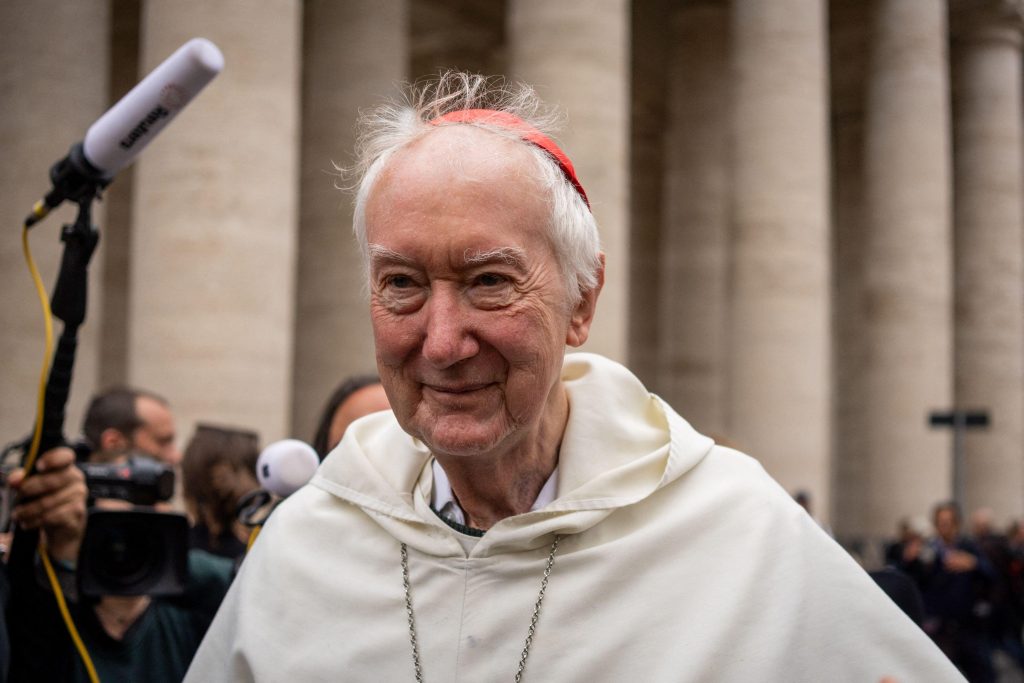
Cardinal Timothy Radcliffe has spoken exclusively to AdVaticanum about the recent London thanksgiving Mass for a same-sex couple Cardinal Timothy Radcliffe has spoken to AdVaticanum to clarify his role in a recent London Mass featuring an “LGBT blessing”. Speaking exclusively AdVaticanum, Cardinal Timothy Radcliffe has offered a measured account of his participation in a thanksgiving Mass held at the Church of the Holy Apostles in London. The event, held on 13 June, marked 50 years of friendship, partnership and commitment to justice between Julian Filochowski and Martin Pendergast, two longstanding figures in pastoral outreach to homosexual Catholics in the Diocese of Westminster. In his remarks, Cardinal Radcliffe firmly distanced himself from any perception that he had participated in a specific blessing of the couple’s relationship. “I gave no blessing to anyone and had not been aware that any blessings would be given,” His Eminence said. The Cardinal emphasised the orthodox nature of his preaching on friendship. “I said that friendship is a participation in the life of God. That is perfectly orthodox. I did not refer specifically to theirs. The Mass was a celebration of all friendship. I mentioned friendship in my own life, I think.” The Cardinal added context to references made during the homily. “When they were referred to, it was in connection with a shared passion for justice, for which they are well known and recognised by the Church.” Questions have arisen over the public nature of the occasion and the blessing imparted by the clergy. The text prayed: “Giving thanks that the Church offers blessing to those who seek it in spirit and in truth, we ask, O God of love, that your grace come down upon Julian and Martin as they mark the 50th anniversary of their relationship. May their love continue to be generous, ever attentive to the needs of others, and deepen all that unites them. May your peace be theirs and your joyful light shine through their lives, and the blessing of God, the Father, and the Son, and the Holy Spirit come upon them and remain with them, now and forever. Amen.” Cardinal Radcliffe reiterated his adherence to existing Church guidance on such matters. “The guidelines given by the Church are that any such occasion should be private so as not to cause misunderstanding. It was agreed that this occasion should be private. Why the privacy was not respected I do not know. So making it more public by writing articles about it would be against the will of the Church as I understand it.” The Cardinal also rejected interpretations that framed the Mass as a celebration of gay relationships. “It was not designed to celebrate gay relationships as such. To promote it as such would be to misrepresent it. To do so for the purposes of exciting scandal would be morally wrong.” The principal celebrant was Fr Jim O’Keefe, with concelebrants including Bishop John Crowley, Emeritus of Middlesbrough, Bishop John Rawsthorne, Emeritus of Hallam, and Canon Chris Vipers of the parish. The event was later highlighted by New Ways Ministry, an organisation focused on LGBT Catholics. Among those participating were figures such as Sr Jeannine Gramick, who read part of the Gospel in dialogue with others, including theologian James Alison. One of the honourees also assisted in the distribution of the Precious Blood during Holy Communion. The 2023 declaration Fiducia supplicans permitted spontaneous blessings for individuals in irregular situations under certain conditions but explicitly ruled out liturgical rites, fixed texts or ceremonies that could resemble the validation of a union. Earlier guidance issued by the Dicastery for the Doctrine of the Faith in 2021 stated that the Church does not have the power to bless unions of persons of the same sex. Julian Filochowski and Martin Pendergast, who entered a civil partnership in 2006 after living together since 1976, have long been active in advocacy and justice work for the LGBT Catholic community. Their earlier 25th anniversary thanksgiving Mass in 2001 reportedly prompted intervention from the then Archbishop of Westminster, Cardinal Cormac Murphy-O’Connor, who instructed the bishop scheduled to preside to withdraw.
Jul. 4, 2026
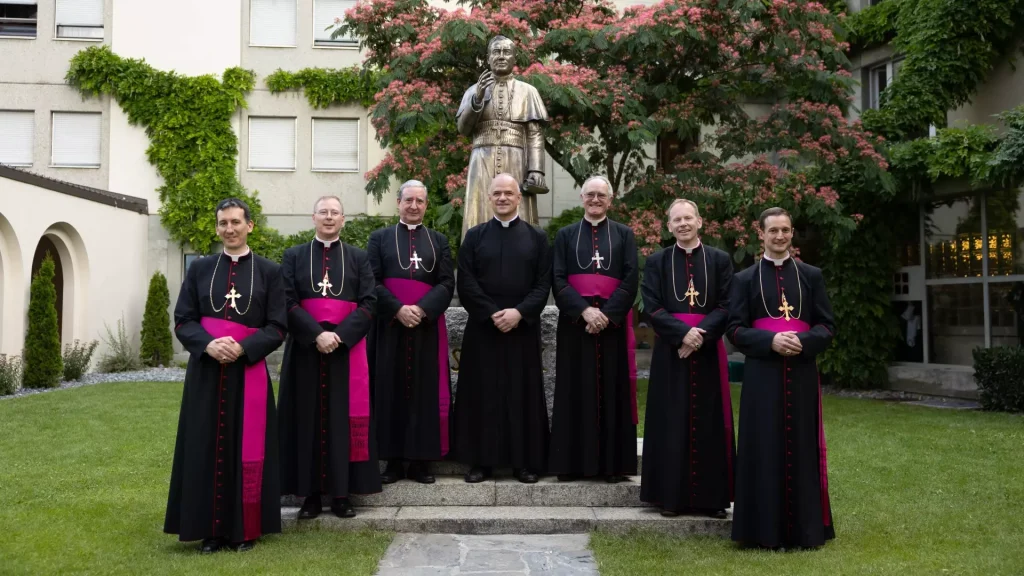
Superior General responds to Pope Leo after excommunication decree
The Superior General of the Society of Saint Pius X has responded to Pope Leo XIV following the decree of excommunication issued by the Dicastery for the Doctrine of the Faith. In a letter sent from Écône on 3 July 2026, Fr Davide Pagliarani responded to the notification signed by the Prefect of the Dicastery, […] The Superior General of the Society of Saint Pius X has responded to Pope Leo XIV following the decree of excommunication issued by the Dicastery for the Doctrine of the Faith. In a letter sent from Écône on 3 July 2026, Fr Davide Pagliarani responded to the notification signed by the Prefect of the Dicastery, Cardinal Víctor Fernández. Fr Pagliarani opens his letter with a pointed reference to St Luke’s Gospel, asking whether a father would give his son a stone instead of bread, a serpent instead of a fish, or a scorpion instead of an egg. He applies this imagery to the Society’s recent appeals to the Holy See. The decision, he suggests, demonstrates the difficult situation facing the universal Church. He goes on to explain that what the SSPX has done, and continues to do, is simply an effort to save souls amid confusion. The Society does not seek to replace the Church but only to remain faithful to her. He writes that, in conscience, the SSPX could not ignore its duty towards souls, a point previously made to the Pope both privately and publicly. The letter continues by explaining that the Society had asked only for “a measure of understanding for a sincere case of conscience”. “We are certain that one day a Pope will wish to employ it for the good of the universal Church,” Fr Pagliarani states. Despite the sanctions, Fr Pagliarani renewed an earlier promise made to the Holy Father. He quotes from his personal letter of 21 November 2025: “The Society promises You […] to devote all its energies to preserving Tradition and placing it at the service of the Church. In doing so, the Society of Saint Pius X does not merely maintain ancient customs; it fosters and preserves priestly vocations, religious vocations, and large, deeply Christian families—in a word, everything that manifests the vitality of the Church, of grace, and of the Catholic faith. Our intention is not to offer the Church a museum of antiquities, but rather the entirety of Tradition: fruitful, a source of spiritual life, embodied and lived out within souls.” The SSPX promises not to receive the new sanctions “with bitterness or revolt”. Instead, Fr Pagliarani writes, the suffering will be offered for the good of souls and of the Church. The sanctions, he says, compel the Society to love the Church more deeply and to provide for her needs with even greater determination. Looking ahead, the Superior General of the SSPX expressed confidence that a future Pope will adopt St Pius X’s programme, Instaurare omnia in Christo (“To restore all things in Christ”). On that day, the Holy Father will find in the SSPX “not a nest of serpents and scorpions, but a small army of loyal sons, ready to do anything to sustain Him in the restoration of all things in Our Lord, and to vindicate before all mankind the imprescriptible rights of Christ the King over all souls and over all nations”. Those souls, he adds, are bound to the Church not upon the “shifting sands of an ambiguous dialogue”, but upon “the rock of the faith of Peter”. Fr Pagliarani asks the Blessed Virgin Mary to hasten that day and prays that Pope Leo XIV may soon experience the joy it will bring. In the meantime, he humbly requests a blessing “as Your sons”, despite the recent decision. “For us, nothing has changed, and nothing ever will change.” The letter closes with an expression of trust in Divine Providence, which sees into every heart, and is signed as the Pope’s “most devoted son in the Lord”. This response comes after the Dicastery for the Doctrine of the Faith (DDF) issued its decree on 2 July. The document declares the excommunications incurred automatically by those involved in the recent consecrations. It refers to earlier admonitions addressed to the Superior General and cites the canonical penalties for the schismatic act. The explanatory note accompanying the decree reviews the history of reconciliation efforts since Pope Paul VI, noting that the latest consecrations without pontifical mandate have worsened the situation. It reaffirms the 1988 judgment that such disobedience constitutes a schismatic act and sets out the implications for ministers and faithful associated with the SSPX, including the illicit administration of the sacraments and the invalidity of marriages assisted by its clergy. The note nevertheless presents the Church as a loving mother, open to those seeking full communion. “Notwithstanding the admonitions addressed to the Superior General of the Priestly Fraternity of Saint Pius X, Bishop Alfonso de Galarreta, having performed a schismatic act by means of the episcopal consecration of four priests, without pontifical mandate and against the will of the Supreme Pontiff, has incurred ipso facto the penalties provided for in can. 1387 and can. 1364 §1 CIC 2021.” Signed by Cardinal Fernández, Prefect of the Dicastery for the Doctrine of the Faith, Mons. Armando Matteo, Secretary for the Doctrinal Section, and Archbishop John J. Kennedy, Secretary for the Disciplinary Section, the decree continues: “It is therefore declared, for all legal effects, that the aforementioned Bishop Alfonso de Galarreta, as well as Pascal Schreiber, Michael Goldade, Michel Poinsinet de Sivry, and Marc Hanappier, have incurred ipso facto the penalty of latae sententiae excommunication reserved to the Apostolic See.” The decree goes further than the excommunications declared in 1988 by stating that “clergy and lay faithful are admonished not to adhere to the schism of the Priestly Fraternity of Saint Pius X, lest they incur ipso facto the penalty of latae sententiae excommunication.” Accordingly, SSPX faithful may also incur the excommunication declared by Rome. Unlike in 1988, when the decree was issued by the Congregation for Bishops, this decree has been issued by the Dicastery for the Doctrine of the Faith. The explanatory note further advises the faithful against formal association with the Society, stating: “Finally, all the faithful are exhorted to remain steadfast in communion with the Roman Pontiff, with the bishops in communion with him, and with the whole Church (cf. Lumen Gentium , 22; can. 751 CIC), and to abstain from participating in the celebrations and activities promoted by the aforementioned Priestly Fraternity of Saint Pius X.” The explanatory note also raises further questions for SSPX faithful by stating: “It is finally noted that the Holy People of God are informed that the sacred ministers of the Priestly Fraternity of Saint Pius X administer the sacraments and the sacrament of Penance illicitly, and that the marriages assisted by them are invalid.” Archbishop Marcel Lefebvre founded the SSPX to preserve traditional priestly formation and liturgy in the years following the Second Vatican Council. The 1988 episcopal consecrations without papal approval led to the original break. Periods of dialogue followed under successive popes, including the lifting of the bishops’ excommunications in 2009 as a gesture intended to facilitate reconciliation. Nevertheless, differences over authority, doctrine, and the role of Tradition have persisted.
Jul. 4, 2026
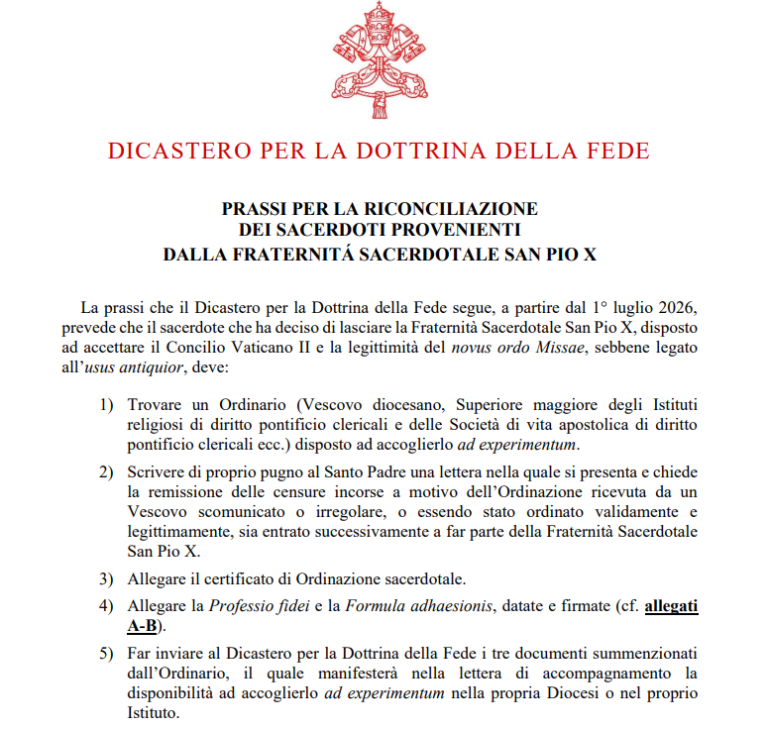
Vatican releases reconciliation procedure for SSPX priests and faithful
After declaring the SSPX bishops excommunicated, the Vatican has published a document outlining how priests and certain lay faithful associated with the Society can be reconciled with the Catholic Church The Dicastery for the Doctrine of the Faith has released a document entitled the “Procedure for the Reconciliation of Priests from the Society of Saint Pius X”, outlining the process of reconciliation for priests attached to the Society of Saint Pius X. The move comes after the consecrations of four new bishops for the Society and a decree which declared that the four bishops, alongside Bishop Alfonso de Galarreta, the principal consecrator, and Bishop Bernard Fellay, had “incurred the ipso facto penalty of latae sententiae excommunication”. The document is intended to help bishops understand what must be done to facilitate a person being fully reconciled with Rome after being aligned with the SSPX. The document states that “a priest who has decided to leave the Priestly Society of Saint Pius X” and is “willing to accept the Second Vatican Council and the legitimacy of the Novus Ordo Missae”, even though he might be “bound by the usus antiquior”, must go through a certain process for reconciliation. For an SSPX priest to be reconciled, he must first find an Ordinary and then write a “handwritten letter to the Holy Father in which he introduces himself and requests the remission of the censures incurred as a result of ordination received from an excommunicated or irregular Bishop, or, having been validly and legitimately ordained, subsequently entered the Priestly Fraternity of Saint Pius X.” He should then attach his certificate of priestly ordination together with a dated and signed copy of a Professio fidei and the Formula Adhaesionis , which is attached to the document and outlines the necessary theological convictions for reconciliation. The documents are then sent to the DDF by the Ordinary, “who will express in the accompanying letter his willingness to accept him ad experimentum in his diocese or his institute.” The Professio fidei document which the priest must sign begins with the Nicene Creed, and continues with a declaration that the priest believes “all those things which are contained in the written or handed-down Word of God and which are proposed by the Church—either by solemn judgment or by the ordinary and universal Magisterium—to be believed as divinely revealed”. The document continues with the priest agreeing that he “firmly embraces and holds all and everything regarding the doctrine of faith or morals that is definitively taught by the same Church”. It concludes with him agreeing that, with “a religious submission of will and intellect”, he adheres “to the teachings which either the Roman Pontiff or the College of Bishops enunciate when they exercise the authentic Magisterium, even if they do not intend to proclaim them by a definitive act.” The final document which the priest must sign, entitled Formula Adhaesionis , asks the priest to agree that he accepts “the doctrine taught in no. 25 of the Dogmatic Constitution Lumen Gentium of the Second Vatican Council regarding the Magisterium of the Church and the adherence due to it.” With regard to “certain doctrines taught by the Second Vatican Council, or regarding subsequent reforms—whether of the Liturgy or of Canon Law—which some find difficult to reconcile with previous declarations of the Magisterium”, he agrees to “follow a positive approach in interpreting the doctrine”. He is further asked to accept “the validity of the Sacrifice of the Mass and of the Sacraments celebrated with the intention of doing what the Church does, and in accordance with the rites found in the typical editions of the Roman Missal as well as the Rituals promulgated by the Supreme Pontiffs Paul VI and John Paul II.” And finally, he must “promise to adhere to the common discipline of the Church and to its laws, especially those contained in the Code of Canon Law promulgated by the Supreme Pontiff John Paul II.” This part of the document is essentially asking the priest to renounce his criticism of the Second Vatican Council and parts of Church teaching which he finds objectionable. This is a requirement which arguably goes further than what is required for priests in normal circumstances to be in good standing with the Catholic Church, with many drawing parallels between the requirements imposed on the Society’s priests and the apparent lack of censure afforded to groups such as the German Synodal Way. The document is understood to have already been in place for priests in similar situations before the 1 July consecrations took place. It is not known at present whether any priests have taken the opportunity for reconciliation. The document also makes provision for “Laypeople who are members of the Third Order of the Priestly Fraternity of St. Pius X; 2. Laypeople who habitually participate in the celebrations of the Priestly Fraternity of St. Pius X, formally sharing its doctrinal positions.” Reconciliation is not needed for those who “have attended the Priestly Fraternity of St. Pius X solely for liturgical or spiritual reasons”, or for faithful who “while aware of the tensions with the Holy See, do not reject the Magisterium or the authority of the Roman Pontiff”. The faithful who are in need of reconciliation must also sign the Professio fidei and the Formula Adhaesionis . They then present themselves to their Ordinary, who should “welcome the lay faithful member in the manner and within the timeframe he deems most appropriate, using, for example, the Rite of Admission to Full Communion with the Catholic Church for Those Who Have Already Been Validly Baptized, duly adapted.” Speaking to the SSPX faithful on the ground, the reaction was defiant. William Waith from Australia stated he “suspected this was not a valid excommunication”, with another pilgrim stating he believed it was a “war against tradition”. When questioned on the possible excommunication of those attending the event at Écône, Abbé Michel Rion, spokesperson for the consecrations, stated that “all the parishioners who are here are certain to be in the Church” and that they are “hurt and so sad that they may be considered that way”.
Jul. 2, 2026