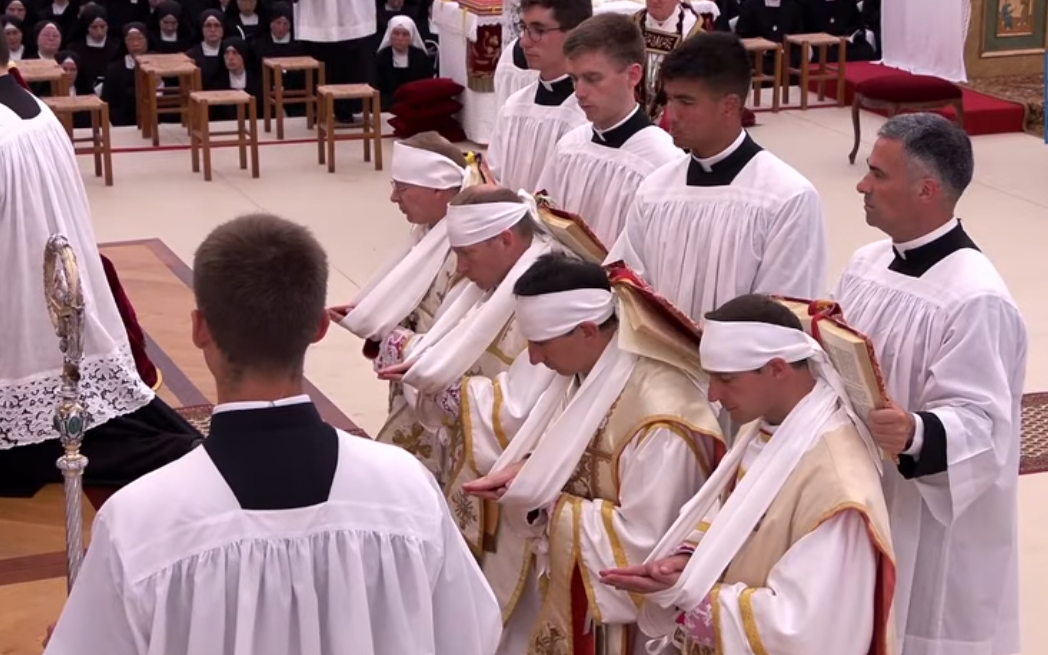
Following the Society of St Pius X’s episcopal consecrations on 1 July 2026, carried out without papal mandate, the Dicastery for the Doctrine of the Faith issued a decree on 2 July declaring the act a schismatic offence and excommunicating the six bishops.
The accompanying explanatory note emphasised that, despite decades of dialogue since the time of Pope Paul VI, the SSPX’s rejection of papal authority and Vatican II teachings had now been aggravated by these unauthorised consecrations, declaring SSPX clergy schismatic, their sacraments (especially Penance and Matrimony) invalid, and warning the faithful against formal adherence under penalty of excommunication.
There have been many statements from bishops regarding the SSPX since the decree. AdVaticanum has compiled what the bishops are doing and what they have said so far, with public statements from diocesan leaders across the US and Europe expressing sorrow over the division.
Bishop Terry R. LaValley of Ogdensburg, New York, was among the first to issue a pastoral letter. In it, he declared that the Priestly Fraternity of St Pius X was in “final schism with the Roman Catholic Church due to today’s unauthorised episcopal ordinations of four bishops without papal mandate”. He instructed Catholics in his diocese not to participate in SSPX liturgies or receive sacraments from its clergy, directing them instead to approved locations offering the Traditional Latin Mass in full communion.
“It is with great sadness that I must share with you that the Society of St Pius X (SSPX) is in final schism,” Bishop LaValley wrote. He noted that the action constituted “a formal separation from the Church’s communion” and made it “illicit and forbidden for Roman Catholics to participate in and receive the Sacraments from bishops and priests associated with the Society of St Pius X, including Baptism, Confirmation, the Holy Eucharist, Penance, Marriage, and Holy Orders”.
The only exception, he recalled, citing canons 976 and 1752, was the Sacrament of Penance in danger of death. The bishop urged those attached to the SSPX to seek nourishment at St Mary’s Church in Potsdam or St Mary’s in Evans Mills, while extending an open invitation to any SSPX priests wishing to return to unity.
Bishop Douglas J. Lucia of Syracuse, New York, issued one of the earliest statements on 2 July, expressing “much sadness” and forbidding participation in SSPX sacraments or activities except in danger of death. He rescinded permissions for the SSPX to use diocesan property.
“I must make it very clear that today’s announcement without a doubt forbids Roman Catholics of good standing to participate in and to receive the Sacraments from bishops and priests associated” with the SSPX, the bishop said, listing the seven sacraments. Continued participation would constitute “formal adherence” to the schismatic state, he warned.
In Missouri, where the SSPX has its United States headquarters, Bishop James V. Johnston of Kansas City-St Joseph described the ordinations as “unfortunate and indeed, a source of grief”. In a 2 July statement, he announced he would prepare guidance for clergy and laity, particularly those worshipping at St Vincent de Paul in Kansas City. “Despite the fruitful efforts of past decades from the Holy See and our local Church to move towards a fully restored ecclesial communion, the schism which has occurred will impact those who choose to formally adhere to the Society of St Pius X,” Bishop Johnston wrote. He stressed that valid reception of Matrimony and Penance would no longer be possible within the SSPX, while reassuring SSPX members of his “pastoral concern as a shepherd”.
Archbishop McKnight, whose archdiocese includes the largest SSPX-built church in the world, the Immaculata, spoke of “profound sorrow” for the wound to visible unity. He recalled years of reconciliation efforts, including the lifting of excommunications by Pope Benedict XVI and faculties granted by Pope Francis. “The actions taken by the Society’s leadership stand in contrast to our repeated efforts at reconciliation,” Archbishop McKnight said.
The canonical penalties were “medicinal measures” ordered towards repentance. He warned the faithful that SSPX sacraments were illicit, with Penance and Matrimony invalid, and that participation expressed separation from the Church’s communion. “Fidelity to Sacred Tradition is never opposed to fidelity to the Successor of Peter,” McKnight added.
Bishop Donald J. Hying of Madison, Wisconsin, detailed the canonical violations, in particular canon 1013 on the need for papal mandate and canon 1387 on the penalty of excommunication. “Schism, which is ‘the refusal of submission to the Supreme Pontiff or of communion with the members of the Church subject to him’, also carries the penalty,” he wrote. The Wisconsin bishop urged Catholics to refrain from attending Mass at SSPX chapels, including St Therese in Waunakee, and to seek licit and valid sacraments elsewhere. The SSPX’s actions had “harmed these discussions and wounded the path to unity”, he noted, calling for prayer that all might be one.
In Texas, Archbishop Gustavo García-Siller of San Antonio notified the faithful of the “schismatic actions” and announced he would no longer grant delegations for weddings or ministry. “The actions taken by bishops Alfonso de Galarreta and Bernard Fellay of the SSPX in ordaining Fathers Pascal Schreiber, Michael Goldade, Michel Poinsinet de Sivry, and Marc Hanappier to the episcopacy without the necessary papal mandate… have deeply wounded the unity of the Church,” he wrote. The Archbishop instructed Catholics to stop attending St Joseph Chapel and encouraged attendance at approved Traditional Latin Mass locations.
Furthermore, the Archdiocese of Denver updated its guidance on “so-called Catholic Masses”, explicitly listing SSPX chapels as illicit. It named St Isidore in Watkins and Annunciation Chapel in Fort Collins, stating that Catholics should not participate in their liturgies or receive Holy Communion there, as such services did not fulfil the Sunday obligation. The statement reiterated the Vatican’s declaration of schism and excommunication for formal adherence.
Archbishop Bernard A. Hebda of St Paul and Minneapolis expressed “great sadness” at the SSPX’s rejection of Pope Leo’s pleas. He mentioned the impact on sincere families and noted the availability of the 1962 Missal at six locations in the archdiocese. “I am confident that those who prefer the Traditional Latin Mass could find a home here,” Archbishop Hebda said. He recalled the ancient principle, “Ubi Petrus, ibi ecclesia” — “Where Peter is, there is the Church” — and prayed for those affected to remain united to the Successor of Peter.
Bishop Frank J. Caggiano of Bridgeport wrote yesterday with “deep sadness” about the invalidity of SSPX confessions and marriages from that point forward. He acknowledged the devotion of families attached to the SSPX but invited them home to approved traditional liturgies in Norwalk, Bridgeport, and Georgetown. “What the Church now asks is straightforward: knowing the situation as it now stands, the faithful of the Catholic Church can no longer take part in the liturgies of the Society,” Bishop Caggiano stated.
In Europe, Bishop Fredrik Hansen of Oslo condemned the schismatic act and urged no participation in SSPX activities. “This is sad, painful, and calls us to prayer and penance,” he said. Addressing traditionalists directly, he acknowledged their attachment to the 1962 Missal and pledged to expand its celebration if beneficial: “If there is a need for it, and if it would be for the good of the Church and of souls, I will also expand this form of Mass celebration in our local Church.”
Bishop Fredrik Hansen stood out as the only bishop to announce plans to expand the Traditional Latin Mass in his diocese in response to the crisis.
The Bishops’ Conference of France issued a collective statement signed by Cardinal Jean-Marc Aveline, Archbishop of Marseille and its president, along with vice-presidents Archbishop Vincent Jordy and Bishop Benoît Bertrand.
“We have received with sadness and sorrow the choice of the Priestly Fraternity of Saint Pius X, and we take note of its canonical consequences,” they wrote. Acknowledging the Fraternity’s presence in France and its impact on families, they expressed paternal solicitude and encouraged a return to full communion. “We invite all the Catholics of France to pray for this intention, and to deploy the charity necessary to welcome those who will make the courageous choice of unity and fidelity to the Successor of Peter.”
Bishop Luc Crepy of Versailles associated himself with the conference statement. “I share the sorrow and sadness at this choice of the Priestly Fraternity of Saint Pius X, which gravely wounds ecclesial communion,” he wrote. He invited prayer for unity and expressed goodwill towards local SSPX priests and faithful, assuring them of a welcome in parishes celebrating the ancient liturgy.