The founder of the Sons of the Most Holy Redeemer is to be consecrated a bishop next month in a dramatic escalation of the community’s break with Rome.
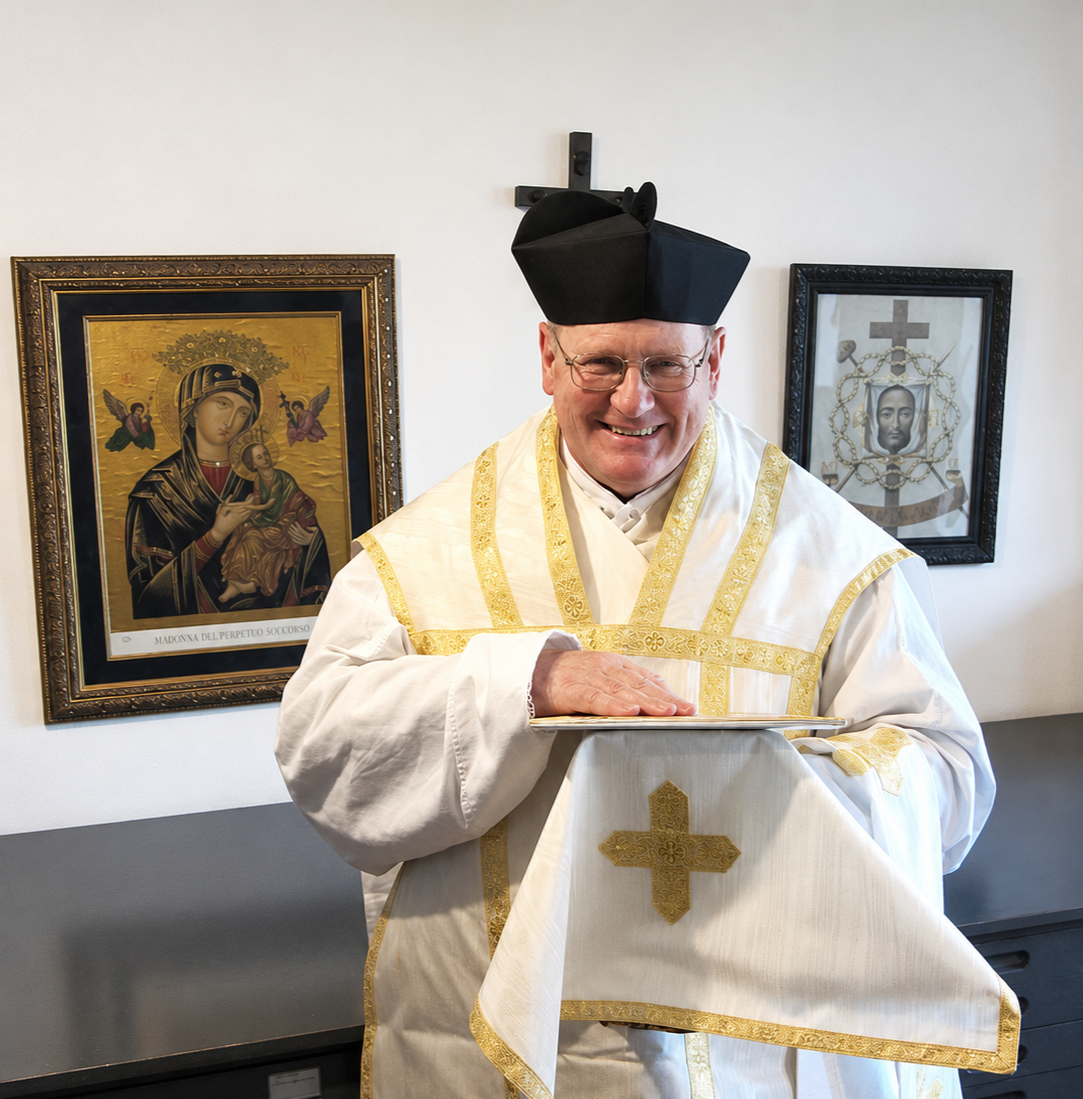
Sedevacantist Bishop Pierre Roy announced on 18 June that Fr Michael Mary, founder and Rector Major of the Sons of the Most Holy Redeemer (FSSR), will receive episcopal consecration on 25 July at the order’s monastery in Orkney.
The ceremony will take place without a papal mandate and will be attended by fellow sedevacantist bishops Bishop Rodrigo Ribeiro da Silva and Bishop Fernando Altamira as co-consecrators.
Sedevacantists maintain that the papal throne (the See of Peter) has been vacant since the death or invalid election of the last legitimate pope, usually identified as Pope Pius XII, though in the case of the community of the Sons of the Most Holy Redeemer it appears to be John XXIII. They argue that subsequent popes have fallen into heresy or invalidly assumed office, rendering their elections null.
As a result, sedevacantists do not believe there is currently a valid pope. They therefore reject any papal mandate or authority issued by Pope Leo XIV, viewing such directives as lacking legitimacy because the Chair of Peter is, in their view, vacant.
In a lengthy letter explaining his decision, Bishop Roy said he had asked Fr Michael Mary to accept consecration “without any solicitation from the Redemptorists and despite some initial reluctance”.
The announcement comes less than a year after the Transalpine Redemptorists publicly repudiated major developments in the post-conciliar Church and effectively embraced sedevacantism.
Bishop Roy said he had maintained close contact with the community since June 2025 and had developed what he described as “a true communion of faith and a sincere friendship”. He argued that the geographical spread of the congregation made episcopal oversight from Canada increasingly impractical.
“The Redemptorists have houses in Scotland, New Zealand, and the United States,” he wrote. “From these houses, they visit Samoa, Australia, and other places. Fulfilling my episcopal duties with the Redemptorists would require me to travel practically the entire world.”
He added that shortages of clergy in his own Canadian missions meant his frequent absences were becoming difficult to sustain and that “it seemed reasonable and necessary to give the Redemptorists a bishop who could properly care for a flock that already knew the sound of his fatherly voice”.
The most controversial passages of the letter concern the nature of the consecration itself.
Bishop Roy explicitly acknowledged that it would take place “in the absence of an apostolic mandate”, asserting that “the See of Rome is clearly occupied by the enemies of God”.
He continued: “His role will be to teach, govern, and sanctify in all fortitude and humility the flock that will gather around him.”
Addressing the question of jurisdiction, Bishop Roy wrote: “I cannot grant him jurisdiction, and I fully acknowledge this. But Christ, the invisible head of the Church and source of all jurisdiction, can, and He certainly will in the limits of the present necessities of the Church, in the absence of a true Supreme Pontiff, so that he may shepherd the scattered flock that will recognise him as a Catholic bishop.”
The bishop also indicated that Fr Michael Mary would be based principally in New Zealand, arguing that Oceania lacked what he regards as a traditional Catholic bishop.
“Father Michael Mary will live primarily in New Zealand, where there is no traditional bishop,” he wrote. “It will therefore not be a luxury for Oceania and its 50 million souls to be able to count on the presence of a Catholic bishop.”
Acknowledging that some would question the prudence of elevating a priest who had led his community into full communion with Rome in 2008 and had only recently separated from it, Bishop Roy argued that the experience had ultimately contributed to the community’s present convictions.
“They could have returned to their old errors,” he wrote, “but instead chose to undertake a serious study of the Church’s situation.”
He said that study had led them to “recognise the current vacancy of the Apostolic See” and to embrace what he described as “the only attitude compatible with the Catholic Faith in the face of conciliar apostasy”.
Founded in 1988 by Fr Michael Mary as a traditionalist Redemptorist congregation, the community initially operated within the orbit of the Society of St Pius X following Archbishop Marcel Lefebvre’s illicit episcopal consecrations that same year.
After periods in England and France, the community established itself on the island of Papa Stronsay in the Orkney archipelago, where it restored monastic life on a site associated with Christian settlement stretching back many centuries.
The election of Pope Benedict XVI and his efforts to reconcile traditionalist groups proved decisive for the congregation’s future. Following the publication of Summorum Pontificum in 2007, the community sought reconciliation with the Holy See and was received into full canonical communion in 2008.
The move was widely regarded at the time as one of the most significant successes of Benedict XVI’s attempt to heal divisions within the traditionalist movement. In 2012, the community received formal recognition as a diocesan institute from Bishop Hugh Gilbert of Aberdeen, apparently securing its place within the life of the Church.
Questions surrounding alleged exorcisms attracted media scrutiny and diocesan concern.
Reports published in New Zealand alleged that exorcisms had taken place without proper authorisation and included claims involving vulnerable individuals. Members of the community strongly disputed aspects of those allegations and rejected accusations that they had conducted major exorcisms involving minors.
The controversy led to increased diocesan oversight and eventually a Vatican apostolic visitation. Although the findings of that investigation were never made public, events reached a climax in July 2024 when Bishop Michael Gielen ordered the community to leave the Diocese of Christchurch and withdrew its faculties. The bishop cited concerns relating to unity and obedience within the local Church.
The congregation appealed against the decision, but the Holy See ultimately upheld the expulsion. It was during this period that relations between the community and ecclesiastical authorities deteriorated sharply. In October 2025, the Transalpine Redemptorists published an open letter explaining that they had reached the conclusion that “the Traditional Catholic Faith” was incompatible with what they described as “the new, modern Church, the fruit of the Second Vatican Council”.
Referring to ecclesiastical authority, the Redemptorists stated: “When a superior departs from his own obedience to Christ the King, his command is no longer the arm of Christ but the gesture of a man.”
They added: “We must obey God before man.”
The declaration drew a swift response from Bishop Hugh Gilbert, whose Diocese of Aberdeen includes Papa Stronsay. The bishop said the diocese “deeply regrets the tone, direction and key elements of this Letter” and stated that it was “incompatible with the Catholic sense of the Church’s unity”.