

Pope Benedict Xvi
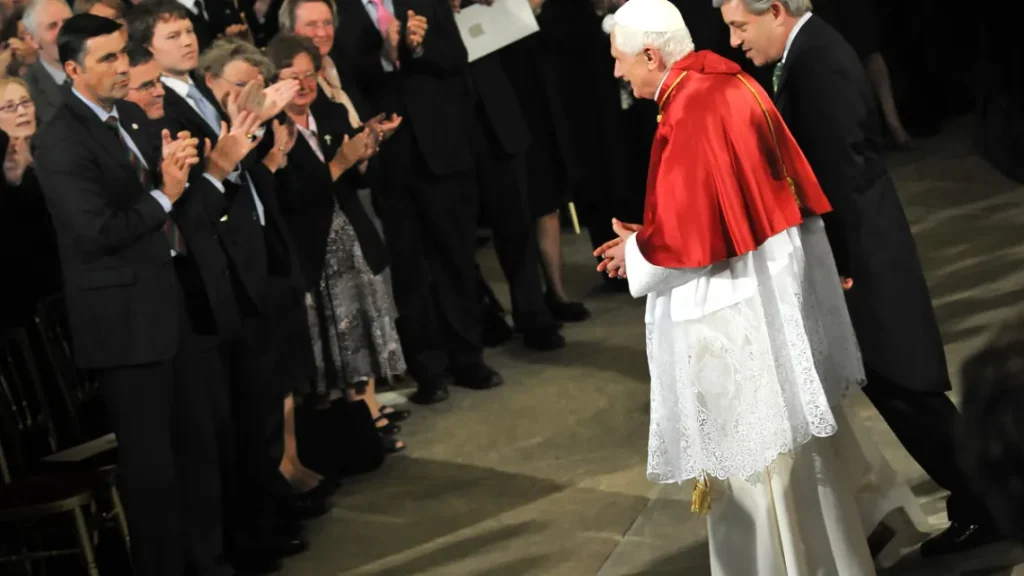
A novena of Benedict XVI’s greatest homilies and addresses, day 4: the Westminster Hall address
Day four of our novena marking the 75th anniversary of Pope Benedict XVI’s priestly ordination features his Westminster Hall address, delivered during his 2010 Apostolic Journey to the United Kingdom To mark the 75th anniversary of Pope Benedict XVI’s priestly ordination, AdVaticanum is publishing a nine-day novena of some of the most important homilies and addresses of his public life. Today we publish Pope Benedict XVI’s address to Westminster Hall, delivered during his Apostolic Journey to the United Kingdom on 17 September 2010. Speaking in the historic chamber where Saint Thomas More was condemned for refusing to act against his conscience, Benedict examined the relationship between faith and politics, the moral foundations of democracy and the place of religion in public life. The address is one of the clearest expressions of Benedict’s political thought, setting out his conviction that reason and faith are not rivals but partners in the search for truth and justice. Mr Speaker, Thank you for your words of welcome on behalf of this distinguished gathering. As I address you, I am conscious of the privilege afforded me to speak to the British people and their representatives in Westminster Hall, a building of unique significance in the civil and political history of the people of these islands. Allow me also to express my esteem for the Parliament which has existed on this site for centuries and which has had such a profound influence on the development of participative government among the nations, especially in the Commonwealth and the English-speaking world at large. Your common law tradition serves as the basis of legal systems in many parts of the world, and your particular vision of the respective rights and duties of the state and the individual, and of the separation of powers, remains an inspiration to many across the globe. As I speak to you in this historic setting, I think of the countless men and women down the centuries who have played their part in the momentous events that have taken place within these walls and have shaped the lives of many generations of Britons, and others besides. In particular, I recall the figure of Saint Thomas More, the great English scholar and statesman, who is admired by believers and non-believers alike for the integrity with which he followed his conscience, even at the cost of displeasing the sovereign whose “good servant” he was, because he chose to serve God first. The dilemma which faced More in those difficult times, the perennial question of the relationship between what is owed to Caesar and what is owed to God, allows me the opportunity to reflect with you briefly on the proper place of religious belief within the political process. This country’s Parliamentary tradition owes much to the national instinct for moderation, to the desire to achieve a genuine balance between the legitimate claims of government and the rights of those subject to it. While decisive steps have been taken at several points in your history to place limits on the exercise of power, the nation’s political institutions have been able to evolve with a remarkable degree of stability. In the process, Britain has emerged as a pluralist democracy which places great value on freedom of speech, freedom of political affiliation and respect for the rule of law, with a strong sense of the individual’s rights and duties, and of the equality of all citizens before the law. While couched in different language, Catholic social teaching has much in common with this approach, in its overriding concern to safeguard the unique dignity of every human person, created in the image and likeness of God, and in its emphasis on the duty of civil authority to foster the common good. And yet the fundamental questions at stake in Thomas More’s trial continue to present themselves in ever-changing terms as new social conditions emerge. Each generation, as it seeks to advance the common good, must ask anew: what are the requirements that governments may reasonably impose upon citizens, and how far do they extend? By appeal to what authority can moral dilemmas be resolved? These questions take us directly to the ethical foundations of civil discourse. If the moral principles underpinning the democratic process are themselves determined by nothing more solid than social consensus, then the fragility of the process becomes all too evident – herein lies the real challenge for democracy. The inadequacy of pragmatic, short-term solutions to complex social and ethical problems has been illustrated all too clearly by the recent global financial crisis. There is widespread agreement that the lack of a solid ethical foundation for economic activity has contributed to the grave difficulties now being experienced by millions of people throughout the world. Just as “every economic decision has a moral consequence” (Caritas in Veritate, 37), so too in the political field, the ethical dimension of policy has far-reaching consequences that no government can afford to ignore. A positive illustration of this is found in one of the British Parliament’s particularly notable achievements – the abolition of the slave trade. The campaign that led to this landmark legislation was built upon firm ethical principles, rooted in the natural law, and it has made a contribution to civilization of which this nation may be justly proud. The central question at issue, then, is this: where is the ethical foundation for political choices to be found? The Catholic tradition maintains that the objective norms governing right action are accessible to reason, prescinding from the content of revelation. According to this understanding, the role of religion in political debate is not so much to supply these norms, as if they could not be known by non-believers – still less to propose concrete political solutions, which would lie altogether outside the competence of religion – but rather to help purify and shed light upon the application of reason to the discovery of objective moral principles. This “corrective” role of religion vis-à-vis reason is not always welcomed, though, partly because distorted forms of religion, such as sectarianism and fundamentalism, can be seen to create serious social problems themselves. And in their turn, these distortions of religion arise when insufficient attention is given to the purifying and structuring role of reason within religion. It is a two-way process. Without the corrective supplied by religion, though, reason too can fall prey to distortions, as when it is manipulated by ideology, or applied in a partial way that fails to take full account of the dignity of the human person. Such misuse of reason, after all, was what gave rise to the slave trade in the first place and to many other social evils, not least the totalitarian ideologies of the twentieth century. This is why I would suggest that the world of reason and the world of faith – the world of secular rationality and the world of religious belief – need one another and should not be afraid to enter into a profound and ongoing dialogue, for the good of our civilization. Religion, in other words, is not a problem for legislators to solve, but a vital contributor to the national conversation. In this light, I cannot but voice my concern at the increasing marginalization of religion, particularly of Christianity, that is taking place in some quarters, even in nations which place a great emphasis on tolerance. There are those who would advocate that the voice of religion be silenced, or at least relegated to the purely private sphere. There are those who argue that the public celebration of festivals such as Christmas should be discouraged, in the questionable belief that it might somehow offend those of other religions or none. And there are those who argue – paradoxically with the intention of eliminating discrimination – that Christians in public roles should be required at times to act against their conscience. These are worrying signs of a failure to appreciate not only the rights of believers to freedom of conscience and freedom of religion, but also the legitimate role of religion in the public square. I would invite all of you, therefore, within your respective spheres of influence, to seek ways of promoting and encouraging dialogue between faith and reason at every level of national life. Your readiness to do so is already implied in the unprecedented invitation extended to me today. And it finds expression in the fields of concern in which your Government has been engaged with the Holy See. In the area of peace, there have been exchanges regarding the elaboration of an international arms trade treaty; regarding human rights, the Holy See and the United Kingdom have welcomed the spread of democracy, especially in the last sixty-five years; in the field of development, there has been collaboration on debt relief, fair trade and financing for development, particularly through the International Finance Facility, the International Immunization Bond, and the Advanced Market Commitment. The Holy See also looks forward to exploring with the United Kingdom new ways to promote environmental responsibility, to the benefit of all. I also note that the present Government has committed the United Kingdom to devoting 0.7% of national income to development aid by 2013. In recent years it has been encouraging to witness the positive signs of a worldwide growth in solidarity towards the poor. But to turn this solidarity into effective action calls for fresh thinking that will improve life conditions in many important areas, such as food production, clean water, job creation, education, support to families, especially migrants, and basic healthcare. Where human lives are concerned, time is always short: yet the world has witnessed the vast resources that governments can draw upon to rescue financial institutions deemed “too big to fail”. Surely the integral human development of the world’s peoples is no less important: here is an enterprise, worthy of the world’s attention, that is truly “too big to fail”. This overview of recent cooperation between the United Kingdom and the Holy See illustrates well how much progress has been made, in the years that have passed since the establishment of bilateral diplomatic relations, in promoting throughout the world the many core values that we share. I hope and pray that this relationship will continue to bear fruit, and that it will be mirrored in a growing acceptance of the need for dialogue and respect at every level of society between the world of reason and the world of faith. I am convinced that, within this country too, there are many areas in which the Church and the public authorities can work together for the good of citizens, in harmony with this Parliament’s historic practice of invoking the Spirit’s guidance upon those who seek to improve the conditions of all mankind. For such cooperation to be possible, religious bodies – including institutions linked to the Catholic Church – need to be free to act in accordance with their own principles and specific convictions based upon the faith and the official teaching of the Church. In this way, such basic rights as religious freedom, freedom of conscience and freedom of association are guaranteed. The angels looking down on us from the magnificent ceiling of this ancient Hall remind us of the long tradition from which British Parliamentary democracy has evolved. They remind us that God is constantly watching over us to guide and protect us. And they summon us to acknowledge the vital contribution that religious belief has made and can continue to make to the life of the nation. Mr Speaker, I thank you once again for this opportunity briefly to address this distinguished audience. Let me assure you and the Lord Speaker of my continued good wishes and prayers for you and for the fruitful work of both Houses of this ancient Parliament. Thank you and God bless you all!
Jun. 24, 2026
A novena of Benedict XVI’s greatest homilies and addresses, day 3: the Regensburg address
For day three of AdVaticanum’s novena of Benedict XVI’s greatest homilies and addresses, we publish in full his Regensburg address, one of the defining texts of his pontificate To mark the 75th anniversary of Pope Benedict XVI’s priestly ordination, AdVaticanum is publishing a nine-day novena of some of the most important homilies and addresses of his public life. For day three, we turn to the Regensburg address, delivered by Benedict XVI on 12 September 2006 during his apostolic journey to Bavaria. Formally titled Faith, Reason and the University: Memories and Reflections , the lecture was given at the University of Regensburg, where Joseph Ratzinger had taught dogmatic theology from 1969 to 1977. The address became a defining text of Benedict’s pontificate. Its central argument was that faith and reason belong together, and that Christianity is diminished when reason is reduced to the merely empirical or technical. Benedict warned against both the “dehellenisation” of Christianity and the narrowing of reason within modern secular culture, insisting instead that the Christian understanding of God is inseparable from the conviction that acting against reason is contrary to God’s nature. Published here in full, it is the natural place to continue a novena of Benedict XVI’s greatest homilies and addresses. It is a moving experience for me to be back again in the university and to be able once again to give a lecture at this podium. I think back to those years when, after a pleasant period at the Freisinger Hochschule, I began teaching at the University of Bonn. That was in 1959, in the days of the old university made up of ordinary professors. The various chairs had neither assistants nor secretaries, but in recompense there was much direct contact with students and in particular among the professors themselves. We would meet before and after lessons in the rooms of the teaching staff. There was a lively exchange with historians, philosophers, philologists and, naturally, between the two theological faculties. Once a semester there was a dies academicus, when professors from every faculty appeared before the students of the entire university, making possible a genuine experience of universitas – something that you too, Magnificent Rector, just mentioned – the experience, in other words, of the fact that despite our specializations which at times make it difficult to communicate with each other, we made up a whole, working in everything on the basis of a single rationality with its various aspects and sharing responsibility for the right use of reason – this reality became a lived experience. The university was also very proud of its two theological faculties. It was clear that, by inquiring about the reasonableness of faith, they too carried out a work which is necessarily part of the “whole” of the universitas scientiarum, even if not everyone could share the faith which theologians seek to correlate with reason as a whole. This profound sense of coherence within the universe of reason was not troubled, even when it was once reported that a colleague had said there was something odd about our university: it had two faculties devoted to something that did not exist: God. That even in the face of such radical scepticism it is still necessary and reasonable to raise the question of God through the use of reason, and to do so in the context of the tradition of the Christian faith: this, within the university as a whole, was accepted without question. I was reminded of all this recently, when I read the edition by Professor Theodore Khoury (Münster) of part of the dialogue carried on – perhaps in 1391 in the winter barracks near Ankara – by the erudite Byzantine emperor Manuel II Paleologus and an educated Persian on the subject of Christianity and Islam, and the truth of both. It was presumably the emperor himself who set down this dialogue, during the siege of Constantinople between 1394 and 1402; and this would explain why his arguments are given in greater detail than those of his Persian interlocutor. The dialogue ranges widely over the structures of faith contained in the Bible and in the Qur’an, and deals especially with the image of God and of man, while necessarily returning repeatedly to the relationship between – as they were called – three “Laws” or “rules of life”: the Old Testament, the New Testament and the Qur’an. It is not my intention to discuss this question in the present lecture; here I would like to discuss only one point – itself rather marginal to the dialogue as a whole – which, in the context of the issue of “faith and reason”, I found interesting and which can serve as the starting-point for my reflections on this issue. In the seventh conversation (διάλεξις – controversy) edited by Professor Khoury, the emperor touches on the theme of the holy war. The emperor must have known that surah 2, 256 reads: “There is no compulsion in religion”. According to some of the experts, this is probably one of the suras of the early period, when Mohammed was still powerless and under threat. But naturally the emperor also knew the instructions, developed later and recorded in the Qur’an, concerning holy war. Without descending to details, such as the difference in treatment accorded to those who have the “Book” and the “infidels”, he addresses his interlocutor with a startling brusqueness, a brusqueness that we find unacceptable, on the central question about the relationship between religion and violence in general, saying: “Show me just what Mohammed brought that was new, and there you will find things only evil and inhuman, such as his command to spread by the sword the faith he preached.” The emperor, after having expressed himself so forcefully, goes on to explain in detail the reasons why spreading the faith through violence is something unreasonable. Violence is incompatible with the nature of God and the nature of the soul. “God”, he says, “is not pleased by blood – and not acting reasonably (σὺν λόγω) is contrary to God’s nature. Faith is born of the soul, not the body. Whoever would lead someone to faith needs the ability to speak well and to reason properly, without violence and threats… To convince a reasonable soul, one does not need a strong arm, or weapons of any kind, or any other means of threatening a person with death…”. The decisive statement in this argument against violent conversion is this: not to act in accordance with reason is contrary to God’s nature. The editor, Theodore Khoury, observes: For the emperor, as a Byzantine shaped by Greek philosophy, this statement is self-evident. But for Muslim teaching, God is absolutely transcendent. His will is not bound up with any of our categories, even that of rationality. Here Khoury quotes a work of the noted French Islamist R. Arnaldez, who points out that Ibn Hazm went so far as to state that God is not bound even by his own word, and that nothing would oblige him to reveal the truth to us. Were it God’s will, we would even have to practise idolatry. At this point, as far as understanding of God and thus the concrete practice of religion is concerned, we are faced with an unavoidable dilemma. Is the conviction that acting unreasonably contradicts God’s nature merely a Greek idea, or is it always and intrinsically true? I believe that here we can see the profound harmony between what is Greek in the best sense of the word and the biblical understanding of faith in God. Modifying the first verse of the Book of Genesis, the first verse of the whole Bible, John began the prologue of his Gospel with the words: “In the beginning was the λόγος”. This is the very word used by the emperor: God acts, σὺν λόγω, with logos. Logos means both reason and word – a reason which is creative and capable of self-communication, precisely as reason. John thus spoke the final word on the biblical concept of God, and in this word all the often toilsome and tortuous threads of biblical faith find their culmination and synthesis. In the beginning was the logos, and the logos is God, says the Evangelist. The encounter between the Biblical message and Greek thought did not happen by chance. The vision of Saint Paul, who saw the roads to Asia barred and in a dream saw a Macedonian man plead with him: “Come over to Macedonia and help us!” (cf. Acts 16:6-10) – this vision can be interpreted as a “distillation” of the intrinsic necessity of a rapprochement between Biblical faith and Greek inquiry. In point of fact, this rapprochement had been going on for some time. The mysterious name of God, revealed from the burning bush, a name which separates this God from all other divinities with their many names and simply asserts being, “I am”, already presents a challenge to the notion of myth, to which Socrates’ attempt to vanquish and transcend myth stands in close analogy. Within the Old Testament, the process which started at the burning bush came to new maturity at the time of the Exile, when the God of Israel, an Israel now deprived of its land and worship, was proclaimed as the God of heaven and earth and described in a simple formula which echoes the words uttered at the burning bush: “I am”. This new understanding of God is accompanied by a kind of enlightenment, which finds stark expression in the mockery of gods who are merely the work of human hands (cf. Ps 115). Thus, despite the bitter conflict with those Hellenistic rulers who sought to accommodate it forcibly to the customs and idolatrous cult of the Greeks, biblical faith, in the Hellenistic period, encountered the best of Greek thought at a deep level, resulting in a mutual enrichment evident especially in the later wisdom literature. Today we know that the Greek translation of the Old Testament produced at Alexandria – the Septuagint – is more than a simple (and in that sense really less than satisfactory) translation of the Hebrew text: it is an independent textual witness and a distinct and important step in the history of revelation, one which brought about this encounter in a way that was decisive for the birth and spread of Christianity. A profound encounter of faith and reason is taking place here, an encounter between genuine enlightenment and religion. From the very heart of Christian faith and, at the same time, the heart of Greek thought now joined to faith, Manuel II was able to say: Not to act “with logos” is contrary to God’s nature. In all honesty, one must observe that in the late Middle Ages we find trends in theology which would sunder this synthesis between the Greek spirit and the Christian spirit. In contrast with the so-called intellectualism of Augustine and Thomas, there arose with Duns Scotus a voluntarism which, in its later developments, led to the claim that we can only know God’s voluntas ordinata. Beyond this is the realm of God’s freedom, in virtue of which he could have done the opposite of everything he has actually done. This gives rise to positions which clearly approach those of Ibn Hazm and might even lead to the image of a capricious God, who is not even bound to truth and goodness. God’s transcendence and otherness are so exalted that our reason, our sense of the true and good, are no longer an authentic mirror of God, whose deepest possibilities remain eternally unattainable and hidden behind his actual decisions. As opposed to this, the faith of the Church has always insisted that between God and us, between his eternal Creator Spirit and our created reason there exists a real analogy, in which – as the Fourth Lateran Council in 1215 stated – unlikeness remains infinitely greater than likeness, yet not to the point of abolishing analogy and its language. God does not become more divine when we push him away from us in a sheer, impenetrable voluntarism; rather, the truly divine God is the God who has revealed himself as logos and, as logos, has acted and continues to act lovingly on our behalf. Certainly, love, as Saint Paul says, “transcends” knowledge and is thereby capable of perceiving more than thought alone (cf. Eph 3:19); nonetheless it continues to be love of the God who is Logos. Consequently, Christian worship is, again to quote Paul – “λογικη λατρεία”, worship in harmony with the eternal Word and with our reason (cf. Rom 12:1). This inner rapprochement between Biblical faith and Greek philosophical inquiry was an event of decisive importance not only from the standpoint of the history of religions, but also from that of world history – it is an event which concerns us even today. Given this convergence, it is not surprising that Christianity, despite its origins and some significant developments in the East, finally took on its historically decisive character in Europe. We can also express this the other way around: this convergence, with the subsequent addition of the Roman heritage, created Europe and remains the foundation of what can rightly be called Europe. The thesis that the critically purified Greek heritage forms an integral part of Christian faith has been countered by the call for a dehellenization of Christianity – a call which has more and more dominated theological discussions since the beginning of the modern age. Viewed more closely, three stages can be observed in the programme of dehellenization: although interconnected, they are clearly distinct from one another in their motivations and objectives. Dehellenization first emerges in connection with the postulates of the Reformation in the sixteenth century. Looking at the tradition of scholastic theology, the Reformers thought they were confronted with a faith system totally conditioned by philosophy, that is to say an articulation of the faith based on an alien system of thought. As a result, faith no longer appeared as a living historical Word but as one element of an overarching philosophical system. The principle of sola scriptura, on the other hand, sought faith in its pure, primordial form, as originally found in the biblical Word. Metaphysics appeared as a premise derived from another source, from which faith had to be liberated in order to become once more fully itself. When Kant stated that he needed to set thinking aside in order to make room for faith, he carried this programme forward with a radicalism that the Reformers could never have foreseen. He thus anchored faith exclusively in practical reason, denying it access to reality as a whole. The liberal theology of the nineteenth and twentieth centuries ushered in a second stage in the process of dehellenization, with Adolf von Harnack as its outstanding representative. When I was a student, and in the early years of my teaching, this programme was highly influential in Catholic theology too. It took as its point of departure Pascal’s distinction between the God of the philosophers and the God of Abraham, Isaac and Jacob. In my inaugural lecture at Bonn in 1959, I tried to address the issue, and I do not intend to repeat here what I said on that occasion, but I would like to describe at least briefly what was new about this second stage of dehellenization. Harnack’s central idea was to return simply to the man Jesus and to his simple message, underneath the accretions of theology and indeed of hellenization: this simple message was seen as the culmination of the religious development of humanity. Jesus was said to have put an end to worship in favour of morality. In the end he was presented as the father of a humanitarian moral message. Fundamentally, Harnack’s goal was to bring Christianity back into harmony with modern reason, liberating it, that is to say, from seemingly philosophical and theological elements, such as faith in Christ’s divinity and the triune God. In this sense, historical-critical exegesis of the New Testament, as he saw it, restored to theology its place within the university: theology, for Harnack, is something essentially historical and therefore strictly scientific. What it is able to say critically about Jesus is, so to speak, an expression of practical reason and consequently it can take its rightful place within the university. Behind this thinking lies the modern self-limitation of reason, classically expressed in Kant’s “Critiques”, but in the meantime further radicalized by the impact of the natural sciences. This modern concept of reason is based, to put it briefly, on a synthesis between Platonism (Cartesianism) and empiricism, a synthesis confirmed by the success of technology. On the one hand it presupposes the mathematical structure of matter, its intrinsic rationality, which makes it possible to understand how matter works and use it efficiently: this basic premise is, so to speak, the Platonic element in the modern understanding of nature. On the other hand, there is nature’s capacity to be exploited for our purposes, and here only the possibility of verification or falsification through experimentation can yield decisive certainty. The weight between the two poles can, depending on the circumstances, shift from one side to the other. As strongly positivistic a thinker as J. Monod has declared himself a convinced Platonist/Cartesian. This gives rise to two principles which are crucial for the issue we have raised. First, only the kind of certainty resulting from the interplay of mathematical and empirical elements can be considered scientific. Anything that would claim to be science must be measured against this criterion. Hence the human sciences, such as history, psychology, sociology and philosophy, attempt to conform themselves to this canon of scientificity. A second point, which is important for our reflections, is that by its very nature this method excludes the question of God, making it appear an unscientific or pre-scientific question. Consequently, we are faced with a reduction of the radius of science and reason, one which needs to be questioned. I will return to this problem later. In the meantime, it must be observed that from this standpoint any attempt to maintain theology’s claim to be “scientific” would end up reducing Christianity to a mere fragment of its former self. But we must say more: if science as a whole is this and this alone, then it is man himself who ends up being reduced, for the specifically human questions about our origin and destiny, the questions raised by religion and ethics, then have no place within the purview of collective reason as defined by “science”, so understood, and must thus be relegated to the realm of the subjective. The subject then decides, on the basis of his experiences, what he considers tenable in matters of religion, and the subjective “conscience” becomes the sole arbiter of what is ethical. In this way, though, ethics and religion lose their power to create a community and become a completely personal matter. This is a dangerous state of affairs for humanity, as we see from the disturbing pathologies of religion and reason which necessarily erupt when reason is so reduced that questions of religion and ethics no longer concern it. Attempts to construct an ethic from the rules of evolution or from psychology and sociology, end up being simply inadequate. Before I draw the conclusions to which all this has been leading, I must briefly refer to the third stage of dehellenization, which is now in progress. In the light of our experience with cultural pluralism, it is often said nowadays that the synthesis with Hellenism achieved in the early Church was an initial inculturation which ought not to be binding on other cultures. The latter are said to have the right to return to the simple message of the New Testament prior to that inculturation, in order to inculturate it anew in their own particular milieux. This thesis is not simply false, but it is coarse and lacking in precision. The New Testament was written in Greek and bears the imprint of the Greek spirit, which had already come to maturity as the Old Testament developed. True, there are elements in the evolution of the early Church which do not have to be integrated into all cultures. Nonetheless, the fundamental decisions made about the relationship between faith and the use of human reason are part of the faith itself; they are developments consonant with the nature of faith itself. And so I come to my conclusion. This attempt, painted with broad strokes, at a critique of modern reason from within has nothing to do with putting the clock back to the time before the Enlightenment and rejecting the insights of the modern age. The positive aspects of modernity are to be acknowledged unreservedly: we are all grateful for the marvellous possibilities that it has opened up for mankind and for the progress in humanity that has been granted to us. The scientific ethos, moreover, is – as you yourself mentioned, Magnificent Rector – the will to be obedient to the truth, and, as such, it embodies an attitude which belongs to the essential decisions of the Christian spirit. The intention here is not one of retrenchment or negative criticism, but of broadening our concept of reason and its application. While we rejoice in the new possibilities open to humanity, we also see the dangers arising from these possibilities and we must ask ourselves how we can overcome them. We will succeed in doing so only if reason and faith come together in a new way, if we overcome the self-imposed limitation of reason to the empirically falsifiable, and if we once more disclose its vast horizons. In this sense theology rightly belongs in the university and within the wide-ranging dialogue of sciences, not merely as a historical discipline and one of the human sciences, but precisely as theology, as inquiry into the rationality of faith. Only thus do we become capable of that genuine dialogue of cultures and religions so urgently needed today. In the Western world it is widely held that only positivistic reason and the forms of philosophy based on it are universally valid. Yet the world’s profoundly religious cultures see this exclusion of the divine from the universality of reason as an attack on their most profound convictions. A reason which is deaf to the divine and which relegates religion into the realm of subcultures is incapable of entering into the dialogue of cultures. At the same time, as I have attempted to show, modern scientific reason with its intrinsically Platonic element bears within itself a question which points beyond itself and beyond the possibilities of its methodology. Modern scientific reason quite simply has to accept the rational structure of matter and the correspondence between our spirit and the prevailing rational structures of nature as a given, on which its methodology has to be based. Yet the question why this has to be so is a real question, and one which has to be remanded by the natural sciences to other modes and planes of thought – to philosophy and theology. For philosophy and, albeit in a different way, for theology, listening to the great experiences and insights of the religious traditions of humanity, and those of the Christian faith in particular, is a source of knowledge, and to ignore it would be an unacceptable restriction of our listening and responding. Here I am reminded of something Socrates said to Phaedo. In their earlier conversations, many false philosophical opinions had been raised, and so Socrates says: “It would be easily understandable if someone became so annoyed at all these false notions that for the rest of his life he despised and mocked all talk about being – but in this way he would be deprived of the truth of existence and would suffer a great loss”. The West has long been endangered by this aversion to the questions which underlie its rationality, and can only suffer great harm thereby. The courage to engage the whole breadth of reason, and not the denial of its grandeur – this is the programme with which a theology grounded in Biblical faith enters into the debates of our time. “Not to act reasonably, not to act with logos, is contrary to the nature of God”, said Manuel II, according to his Christian understanding of God, in response to his Persian interlocutor. It is to this great logos, to this breadth of reason, that we invite our partners in the dialogue of cultures. To rediscover it constantly is the great task of the university.
Jun. 23, 2026
A novena of Benedict XVI’s greatest homilies and addresses, day 2: the Inauguration Mass
Day two of our novena of Benedict XVI’s greatest homilies and addresses features the homily delivered at the Inauguration Mass of his pontificate, preached in St Peter’s Square just days after his election in April 2005 The second text in this novena is the homily delivered by Benedict XVI at the Mass inaugurating his pontificate on 24 April 2005, five days after his election to the Chair of St Peter. If the Pro Eligendo Romano Pontifice homily has often been read as Cardinal Ratzinger’s diagnosis of the spiritual confusion of the modern West, the inauguration homily can be read as Benedict’s answer to it. Preached in St Peter’s Square before the universal Church and a watching world, it set the tone for the pontificate that was about to begin: one centred not on novelty or personality, but on the person of Jesus Christ, the freedom of the Christian life, and the duty of the Pope to serve rather than rule in worldly terms. It was in this homily that Benedict delivered one of the most memorable lines of his pontificate: “Do not be afraid of Christ! He takes nothing away, and he gives you everything.” Read after the pre-conclave homily, the inauguration sermon shows the transition from Cardinal Ratzinger, diagnosing the dangers of relativism, to Benedict XVI, setting out the Christ-centred vision that would shape his pontificate. It is therefore the natural second text in this series. During these days of great intensity, we have chanted the litany of the saints on three different occasions: at the funeral of our Holy Father John Paul II; as the Cardinals entered the Conclave; and again today, when we sang it with the response: Tu illum adiuva – sustain the new Successor of Saint Peter. On each occasion, in a particular way, I found great consolation in listening to this prayerful chant. How alone we all felt after the passing of John Paul II – the Pope who for over twenty-six years had been our shepherd and guide on our journey through life! He crossed the threshold of the next life, entering into the mystery of God. But he did not take this step alone. Those who believe are never alone – neither in life nor in death. At that moment, we could call upon the Saints from every age – his friends, his brothers and sisters in the faith – knowing that they would form a living procession to accompany him into the next world, into the glory of God. We knew that his arrival was awaited. Now we know that he is among his own and is truly at home. We were also consoled as we made our solemn entrance into Conclave, to elect the one whom the Lord had chosen. How would we be able to discern his name? How could 115 Bishops, from every culture and every country, discover the one on whom the Lord wished to confer the mission of binding and loosing? Once again, we knew that we were not alone, we knew that we were surrounded, led and guided by the friends of God. And now, at this moment, weak servant of God that I am, I must assume this enormous task, which truly exceeds all human capacity. How can I do this? How will I be able to do it? All of you, my dear friends, have just invoked the entire host of Saints, represented by some of the great names in the history of God’s dealings with mankind. In this way, I too can say with renewed conviction: I am not alone. I do not have to carry alone what in truth I could never carry alone. All the Saints of God are there to protect me, to sustain me and to carry me. And your prayers, my dear friends, your indulgence, your love, your faith and your hope accompany me. Indeed, the communion of Saints consists not only of the great men and women who went before us and whose names we know. All of us belong to the communion of Saints, we who have been baptized in the name of the Father, and of the Son and of the Holy Spirit, we who draw life from the gift of Christ’s Body and Blood, through which he transforms us and makes us like himself. Yes, the Church is alive – this is the wonderful experience of these days. During those sad days of the Pope’s illness and death, it became wonderfully evident to us that the Church is alive. And the Church is young. She holds within herself the future of the world and therefore shows each of us the way towards the future. The Church is alive and we are seeing it: we are experiencing the joy that the Risen Lord promised his followers. The Church is alive – she is alive because Christ is alive, because he is truly risen. In the suffering that we saw on the Holy Father’s face in those days of Easter, we contemplated the mystery of Christ’s Passion and we touched his wounds. But throughout these days we have also been able, in a profound sense, to touch the Risen One. We have been able to experience the joy that he promised, after a brief period of darkness, as the fruit of his resurrection. The Church is alive – with these words, I greet with great joy and gratitude all of you gathered here, my venerable brother Cardinals and Bishops, my dear priests, deacons, Church workers, catechists. I greet you, men and women Religious, witnesses of the transfiguring presence of God. I greet you, members of the lay faithful, immersed in the great task of building up the Kingdom of God which spreads throughout the world, in every area of life. With great affection I also greet all those who have been reborn in the sacrament of Baptism but are not yet in full communion with us; and you, my brothers and sisters of the Jewish people, to whom we are joined by a great shared spiritual heritage, one rooted in God’s irrevocable promises. Finally, like a wave gathering force, my thoughts go out to all men and women of today, to believers and non-believers alike. Dear friends! At this moment there is no need for me to present a programme of governance. I was able to give an indication of what I see as my task in my Message of Wednesday 20 April, and there will be other opportunities to do so. My real programme of governance is not to do my own will, not to pursue my own ideas, but to listen, together with the whole Church, to the word and the will of the Lord, to be guided by Him, so that He himself will lead the Church at this hour of our history. Instead of putting forward a programme, I should simply like to comment on the two liturgical symbols which represent the inauguration of the Petrine Ministry; both these symbols, moreover, reflect clearly what we heard proclaimed in today’s readings. The first symbol is the Pallium, woven in pure wool, which will be placed on my shoulders. This ancient sign, which the Bishops of Rome have worn since the fourth century, may be considered an image of the yoke of Christ, which the Bishop of this City, the Servant of the Servants of God, takes upon his shoulders. God’s yoke is God’s will, which we accept. And this will does not weigh down on us, oppressing us and taking away our freedom. To know what God wants, to know where the path of life is found – this was Israel’s joy, this was her great privilege. It is also our joy: God’s will does not alienate us, it purifies us – even if this can be painful – and so it leads us to ourselves. In this way, we serve not only him, but the salvation of the whole world, of all history. The symbolism of the Pallium is even more concrete: the lamb’s wool is meant to represent the lost, sick or weak sheep which the shepherd places on his shoulders and carries to the waters of life. For the Fathers of the Church, the parable of the lost sheep, which the shepherd seeks in the desert, was an image of the mystery of Christ and the Church. The human race – every one of us – is the sheep lost in the desert which no longer knows the way. The Son of God will not let this happen; he cannot abandon humanity in so wretched a condition. He leaps to his feet and abandons the glory of heaven, in order to go in search of the sheep and pursue it, all the way to the Cross. He takes it upon his shoulders and carries our humanity; he carries us all – he is the good shepherd who lays down his life for the sheep. What the Pallium indicates first and foremost is that we are all carried by Christ. But at the same time it invites us to carry one another. Hence the Pallium becomes a symbol of the shepherd’s mission, of which the Second Reading and the Gospel speak. The pastor must be inspired by Christ’s holy zeal: for him it is not a matter of indifference that so many people are living in the desert. And there are so many kinds of desert. There is the desert of poverty, the desert of hunger and thirst, the desert of abandonment, of loneliness, of destroyed love. There is the desert of God’s darkness, the emptiness of souls no longer aware of their dignity or the goal of human life. The external deserts in the world are growing, because the internal deserts have become so vast. Therefore the earth’s treasures no longer serve to build God’s garden for all to live in, but they have been made to serve the powers of exploitation and destruction. The Church as a whole and all her Pastors, like Christ, must set out to lead people out of the desert, towards the place of life, towards friendship with the Son of God, towards the One who gives us life, and life in abundance. The symbol of the lamb also has a deeper meaning. In the Ancient Near East, it was customary for kings to style themselves shepherds of their people. This was an image of their power, a cynical image: to them their subjects were like sheep, which the shepherd could dispose of as he wished. When the shepherd of all humanity, the living God, himself became a lamb, he stood on the side of the lambs, with those who are downtrodden and killed. This is how he reveals himself to be the true shepherd: “I am the Good Shepherd . . . I lay down my life for the sheep”, Jesus says of himself (Jn 10:14f). It is not power, but love that redeems us! This is God’s sign: he himself is love. How often we wish that God would make show himself stronger, that he would strike decisively, defeating evil and creating a better world. All ideologies of power justify themselves in exactly this way, they justify the destruction of whatever would stand in the way of progress and the liberation of humanity. We suffer on account of God’s patience. And yet, we need his patience. God, who became a lamb, tells us that the world is saved by the Crucified One, not by those who crucified him. The world is redeemed by the patience of God. It is destroyed by the impatience of man. One of the basic characteristics of a shepherd must be to love the people entrusted to him, even as he loves Christ whom he serves. “Feed my sheep”, says Christ to Peter, and now, at this moment, he says it to me as well. Feeding means loving, and loving also means being ready to suffer. Loving means giving the sheep what is truly good, the nourishment of God’s truth, of God’s word, the nourishment of his presence, which he gives us in the Blessed Sacrament. My dear friends – at this moment I can only say: pray for me, that I may learn to love the Lord more and more. Pray for me, that I may learn to love his flock more and more – in other words, you, the holy Church, each one of you and all of you together. Pray for me, that I may not flee for fear of the wolves. Let us pray for one another, that the Lord will carry us and that we will learn to carry one another. The second symbol used in today’s liturgy to express the inauguration of the Petrine Ministry is the presentation of the fisherman’s ring. Peter’s call to be a shepherd, which we heard in the Gospel, comes after the account of a miraculous catch of fish: after a night in which the disciples had let down their nets without success, they see the Risen Lord on the shore. He tells them to let down their nets once more, and the nets become so full that they can hardly pull them in; 153 large fish: “and although there were so many, the net was not torn” (Jn 21:11). This account, coming at the end of Jesus’s earthly journey with his disciples, corresponds to an account found at the beginning: there too, the disciples had caught nothing the entire night; there too, Jesus had invited Simon once more to put out into the deep. And Simon, who was not yet called Peter, gave the wonderful reply: “Master, at your word I will let down the nets.” And then came the conferral of his mission: “Do not be afraid. Henceforth you will be catching men” (Lk 5:1-11). Today too the Church and the successors of the Apostles are told to put out into the deep sea of history and to let down the nets, so as to win men and women over to the Gospel – to God, to Christ, to true life. The Fathers made a very significant commentary on this singular task. This is what they say: for a fish, created for water, it is fatal to be taken out of the sea, to be removed from its vital element to serve as human food. But in the mission of a fisher of men, the reverse is true. We are living in alienation, in the salt waters of suffering and death; in a sea of darkness without light. The net of the Gospel pulls us out of the waters of death and brings us into the splendour of God’s light, into true life. It is really true: as we follow Christ in this mission to be fishers of men, we must bring men and women out of the sea that is salted with so many forms of alienation and onto the land of life, into the light of God. It is really so: the purpose of our lives is to reveal God to men. And only where God is seen does life truly begin. Only when we meet the living God in Christ do we know what life is. We are not some casual and meaningless product of evolution. Each of us is the result of a thought of God. Each of us is willed, each of us is loved, each of us is necessary. There is nothing more beautiful than to be surprised by the Gospel, by the encounter with Christ. There is nothing more beautiful than to know Him and to speak to others of our friendship with Him. The task of the shepherd, the task of the fisher of men, can often seem wearisome. But it is beautiful and wonderful, because it is truly a service to joy, to God’s joy which longs to break into the world. Here I want to add something: both the image of the shepherd and that of the fisherman issue an explicit call to unity. “I have other sheep that are not of this fold; I must lead them too, and they will heed my voice. So there shall be one flock, one shepherd” (Jn 10:16); these are the words of Jesus at the end of his discourse on the Good Shepherd. And the account of the 153 large fish ends with the joyful statement: “although there were so many, the net was not torn” (Jn 21:11). Alas, beloved Lord, with sorrow we must now acknowledge that it has been torn! But no – we must not be sad! Let us rejoice because of your promise, which does not disappoint, and let us do all we can to pursue the path towards the unity you have promised. Let us remember it in our prayer to the Lord, as we plead with him: yes, Lord, remember your promise. Grant that we may be one flock and one shepherd! Do not allow your net to be torn, help us to be servants of unity! At this point, my mind goes back to 22 October 1978, when Pope John Paul II began his ministry here in Saint Peter’s Square. His words on that occasion constantly echo in my ears: “Do not be afraid! Open wide the doors for Christ!” The Pope was addressing the mighty, the powerful of this world, who feared that Christ might take away something of their power if they were to let him in, if they were to allow the faith to be free. Yes, he would certainly have taken something away from them: the dominion of corruption, the manipulation of law and the freedom to do as they pleased. But he would not have taken away anything that pertains to human freedom or dignity, or to the building of a just society. The Pope was also speaking to everyone, especially the young. Are we not perhaps all afraid in some way? If we let Christ enter fully into our lives, if we open ourselves totally to him, are we not afraid that He might take something away from us? Are we not perhaps afraid to give up something significant, something unique, something that makes life so beautiful? Do we not then risk ending up diminished and deprived of our freedom? And once again the Pope said: No! If we let Christ into our lives, we lose nothing, nothing, absolutely nothing of what makes life free, beautiful and great. No! Only in this friendship are the doors of life opened wide. Only in this friendship is the great potential of human existence truly revealed. Only in this friendship do we experience beauty and liberation. And so, today, with great strength and great conviction, on the basis of long personal experience of life, I say to you, dear young people: Do not be afraid of Christ! He takes nothing away, and he gives you everything. When we give ourselves to him, we receive a hundredfold in return. Yes, open, open wide the doors to Christ – and you will find true life. Amen.
Jun. 22, 2026
A novena of Benedict XVI’s greatest homilies and addresses, day 1: Pro Eligendo Romano Pontifice
To mark the 75th anniversary of Pope Benedict XVI’s priestly ordination on 29 June, AdVaticanum is publishing a nine-day series of some of the most important homilies and addresses of his public life. Day one begins with the homily Cardinal Joseph Ratzinger delivered at the Mass Pro Eligendo Romano Pontifice on 18 April 2005, the day before he was elected Pope To mark the 75th anniversary of Pope Benedict XVI’s priestly ordination on 29 June this year, AdVaticanum is publishing a nine-day novena of some of the most important homilies and addresses of his public life. Potentially the greatest churchman of his generation, even before he was elected Pope, Pope Benedict’s pontificate was in perfect continuity with that of his predecessor, Pope Saint John Paul II. It did, however, bring to the Chair of St Peter a serious academic depth and a humility rare in someone of such high office. Ordained a priest on 29 June 1951 in Freising alongside his brother Georg, to whom, together with their sister Maria, he remained deeply close throughout his life, Benedict’s priestly ministry was the defining feature of his life. He had a deep understanding of the sacramental nature of the priesthood and was a renowned preacher. After serving as a theology professor at Bonn, Münster, Tübingen and Regensburg, he was appointed Archbishop of Munich and Freising in 1977 and created a cardinal just a few months later, a meteoric rise. In 1981 he was appointed Prefect of the Congregation for the Doctrine of the Faith, a significant office in a pontificate known for its orthodoxy. Nicknamed “God’s Rottweiler”, he acquired a reputation for defending Catholic doctrine and for steering the Church through an age in which many Christian denominations were adapting to secular currents. The following decades established him as one of the principal theological voices of the modern Church. The day before he was elected Pope, Cardinal Ratzinger delivered a homily at the Mass Pro Eligendo Romano Pontifice on 18 April 2005. It was a text that would come to be read as both a diagnosis of the modern West and, in some respects, a manifesto for the pontificate that followed. Published here in full, it is the natural place to begin a novena of Benedict XVI’s greatest homilies and addresses. At this moment of great responsibility, let us listen with special attention to what the Lord says to us in his own words. I would like to examine just a few passages from the three readings that concern us directly at this time. The first one offers us a prophetic portrait of the person of the Messiah – a portrait that receives its full meaning from the moment when Jesus reads the text in the synagogue at Nazareth and says, “Today this Scripture passage is fulfilled in your hearing” (Lk 4: 21). At the core of the prophetic text we find a word which seems contradictory, at least at first sight. The Messiah, speaking of himself, says that he was sent “to announce a year of favour from the Lord and a day of vindication by our God” (Is 61: 2). We hear with joy the news of a year of favour: divine mercy puts a limit on evil, as the Holy Father told us. Jesus Christ is divine mercy in person: encountering Christ means encountering God’s mercy. Christ’s mandate has become our mandate through the priestly anointing. We are called to proclaim, not only with our words but also with our lives and with the valuable signs of the sacraments, “the year of favour from the Lord”. But what does the prophet Isaiah mean when he announces “the day of vindication by our God”? At Nazareth, Jesus omitted these words in his reading of the prophet’s text; he concluded by announcing the year of favour. Might this have been the reason for the outburst of scandal after his preaching? We do not know. In any case, the Lord offered a genuine commentary on these words by being put to death on the cross. St Peter says: “In his own body he brought your sins to the cross” (I Pt 2: 24). And St Paul writes in his Letter to the Galatians: “Christ has delivered us from the power of the law’s curse by himself becoming a curse for us, as it is written, “Accursed is anyone who is hanged on a tree’. This happened so that through Christ Jesus the blessing bestowed on Abraham might descend on the Gentiles in Christ Jesus, thereby making it possible for us to receive the promised Spirit through faith” (Gal 3: 13f.). Christ’s mercy is not a grace that comes cheap, nor does it imply the trivialisation of evil. Christ carries the full weight of evil and all its destructive force in his body and in his soul. He burns and transforms evil in suffering, in the fire of his suffering love. The day of vindication and the year of favour converge in the Paschal Mystery, in the dead and Risen Christ. This is the vengeance of God: he himself suffers for us, in the person of his Son. The more deeply stirred we are by the Lord’s mercy, the greater the solidarity we feel with his suffering – and we become willing to complete in our own flesh “what is lacking in the afflictions of Christ” (Col 1: 24). Let us move on to the second reading, the letter to the Ephesians. Here we see essentially three aspects: first of all, the ministries and charisms in the Church as gifts of the Lord who rose and ascended into heaven; then, the maturing of faith and the knowledge of the Son of God as the condition and content of unity in the Body of Christ; and lastly, our common participation in the growth of the Body of Christ, that is, the transformation of the world into communion with the Lord. Let us dwell on only two points. The first is the journey towards “the maturity of Christ”, as the Italian text says, simplifying it slightly. More precisely, in accordance with the Greek text, we should speak of the “measure of the fullness of Christ” that we are called to attain if we are to be true adults in the faith. We must not remain children in faith, in the condition of minors. And what does it mean to be children in faith? St Paul answers: it means being “tossed here and there, carried about by every wind of doctrine” (Eph 4: 14). This description is very timely! How many winds of doctrine have we known in recent decades, how many ideological currents, how many ways of thinking. The small boat of the thought of many Christians has often been tossed about by these waves – flung from one extreme to another: from Marxism to liberalism, even to libertinism; from collectivism to radical individualism; from atheism to a vague religious mysticism; from agnosticism to syncretism and so forth. Every day new sects spring up, and what St Paul says about human deception and the trickery that strives to entice people into error (cf. Eph 4: 14) comes true. Today, having a clear faith based on the Creed of the Church is often labeled as fundamentalism. Whereas relativism, that is, letting oneself be “tossed here and there, carried about by every wind of doctrine”, seems the only attitude that can cope with modern times. We are building a dictatorship of relativism that does not recognise anything as definitive and whose ultimate goal consists solely of one’s own ego and desires. We, however, have a different goal: the Son of God, the true man. He is the measure of true humanism. An “adult” faith is not a faith that follows the trends of fashion and the latest novelty; a mature adult faith is deeply rooted in friendship with Christ. It is this friendship that opens us up to all that is good and gives us a criterion by which to distinguish the true from the false, and deceit from truth. We must develop this adult faith; we must guide the flock of Christ to this faith. And it is this faith – only faith – that creates unity and is fulfilled in love. On this theme, St Paul offers us as a fundamental formula for Christian existence some beautiful words, in contrast to the continual vicissitudes of those who, like children, are tossed about by the waves: make truth in love. Truth and love coincide in Christ. To the extent that we draw close to Christ, in our own lives too, truth and love are blended. Love without truth would be blind; truth without love would be like “a clanging cymbal” (I Cor 13: 1). Let us now look at the Gospel, from whose riches I would like to draw only two small observations. The Lord addresses these wonderful words to us: “I no longer speak of you as slaves…. Instead, I call you friends” (Jn 15: 15). We so often feel, and it is true, that we are only useless servants (cf. Lk 17: 10). Yet, in spite of this, the Lord calls us friends, he makes us his friends, he gives us his friendship. The Lord gives friendship a dual definition. There are no secrets between friends: Christ tells us all that he hears from the Father; he gives us his full trust and with trust, also knowledge. He reveals his face and his heart to us. He shows us the tenderness he feels for us, his passionate love that goes even as far as the folly of the Cross. He entrusts himself to us, he gives us the power to speak in his name: “this is my body…”, “I forgive you…”. He entrusts his Body, the Church, to us. To our weak minds, to our weak hands, he entrusts his truth – the mystery of God the Father, the Son and the Holy Spirit; the mystery of God who “so loved the world that he gave his only Son” (Jn 3: 16). He made us his friends – and how do we respond? The second element Jesus uses to define friendship is the communion of wills. For the Romans “Idem velle – idem nolle” [same desires, same dislikes] was also the definition of friendship. “You are my friends if you do what I command you” (Jn 15: 14). Friendship with Christ coincides with the third request of the Our Father: “Thy will be done on earth as it is in heaven”. At his hour in the Garden of Gethsemane, Jesus transformed our rebellious human will into a will conformed and united with the divine will. He suffered the whole drama of our autonomy – and precisely by placing our will in God’s hands, he gives us true freedom: “Not as I will, but as you will” (Mt 26: 39). Our redemption is brought about in this communion of wills: being friends of Jesus, to become friends of God. The more we love Jesus, the more we know him, the more our true freedom develops and our joy in being redeemed flourishes. Thank you, Jesus, for your friendship! The other element of the Gospel to which I wanted to refer is Jesus’ teaching on bearing fruit: “It was I who chose you to go forth and bear fruit. Your fruit must endure” (Jn 15: 16). It is here that appears the dynamism of the life of a Christian, an apostle: I chose you to go forth. We must be enlivened by a holy restlessness: a restlessness to bring to everyone the gift of faith, of friendship with Christ. Truly, the love and friendship of God was given to us so that it might also be shared with others. We have received the faith to give it to others – we are priests in order to serve others. And we must bear fruit that will endure. All people desire to leave a lasting mark. But what endures? Money does not. Even buildings do not, nor books. After a certain time, longer or shorter, all these things disappear. The only thing that lasts forever is the human soul, the human person created by God for eternity. The fruit that endures is therefore all that we have sown in human souls: love, knowledge, a gesture capable of touching hearts, words that open the soul to joy in the Lord. So let us go and pray to the Lord to help us bear fruit that endures. Only in this way will the earth be changed from a valley of tears to a garden of God. To conclude, let us return once again to the Letter to the Ephesians. The Letter says, with words from Psalm 68, that Christ, ascending into heaven, “gave gifts to men” (Eph 4: 8). The victor offers gifts. And these gifts are apostles, prophets, evangelists, pastors and teachers. Our ministry is a gift of Christ to humankind, to build up his body – the new world. We live out our ministry in this way, as a gift of Christ to humanity! At this time, however, let us above all pray insistently to the Lord that after his great gift of Pope John Paul II, he will once again give us a Pastor according to his own heart, a Pastor who will guide us to knowledge of Christ, to his love and to true joy. Amen.
Jun. 21, 2026
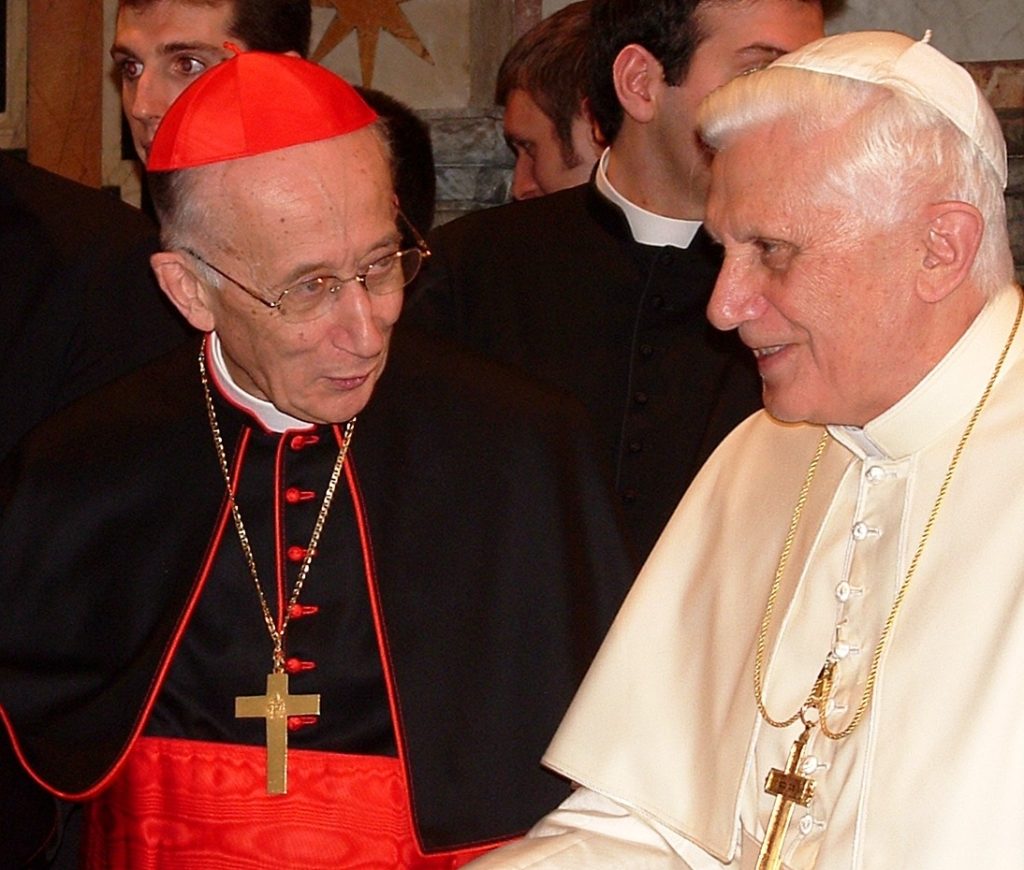
Cardinal Ruini’s testament reveals final thoughts on Pope Francis
The full testament of Cardinal Camillo Ruini has been published, including passages on Pope Francis and the post-conciliar Church that this publication can reveal some close to the late cardinal feared might never be made public. Read more. The full testament of Cardinal Camillo Ruini has been published after people close to the late cardinal expressed concern that parts of the document might never be made public. The disclosure followed the late cardinal’s death and Pope Leo XIV’s citation of the testament during his homily at Ruini’s Requiem Mass. The testament was exclusively published by Messa in Latino , which released the complete spiritual text and stated that it was doing so to prevent the document from being “cut” or amended. The revelation has taken on additional significance as AdVaticanum can reveal that there were concerns the testament would not be published in its entirety. To date, neither the Holy See Press Office nor the Vatican has done so. On good authority, this publication can reveal that people close to the late cardinal wanted the complete testament published, particularly those sections dealing with the post-Second Vatican Council Church and Pope Francis. Reflecting on the last pontificate, Cardinal Ruini expressed gratitude for what he described as the late Pope’s “extraordinary evangelising drive”, but also acknowledged a struggle with some of the directions taken by the Church in recent years. “When Pope Francis was elected, I rejoiced and, to the extent I could, immediately supported him,” the late cardinal wrote. “Even today, I rejoice and thank him for his extraordinary evangelising drive.” Yet the cardinal continued with a note of candour unusual in a spiritual testament: “I must confess, however, that I find myself in a state of unease, certainly not for personal reasons, but because I struggle to understand certain orientations that seem to reopen wounds that have barely healed since the Council. I humbly ask the Lord to convince me inwardly that the Church is His and that He Himself cares for it, beyond our human views.” Long regarded as one of the most influential churchmen of the post-war Italian Church, Cardinal Ruini was a steadfast supporter of the Second Vatican Council while also becoming one of the most prominent critics of what he viewed as distortions in its implementation. That dual concern is visible throughout the testament. Reflecting on his years as a priest in Reggio Emilia, Cardinal Ruini gave thanks for the Council itself, writing that he was grateful “for the Second Vatican Council, for having experienced it and helped others experience it joyfully in Reggio Emilia, and also for having given me the clarity and strength to oppose the post-conciliar excesses”. The cardinal presented himself as a defender of the Council who believed that some developments undertaken in its name had gone beyond the intentions of the Fathers who gathered in Rome between 1962 and 1965. The testament also sheds fresh light on Ruini’s relationship with the last three pontificates. He described St John Paul II as “a very special grace”, recalling more than two decades of close collaboration after becoming one of the Polish Pope’s most trusted advisers. “In John Paul II, I experienced your presence, Lord,” Cardinal Ruini wrote. “I was able to touch firsthand the union in prayer, the inseparability of prayer, life and apostolate, the courage of faith that guides history, and the capacity to love and forgive.” His words concerning Pope Benedict XVI were similarly affectionate. “After John Paul II, I collaborated for three years with Benedict XVI, and I thank him wholeheartedly, also for the affection he continues to show me,” the late cardinal wrote. Yet despite his immense ecclesiastical influence, the testament is notable for its intensely personal and penitential tone. Cardinal Ruini repeatedly asks forgiveness for failures, weaknesses and sins, presenting himself not as a prince of the Church but as a Christian preparing for judgement. “I confess first of all the weakness of my faith,” the former Cardinal Archpriest of St John Lateran wrote. “Despite all this, however, in the depths of my heart I have always been sustained by faith, even though, by the grace of God, I believe I have never succumbed to temptation.” The testament also reveals a recurring theme of gratitude. Cardinal Ruini meticulously recalled family members, friends, priests, collaborators and colleagues who shaped his life, from his childhood in Sassuolo to his years at the Gregorian University and the Almo Collegio Capranica, and later his service as President of the Italian Bishops’ Conference and Cardinal Vicar of Rome. At the same time, he acknowledged that the authority he exercised could sometimes be accompanied by severity. “I recognise and confess, however, that I have at times acted with substantial harshness,” he wrote, before asking forgiveness from those whom he had caused pain. In the end, however, the testament is less a political statement than a spiritual examination of conscience. Its final pages are occupied not by ecclesiastical disputes but by an appeal for mercy and perseverance. “Lord, faithful God, never tire of loving me, calling me, and converting me,” Cardinal Ruini wrote. “Father, rich in mercy, grant me and all my brothers and sisters in humanity the grace of final perseverance.”
Jun. 18, 2026
Archbishop Gänswein on Benedict and Francis relationship
In an interview with La Repubblica, Pope Benedict’s longtime personal secretary discusses Benedict XVI and Pope Francis’s relationship, including tensions over the traditional Mass Archbishop Georg Gänswein has said that Pope Emeritus Benedict XVI never criticised the restrictions imposed on the traditional Mass by Pope Francis, despite being personally troubled by them. In an interview published by La Repubblica on April 20, Archbishop Gänswein, who served for years as Benedict’s personal secretary, said: “Benedict never commented on Pope Francis’s motu proprio Traditionis custodes. In my book I wrote that when we read L’Osservatore Romano [about Traditionis custodes], Benedict’s heart grew heavy. That is true, but I am the one saying it, not him.” The archbishop, now Apostolic nuncio in Lithuania, also spoke at length about the unprecedented coexistence of two popes following Benedict’s resignation in 2013. “There was only one Pope. The other was still called Pope, but he was in reality the Pope Emeritus. That is a very important difference,” he said. He added that Pope Emeritus Benedict XVI himself took visible steps to mark the distinction, removing elements of papal dress and adopting a simpler presentation, even as he retained the title “Pope Emeritus”, which Gänswein confirmed “he chose himself”. Responding to claims that the resignation had been shaped by scandal, Gänswein rejected any link to the Vatileaks scandal or other controversies. “None of what you have recalled had anything to do with it. Neither Vatileaks, nor the so called ‘gay lobbies’, nor anything else. The resignation was the fruit of deep reflection and intense prayer. The Pope put the question to his conscience and then made his decision.” He recalled the moment of the conclave that elected Francis, describing how he saw the white smoke from his office before going to the Sala Regia. “Then the door opened and from a distance I saw the cardinals congratulating the new Pope. Almost at once, the name Jorge Mario Bergoglio spread through the entire hall like wildfire.” When he met the newly elected Pope, Gänswein said Francis spoke first: “I would like to meet Benedict. Can you help me?” The first meeting between the two men took place at Castel Gandolfo on March 23, 2013. Gänswein said the encounter was marked by mutual deference. “When they entered the chapel, Pope Benedict wanted to let Pope Francis go first, but Francis refused. The same thing happened with the prie-dieu.” He added that Pope Emeritus Benedict XVI had prepared a box of documents relating to the Vatileaks inquiry, which he handed over personally. “He wanted to explain the contents to Francis and tell him what he thought. He did it in writing, as usual, and put everything inside.” Archbishop Gänswein confirmed that Pope Francis chose not to reside in the Apostolic Palace after his election. “The Pope told me to find him something else,” he said, admitting that he initially did not take the request seriously. He later understood the decision more clearly when Francis explained: “I have never lived in such large rooms. I want to live in smaller ones.” The Pope subsequently remained at the Casa Santa Marta. The interview also addressed perceptions of tension between the two pontificates. Archbishop Gänswein said reports of sustained opposition organised around Benedict were exaggerated. “From what I experienced, the real situation was greatly exaggerated.” He acknowledged that “there were some observations about Francis’s behaviour and choices”, but added: “It is perfectly normal to comment on a Pope’s decisions; it is not in itself forbidden.” Reflecting on his own position, Archbishop Gänswein referred to a remark he had made about carrying the “mark of Cain”. He clarified: “I did say that, but in general, not with reference to Pope Francis.” He added that Benedict’s figure “aroused both friends and enemies”, and that his own association with the former Pope had remained a defining factor. Archbishop Gänswein also described the personal relationship that developed between the two popes in more ordinary terms. He pointed to small gestures, including visits and the exchange of gifts, as evidence of a cordial rapport. “One could sense it, atmospherically, so to speak, from the climate that had been created between them,” he said, noting that such gestures were “signs of mutual attention”. He also gave a detailed account of the moment following Benedict’s death, when Francis arrived at the Mater Ecclesiae Monastery. “Pope Francis had told me: ‘When the hour comes, please call me directly.’ I did so on my mobile phone. Shortly afterwards the Pope arrived.” Archbishop Gänswein said: “Francis blessed his predecessor, then sat down beside him, remained in silence for a few minutes, and then we all prayed together.” Asked about a comparison between recent popes, Gänswein declined to offer a clear characterisation of the current pontificate beyond noting the significance of the name. “That is a difficult question at the moment,” he said. “But the name Leo itself already says something, don’t you think?” The remarks of Archbishop Georg Gänswein over recent years, taken together with testimony from those close to Pope Emeritus Benedict XVI, suggest a more restrained relationship than some accounts presented during the years of his retirement alongside Pope Francis. The evidence increasingly suggests that the relationship may have been difficult, even if this was never publicly acknowledged by Pope Emeritus Benedict XVI himself. His silence, long interpreted as serene acquiescence, now appears as an act of discipline intended to avoid any impression of a divided papacy. The clearest point of tension concerns the motu proprio Traditionis custodes, which reversed the more permissive framework established by Benedict for the older form of the Roman rite in Summorum Pontificum. Archbishop Gänswein said in an interview with Die Tagespost on January 20, 2023: “It was very hard. I believe that reading the new motu proprio broke Pope Benedict’s heart because his intention had been to help all those who had found their home in the traditional Mass, to find inner peace, liturgical peace, so that they would abandon the position of Archbishop Lefebvre.” That judgement, offered by the man who knew Benedict most intimately in his final years, corresponds to a known priority of Benedict’s pontificate: the reconciliation of those attached to the older liturgy. Sources close to Archbishop Gänswein and to Pope Emeritus Benedict XVI have further confirmed this, telling AdVaticanum that the promulgation of Traditionis custodes “caused [Benedict] pain”. That pain was not expressed publicly. Instead, Pope Emeritus Benedict XVI maintained the silence he had promised upon his resignation. More significant, and less often discussed, is the way Archbishop Gänswein’s own position further complicates the picture. Once Prefect of the Papal Household, he was effectively sidelined and later sent to Germany and then the Baltics as nuncio. The same sources told AdVaticanum that Pope Emeritus Benedict XVI made both formal and informal requests that his secretary be allowed to remain in the Vatican. They said: “There wasn’t an actual relationship. Sometimes Benedict asked favours of Francis to keep Gänswein in the Vatican and not remove him, both formally and informally.” These requests, it is said, went unanswered. This asymmetry is also discernible in reflections offered by the papal biographer Peter Seewald in an interview with Nico Spuntoni. Seewald contrasted the widely remembered homily delivered by then Cardinal Ratzinger at the funeral of Pope St John Paul II with the more restrained tone of the rites following Benedict’s own death. “We all remember the warm words that Cardinal Ratzinger spoke at the requiem for John Paul II,” he said. “But no one remembers Bergoglio’s words at the requiem for Benedict XVI. They were as cold as the whole ceremony, which had to be rather brief so as not to honour his predecessor too much. At least that was my impression.” Pressed on whether such a judgement was too severe, Seewald continued: “I mean, how does one manifest friendship? With a mere statement in words, or by living it?” He pointed to differences “in temperament, culture, intellect and above all in the direction of the pontificates”, adding that Benedict had promised obedience and “remained silent so as not to give the slightest impression of wanting to interfere in his successor’s governance”. That silence, he suggested, was not without consequence. “Benedict trusted Francis. But he was bitterly disappointed several times.” Historically, the coexistence of a reigning Pope and a Pope Emeritus was itself without precedent in the modern Church. Pope Emeritus Benedict XVI sought to define that relationship through withdrawal, discretion and loyalty. His intention was to remove himself entirely from the exercise of authority. Yet the very novelty of the situation meant that every gesture and every silence acquired a significance beyond the personal.
Apr. 23, 2026