

Bishop Athanasius Schneider
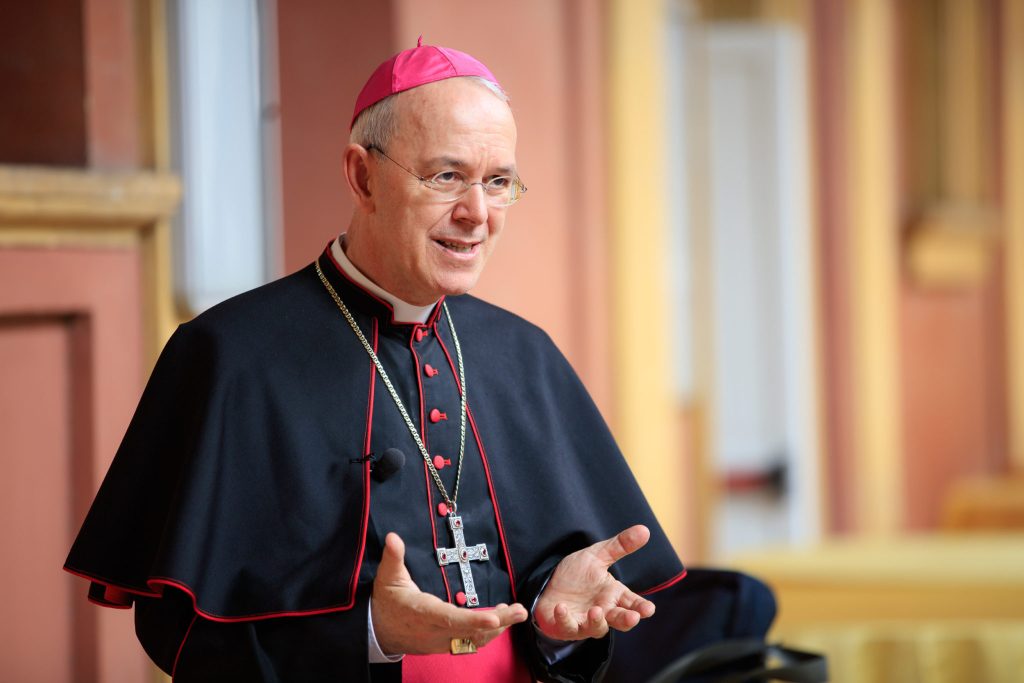
Schneider: Pope Leo “continues” Francis’s reforms
Bishop Athanasius Schneider has said Pope Leo XIV “continues” the course set by Pope Francis, arguing that both pontiffs see recent developments in the Church as a natural consequence of Vatican II. In a recent interview, he also discussed the SSPX, Vatican II and what he described as a doctrinal crisis within the Church. Bishop Athanasius Schneider has said that Pope Leo XIV is continuing the course pursued by Pope Francis. The auxiliary bishop of Astana made the remarks in a lengthy interview published on 8 June on the YouTube channel Veritatis Vox. He discussed Pope Leo’s pontificate, the authority of Vatican II, the doctrinal crisis in the Church and the position of the Society of St Pius X. Reflecting on the new pontificate, Bishop Schneider argued that Pope Francis viewed his reforms as a natural consequence of the council and suggested that Pope Leo shares the same understanding. “Pope Francis, with all his so-called reforms, which were very questionable also doctrinally, was convinced that this is a natural, coherent development of the teaching of Vatican II,” he said, adding: “In this sense, it’s obvious that Pope Leo continues and understands it.” The bishop also delivered a stark assessment of the state of the Church, claiming that some senior clerics had drifted away from the fullness of Catholic teaching. He said a “remarkable number of high-ranking clergy – cardinals and bishops” no longer held “the Catholic faith in its fullness” and had embraced “another church: half Protestant, half worldly, adapted to the spirit of the age”. He argued that attempts to reconcile Catholic teaching with modern secular culture had produced confusion among the faithful. According to Bishop Schneider, some Church leaders had sought to adapt the faith “completely to the world”, resulting in “widespread confusion, obscurity and darkness in doctrine, morals and liturgy”. Much of the interview focused on the continuing debate over Vatican II, a subject that has long divided traditionalist Catholics and Church authorities. Bishop Schneider criticised what he sees as an unwillingness among some Vatican officials to acknowledge difficulties within certain conciliar texts. Referring to comments by Cardinal Víctor Manuel Fernández, prefect of the Dicastery for the Doctrine of the Faith, he said that insisting Vatican II could not be corrected effectively treated “a pastoral, non-definitive council as if it were infallible”. He added that Church authorities had spent decades treating the council as “a de facto untouchable teaching”. The bishop also challenged comments by Cardinal Gerhard Müller, the former prefect of the Congregation for the Doctrine of the Faith, who has argued that the council must be accepted in its entirety. Bishop Schneider said such a position was “not correct”, maintaining that Vatican II and Pope St Paul VI had explicitly stated that the council did not intend to define new dogmas or issue definitive teachings binding on all Catholics. He added that Cardinal Müller “directly contradicts the Council itself and Paul VI”. Addressing broader questions of authority within the Church, Bishop Schneider criticised what he described as demands for unquestioning acceptance of disputed teachings. “To demand acceptance of problematic teachings by ‘switching off our intellect’ is an abuse of authority,” he said, invoking a well-known observation by G.K. Chesterton that Catholics are asked to remove their hats when entering church, “not their heads”. The bishop further argued that elements of Vatican II placed excessive emphasis on human concerns at the expense of the supernatural mission of the Church. He said the council contained “tendencies toward naturalism and anthropocentrism, emphasizing temporal realities at the expense of the supernatural life of grace and eternity”, identifying the pastoral constitution Gaudium et Spes as “the clearest expression of this tendency”. He also referred to the late Belgian Cardinal Léon-Joseph Suenens, one of the most influential figures at the council, who famously described Vatican II as a “French Revolution inside the Catholic Church”. Bishop Schneider said that “in some way, he was correct”, arguing that the council initiated a process that encouraged naturalistic and anthropocentric approaches within ecclesial life. The interview also addressed the Society of St Pius X, whose relationship with Rome remains in limbo as the 1 July episcopal consecrations approach. Bishop Schneider defended Catholics attached to the SSPX and questioned what he described as unequal disciplinary standards within the Church. Referring to the possibility of sanctions against traditionalists, he said it would be unjust to punish those who “recognize the Pope” and wish to “serve the Roman Church” but find themselves facing “a dilemma of conscience”. By contrast, he criticised supporters of Germany’s Synodal Way and other bishops whom he accused of promoting doctrinal error without consequence. “Meanwhile,” he said, “the German Synodal Way and other bishops around the world proclaim openly heresies and commit blasphemies really during liturgies, all unpunished, not admonished.” Photo credit: Voice of the family
Jun. 10, 2026
Schneider, Murray and SSPX accuse Vatican of ‘complicity’ in promoting LGBT ideology
Bishop Athanasius Schneider, Fr Gerald Murray and the Society of Saint Pius X have accused the Vatican of being “complicit” in promoting homosexuality after the publication of the Synod Study Group 9 report The publication of Synod Study Group 9’s report has become a crisis and controversy that the Vatican cannot ignore, although such appears to be its current policy. Mounting criticism of the report – released by Study Group 9, born out of the Synod on Synodality – has already included cardinals such as Müller and Eijk, numerous priests and veteran commentators. Such rebuke has largely centred on the message contained within the report, which presented an unfiltered promotion of homosexual ideology and lifestyles whilst remaining notably quiet about Catholic teaching on the matter. But now attention is turning elsewhere as clerics accuse the Vatican of being complicit in promoting homosexuality by virtue of allowing the report to be published, and by the Vatican’s near silence in the face of the scandal. Speaking recently to Raymond Arroyo, Bishop Athanasius Schneider described the report as “a propaganda text, which very carefully and cunningly uses certain traditional documents or biblical expressions, but which fundamentally aims to promote the acceptance of homosexual ideology.” Such themes within the Study Group report are by no means surprising given that the group itself comprises a number of LGBT advocates, and Fr James Martin SJ was revealed to have had key influence in drafting it. But Schneider warned that the Holy See is far from being innocent. It was “issued by an organ of the Holy See,” he noted, and thus many Catholics will be led to believe that it is Church teaching. “The majority of ordinary Catholics are unaware of the distinctions between a magisterial text, a Vatican text, and a study group in the Vatican.” Therefore, he warned, “the message given to the entire world and to Catholics is that, from now on, the Holy See is basically accepting, de facto, same-sex relationships, same-sex activity and the so-called LGBTQ agenda, which is an un-Christian worldly ideology.” The General Secretariat of the Synod of Bishops has indeed sought to distance itself from the text, stating that “these reports cannot be attributed” to them, and that the group “worked, as is logical, autonomously.” However, for the auxiliary bishop – who has personally conveyed his concerns about the Church’s doctrinal crisis to Pope Leo XIV – such a response is lacking. “It’s not convincing at all,” he stated. “It is [the study group report] officially under a Vatican dicastery or organ called the Synod Secretariat, which has officially published [the text], though of course as a study group.” For the Synod Secretariat to assign responsibility to the Study Group is “a trickery to close our eyes,” opined Schneider, “and then to transmit, and be a propaganda platform for this homosexual ideology – to infect ever more the Catholic Church through the acceptance of this style of life.” The auxiliary of Astana, Kazakhstan, is known for being outspoken in his ecclesial commentaries. But he is not alone in his thoughts on this point. Prominent canon lawyer and New York cleric Fr Gerald Murray also accused the Vatican of being at fault. Writing a commentary in The Catholic Thing , Murray attested that the Synod Secretariat “has become the Holy See’s officially sponsored agent of destruction of Catholic doctrine, which is disparaged and dismissed as being deductive principles set forth in an immutable and rigid manner – sterile, regressive and ossified statements, as being ‘pre-packaged’ doctrines, which are merely abstractions and theories.” Murray, like Schneider, is a cleric in good standing with the Church and walks a fine line between highlighting doctrinal crises and moral relativism while also promoting loyalty to the See of Peter, in contrast to those tempted to argue that the See is vacant. His commentary is unabashed when law, morals or doctrine are at stake. “Why would the Synod of Bishops publish interviews with men who reject Catholic teaching on the nature of marriage, inspired as it is by the Holy Spirit, as part of its effort to discern the workings of the Holy Spirit in the Church today?” he queried. “This Vatican-sponsored destructive subversion must come to an end now,” wrote Murray. “Souls are endangered by the scandalous false teachings being propagated by the Synod. Pope Leo needs to strengthen the brethren in the Faith by putting an end to this poisonous betrayal of God’s truth.” The Vatican’s response appears to be limited simply to the perfunctory hand-washing attempt by the Synod Secretariat, who are doubtless relying on the natural continuation of the news cycle and the lack of attention given by many Catholics to the details. Yet for the Society of St Pius X, turning a blind eye to such events is not an option. The state of emergency within the Church is worse now than in 1988, the SSPX’s superior general has repeatedly stated during the spring. Outlining the Holy See’s “complicity” with the LGBT lobby – as reportedly evidenced by Fiducia Supplicans and the conciliatory approach to the German bishops – the Society pointed to the Study Group report as the final piece of the puzzle. Fiducia Supplicans destroyed the Holy See’s ability to clamp down on LGBT promotion, the Society argued, whilst simultaneously “faith and moral conviction are deserting the Curia”. “If anyone doubts this, let them read the report of Study Group No. 9, which aligns with the Synodal Path and its conclusions on the LGBT issue,” the Society’s official news portal argued. “While we wait for the ‘dialogue’ to produce ‘consensus’ between Rome and the German Catholic Church, the problem is spreading among German Catholics and beginning to cross borders, with the blessing of the Curia. Under these circumstances, we must speak of complicity.”
May 22, 2026