

Latest
The quiet rise of Generation X within the Church hierarchy
A younger group of cardinals, drawn from Generation X, is emerging within the College. These prelates are already stepping into positions of influence “Generation X”, often described as the forgotten generation between “Boomers” and “Millennials”, is generally considered to include those born between 1965 and 1980. In secular terms, they are characterised by relative wealth, having bought homes before the steepest price rises of the 2000s and 2010s, and by confidence with technology which stops short of the digital nativeness of millennials. Leonardo DiCaprio, Elon Musk and Justin Trudeau are some of the better-known inhabitants of the age bracket, with JD Vance just missing the boat and describing himself as a “geriatric millennial”. In the Church, they are the men who entered the post-Vatican II seminaries, marked by a steep decline in attendance. But their formation for the priesthood also came at the end of the liturgical experiments of the 1970s and 1980s, which erroneously attempted to capture the vision of Sacrosanctum Concilium . They were also the first generation to be raised almost entirely with the 1969 Mass of Paul VI and were, in some ways, the test run for the expected fruit which the Council might bear. In all likelihood, the next conclave, whenever that may be, will elect a cardinal from this generation of priests. Currently, just 17 members of the College of Cardinals were born after 1965. Amongst those, some are making a meteoric rise through the hierarchy and whom we can expect to see much more of in the coming years. For example, Cardinal George Koovakad, born on 11 August 1973 and sitting comfortably in the middle of Generation X, is probably the most senior cardinal from the Eastern Churches and the second youngest among the group after Cardinal Mykola Bychok. A priest of India’s Syro-Malabar Church, he was ordained in 2004 before entering the diplomatic service of the Holy See in 2006. Elevated to the cardinalate directly from the rank of priest, he was made an archbishop after the announcement of his elevation. He became known as the “travel agent” of the Francis era, arranging the complex itinerary of one of history’s most travelled popes. In 2025 he was appointed Prefect of the Dicastery for Interreligious Dialogue, becoming the first prelate from the Syro-Malabar Church to head a curial department. Another is Cardinal Francis Leo. With both the current pontiff and his predecessor’s name, his story is one of meteoric rise. In 2022 he was made Auxiliary Bishop of Montreal before being appointed Archbishop of Toronto less than a year later. Pope Francis made him a cardinal in the December 2024 consistory. Cardinal Leo is a renowned Mariologist and founder of the Canadian Mariological Society. He has also served as secretary general of the Canadian Conference of Catholic Bishops and has an impressive record in the Holy See’s diplomatic service. At the most recent conclave, the Portuguese-speaking bloc was significant. Portugal, a country with just 10 million inhabitants, had four voting-age cardinals, while Brazil had seven. Combined with two Portuguese-speaking Africans, the total was 13, just under 10 per cent of cardinal electors. Among them, Cardinal Américo Aguiar was the youngest. Tasked with organising the 2023 World Youth Day in Lisbon, which was widely seen as a huge success as well as financially profitable, it was announced that he would be made a cardinal before the event. As Auxiliary Bishop of Lisbon, Cardinal Aguiar’s appointment was unusual. The move was made even more so by the fact that, by the time he officially received his red hat in the September 2023 consistory, a new Patriarch of Lisbon had been appointed, Archbishop Rui Valério, who has to this day not been made a cardinal. Cardinal Aguiar’s effectively higher rank than his superior is made even stranger by the apparent ignoring of the long-established tradition of the Patriarch of Lisbon being made a cardinal. Cardinal François-Xavier Bustillo is a Generation X cardinal emblematic of what Pope Benedict XVI called “the new evangelisation”, the missionary effort to re-Christianise those parts of Europe that have been lost to secularism. Joining the Franciscans at the age of just 17, he was ordained a priest in 1994 and, that same year, founded the convent of Saint Bonaventure in Narbonne, with a mission to re-evangelise a town where 19th- and 20th-century anti-clericalism had been particularly strong. In 2021 he was appointed by Pope Francis as Bishop of Corsica and, in 2022, the late pontiff arranged for copies of Cardinal Bustillo’s book, Testimoni, non funzionari (Witnesses, Not Officials), to be handed out to priests attending the Chrism Mass in St Peter’s Basilica. A year later he was made a cardinal and became a member of the Dicastery for the Clergy. Cardinal Bustillo was recently tasked with helping with the formation of Spain’s priests, in a country which remains a centre of priestly formation, with more than a thousand men in training. “Generation X”, by the standards of Church hierarchy, has relative youth on its side, and these men, alongside their colleagues in the College of Cardinals of the same generation, represent the next wave of leadership. While the voice of a prince of the Church always deserves attention, these are the figures we can expect to hear more from. By listening to them closely, we may gain a clearer sense of the direction the Church will take in the coming years.
Apr. 30, 2026
Cardinal Farrell warns of global collapse in Catholic baptisms and marriages
Cardinal Kevin Farrell, prefect of the Dicastery for the Laity, Family and Life, says baptisms of young children have fallen by 31.1 per cent and Catholic marriages by 48 per cent since 1991, warning of a weakening transmission of the faith within families Cardinal Kevin Farrell has warned of a sharp global decline in Catholic baptisms and marriages, pointing to figures showing a sustained weakening in the transmission of the faith within families over the past three decades. Speaking at a Vatican study seminar on marriage formation held in the Vatican Gardens on April 28, the prefect of the Dicastery for Laity, Family and Life cited data from the Annuarium Statisticum Ecclesiae 2021 indicating that between 1991 and 2021 the number of baptisms administered worldwide to children under the age of seven fell by 31.1 per cent, while Catholic marriages declined by 48 per cent. “The transmission of faith within families is weaker now than in the past,” Cardinal Farrell said. “According to the Annuarium Statisticum Ecclesiae 2021 , between 1991 and 2021, the number of baptisms administered worldwide to children under the age of seven declined by 31.1 per cent, and Catholic marriages by 48 per cent.” The cardinal added: “Faced with these figures, we must not lose heart; rather, we must remain fully aware of them so as to transform this situation into an opportunity for ecclesial renewal.” The remarks were delivered during a study day entitled The Sacrament of Marriage, Faith, and the Munus Docendi , which brought together representatives of the Roman Curia, seminary rectors, theologians and those involved in priestly formation. The gathering focused on how future priests are trained to teach and accompany families in a rapidly changing cultural environment. In a text published in L’Osservatore Romano , Cardinal Farrell said that “profound cultural transformations have redefined the processes of family formation”, noting that the bond between couples is “increasingly seen as an individual experiment, less and less as a definitive bond”. “Marriage is no longer considered necessary for the formation of a family alliance,” he said, adding that cohabitation has become “the choice, now considered almost obligatory by many, to test the couple’s stability with a view, though not always, to a stronger future bond”. He said these developments pose “urgent” challenges for the Church, particularly in youth and family ministry, and pointed to reports from bishops during their ad limina visits describing “enormous difficulties in reaching the families of baptised faithful who no longer come to the Church”. The cardinal asked how the Church might make its teaching mission more effective so that “new generations of priests can raise children and young people in the faith, cultivate in them the Christian vocation of marriage, and accompany families in the value-based challenges of our time”. The seminar also heard from Fr Andrea Bozzolo, rector of the Pontifical Salesian University, who emphasised the need for “pastoral guidance” that combines biblical and theological formation with an understanding of contemporary cultural realities and “listening to concrete family experiences”, with particular attention to “the emotional and sexual education of adolescents and young people”. Fr Fabio Rosini, a biblical scholar and professor of homiletics and pastoral theology, warned against a model of priestly formation that remains detached from lived experience. “If we continue to train priests to be producers of a penultimate life, it won’t be of much use to sacramentally married couples, and it won’t matter what they have to say,” he said. “We run the risk of continuing to sell the world to the world.” He added that “after centuries of parenthetical language, after the conciliar revival of kerygmatic language, given the need to proceed with the pedagogy that leads to Baptism, the time has come to return to didactic-instructive language”. Cardinal Farrell said that while many seminaries and pontifical universities provide solid theological teaching on the sacrament of marriage, this “risks remaining theoretical” if it is not connected to the realities of family life and the cultural conditions in which people live. “This makes it difficult for many pastors to effectively engage with the world of young people and families as it presents itself today,” he said, referring to “families marked by processes of de-Christianisation, young people disinterested in marriage, or coming from fragile and discontinuous family situations”. He added that requests for Church weddings often “do not reflect a mature faith, nor an awareness of the ecclesial and sacramental significance of what is being requested”, and that in some cases “even a trace of predisposition to faith is lacking”. The cardinal said this helps explain “the high number of couples in crisis who choose to separate, unable to find the grace to save their marriage in the sacrament”. “At the pastoral level, it cannot be reduced to the simple transmission to the laity, in didactic and theoretical form, of what the Church teaches and requires regarding marriage,” he said. “Rather, it requires the ability to accompany those intending to marry on a path of experiential maturation, preparing them to welcome the grace of Christ, enabling them to live a Christian life.” Quoting the Pope, the cardinal said: “In the family, faith is transmitted together with life, from generation to generation,” and added that “since families struggle to transmit the faith and could be tempted to shirk this task, we must try to stand alongside them without replacing them”. He said the aim of the current reflection is to promote a form of priestly formation “more closely aligned with pastoral practice and capable of generating new Christian families in the faith”. The study day concluded with a call for continued discernment on how best to proclaim, protect and accompany the vocation to marriage in contemporary society, with an emphasis on forming “teachers of the faith and authentic spiritual fathers to foster Christian families”.
Apr. 30, 2026
Switzerland drops case against Crasso in setback for Vatican ‘trial of the century’
Swiss prosecutors have dismissed proceedings against Enrico Crasso, rejecting Vatican claims over fund mismanagement and criticising the Secretariat of State’s lack of cooperation Switzerland has dismissed criminal proceedings against Enrico Crasso, the former financial adviser to the Secretariat of State, concluding that no offences were committed in relation to the management of Vatican funds, delivering a further blow to the Holy See’s “Trial of the Century”. First reported by Nico Spuntoni, Vatican correspondent of Il Giornale , the decision was issued by Federal Prosecutor Annina Scherrer in Lugano following an investigation opened in June 2020 after a complaint by the Secretariat of State. The Vatican Secretariat of State had alleged criminal mismanagement in connection with investments made through the Centurion Global Fund, as well as raising accusations of fraud and corruption. The Swiss authorities found no evidence to support those claims. In her decree, Federal Prosecutor Scherrer determined that there had been no mismanagement or embezzlement on the part of Crasso in his role as a financial consultant. The ruling explicitly states that the Secretariat of State “must be considered an experienced investor, fully aware of the provisions to which it adhered”, rejecting the suggestion that it had been misled in its dealings. The case centred on investments managed by Crasso through his company, Sogenel Capital Investment, under a mandate from the Secretariat of State. These financial arrangements had already formed part of the broader Vatican investigation into the purchase of a London property in Sloane Avenue, a transaction that triggered one of the most significant financial trials in the history of the Holy See. The Swiss proceedings ran in parallel to the Vatican’s own judicial process. In the first-instance Vatican trial, Crasso had been sentenced to seven years’ imprisonment for embezzlement and self-laundering. However, he had been acquitted of charges specifically related to the management of the Centurion Fund. That distinction was noted in the Swiss prosecutor’s findings. The credibility of the Vatican trial has already been called into question after the Court of Appeal declared parts of the proceedings null. The Swiss ruling adds to the difficulties facing the prosecution’s case. However, the decree from Lugano contains direct criticism of the Vatican’s conduct during the investigation. Despite being the complainant, the Secretariat of State did not comply with requests from Swiss authorities to facilitate interviews with key figures connected to the case. According to the decree, Swiss investigators sought to question several individuals, including Monsignor Alberto Perlasca and Archbishop Edgar Peña Parra, through formal letters rogatory. These requests were not executed. In a note dated November 30, 2023, the Secretariat of State responded: “These are jurisdictional acts that cannot be performed by state authorities in the territory of another state,” adding that it would consider “the appropriateness of Swiss magistrates sending the tribunal the questions to be asked or the facts requested for examination.” Scherrer highlighted this refusal in her findings, describing the situation as paradoxical given that the Vatican itself had initiated the complaint. The decree records that the Swiss authorities received the response “not without surprise” and concluded that the lack of cooperation hindered the investigation. The prosecutor further observed that “interrogating the persons informed of the facts (…) would have been of fundamental importance to verifying the veracity” of the allegations. In light of the Vatican’s position, the Swiss authorities declined to proceed by submitting questions through the Vatican tribunal, citing concerns over the integrity of the process. The decree also points to what Scherrer described as “the influence of the private accuser and whistleblower within the Vatican State”, suggesting that internal dynamics may have affected the handling of the case. The refusal to allow direct questioning of witnesses was regarded as a significant obstacle to establishing the facts. The outcome leaves the Secretariat of State without recourse in the Swiss jurisdiction and raises further questions about the coherence of the wider legal strategy pursued by the Holy See. It follows earlier setbacks in other jurisdictions, including proceedings in England related to the London property deal. The Secretariat of State has not publicly responded in detail to the Swiss decision. The case nevertheless marks another stage in a protracted process that has tested the Holy See’s judicial structures and its approach to financial governance.
Apr. 30, 2026
Bishop Eleganti on the old rite, Islam and the future of the Church
Bishop Marian Eleganti speaks to AdVaticanum on the appeal of the traditional liturgy, Islam and the Society of St Pius X. Eleganti addresses the fallout of the Second Vatican Council, the place of the old rite and the pertinent questions facing the Church in the West The Benedictine Bishop Marian Eleganti, former Abbot of St Otmarsberg Abbey and auxiliary bishop of the Diocese of Chur until 2021, is well known for his defence of the truth and beauty of Catholicism in the face of an increasingly hostile West. A principled churchman, he has often paid the price for adhering to his conscience, stepping down as the Swiss bishops’ youth bishop in 2018 due to disagreements with other bishops at the 2018 Youth Synod and offering his resignation in 2021 at the age of 65, a full ten years before the mandatory retirement age for bishops. In this interview, he sits down with AdVaticanum to reflect on his years of priestly ministry and to offer his erudite analysis of the challenges facing the Church in the twenty-first century. He addresses Islam, the Society of St Pius X, the liturgy and the fallout of the Second Vatican Council with the characteristic clarity that has made him a much respected voice within the Church. AV: Your Excellency, you were born in 1955 and have recounted serving as an enthusiastic altar boy in the traditional rite in your childhood before being retrained for the Novus Ordo. You have described the post-conciliar liturgical intervention as “a rather violent, provisional reconstruction of the Holy Mass… associated with great losses that need to be addressed”, noting differences especially in the prayers, postures, and ad orientem orientation. Young Catholics today, who often know little about the texts of Vatican II, are increasingly drawn to the Tridentine rite for its beauty and transcendence. In your view, what specific elements of the ancient liturgy address the spiritual hunger of this generation, and how would you respond to claims that restricting the Traditional Latin Mass is necessary for ecclesial unity? +ME: I believe that the appeal of the Old Liturgy for young people lies primarily in several key aspects. Firstly, its focus, and the centrality, on God or Christ, rather than on the community. The general orientation of everyone (the congregation and the priest) is towards Him. Another is the palpable reverence associated with the encounter with the transcendent God or the present Christ. There is also the stillness and silence, reminiscent of the worship of the Lamb in the Book of Revelation. I believe people are also drawn to the solemnity and dignity of the vestments, liturgical objects, and the altar, as well as the overall design of the sanctuary. Finally, Gregorian chant, which has been a trend for some time, even in secular circles. Reverence, faith, prayer, love, and inner devotion or participation have their roots in the heart. They can be found just as easily in the Novus Ordo. I am the same person in any rite. How I stand before God and celebrate Him is decided within me. It is not the form that makes me devout. Devotion is either present or it is not, regardless of the form. The inner self then also takes on the proper mode of expression; it does not work the other way around. I kneel because I am devout; I am not devout because I kneel. If a form becomes associated with false thinking, it can become a divisive force and a question of “to be or not to be”, which a rite never is. Every form has advantages and disadvantages, and the wise person distinguishes without doing wrong. Why did Jesus call the outwardly righteous Pharisees whitewashed tombs? The discrepancy between what is inside and what is outside can be very great, whatever form it takes. AV: Building on your recent calls (including in early 2026 reflections) for renewed study of the liturgical crisis under a new pontificate, such as the marginalisation of the tabernacle and overemphasis on the “meal character”, do you see a path for restoring wider access to the Tridentine rite beyond the restrictions of Traditionis Custodes? What concrete pastoral measures would you recommend to bishops to allow the old liturgy to flourish again as a living treasure? +ME: We have so many rites in the Catholic Church. We should accept them for what they are: mere rites. We must infuse every rite with love and devotion; otherwise, it misses its mark. The Old and New Rites, as such, have nothing to do with whether we recognise the Council or not, or how we deal with its texts or reforms. These questions are not to be resolved at the level of the rites. Whether the New Mass corresponds to the vision of the Council Fathers who inspired it is a historical question. The answer may vary. Why don’t we simply give hearts the freedom to pray as they wish and to honour God as they like, without disqualifying any person or rite? The Church must set the framework for this. That is not a problem. Rites are not absolute. In a validly administered sacrament, the believer always finds God, regardless of the rite, provided, of course, that the sacraments are celebrated as the Church prescribes and with the inner attitude and dignity I have described above. AV: Your Excellency, you have described the post-Vatican II era as bringing “an indescribable decline in the practice and knowledge of the faith, widespread liturgical formlessness and arbitrariness” instead of the expected “springtime”. Official statistics from the Annuario Pontificio 2026 and Annuarium Statisticum Ecclesiae 2024 confirm a 13-year decline in priestly vocations that has accelerated recently, with major seminarians worldwide falling from 106,495 in 2023 to 103,604 in 2024 (a 2.72% drop), following prior yearly declines, with Europe seeing particularly sharp losses and a net global priest decrease of 734 between 2022 and 2023 despite Catholic population growth. What, in your view, are the specific post-conciliar developments or practices that have contributed to the excesses and loss of the sacred, and how should they now be corrected within the life of the Church? +ME: On the topic of the Old Rite, we must remember the causes of this phenomenon do not lie in the Novus Ordo. The Council Fathers had intended a modest liturgical reform. Excesses, lack of form, trivialisation of the sacred, liturgical disobedience, community-centredness, the absence of priests, or even a hostility towards priests, are phenomena of the post-conciliar era that cannot be attributed to the Council’s texts, any more than post-conciliar heretical tendencies can. The worst of all evils is the practical irrelevance of God in our society and the turning away from Christianity, which has been replaced by ideologies or other forces that have an extremely destructive effect on everything that was once sacred to the so-called Christian West. Nothing better has taken its place. This is becoming increasingly clear. AV: Specifically, focusing on vocations, this multi-year decline has hit Europe and the Americas hardest, with empty seminaries and ageing clergy in many places, while Africa and Asia show some growth. What would you propose to reverse it? +ME: There are many young converts and those seeking baptism. They want to build Christian marriages and families. This is where we need to invest our efforts. We must impart knowledge of the faith to children and young people, provide them with support, and introduce them to the sacraments; we must accompany young families. As a parish priest, I would begin by celebrating Holy Mass as deeply and beautifully as possible, accompanied by brief catechesis. Following the liturgy: fellowship, love, and joy; parents forming friendships, children getting to know one another and playing together. People and charisms gather around every devout priest. With Holy Mass at the centre of life, the Church begins to renew itself. If the priest is a bride in love, the community he gathers around him will soon be the same. This brings an unimaginable momentum. AV: In your October 2025 article “Homosexuality in Society and in the Church: An Elephant in the Room”, you identified the “widespread homosexuality in the clergy and its significance in the abuse crisis” as the ignored “elephant in the room”, calling it a phenomenon sui generis with negative consequences that must be named, while noting that silence renders other prevention efforts incomplete. What pastoral experience or observations led you to this conclusion, and do you think enough is being addressed openly despite earlier calls for psychological screening? +ME: This is not a matter of my own subjective impressions or pastoral experience, but of pure statistics. I wrote to Pope Leo XIV about this. All Church studies on abuse show a disproportionately high number of male victims. It does little good to turn a blind eye to this. There is a factual correlation, without implying that clergy with a homosexual orientation are predestined to commit abuse because of their orientation. The same applies to heterosexuals. There are also many cases of sexual abuse outside the Church, but society primarily focuses on and is scandalised by those within the clergy. To sin means: I could have acted differently, but everyone has their own preferences. AV: As auxiliary bishop emeritus of the Church in Switzerland, you have witnessed the challenges of secularisation in the country. What is your current assessment of the state of the faith in Switzerland, and are there any emerging Swiss “hotspots” of renewal among younger generations rediscovering the faith? +ME: Generally speaking, I give the Swiss very poor marks when it comes to their spiritual life and their connection to the Church. While most of them have been baptised, they have never truly become disciples of Jesus. I say this merely as an observation. It may not necessarily be their own fault. That said, there are genuine hotspots of faith. As the bishop for youth, I was right in the thick of it. Even today, I rejoice in the growth of these hotspots. AV: Your Excellency, you have been clear in your statements that the SSPX’s planned episcopal consecrations on 1 July 2026, without papal mandate, would constitute a “schismatic act” rupturing visible unity with the Pope, citing issues of autonomy, non-incardinated priests, and self-positioning as the true Church. What is the current attitude towards the SSPX within Switzerland? Do you perceive growing support for the SSPX among the faithful? +ME: The Society of St Pius X has gone to great lengths to justify its decision, both internally and externally. Many faithful simply love the traditional liturgy without truly identifying with the Society’s ideology. They are, in fact, often put off by what they sometimes encounter in parishes. I would not say that there is growing support for the Society of St Pius X among the faithful. AV: On the broader European scene, Cardinal Gerhard Müller has recently described mass migration from Islamic countries into Europe as posing significant challenges to integration, warning of risks such as cultural strain, potential social conflict, and growing Muslim influence in public life if not managed carefully. Your Grace, how do you assess the compatibility of large-scale Islamic immigration with preserving Europe’s Christian identity? What role should the Catholic Church play in addressing this, balancing the Gospel’s call to charity and welcome with a realistic consideration of the demographic, religious, and social shifts underway? +ME: Islam, not just so-called Islamism, is, by its very nature, an anti-Christian religion, in theory and in practice. Christianity has never fared well under Islamic rule. This remains true today. Wherever Islam holds sway, Christianity is being decimated to the point of near extinction. I consider Islam incompatible with the Western idea of freedom and the secular state. Ultimately, only the numerical balance will decide which of the two, Christianity or Islam, will disappear and perish or remain in a state of tolerance. Even secular political entities like the European Union exhibit anti-Christian traits today. Due to Islam’s incompatibility with the Christian idea of the separation of state and politics and church and religion (“Render unto Caesar what is Caesar’s, and unto God what is God’s”), I consider Islam to be incompatible with the Judeo-Christian tradition of the West, which still strongly shapes our thinking and political system. The more Muslims are naturalised into our societies, the worse it could become unless Christ converts them and sets them free. AV: And finally, Your Excellency, could you offer your thoughts on the recent scandal in the Diocese of Chur, Switzerland, where three people shared the Eucharist with their pets? +ME: I cannot understand why the Holy Eucharist is celebrated in connection with the blessing of animals. Animals do not belong in a sacred space. They can be blessed outside the church, if one wishes. It is simply terrible that the sacraments, above all the Holy Mass, are no longer understood. The Holy Eucharist is viewed by many as a mere symbol and treated accordingly. But it is the Body of Christ, that is, the living, mysteriously present Person of the Lord. It causes me great pain to hear of such profanations. AV: Thank you, Your Excellency, for your continued dedication to the Church.
Apr. 30, 2026
Bishop of the Diocese of Charlotte refuses communion to family at altar rail
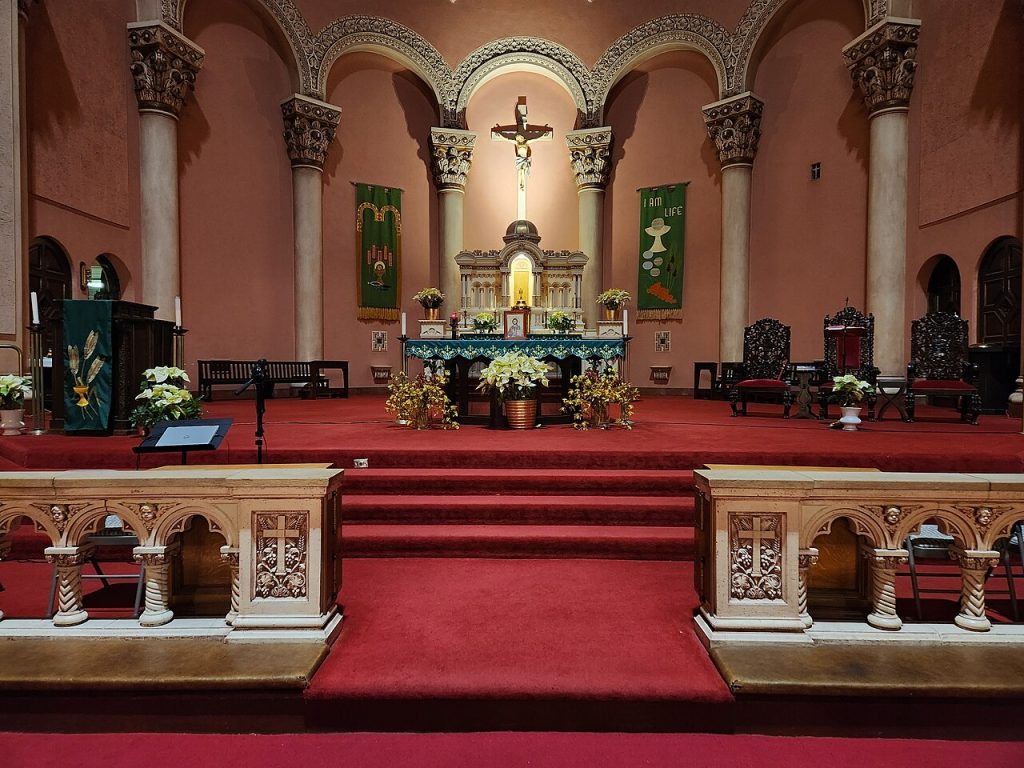
A Catholic family in North Carolina claims they were refused Holy Communion after approaching the altar rail during a Confirmation Mass, according to a report from the Diocese Bishop Michael Martin of Charlotte has refused Holy Communion to a Catholic family who approached the altar rail during a Confirmation Mass. The incident took place on April 29 at Our Lady of Grace parish in Greensboro, North Carolina. While the Confirmation ceremony took place as usual, during Communion only two or three families approached the altar rail to receive the Eucharist. One father who brought his family said to AdVaticanum: “He was sitting in front of us when we went to the rail and he simply ignored us. All the priests turned their backs on us,” he said. “Everyone else communicated and we were denied. To be frank, it was very humiliating.” The same witness said that while the wider congregation received Communion, those kneeling at the rail were passed over. Attempts were made to speak to Bishop Martin about incident after the Confirmation Mass, but he did not respond in detail. Photo taken from the confirmation Mass. Submitted anonymously. The claim comes amid the current liturgical dispute in the Diocese of Charlotte. Bishop Martin has introduced norms governing the reception of Holy Communion, emphasising that the “normative posture” in the United States is to receive standing, following a bow of the head. The controversy unfolds alongside involvement from the Dicastery for Divine Worship and the Discipline of the Sacraments, which has acknowledged receipt of a formal “hierarchical recourse” concerning Bishop Michael Martin’s handling of liturgical matters in the Diocese of Charlotte. In a letter dated February 16 and signed by Fr Pierre Paul, the dicastery confirmed that the case had been registered under protocol number 369/25 and would be examined in accordance with canonical procedures. The acknowledgement signifies that the Holy See has formally taken cognisance of the complaint, although such steps are procedural and do not in themselves indicate that any corrective action will follow. Previously, in a pastoral letter issued on December 17, he wrote, “The liturgy of the Church is the work of God and the work on behalf of God in the life of the Church. These norms for our diocese move us together towards the Church’s vision for the fuller and more active participation of the faithful.” In this pastoral letter of December 17, Bishop Michael Martin set out specific norms concerning the manner of receiving Holy Communion in the Diocese of Charlotte, including explicit reference to altar rails. He added that “our unity as believers in Holy Communion is expressed through our postures and gestures that reflect our mystical communion and unity as fellow believers,” stressing that the Eucharist is “a communal act of worship, not only an individual act of piety.” The same directive instructed parishes that had reintroduced altar rails or kneelers for the distribution of Communion to discontinue the practice and remove any such furnishings, describing them as “a visible contradiction” of the prescribed norm. It stated that Holy Communion should be received as the faithful “go in procession, witnessing that the Church journeys forward and receives Holy Communion as a pilgrim people on their way.” At the same time, the bishop’s letter reiterated that individuals are not to be denied Holy Communion on the basis of posture, even if they choose to kneel. “Clergy and catechists,” he wrote, “are to instruct communicants according to the normative posture in the United States” and “are not to teach that some other manner is better, preferred, more efficacious, etc.” AdVaticanum asked the diocese for comment, but at the time of publication it has not responded.
Apr. 29, 2026
German Synodal Way figures defend blessings guidance as Pope reiterates opposition
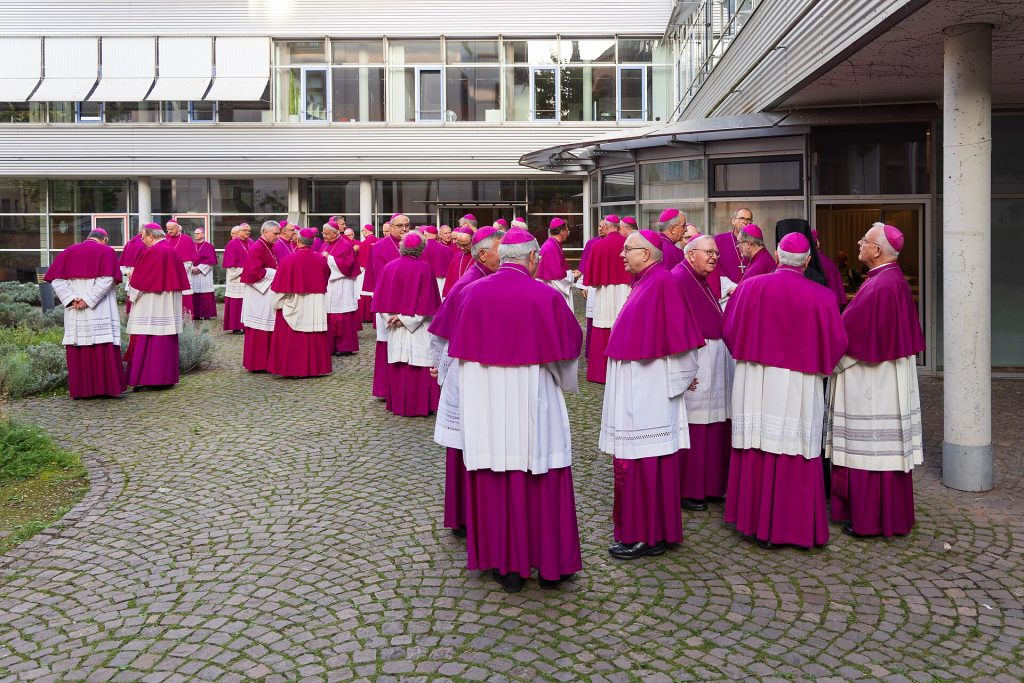
Leaders behind the German Synodal Way have defended new guidance permitting blessings for couples in irregular unions, as Pope Leo states that the Holy See does not support formalised blessings beyond those allowed under Fiducia supplicans The architects of the German Synodal Way have defended controversial guidelines permitting the blessing of couples in irregular unions, amid concerns raised by the Pope that such practices risk undermining ecclesial unity. The dispute centres on pastoral norms adopted in 2025 by the German Bishops’ Conference and the Central Committee of German Catholics (ZdK), which seek to provide a framework for blessing couples who are unable, or do not wish, to enter into a sacramental marriage. The initiative has now been taken up in several dioceses, most notably Munich and Freising, where Cardinal Reinhard Marx has instructed clergy to ensure that “no couple should be turned away” if they request a blessing. In a letter to clergy and pastoral workers, Cardinal Marx wrote: “To all couples who love each other and seek a blessing from the Church for their partnership, I wish that they may feel God’s grace in this blessing.” The archdiocese has confirmed that the guidelines, entitled Segen gibt der Liebe Kraft (“Blessing Gives Love Strength”), will form a “fundamental element” of pastoral practice. Training sessions are scheduled to begin in June to standardise how such blessings are carried out across parishes. The policy goes further than merely permitting individual priests to exercise discretion. Clergy unwilling to conduct the ceremonies themselves are not free to simply refuse; instead, they are expected to refer couples to another priest or pastoral worker. Bishop Georg Bätzing, who oversaw the introduction of the guidelines while serving as chairman of the German Bishops’ Conference, has defended their implementation. He said that although “there are differing views on this within the universal Church”, the practice as carried out in his Diocese of Limburg “serves the people” and “does not jeopardise the unity of the Church”. Limburg was among the first dioceses to publish the norms formally in its official gazette, signalling full adoption. Support has also come from the ZdK, which co-authored the document. Its president, Irme Stetter-Karp, said there was “no reason to withdraw the guidelines” and emphasised their limited scope. The aim, she said, was simply to encourage the provision of blessing ceremonies “for couples who do not wish to enter into a sacramental church marriage or for whom such a marriage is not an option”. She added: “No more and no less. There is no possibility of confusing it with the sacrament of marriage.” The dioceses of Cologne, Augsburg, Eichstätt, Passau and Regensburg have all declined to implement the document, arguing that it exceeds the provisions set out in Fiducia supplicans, the 2023 Vatican instruction on blessings. The bishops of the opposing diocese are led by notably more conservative bishops in comparison to others in the German bishops conference, with the exception of the diocese of Eichstätt, which is currently vacant after the 2025 resignation of Bishop Gregor Franz Hanke. Fiducia supplicans allowed for spontaneous, non-liturgical blessings of individuals in irregular situations, but drew a clear line against any form of ritual that might resemble a marriage ceremony or give the impression of endorsing a union contrary to Church teaching. Pope Leo was asked during a press conference on April 23 about the decision to permit such blessings in Munich. The Pontiff responded: “The Holy See has made it clear that we do not agree with the formalised blessing of couples, in this case, homosexual couples, as you asked, or couples in irregular situations, beyond what was specifically, if you will, allowed for by Pope Francis in saying all people receive blessings.” The Holy Father continued by distinguishing between general blessings and those directed at particular unions. “When a priest gives a blessing at the end of Mass, when the Pope gives a blessing at the end of a large celebration like the one we had today, they are blessings for all people,” he said, invoking his predecessor’s phrase “Tutti, tutti, tutti” to emphasise that all are welcome and called to conversion. The Archdiocese of Munich and Freising has described internal communications about the guidelines as “an internal memo”, and has not yet formally promulgated them in its official gazette. Other dioceses, including Osnabrück and Aachen, have taken that step, effectively committing themselves to the policy.
Apr. 29, 2026