More than 250 attendees gathered in London at the end of last month for the St Patrick’s Summit in Soho. Titled ‘Freedom of the Heart’, the event was centred on using monastic wisdom for everyday life and was hosted for young Catholics feeling the pressures of modern secular life.
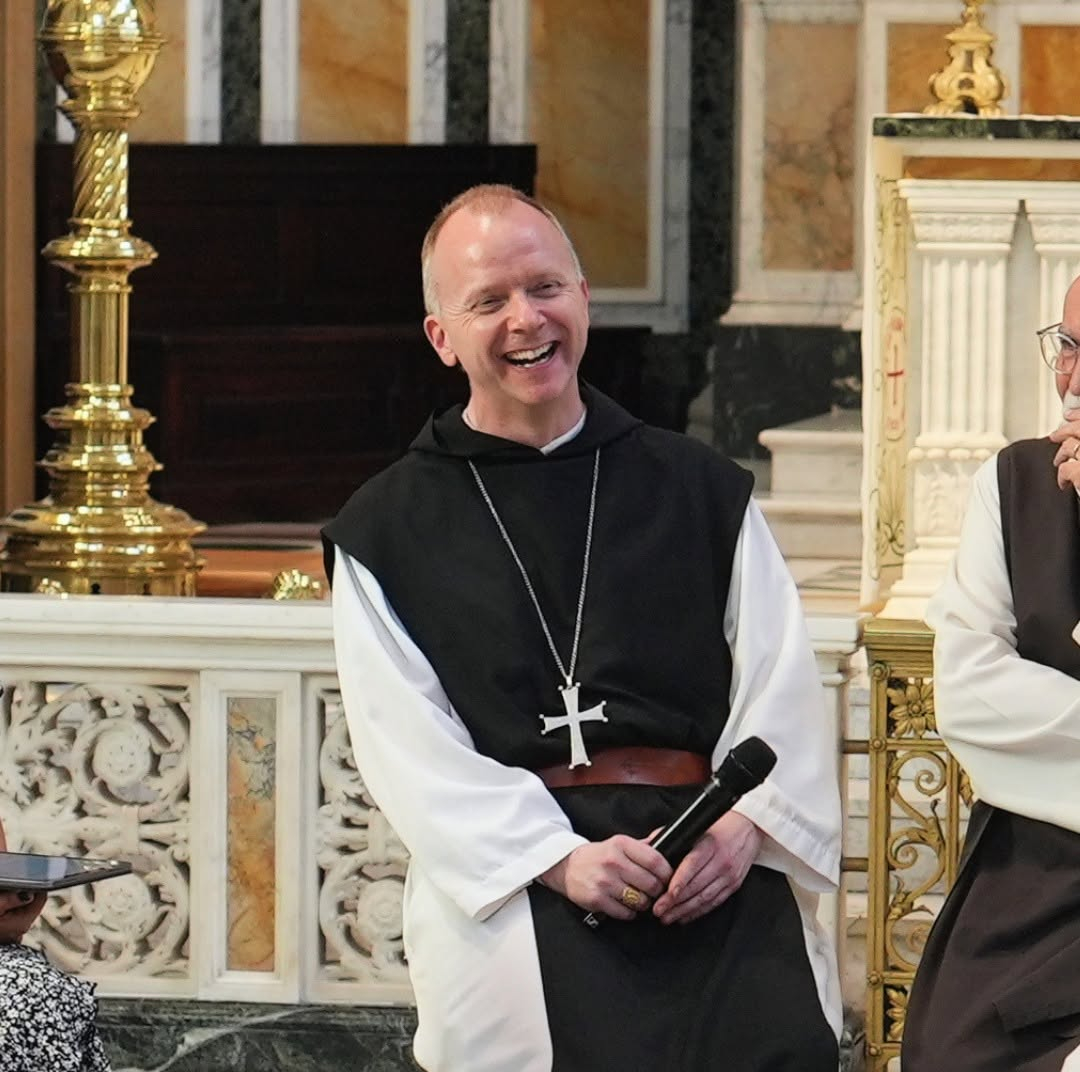
The summit brought together Bishop Erik Varden and Father Jacques Philippe, two of the most popular writers in the Church today.
Bishop Erik Varden was born in Norway in 1974 and was baptised into a Lutheran family. In his teenage years, however, he declared himself an atheist “with a degree of self-satisfied pride and a degree of vanity”. At around the age of 15, he experienced what he later described as an “awakening of the supernatural” through music and beauty. Received into the Catholic Church while studying theology at the University of Cambridge, he later entered the Trappist monastery of Mount Saint Bernard Abbey in 2002. Ordained priest in 2011, elected abbot in 2015 and appointed Bishop of Trondheim in 2019 by Pope Francis, Bishop Varden has gained a wide readership for his ability to present the wisdom of the monastic tradition and the Desert Fathers through a contemporary lens. He was was also invited personally by Pope Leo XIV to preach the Lenten Retreat in the Vatican, during which he spoke on St Bernard of Clairvaux.
Father Jacques Philippe was born in Lorraine, France, in 1947. After studying mathematics and spending several years teaching, he joined the Community of the Beatitudes in 1976 and was ordained a priest in 1985. He spent several years in Jerusalem and Nazareth studying Hebrew and the Jewish roots of Christianity, and also studied theology and canon law in Rome. A prolific author, Philippe has sold more than one million books in 24 languages, including Interior Freedom and Time for God. He has become internationally known for presenting the teachings of spiritual masters such as St John of the Cross and St Teresa of Avila in a simple and practical way.
In Bishop Varden’s keynote address, ‘Purity of Heart and the Unity of Life’, he reflected on the Christian understanding of freedom as the ordering of the whole person towards God in unity. Drawing from Scripture and the monastic tradition, he argued that purity of heart is not something “repressive”, but integrated: the healing of our desires so that life becomes centred on love. Referencing the Beatitude, “Blessed are the pure in heart, for they shall see God”, and drawing on themes from his book Chastity: Reconciliation of the Senses, Bishop Varden suggested that modern society often misunderstands freedom as liberation from constraints. The Christian notion of freedom, however, is “about enabling commitment. Christ came to make the two one… Christianity entertains hope of transcending human dichotomies… through a transfiguration in love that realises our thirst for infinity through graced communion with Infinite Being.”
Bishop Varden suggested that modern society misunderstands the role of celibacy, viewing it through a negative lens, as though it were merely the absence of sexuality. Drawing from the teaching of the Church, such as St John Paul II’s Pastores Dabo Vobis, he highlighted that celibacy and chastity have a thoroughly positive reality. The desires and longings that we naturally have are to be fulfilled directly by God himself, through contemplation in this life and the beatific vision in the next. Bishop Varden also noted the growing difficulty young people face in forming deep relationships, suggesting that beneath this lies a broader crisis of desire and purpose.
Throughout the talk, Bishop Varden returned to the theme of contemplation, citing St Bruno of Cologne and the maxim “ubi amor, ibi oculus” (where the love is, there the eye is also). What people love ultimately determines how they see reality. True freedom consists not in self-assertion, but in learning to live in a manner “disarmed” before God and our neighbours. Echoing themes from Pope Leo XIV, Bishop Varden spoke of a “chastity of society” capable of overcoming division. He concluded with the image of water being transformed into wine, suggesting that grace does not destroy human nature, but elevates it, making us “partakers of the divine nature” (2 Peter 1:4).
Father Jacques Philippe’s keynote, titled ‘Interior Freedom and the Healing of Desire’, explored the same Beatitude: “Blessed are the pure in heart, for they shall see God.” Purity of heart is not something reserved for spiritual elites but is attainable for all, even the “fragile and wounded”, through a life of prayer, hope and perseverance in God’s grace. Using the story of Elijah, Fr Philippe contrasted purity as worship of the living God with impurity as worship of idols. An impure heart is divided among competing loves, but a pure heart is wholly oriented towards God. Fr Philippe also emphasised the thought of St John of the Cross that even the smallest acts performed with genuine love are far greater than all other works performed without charity.
Fr Philippe made the theological virtue of hope a centrepiece of his address. Hope enables Christians to continue seeking holiness despite their weaknesses. He cited St Teresa of Avila’s determination and encouraged the audience not to be discouraged by setbacks, but to persevere with confidence in God’s mercy. He then turned to St Thérèse of Lisieux, whose ‘Little Way’ allowed her to “see the gentle face of Jesus” and allowed Him to work within her. Thanksgiving for the graces received makes us pure and “not self-centred”, and frees the Christian from excessive self-preoccupation.
The keynotes were followed by a joint discussion and Q&A between Bishop Varden and Fr Philippe on living these principles daily. When asked where the journey towards purity of heart begins, Bishop Varden suggested honest questions: “Where am I fragmented? Where am I stuck?” He referenced Christ’s encounter with the paralytic, noting that healing begins with the willingness to answer the Lord’s question: “Do you want to be healed?” Fr Philippe emphasised the supernatural means of the Christian life, such as the sacraments, but also natural means, such as asking for help. “This can be difficult,” he noted, but is very important.
The audience also asked about their relationship with screens and modern distractions, during which both speakers spoke of the importance of real-life friendship and praying together in person. Fr Philippe remarked that “it is beautiful to be together”, allowing real human relationships to be lived out.
The summit also included Mass, shared meals and talks from the Dominican Sisters of St Joseph, where Sister Carino O.P. reflected on how “a rule of life” rooted in prayer, work and rest can help Christians find greater freedom.
At this time in the Church and in modern society, when many young people are searching for meaning amid distraction, isolation and spiritual uncertainty, St Patrick’s Summit offers something rare: a vision of Christian freedom rooted in prayer, friendship, healing and communion with Jesus Christ. The strong attendance, together with previous talks that have attracted thousands of views on YouTube, shows that the hunger for the spiritual life remains very much alive, and that churches like St Patrick’s can be a cornerstone in fostering it.