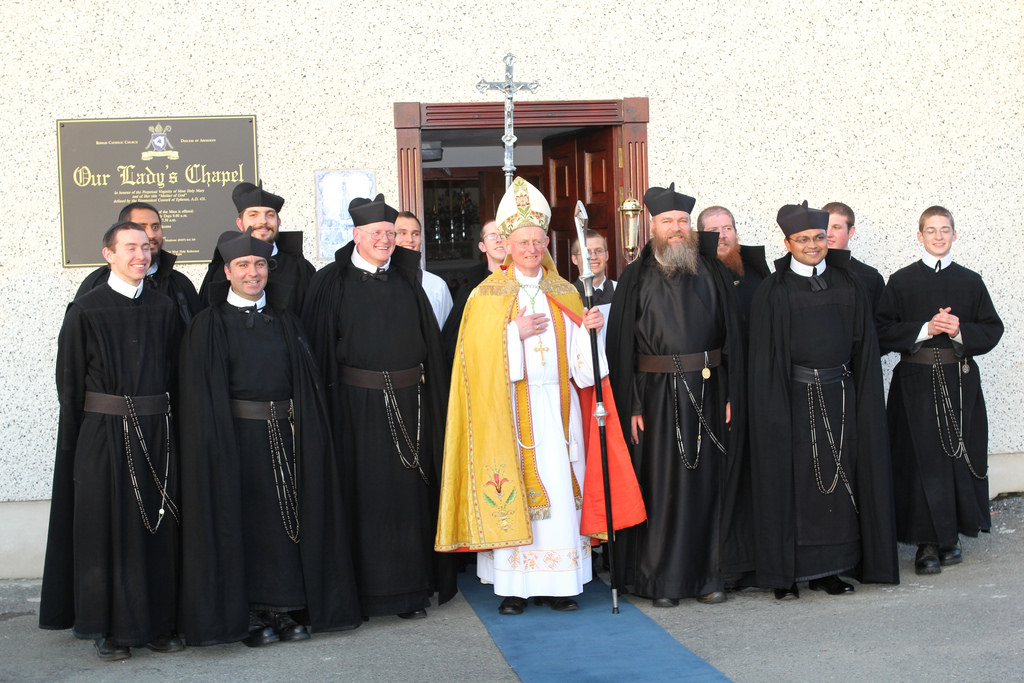
The Congregation of the Most Holy Redeemer has issued a public clarification distancing itself from the self-declared sedevacantist Sons of the Most Holy Redeemer (FSSR), based on Papa Stronsay, who will proceed with the episcopal consecration of its founder without papal approval.
In a statement released from Rome on 7 July, the congregation’s Superior General, Fr Rogério Gomes CSsR, stressed that the Sons of the Most Holy Redeemer (FSSR) “has never been part of the Congregation of the Most Holy Redeemer (C.Ss.R.), nor has it ever been juridically affiliated with the Redemptorist General Government”. The intervention comes ahead of the scheduled consecration of Fr Michael Mary as a bishop on 25 July by the sedevacantist Bishop Pierre Roy, a ceremony that will take place without a papal mandate.
The Superior General of the Redemptorists, Fr Gomes, said inaccurate reports circulating on social media and elsewhere had wrongly associated the worldwide Redemptorist congregation with the community founded by Fr Michael Mary.
He said that “false (fake news), inaccurate, and historically uninformed reports” had created confusion by “improperly associating the Congregation of the Most Holy Redeemer (C.Ss.R.) with groups that do not belong to its canonical structure”. The congregation therefore considered it necessary to explain the historical and canonical distinction between the two bodies.
Central to the statement is the insistence that the title “Transalpine Redemptorists” has an authentic historical meaning dating back to the expansion of the Redemptorists beyond the Alps by St Clement Mary Hofbauer during the late eighteenth and early nineteenth centuries. Fr Gomes recalled that the saint remained “always faithful to the Congregation and to the Church” and was later canonised in recognition of his contribution to the order’s missionary expansion.
By contrast, the community now widely known by that name, he explained, originated only in 1988 after separating from the Redemptorists. Initially associated with the Society of St Pius X, it later adopted the formal title Sons of the Most Holy Redeemer.
Although the institute entered into full communion with the Holy See in 2008 and was erected as a diocesan religious institute in the Diocese of Aberdeen in 2012, Fr Gomes emphasised that this did not make it part of the Redemptorist congregation itself. “It has never been part of the Congregation of the Most Holy Redeemer,” he wrote, underlining that the two communities have always been separate juridical entities despite their similar spirituality and historical inspiration.
The statement also addressed the deterioration in relations between the FSSR and ecclesiastical authorities in recent years. Without detailing individual disputes, Fr Gomes observed that “new doctrinal and ecclesial tensions have emerged” because of criticisms directed at the Second Vatican Council and the post-conciliar popes.
Such views, he said, “do not represent the Congregation of the Most Holy Redeemer and are monitored and evaluated by the competent ecclesiastical authorities”.
“It is also necessary to clarify that the Redemptorists present in Scotland who belong to the Congregation of the Most Holy Redeemer are not schismatics,” Fr Gomes said. The Superior General explained that those communities remain “in full communion with the universal Church, the Roman Pontiff, and the General Government of the Congregation”. Their members, he continued, “embrace the authentic Magisterium, recognise the authority of the Second Vatican Council, and carry out their mission” according to both the congregation’s constitutions and canon law.
Concluding the statement, Fr Gomes urged Catholics to distinguish clearly between the Redemptorists and the Sons of the Most Holy Redeemer, warning that misunderstanding had been fuelled by “a lack of historical and canonical knowledge” together with the rapid spread of information on social media. He called on readers to verify sources carefully and avoid sharing inaccurate claims that could damage “historical truth, ecclesial communion, the identity of the Redemptorist mission, and the witness of unity that the Church is called to offer to the world”.
The clarification comes only weeks before Fr Michael Mary is due to receive episcopal consecration from Bishop Pierre Roy, a former priest of the Society of St Pius X who is now a sedevacantist. The ceremony is scheduled to take place at the community’s monastery on Papa Stronsay in Orkney.
In announcing the consecration, Bishop Roy acknowledged that it would proceed “in the absence of an apostolic mandate”. Explaining his decision, he wrote that he believed the geographical spread of the community across Scotland, New Zealand and the United States made it necessary for the congregation to have its own bishop.
He said Fr Michael Mary had accepted the appointment “without any solicitation from the Redemptorists and despite some initial reluctance”. Bishop Roy further argued that Christ himself would provide the jurisdiction necessary for episcopal ministry “in the absence of a true Supreme Pontiff”.
The FSSR’s present position marks a dramatic reversal from the path it followed under Pope Benedict XVI. Founded in 1988 in the aftermath of Archbishop Marcel Lefebvre’s illicit episcopal consecrations, the community was initially associated with the Society of St Pius X before seeking reconciliation with Rome after the publication of Summorum Pontificum. It entered full communion with the Holy See in 2008 and, four years later, received canonical recognition as a diocesan institute in Aberdeen.
Relations with ecclesiastical authorities later deteriorated following controversies surrounding the community’s apostolate in New Zealand and increasing concerns over unity and obedience. After an apostolic visitation, the community was required to leave the Diocese of Christchurch in 2024, while subsequent appeals proved unsuccessful. By October 2025 it had publicly concluded that the post-conciliar Church was incompatible with what it described as the “Traditional Catholic Faith”, before embracing sedevacantism in 2026.