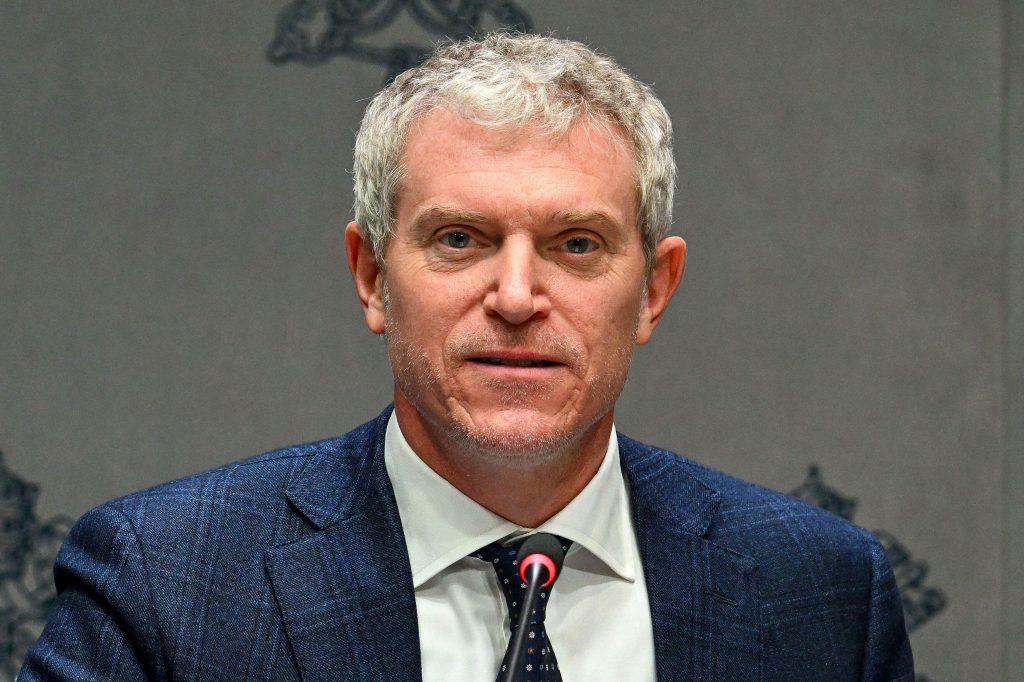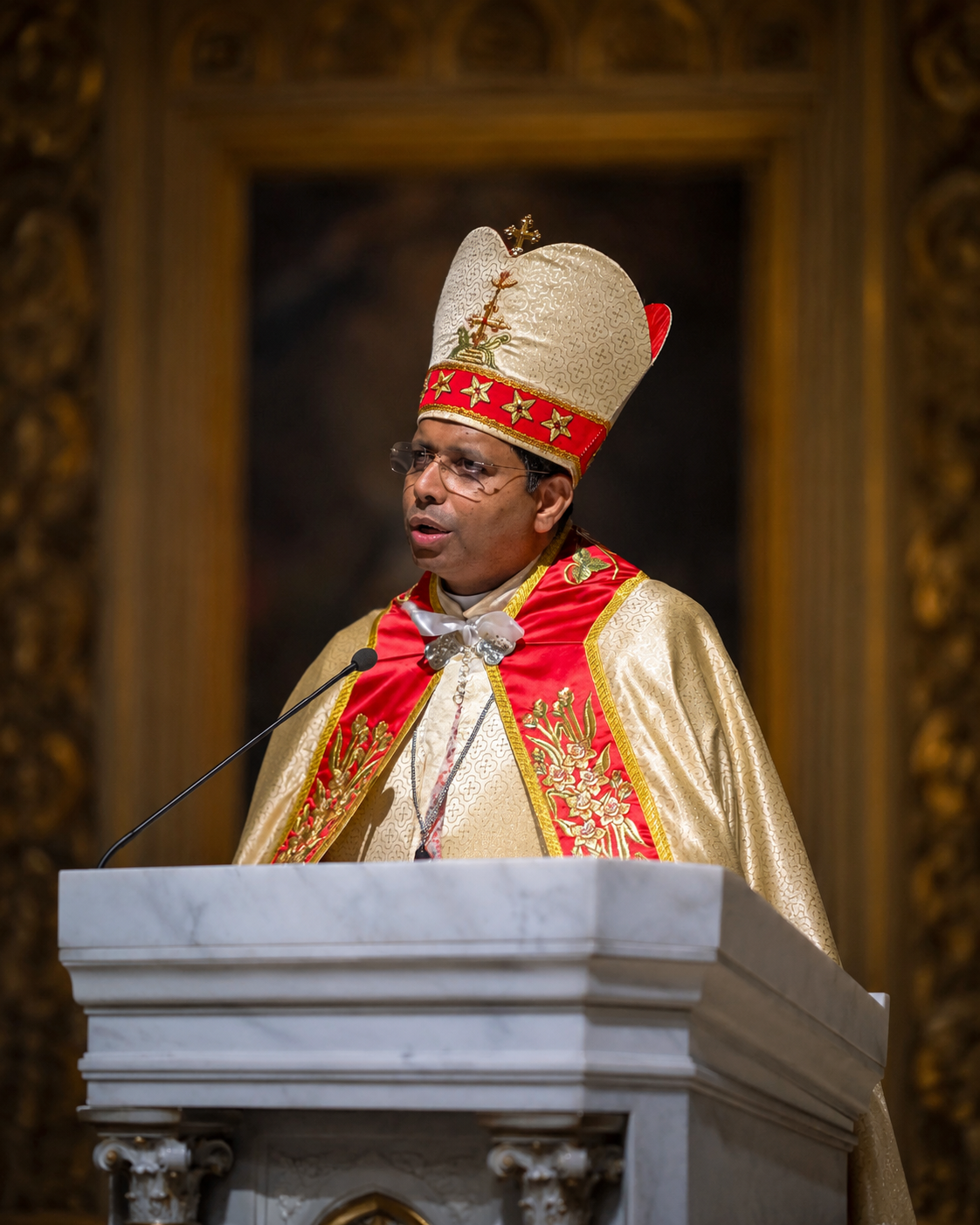
Cardinal George Jacob Koovakad is the Prefect of the Dicastery for Interreligious Dialogue, the Vatican department responsible for promoting understanding, cooperation and engagement between the Catholic Church and followers of other religious traditions.
After joining the Holy See’s diplomatic service in 2006, following studies at the Pontifical Ecclesiastical Academy, he held posts in Algeria, South Korea, Iran, Costa Rica and Venezuela. His experience later led to his being entrusted with the organisation of papal trips, including high-risk journeys such as Pope Francis’s 2021 visit to Iraq, earning him the reputation of being the Francis pontificate’s “travel agent” as he arranged the complex itinerary of one of the most travelled popes in history.
Created a cardinal in 2024 and appointed Prefect of the Dicastery for Interreligious Dialogue in 2025, his career has marked a series of firsts. He is the first member of the Syro-Malabar Catholic Church to head a curial department. He was also the first Indian priest to be created cardinal before being appointed a bishop, and, at the age of 51, the youngest cardinal in the history of the Syro-Malabar Church.
In this exclusive interview with AdVaticanum, he discusses the work of his department, the justification for his 2025 meeting with the Patriarch of Moscow, and Pope Leo’s visit to the Great Mosque of Algiers.
AV: Can interreligious dialogue and evangelisation coexist without tension, or is there an inherent conflict between them?
+JK: The document Dialogue and Proclamation argues that interreligious dialogue and evangelisation can coexist because both are essential dimensions of the Church’s evangelising mission. It clearly states that dialogue and evangelisation are “interrelated yet not interchangeable” (§77). Dialogue does not replace proclamation, and proclamation must be carried out in a spirit of dialogue.
Theologically, this document sees no inherent conflict between the two. Dialogue is part of the “dialogue of salvation” initiated by God (§80), while proclamation seeks to lead people to explicit faith in Jesus Christ (§81). The Church therefore recognises the presence of “seeds of the Word” in other religions (§82) while still affirming the uniqueness of Christ as Lord and Saviour.
At the practical level, however, tensions can arise. Proclamation may sometimes be perceived as disrespectful or as hidden proselytism, while excessive emphasis on dialogue can weaken the call to proclaim the Good News. For this reason, the document stresses discernment, sensitivity to context, respect for freedom, and guidance by the Holy Spirit.
To overcome this tension, Dialogue and Proclamation proposes a spirituality of dialogue rooted in humility, love, and authentic witness. Christians are called to engage sincerely with followers of other religions while also sharing, when appropriate, the joy and hope they have found in Christ (§83). Jesus himself is presented as the model who united openness to others with faithful proclamation (§85). Thus, dialogue and evangelisation are not opposing activities but complementary expressions of the Church’s one mission.
AV: The Church often engages with religious actors and states whose records on human rights are contested. How do you balance dialogue with moral clarity?
+JK: The Church is open to engaging in dialogue with everyone, based on her conviction that every human person is created in the image of God and remains the object of God’s salvific concern. Interreligious dialogue is not mere diplomacy or pragmatic coexistence, but part of the Church’s evangelising and salvific mission. Therefore, dialogue cannot mean moral relativism, silence in the face of injustice, or the dilution of truth claims. At the same time, moral clarity should not lead to hostility, exclusion, or a refusal of encounter.
A “positive evaluation” of other religious traditions involves recognising in them “rays of truth”, “seeds of the Word”, and the action of the Holy Spirit. This theological openness obliges the Church to approach religious actors, even those situated within imperfect political or social systems, with “presence, respect and love”. Dialogue is thus maintained because the Church believes that God’s grace can operate within every human and religious context, and because genuine engagement may foster a change of mind and heart, purification, and a deeper commitment to truth and justice.
At the same time, discernment is necessary. Not everything in religious traditions or their social expressions is good. Because sin affects all human institutions and cultures, the Church must be capable of recognising contradictions between certain practices and the demands of the Gospel. Thus, engagement with religious actors or states whose human rights records are problematic does not imply endorsement of all their actions. The Church distinguishes between respect for persons and approval of policies.
The Church enters dialogue not by abandoning moral principles, but by witnessing to truth within relationship. Hence, moral clarity is exercised through prophetic witness, defence of human dignity, advocacy for peace and justice, and fidelity to conscience, while dialogue remains the preferred method because it mirrors God’s own “dialogue of salvation” with humanity.
Therefore, the Church’s engagement with contested religious or political actors can be understood through a dual fidelity: fidelity to truth, justice, and the dignity of the human person; and fidelity to dialogue as a means of peace, mutual understanding, and cooperation with the action of the Holy Spirit in history.
In practice, this means the Church neither withdraws from engagement nor compromises essential moral principles. Rather, she seeks a form of dialogue that is truthful, respectful, discerning, and transformative.
AV: In regions marked by distrust or even persecution, what does meaningful “dialogue” actually look like in practice?
+JK: In these contexts, meaningful dialogue does not primarily begin with formal theological discussions. According to Dialogue and Mission, dialogue first takes the form of an attitude: one of respect, patience, presence, and shared humanity (§29). In difficult contexts, dialogue often becomes a “dialogue of life”, where Christians and followers of other religions learn to live together with mutual dignity despite tensions and differences. Distrust and persecution often exist because of a lack of dialogue. In that context, dialogue can become one of the most powerful antidotes to misunderstanding and conflict.
Practically, this may involve simple but significant acts: defending one another’s human rights, cooperating for peace and justice, helping the poor together, sharing daily life, or maintaining relationships of hospitality and solidarity (§31–32). In situations of persecution, dialogue may even consist in refusing hatred and revenge, and instead witnessing to forgiveness and reconciliation. Authentic dialogue requires learning “to forgive” and “to understand the heart of others” even amid disagreement and historical wounds.
Dialogue is inseparable from respect for freedom of conscience. Therefore, meaningful dialogue cannot involve coercion, manipulation, or proselytism. Rather, Christians are called to give witness to their faith “with courtesy and respect”, while remaining open to listening and learning from others. In such fragile contexts, dialogue may not produce immediate visible results. Christians are invited to trust the work of the Holy Spirit, who acts silently within peoples and cultures.
Thus, meaningful dialogue in hostile environments is often quiet, gradual, and relational rather than institutional or doctrinal. It is ultimately a witness to the Gospel through love, endurance, humility, and the commitment to remain open to the other even in times of fear and division.
AV: In 2025 you met privately with Patriarch Kirill, who has lent theological legitimacy to the war in Ukraine, and described the encounter as “deeply meaningful.” Do you believe private diplomacy can exert any real moral pressure on religious leaders who have aligned themselves with political violence?
+JK: The Dicastery for Interreligious Dialogue is entrusted with the mission of fostering encounter, communication, and mutual understanding among peoples of all faiths, religious traditions, and cultural backgrounds. Through its various initiatives and engagements, the Dicastery seeks to promote peace, justice, the common good, and the spirit of human fraternity that unites the members of the one human family.
Pope Francis consistently maintained that dialogue should remain open even in moments of serious conflict and moral disagreement. While he criticised religious language used to justify war, he also believed that breaking communication entirely would not help the cause of peace. Authentic dialogue can only flourish when it is carried out with openness of heart and freedom from prejudice towards the persons one encounters. Conversations shaped by preconceived judgements or narrow assumptions seldom bear meaningful fruit. True dialogue, instead, calls for attentive listening, mutual respect, intellectual honesty, and a sincere appreciation of the dignity of every human person.
Every encounter thus becomes more than a simple exchange of ideas; it is a hopeful and constructive effort to contribute to the harmony of society and to the advancement of humanity. In a world often marked by division and misunderstanding, dialogue remains an indispensable path towards reconciliation, solidarity, and peaceful coexistence among peoples and nations.
AV: You accompanied Pope Leo on his visit to Africa in April, including his encounter with a mosque. What moments stood out to you as revealing the true potential, or limits, of interreligious dialogue? And what is the theological significance of a Pope entering and praying in a non-Catholic religious site?
+JK: Theologically, a Pope entering and praying in non-Christian spaces is understood not as an act of religious relativism or syncretism, but as a gesture of respect, dialogue, peace, and shared human solidarity. The document Dialogue in Truth and Charity makes a careful distinction between “praying together” and “being together for prayer” (§83). Catholics believe that authentic Christian prayer is always through Christ and in the Holy Spirit (§81); therefore, common interreligious prayer implying a shared understanding of God is generally avoided.
When a Pope visits a mosque, synagogue, temple, or other non-Christian sacred space, such gestures should be interpreted primarily as expressions of openness, mutual respect, and the Church’s commitment to interreligious dialogue. They witness to the dignity of the religious search present in humanity and encourage peace and fraternity among peoples. Pope John Paul II explained after the Assisi meeting that while believers of different religions cannot ordinarily “pray together” in the strict sense, they can remain present while others pray, showing reverence for the sincere search for God by others.
Thus, Catholics should understand papal gestures in non-Christian spaces as symbolic acts of encounter and dialogue, not as a denial of the uniqueness of Christ or as approval of all religious beliefs equally. The document insists that such occasions require prudence and must avoid any appearance of relativism or syncretism (§83). The Pope’s presence in such places therefore has a pastoral and diplomatic significance: it reflects the Church’s mission to foster peace, mutual understanding, and respectful coexistence while remaining faithful to Christian doctrine.