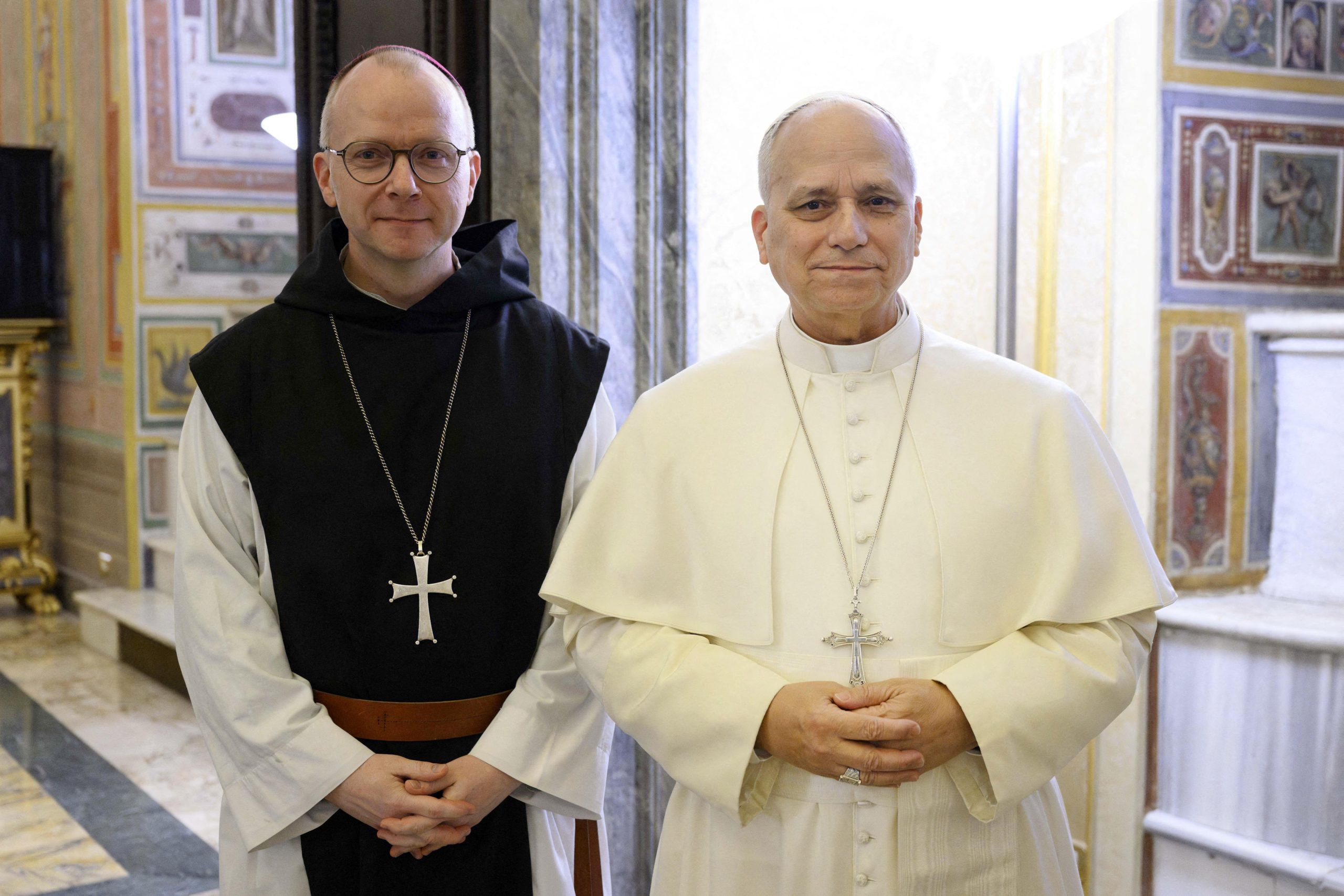
In recent times, few Catholic voices have attracted as much attention as Bishop Erik Varden. A Trappist monk, a convert to the Catholic faith from atheism, former Abbot of Mount Saint Bernard Abbey, and now Bishop of Trondheim, Varden is one of the Church’s most prominent writers. His theological contribution received papal recognition when Pope Leo XIV personally invited him to preach the annual Lenten retreat to the Roman Curia, later published as Alight with Hidden Glory.
Varden’s growing popularity, however, is not only the result of his appointment to the episcopacy or his invitation from the Holy Father. At a time when many are thirsting for spiritual nourishment, his conferences, interviews and retreats have found a wide audience. Drawing upon Scripture, the Fathers of the Church and contemporary culture, Varden synthesises these influences into a fluid, moving and compelling style of preaching, leading people into a deeper communion with Christ.
Bishop Varden was born in Norway in 1974 and baptised into a Lutheran family. When reflecting on the “seeds of his vocation” as a young man, Varden recalls that he “was privileged to grow up in a home marked by goodness, and kindness, and generosity… It wasn’t explicitly religious, but it was always respectful” (The Napa Institute, 2026). He then describes his outlook as a teenager: “I was very skeptical of established religion when I was fourteen… and I relished my own sense of autonomy and independence and declaring myself removed from all that.” He admits that around this time he identified himself, “with a degree of self-satisfied pride… as an agnostic and even an atheist.”
There was, however, a decisive change when Varden was fifteen years old. He recounts that listening to Mahler’s Symphony No. 2 “pierced” him. “I listened to that music and it wounded me, or it revealed a wound in me. It revealed to me that I was carrying something within me that was somehow greater than I was.” This became a decisive turning point, not only because it “set” him on the path towards pursuing his education abroad, but also because it confronted him with what Aristotle calls catharsis: the ability to encounter “normally hidden emotion… [and the] depths in him or herself” (Varden, 2023, p. 14).
After completing his schooling in Norway, Varden attended Atlantic College in Wales before studying Theology and Religious Studies at Cambridge. During this period, he encountered serious believers, including a Muslim roommate, who “challenged me intellectually… and encouraged me.” He also made his first visit to a Trappist monastery, an experience that both “frightened” and “haunted” him because of its “degree of radicality”. Yet it was precisely this encounter that drew him towards Catholicism, and at the age of nineteen he was received into the Catholic Church.
After becoming a Catholic, Varden did not initially intend to become a monk. However, after a confessor told him, “You will be a housemaster in this place for the next 40 years of your life,” he began to reconsider his future. Having completed a doctorate in Historical Theology, he felt drawn to explore a monastic vocation and joined Mount Saint Bernard Abbey in 2002, making his solemn profession a few years later.
Following his Licentiate in Sacred Theology in Rome, he was ordained to the priesthood in 2011. In 2015, he was elected Abbot of Mount Saint Bernard, becoming the first abbot born outside Britain or Ireland in the monastery’s history. His abbacy coincided with a period of renewal and growth, including the development of the monastery’s brewery and greater public engagement through retreats, conferences and writing. In 2019, Pope Francis appointed him Bishop-Prelate of Trondheim in Norway. Consecrated a bishop in 2020, Varden has continued to combine pastoral leadership with writing and preaching, becoming one of the Church’s most influential voices. Beauty, however, remained a recurring theme throughout his life. Just as Mahler’s music awakened in him a longing for transcendence, his later writings repeatedly present beauty as the means by which God wounds the heart and draws it towards Himself.
At the heart of Varden’s theology lies a deeply Augustinian understanding of the human person. In a time of uncertainty both in the secular world and within the Church, Varden asks a fundamental question: what does it mean to be human? He answers this simply in Chastity: “To be human is to exist with the sense of an absence to be filled. Only in the light of our human substance’s longing for union with the divine do our lesser yearnings make sense” (Varden, 2023, p. 14).
For Varden, this longing is not a defect but the mark of our humanity. As a teenager listening to Mahler’s Second Symphony, beauty awakened desire, and that desire became the beginning of faith. Human beings, Varden argues, are not self-sufficient creatures capable of finding fulfilment within themselves. Rather, they are marked by an innate longing for transcendence.
If longing is the beginning of Varden’s theology, the Cross stands at its centre. Modern society, he argues, oscillates between two opposite errors: the “fetishization of woundedness” and “an effort to eliminate wounds or to keep them out of sight” (McGrath Institute for Church Life, 2025). Neither approach brings healing. The answer is found in the Crucified Christ.
Reflecting on Christ’s Passion, Varden writes that His wounds “open a different dimension”, making genuine compassion possible: the ability to “lament without suffocating in our lamentation, to lament without yielding to rage, being opened instead to that literally, crucially Christian characteristic, a defining mark of the Christian condition, which is compassion.” Christ’s wounds are not erased; they become the place where divine love is revealed and where redemption is accomplished. They remain in His risen body as signs of redeeming love and His victory over death. The Christian, therefore, should not define himself by his wounds but allow them to be transformed through an encounter with the Crucified and Risen Lord. This conviction explains why hope occupies such a central place in Varden’s preaching. Redemption does not remove the suffering of human life but gives it meaning by drawing it into the mystery of Christ’s Passion, Death and Resurrection.
If Varden’s theology begins with human nature, its wounds and its longing for God, it culminates in a vision of freedom. This freedom is not understood in the modern sense as the unrestricted ability to do whatever one pleases, but as the capacity to live in accordance with the way God created us. Varden notes that the word “chastity” is linked to the idea of integrity, from the Latin integer, meaning to be “of one piece”.
Such integration, however, requires discipline. Varden illustrates this with the image of a dancer in Chastity: “Years of relentless labor are required to gain that seemingly effortless freedom of movement…” Just as a dancer submits to years of discipline in order to move with grace, so the Christian must undergo a process of spiritual formation in order to live according to God’s design. This discipline is not the denial of human flourishing but its necessary condition.
The same theme appears in the Beatitudes, where Christ says: “Blessed are the pure in heart, for they shall see God.” Purity of heart is therefore the gradual integration of the human person, making him capable of perceiving God, his neighbour and himself truthfully. Varden draws on Christ’s words in the Gospel of Matthew, noting that if the eye is “sound”, the whole body is full of light. The opposite of purity is not impurity but confusion, for the pure heart is not the heart that has never struggled, but the heart that has become unified in its pursuit of God.
The appeal of Bishop Erik Varden lies in his ability to show that Catholic theology is not a collection of abstract ideas but the answer to the deepest longings of the human heart. Beginning with desire and restlessness, moving through the wounds of Christ, and culminating in a freedom born of hope, his theology presents the Christian life as the gradual restoration of the human person. In a time marked by fragmentation, anxiety and instability, it is a vision that is intellectually rigorous, spiritually rich and profoundly beautiful.