

Vila
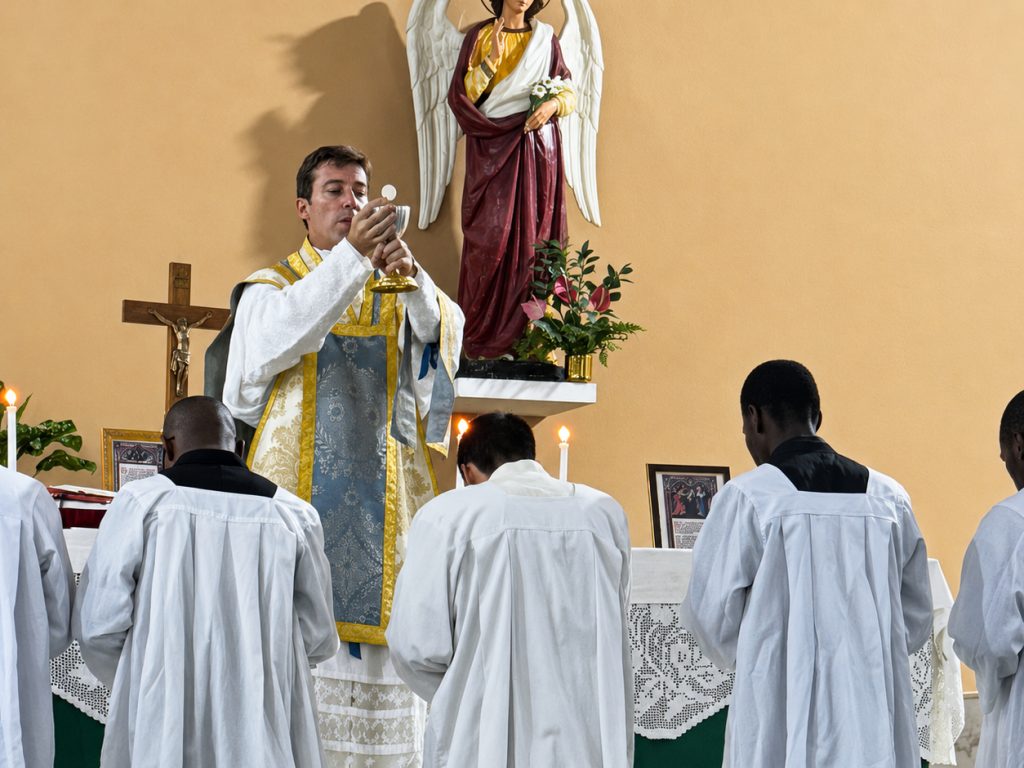
Father João Silveira denied permission to celebrate Mass in Ávila
Father João Silveira was denied permission to celebrate Holy Mass in Ávila after diocesan officials told him the local bishop had said: “That Mass is prohibited in this diocese” Father João Silveira, a Portuguese missionary priest, has been denied permission to celebrate Holy Mass at a chapel in Ávila, Spain. On 15 June, Fr Silveira was leading a group of pilgrims from the United States who had specifically requested his accompaniment because he exclusively celebrates the older form of the Roman Rite. When they arrived in Ávila, a Spanish city north-west of Madrid, the priest arranged to use a chapel to celebrate Holy Mass. He was then informed that, in order to do so, he would need authorisation from the local bishop, Bishop Jesús Rico García. As the Mass was private, Fr Silveira did not require permission. However, out of respect for the community allowing him to use the church, he agreed to seek it. When Fr Silveira arrived at the bishop’s residence with his celebret to demonstrate that he was a Catholic priest in good standing, he was received by the Vicar General of the diocese. After waiting for some time, he was informed by a diocesan employee that he did not have permission to celebrate the Mass and that the bishop had said: “That Mass is prohibited in this diocese.” Fr Silveira was then left to show himself out. Ordained a priest by Pope Saint John Paul II in 1979 and appointed bishop by Pope Francis in 2023, Bishop Jesús Rico García has held a variety of positions across the Spanish-speaking Church, including Spiritual Director of the Pontifical Spanish College of St Joseph and Rector of the Mosén Sol de México Seminary. He made local headlines when he used his episcopal consecration to call for a “Church open to all”. Responding to the situation, Fr Silveira asked on X: “What harm could possibly come to the world?” He also pointed out that the rite is “exactly the same one used in the convents of the Discalced Carmelites, stemming from the reform of Saint Teresa of Ávila and Saint John of the Cross”, and asked how it could have been “good for those great saints, but now it is bad for us?” The priest also pointed to Canon 932 §1, which states: “The Eucharistic celebration must be carried out in a sacred place unless, in a particular case, necessity requires otherwise; in that case, it must be celebrated in a decent place.” He argued that, in this case, the bishop had created a “necessity”, resulting in Holy Mass being celebrated in a hotel room rather than a church. Fr Silveira said this was not the first time he had been subject to such a ruling and stated that “Pope Leo must act quickly to put an end to these abuses of authority”. Fr Silveira is well known and respected among Catholics who attend the Traditional Latin Mass. As a missionary priest, he travels throughout the world to offer the Traditional Latin Mass, particularly in places where it is not readily available. His work regularly takes him to remote parts of Africa and Asia, where the Church is growing rapidly. At the time of writing, the priest’s post had been viewed more than 200,000 times. The Diocese of Ávila has not responded to AdVaticanum’s request for comment. However, speaking to the Spanish publication Religión Confidencial, the bishopric cited Pope Francis’s motu proprio Traditionis Custodes, explaining that “it clearly specifies that ‘the liturgical books promulgated by the Holy Pontiffs Paul VI and John Paul II, in conformity with the decrees of the Second Vatican Council, are the sole expression of the lex orandi of the Roman Rite’ (Article 1) and that ‘the diocesan bishop, as moderator, promoter, and custodian of all liturgical life in the particular Church entrusted to him, is responsible for regulating liturgical celebrations in his own diocese. Therefore, it is within his exclusive competence to authorise the use of the 1962 Missale Romanum in the diocese, following the guidelines of the Apostolic See’ (Article 2).” Commenting further on the situation, Fr Silveira wrote: “Of course, the bishop is the moderator of the liturgy in his diocese. However, among these powers of moderation, or organisation, the power to prohibit the Traditional Mass at his own discretion is not included. To do so is an abuse of authority, as can be understood from the arguments given earlier.” The priest quoted Pope Benedict XVI’s well-known assessment that “what was sacred for previous generations remains sacred and great for us as well, and cannot all of a sudden be entirely forbidden or even considered harmful”. He also noted that the same conclusion had been reached by the commission of nine cardinals convened in 1986 by Pope Saint John Paul II. He further argued that, because this was a private Mass, there was even less justification for prohibiting it. Fr Silveira asked: “It is not strange that ‘foreign’ priests pass through there: it is something that happens continuously. Would a priest of the Byzantine Rite also have been prohibited from celebrating?”
Jun. 18, 2026