

Pope Leo Xiv
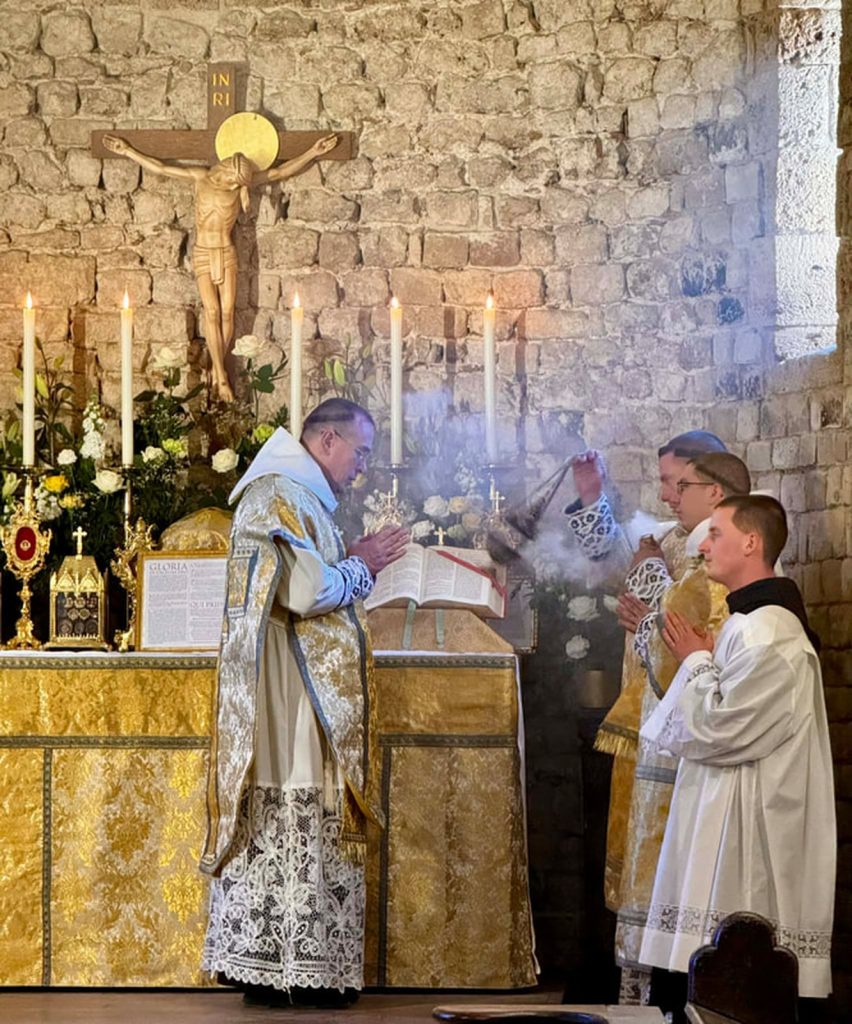
Dom Alcuin Reid calls for month of prayer for the unity of the Church as SSPX consecrations approach
Dom Alcuin Reid, prior of the Monastère Saint-Benoît in France, has called on Catholics to make June a month of prayer and fasting for the unity of the Church ahead of the SSPX’s planned episcopal consecrations on 1 July. He has urged prayers for Pope Leo XIV, his advisers and the Society of St Pius X Monastère Saint-Benoît, an international English-speaking traditional Benedictine monastery in the Diocese of Fréjus-Toulon, France, has called on Catholics to make June a month of prayer for the unity of the Church. The monastery’s prior, Dom Alcuin Reid, explained that “the Church faces the possibility of the hardening of divisions through the positions held by various parties in respect of the episcopal consecrations announced for 1 July by the Society of St Pius X.” The monk also drew on reflections made by Pope Benedict XVI in 2007, in which he stated that, “looking back over the past, to the divisions which in the course of the centuries have rent the Body of Christ, one continually has the impression that, at critical moments when divisions were coming about, not enough was done by the Church’s leaders to maintain or regain reconciliation and unity.” With this in mind, he appealed to Catholics to “make the month of June a time of earnest prayer and fasting for the unity of the Church, praying in particular for the Holy Father and his advisers as well as the leaders of the Society of St Pius X.” For its part, the monastery will offer up one day a week in particular for the intention. Dom Reid stated: “The monastery will observe one day each week as a day of particular prayer and fasting: Wednesdays, June 3, 10 and 17, and Friday, June 26 (respecting the feasts of the Sacred Heart and St John the Baptist). On these days the Conventual Mass will be a votive Mass Pro unitate Ecclesiae, and a Holy Hour of adoration will be offered before the Most Blessed Sacrament from the Office of Sext, concluding with Benediction of the Most Blessed Sacrament.” Dom Alcuin Reid is a renowned liturgical scholar whose 2004 book, The Organic Development of the Liturgy , featured a foreword by the then Cardinal Joseph Ratzinger. In 2011, he went on to found the Monastère Saint-Benoît at the invitation of the then Bishop of Fréjus-Toulon, Bishop Dominique Rey. The monastery seeks to live a classical Benedictine life, celebrating the sacred liturgy in all its fullness according to the older traditional Latin forms of the Roman and monastic rites.
Jun. 1, 2026
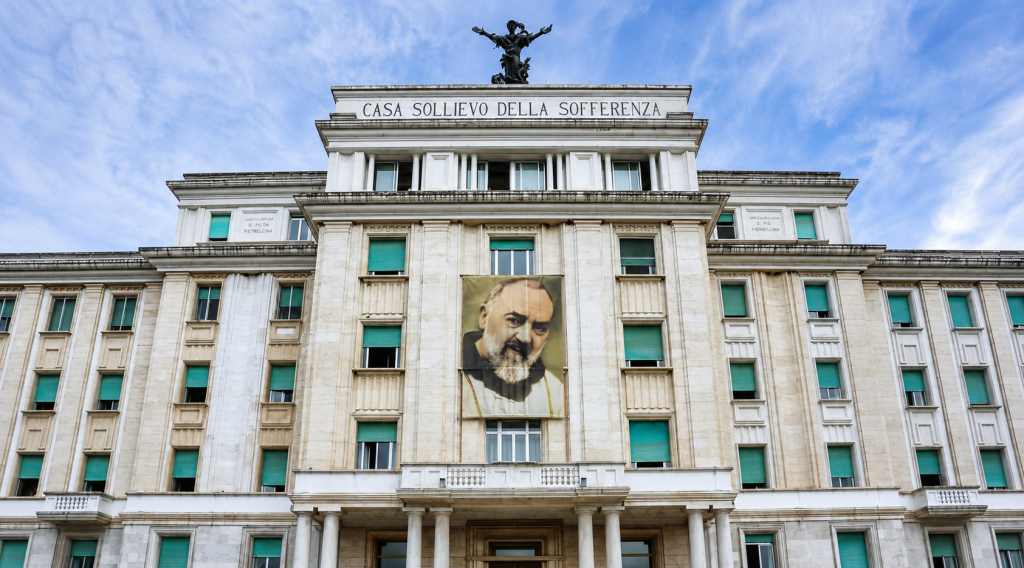
Pope Leo XIV takes direct control of Padre Pio’s hospital after financial crisis
Pope Leo XIV has placed the hospital founded by Padre Pio under direct Vatican control following years of financial turmoil and mounting debt at the Casa Sollievo della Sofferenza in southern Italy. Pope Leo XIV has moved to take direct control of the hospital founded by Padre Pio after years of financial turmoil at the Casa Sollievo della Sofferenza in San Giovanni Rotondo. In a chirograph issued on 28 May, the Pope established a new Steering and Supervisory Commission with extensive powers over the foundation governing the hospital, one of the largest Catholic medical institutions in Europe. The document grants the commission authority to act “in derogation of current legislation and without requiring any authorisation” and, where necessary, “even in place of the Foundation’s statutory bodies”. The commission will be chaired by Maximino Caballero Ledo, prefect of the Secretariat for the Economy, while Fabio Gasperini, secretary of the same dicastery, will serve as coordinator. Other members include Archbishop Paolo Rudelli, Archbishop Giordano Piccinotti and Archbishop Giorgio Ferretti. A technical committee attached to the body will include Benjamin Estévez de Cominges, currently secretary-general of the Vatican’s Secretariat for the Economy, the hospital’s current director general, Gino Gumirato, and the lawyer Alessandro Ela Oyana. The decree effectively places the Vatican directly in charge of the institution founded by St Pio of Pietrelcina in 1956. The hospital receives tens of thousands of patients every year and employs around 2,700 staff. The foundation’s finances has been under scrutiny after reports of increasing debt and internal disputes over staffing and management. The Italian television programme Far West reported earlier this year on what it described as “a story of multimillion-euro debts, €250 million in total, inflated paycheques and cronyism. A story of money disappearing from the saint’s hospital.” Gumirato later disputed the figure broadcast by the programme, saying: “Talking about a €250 million deficit is incorrect. The Foundation’s actual debts to suppliers are approximately €108 million.” He added that the debts had to be considered alongside receivables owed to the hospital by the Puglia regional government, estimated at around €32 million. The Vatican intervention comes after years of concern inside the Holy See over the management of the institution. In 2019, Domenico Crupi resigned as director general after serving in the role since 2007. He was replaced by Michele Giuliani following pressure from the Secretariat of State. According to reports, concerns had emerged that the true financial position of the foundation had not been fully represented to the Holy See. Crupi rejected accusations of financial irregularities at the time and referred to “the financial equilibrium certified by an international auditing firm”. The latest crisis intensified in late 2025 after management announced changes to employment contracts for doctors and staff as part of restructuring measures. Trade unions responded by declaring a state of unrest and planning strike action. Demonstrations were later held outside the hospital. Italian media reported that during a Christmas gathering attended by Archbishop Franco Moscone of Manfredonia-Vieste-San Giovanni Rotondo, employees confronted members of the management team and demanded resignations. Moscone subsequently acknowledged the seriousness of the situation and said: “The Holy See is aware of the situation; it is up to them to make the most important decisions. The foundation can’t do much more than that. Perhaps the Holy See itself doesn’t know what to do.” The decree also gives Caballero Ledo authority to represent the foundation before Italian public authorities, allowing the Vatican-appointed body to intervene directly in civil and administrative matters linked to the hospital’s operations. Although the existing board formally remains in place, practical authority over the institution now rests with the Vatican commission. Padre Pio conceived the hospital as a “home for the relief of suffering” and oversaw its creation in the impoverished Gargano region of southern Italy after the Second World War. The Capuchin friar personally appealed for international donations to finance the project, which became one of the most significant charitable works associated with a modern saint. In 1957, Padre Pio asked Pope Pius XII to ensure that ownership of the hospital would pass directly to the Holy See after his death. The request was accepted and, following the friar’s death in 1968, the institution came under Vatican ownership.
May 28, 2026

Creator of Magisterium AI speaks to AdVaticanum about Magnifica Humanitas
Matthew Harvey Sanders, founder of Magisterium AI, tells AdVaticanum that Pope Leo XIV’s Magnifica Humanitas has set a new benchmark for how Catholics should approach artificial intelligence, warning against treating AI as if it possesses conscience or moral interiority The founder of the Catholic artificial intelligence platform Magisterium AI has said that Pope Leo XIV’s first encyclical on artificial intelligence has set a new benchmark for how Catholic institutions should approach emerging technologies, while warning against treating AI systems as if they possess conscience or moral interiority. Matthew Harvey Sanders, founder and chief executive of the Canadian technology company Longbeard, spoke exclusively to AdVaticanum following the publication of Magnifica Humanitas , the Pope’s inaugural encyclical, which was formally presented at the Vatican this week on AI. Matthew Sanders described the atmosphere surrounding the launch as unlike anything he had experienced in the technology sector, saying the event brought together Vatican officials, clergy, engineers, investors and researchers in a setting marked by “a particular solemnity”. “I have attended a great many events in the technology sector,” he said. “The hall where Leo XIV presented Magnifica Humanitas did not feel like any of them.” He said Pope Leo approached the subject of artificial intelligence without either fear or fashionable enthusiasm, adding that the Pontiff appeared entirely comfortable discussing the implications of rapidly developing technologies. “He spoke without the defensive caution you often find from institutional leaders engaging with technical topics, and without the performative enthusiasm of someone trying to signal relevance,” Sanders said. “He was simply present to the conversation.” Sanders argued that the most significant aspect of the papal intervention was not a condemnation of artificial intelligence itself, but what he described as an “invitation” by the Pope to technology developers and researchers to engage seriously with questions concerning the human person. “What he extended that day was an invitation to every laboratory and every developer in the field: not a verdict on the technology, but an ongoing engagement about what it means for the human person,” he said. “That invitation, in my view, is the most consequential thing that could have come out of the day.” Sanders also disclosed that he spent time during the Vatican gathering speaking with two senior researchers from the American artificial intelligence company Anthropic, including Chris Olah, whose work has focused on mechanistic interpretability, and Amanda Askell, who leads research into the behavioural character of the Claude AI model. “Chris Olah has spent years on mechanistic interpretability: the painstaking effort to reverse-engineer a trained neural network and understand, at a granular level, what is actually occurring when the model processes language,” Sanders said. Referring to Askell, he added: “Amanda Askell leads the work on Claude’s character; she has conducted more careful, sustained inquiry into how a large language model behaves under pressure, across context and at the edges of its training than arguably anyone working today.” Sanders said that while both conversations were “genuinely interesting”, he nevertheless believed the Pope was correct to reject attempts to describe artificial intelligence systems as possessing conscience or moral interiority. “There is an openness in parts of the research community to describing current models as possessing something resembling conscience or moral interiority,” he said. “The encyclical addresses this head-on, and I think the Pope is right to resist it. “Attributing moral subjecthood to a statistical system is a category error with consequences that go well beyond the lab.” Sanders said the presence in the same room of leading AI researchers alongside the Bishop of Rome reflected the scale of the questions now confronting both the Church and the technology industry. “The fact that the conversation in that room included both of them and the Bishop of Rome struck me as exactly the kind of encounter this moment requires,” he said. According to Sanders, Pope Leo’s principal concern is not simply what legal or regulatory restraints should govern artificial intelligence, but what understanding of the human person should precede and shape those rules. He connected the encyclical’s arguments to themes he explored earlier this year in an essay entitled “The Church as the Ark for a Post-Work World”, in which he argued that the greatest disruption caused by artificial intelligence would not ultimately be economic but existential. “My argument there was that the coming crisis of AI is not fundamentally economic: it is existential,” Sanders said. Referring to the Austrian psychiatrist Viktor Frankl, he added: “Viktor Frankl described what happens when a civilisation’s anchor for human identity is removed: an ‘existential vacuum’, a suffocating meaninglessness that no material provision can address.” “Silicon Valley’s answer to the disruption of labour is what I called the ‘hollow utopia’: income to fund the body, and infinite digital distraction to occupy the mind,” Sanders said. He contrasted this with the vision presented in Magnifica Humanitas , arguing that the Pope had rejected the idea that efficiency or economic productivity alone can define human flourishing. “When he cites John Paul II in §129, asking whether AI makes human life on earth ‘more human’ in every aspect of that life and more worthy of man, he is insisting the criterion is not comfort or efficiency,” Sanders said. He also pointed to another section of the encyclical which states that “no computational system, however sophisticated, can create a heart that gives itself, or a conscience that discerns good from evil”. “The GDP era told us human value was about output,” Sanders said. “The encyclical says it never was.” Speaking about the implications of Magnifica Humanitas for Magisterium AI, Sanders said he wanted “to be careful not to appropriate it for our own promotional purposes”, but argued that the encyclical nevertheless addressed “something much larger than any single company”. He highlighted the line: “A more moral AI is not enough if that morality is determined by a few”, adding: “That sentence captures the structural reason Magisterium AI was built the way it was built.” Sanders insisted that “a general-purpose AI platform cannot be made Catholic simply by pointing its outputs at Catholic content”, because “the moral architecture of a system, who controls its training data, what its reward functions are optimised for, what the company that built it needs commercially, shapes every response it generates”. He added that Magisterium AI was built around what the company calls the “off-ramp”, explaining: “Catholic AI should answer a question and then send the person back into prayer, real relationships and the sacramental life of the Church. It should be designed to be finished with.” He also cited another line from the encyclical stating that “technology is never neutral, because it takes on the characteristics of those who devise, finance, regulate and use it”. Referring to the encyclical’s treatment of subsidiarity, he warned that many Church institutions presently rely on technologies controlled by corporations whose priorities may change without notice. “They are using tools built and governed by a handful of companies, running on infrastructure they neither own nor fully understand,” he said. Sanders recalled advice once given to him by the former Archbishop of Toronto, Cardinal Thomas Collins. “My former boss, Cardinal Thomas Collins, used to say: ‘If you know where you’re going, you’ll be more likely to get there.’” Near the conclusion, Sanders said: “The encyclical has sharpened the question of where Catholic institutions should be going with this technology. It has not done the building for us. “The work of constructing digital infrastructure that actually embodies these principles is still largely ahead of us. But the standard has been set.”
May 27, 2026
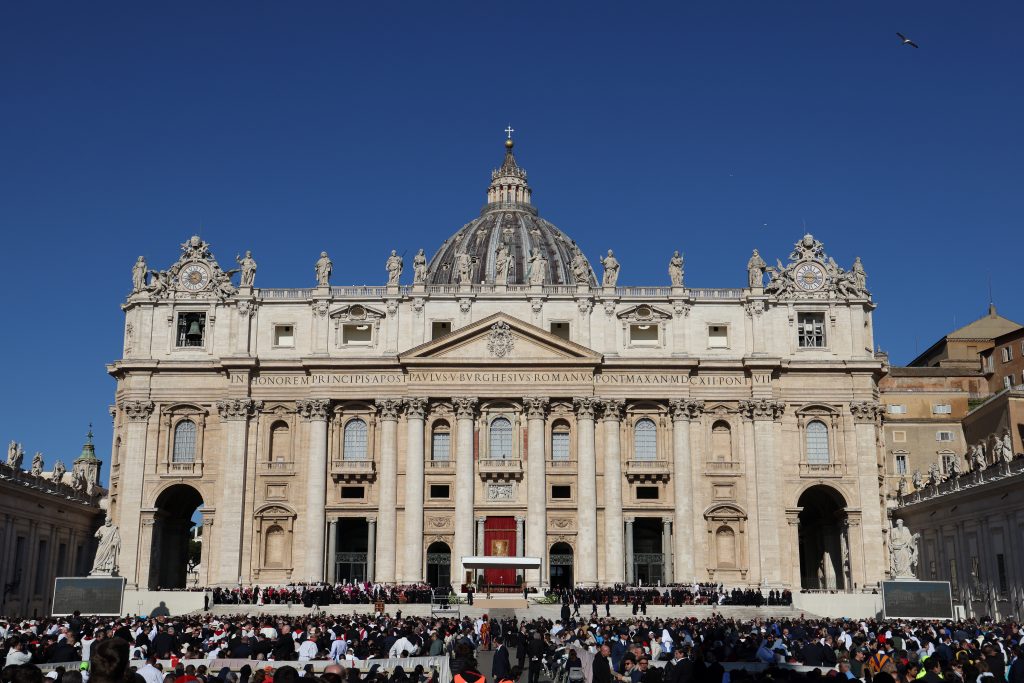
Global reactions pour in after Pope Leo XIV’s AI encyclical
Politicians, bishops and technology leaders across the United States, Britain and Canada have begun responding to Pope Leo XIV’s first encyclical, Magnifica Humanitas The first international reactions to Pope Leo XIV’s inaugural encyclical have begun to emerge less than 24 hours after its publication, with bishops, politicians and technology figures across the United States, Britain and Canada welcoming the document’s warnings about the dangers posed by artificial intelligence. The encyclical, Magnifica Humanitas, was released by the Vatican on 25 May and is already being compared to Pope Leo XIII’s landmark 1891 social encyclical Rerum Novarum, which addressed the upheavals of the Industrial Revolution. Pope Leo XIV deliberately dated the text 15 May to coincide with the 135th anniversary of the earlier document. One of the strongest official political reactions came from the United States ambassador to the Holy See, Brian Burch, who praised the Vatican’s intervention in the growing global debate surrounding AI. “We welcome the Holy See’s important contribution to the subject of artificial intelligence,” Burch said. “The Vatican’s moral leadership on technology and human dignity contributes meaningfully to the global conversation on AI.” Burch said the United States shared the Holy See’s commitment to ensuring that artificial intelligence “serves humanity and upholds fundamental values”, while also defending the Trump administration’s emphasis on innovation and American leadership in the sector. “The United States is likewise committed to exporting American AI technologies built on principles of transparency, security and human flourishing, ensuring the world benefits from AI systems that reflect democratic values rather than authoritarian control,” he said. David Sacks, the technology investor and former White House AI adviser, also responded publicly to the encyclical, agreeing with the Pope’s argument that AI should remain a tool at the service of humanity rather than become an instrument of “domination or exclusion”. Writing on X, however, Sacks questioned how governments could be trusted with increased regulatory authority over artificial intelligence. “If we hand governments sweeping power over AI development in the name of safety, how do we prevent it from being used to censor, surveil and control citizens, as Orwell foretold in 1984?” he wrote. “This is the real alignment problem. The oldest questions of human nature and authority don’t disappear in the AI age. They become newly relevant.” The encyclical also drew praise from Democratic Senator Chris Murphy of Connecticut, who said Pope Leo XIV had articulated growing concerns about the social and moral effects of artificial intelligence. “AI threatens to undermine the basic building blocks of humanity as it seeks to replace our most basic functions, like creativity, friendship and critical thinking,” Murphy wrote, describing the Pope’s warning against monopolisation of AI technologies by powerful corporations as “really important”. Catholic bishops throughout the English-speaking world moved quickly to welcome the document, presenting it as a major contribution to Catholic social teaching at a moment of rapid technological change. Archbishop Paul S. Coakley of Oklahoma City, president of the United States Conference of Catholic Bishops, said the Church in the United States received the encyclical “with gratitude and praise”. “It is a powerful reminder that no technology can replace a child of God, and all technology should be placed at the service of helping humanity thrive,” he said. Drawing parallels with Rerum Novarum, Archbishop Coakley said Pope Leo XIV had shone “the light of the Gospel and the tradition of the Church” on the opportunities and dangers created by artificial intelligence. “The Pope calls us to never lose sight of the inherent dignity of all human life and the moral imperative for technology to support peace and the common good rather than the limited interests of a few,” he said. The Archbishop also revealed that the US bishops’ conference had already tasked its doctrine committee with coordinating the Church’s response to developments in artificial intelligence. In England and Wales, Archbishop Richard Moth, president of the bishops’ conference, and the Archbishop of Westminster described the encyclical as “an important contribution to integral human development during a time of considerable change”. “One of the first interventions of Pope Leo since he was elected Pope was to draw attention to the profound challenges AI will bring to humanity,” Archbishop Moth said. The Archbishop of Westminster noted that the Church’s social teaching tradition since Rerum Novarum offered substantial guidance for navigating technological and economic upheaval. “We must respond to these, placing the centrality of humanity above all else, most especially the solidarity that is needed if we are to seek peace among peoples,” he said. “Pope Leo reminds us that ‘more powerful does not necessarily mean better.’” Archbishop Moth warned that technology “must not be used to embed unjust economic systems and abuses of power, but must always be at the service of human development”. He also disclosed that the Bishops’ Conference of England and Wales had established a working group to study the encyclical and examine the ethical issues generated by artificial intelligence. Other American bishops issued similar statements within hours of publication. Bishop Michael Burbidge of Arlington said the encyclical was especially welcome “in this time of tremendous social and technological change”. “I encourage all to join me over the coming days in reading Magnifica Humanitas in its entirety and prayerfully considering all that the Holy Father shares,” Bishop Burbidge said. Archbishop Richard Henning of Boston described the document as “timely and important”, while Archbishop Nelson Pérez of Philadelphia encouraged Catholics to reflect on its “vital message” concerning the protection of human dignity during rapid technological development. Bishop William Koenig of Wilmington, Delaware, said the encyclical drew upon the wisdom of Catholic social teaching to ensure that technological progress remained directed towards “human flourishing”. The Canadian Conference of Catholic Bishops also welcomed the document, saying it offered guidance for protecting the human person during “a profound epochal shift”. The bishops highlighted the encyclical’s call for “a civilization of love founded on justice, dialogue and shared responsibility” as an alternative to what the Vatican described as “the culture of power and war”. However, a more critical reaction came from the Bishop Emeritus of Tyler, Bishop Joseph Strickland, who published a lengthy critique arguing that Magnifica Humanitas risked placing excessive emphasis on social structures and human flourishing at the expense of sin, repentance and salvation. While acknowledging the encyclical’s “strong and important” rejection of transhumanism and its warnings about “AI warfare, exploitation, digital manipulation and technological domination”, Bishop Strickland said the document devoted comparatively little attention to “original sin, concupiscence, personal repentance, moral culpability, judgment, hell, penance, or the eternal destiny of the soul”. Bishop Strickland argued that “the roots of evil begin to appear primarily structural rather than spiritual” and warned that the encyclical’s repeated calls for a “civilization of love” risked sounding “less like the fruit of conversion to Christ and more like a global humanitarian project centred on fraternity, solidarity, inclusion and peace”. The former Bishop of Tyler said many Catholics would find the document “deeply unsettling” because “the entire framework is subtly shifting: from God-centredness to man-centredness, from salvation to human flourishing, from sin to systems”. He concluded by warning against “religious humanism” and insisting that “the answer remains what it has always been: Jesus Christ, King of kings and Lord of lords.”
May 26, 2026

Pope Leo XIV warns Europe faces ‘drastic sterility’ after abandoning Christianity and embracing abortion
Pope Leo XIV has warned that Europe’s demographic crisis has been driven by the abandonment of the Christian principles that shaped the post-war European project, telling lawmakers in Rome that the continent faces a “time of drastic sterility” marked by abortion. The Pope made the remarks on Monday morning during an audience with members of […] Pope Leo XIV has warned that Europe’s demographic crisis has been driven by the abandonment of the Christian principles that shaped the post-war European project, telling lawmakers in Rome that the continent faces a “time of drastic sterility” marked by abortion. The Pope made the remarks on Monday morning during an audience with members of the European Parliament’s Demography Intergroup in the Clementine Hall of the Apostolic Palace. The meeting brought together MEPs alongside senior European and Italian officials attending a conference on family and demographics, including the European Commissioner for the Mediterranean, the Italian Minister for Family, Natality and Equal Opportunities, and the OSCE Special Representative on Demographic Change and Security. Addressing delegates, the Pontiff described Europe’s falling birth rates and ageing populations as an “urgent challenge with practical implications for millions of people and their families” across the continent. Referring to remarks frequently made by Pope Francis, Pope Leo said Europe was becoming the “‘old continent’ – no longer because of its glorious history, but because of its advancing age”. Official figures for 2024 show that the EU’s total fertility rate fell to a record low of 1.34 live births per woman, with just 3.55 million babies born across the bloc. No European country currently reaches the replacement level of around 2.1 children per woman required to maintain a stable population without imigration. The Pope said the crisis extended far beyond economics and population statistics, warning that it pointed to a deeper collapse in intergenerational solidarity and cultural confidence. “Demographic data are not merely statistics, but speak of fatherhood, motherhood and children,” His Holiness said. “And children are the future.” Pope Leo said Europe had failed to equip younger generations with both the material stability and cultural inheritance necessary to build families and face the future confidently. “Over recent decades, we can see that a rejection of the Christian inspiration of the founding fathers of the EU institutions has led to a time of drastic sterility,” the Pope said, adding that this had occurred “not only because too many have been deprived of the right to be born, but also because there has been a failure to pass on the material and cultural tools that young people need to face the future”. Across Europe, the abortion rate stands at approximately 29 per 1,000 women aged 15–44. In several countries, hundreds of thousands of abortions continue to be performed each year, even as birth rates remain at historic lows. Unsurprisingly, there has also been a rejection of traditional social norms. The EU crude marriage rate has fallen by more than half since the mid-1960s, standing at 3.9 marriages per 1,000 people in 2024. Regrettably, the fall reduction in Catholic marriages has been even greater. The Pontiff criticised what he described as contradictory social policies, which publicly claim to support families while simultaneously undermining motherhood and promoting abortion. He said Europe was increasingly confronted by “purportedly family-friendly policies” that “promote discrimination against motherhood, exalt abortion as a right, and undermine the very foundation of the desire to start a family”. The Pope also linked demographic decline to what he called the “pandemic of loneliness”, describing it as one of the many social consequences flowing from shrinking and ageing populations. He told lawmakers that Europe’s demographic problems demanded coordinated action from political institutions, governments, academics and wider civil society, saying the issue represented “a crucial juncture for the anthropological, social and economic future of Europe”. Pope Leo urged European leaders to place the family at the centre of policymaking and reaffirmed the Church’s teaching that the family is rooted in marriage between a man and a woman. Citing Pope St John Paul II’s apostolic exhortation Familiaris Consortio, he said the family remained “the first and irreplaceable school of social life” and described it as “founded on marriage between a man and a woman, a reality that unites the personal and public dimensions”. The Pontiff said lawmakers had a responsibility to encourage the “shared responsibility and active role of families in social, political and cultural life”, while also safeguarding the principle of subsidiarity. “For only by respecting and promoting this central place of the family, and applying the principle of subsidiarity, is it possible to avoid the two extremes of excessive State intervention and individualism,” His Holiness said. Throughout the address, Pope Leo framed demographic decline not simply as a policy challenge but as a question touching the future identity and stability of Europe itself. He called for cooperation between European institutions and Christian organisations, pointing to the work of the Federation of Catholic Family Associations in Europe and the Commission of the Bishops’ Conferences of the European Union as examples of how civil society groups could contribute to political debate and practical reform. “This is the impetus Christians are bringing to the European project,” he said, “so that policies look to human persons in their entirety and always promote the dignity of human beings.” The Pope insisted the Church was not proposing a return to older political or social arrangements, but rather the recovery of enduring principles capable of guiding modern societies through cultural and demographic decline. “This approach is not a matter of returning to social models of the past,” he said, but of offering “unchanging principles” capable of answering fundamental questions about “the meaning and value of human life”, authentic human society and the kind of world future generations will inherit. The Pope concluded by calling for what he described as “a fresh springtide for the family” to reverse “the winter chill of our ageing populations”. Pope St John Paul II made opposition to abortion and the defence of the family defining themes of his pontificate, particularly in Evangelium Vitae, his 1995 encyclical condemning abortion and euthanasia. Pope Leo’s address continues that emphasis while placing demographic decline at the centre of wider debates over Europe’s future direction. “What kind of world do we want to hand on to future generations?” the Pope asked delegates gathered in the Apostolic Palace. The question hung over the audience as European lawmakers departed the Vatican. In his comments, the Pontiff added his voice to some of the existential questions facing the continent, which can at present only accurately be described as being in a state of decline.
May 26, 2026

Magnifica Humanitas offers a window into Leo XIV’s moral compass
Magnifica Humanitas is far more than an encyclical on artificial intelligence. Michael Haynes finds that Pope Leo XIV’s first major text offers a window into the moral vision shaping his pontificate With the launch of his first encyclical there is now no doubt that Leo’s choice of regnal name and entire papacy is centred around what he sees as a pivotal moment for the future of the Church and humanity. “Artificial intelligence needs to be disarmed,” said Leo XIV while launching Magnifica Humanitas today. “This moment needs words capable of attracting attention, of awakening consciences.” This is not to say that Leo opposes the seemingly relentless drive of artificial intelligence (AI) or the wider technological development of the modern world. While AI cannot be deemed “morally neutral”, Leo urged that “it must be at the service of all and the common good”. In short, this could be taken as a summation of the entire encyclical : a plea for the pursuit of the common good. It is certainly written as a response to AI and describes itself as being in the “age of AI”. But it is much wider than AI itself, as Leo appeared to launch his pontificate anew. Just as during his address to the College of Cardinals last May he outlined his papal priorities, in Magnifica Humanitas Leo revealed his deeper concerns about wider society. Given the length of the encyclical, no single analysis can justly summarise all that it contains, but one key element to examine first is what the text reveals about the Pontiff’s moral compass and his view of addressing crises in the Church and wider secular society. Far from being a mere appeal from another cleric for some generically responsible behaviour, this time regarding AI, Leo delved into the entire foundation of societal life. For Leo, the link between his encyclical and his namesake’s Rerum Novarum is palpable. “Like the earlier Leo, I feel entrusted to look upon another huge transformation with eyes of faith, with lucidity of reason, with openness to mystery, and with cries of the poor and the earth resounding in my heart,” he commented during the launch event. This is why Magnifica Humanitas does not deal briefly and solely with AI, but instead uses the topic to launch into a wider schooling of society about improving standards of behaviour and acting in a more Christian manner while seeking the common good. Leo’s assessment of how to preserve humanity from the dangers posed by AI is to attempt a ground-up re-education of society with God at the centre. In part this explains the considerable length of the text, which will have disappointed those looking for a return to briefer tomes. Of the 245 paragraphs and 224 footnotes, Pope Francis is cited 54 times, Benedict XVI 16 times, John Paul II nearly 40 times, and the Second Vatican Council 13 times. St Augustine also features throughout, with a quotation drawn from J.R.R. Tolkien. The tone is a mixture of different elements. Firstly, it is undeniably clear that Leo is seeking to address the result of many years of increasingly anti-Catholic secularism. “We live at a time of significant spiritual and cultural blindness,” he stated. In order to resolve this crisis, a crisis which then spills over into the use of AI, Leo urges society to return to elements intrinsic to Christian civilisation, such as pursuing the common good. “In the era of artificial intelligence, when human dignity is threatened by new forms of dehumanization, ours is the pressing duty to remain profoundly human,” he writes. “We must lovingly safeguard the grandeur of humanity bestowed upon us and revealed in its fullness in Christ, the splendour of which no machine can ever replace.” His approach to how best to use AI thus necessarily involves a quasi-catechesis on the re-Christianisation of society. Leo decried how “the risk of dehumanization — of building a future that excludes God and reduces the other to a means — is an ancient and ever-new temptation that today takes on a technical guise”. Should AI and wider technological development continue in the line of the Tower of Babel, then all will suffer, Leo argued. “Babel thus reveals the limits of any effort that, however grandiose, arises from self-affirmation, sacrifices human dignity for efficiency and aspires to reach heaven without God’s blessing.” “What saves humanity,” he added later in the encyclical, “is the divine love that descends into the most fragile point of our history and renews it from within.” The Pontiff urged all readers to recognise “the harmony that arises when all persons assume their own role and recognize that their strength comes from the Lord”. Such lines present a decidedly Christian tone to the text, if perhaps not a stridently or overtly Catholic one. It reads as Leo’s heartfelt appeal to the world at large to act in a more polite, respectful and ultimately Christian manner. “In order to protect the human person in the age of artificial intelligence, I believe that today we must once again reflect on the common good, the universal destination of goods, subsidiarity, solidarity and social justice,” wrote Leo, having noted that “a city founded on the common good implies, first and foremost, building on a firm relationship with God”. At other times the text seems less unabashedly Catholic than a papal encyclical ought confidently to appear. In large part this is due to the Pope’s reiteration of his predecessor’s text Dignitas Infinita regarding human dignity, and an underlying tone in the text which appears to orient the Pope’s proposed societal changes as being chiefly desirable because they benefit man, rather than being linked to a conversion of hearts and minds to Catholicism. Assuredly, in certain sections the Pope notes the importance of having God at the foundation of activity, but in others a far more secular tone is present. Modern teaching on human dignity tends to upend traditional teaching, generally remaining silent on supernatural dignity and then elevating natural dignity. For a more detailed analysis on the topic than is possible here, see this correspondent’s article and book on the topic. Citing this teaching on human dignity, Leo writes that it is this which “requires us to shape the way we live together, including our economic and political choices, and the makeup of our cities”. Yet such an aspect is also very much in line with Leo’s papal style: avoiding polemics, and outwardly remaining calm as he seeks to find common ground with all in an apparent attempt to defuse tensions and foster peaceful dialogue. This does not stop him from once again decrying abortion and euthanasia. Nor did Leo feel restrained in making a bold statement declaring that the Church’s longstanding teaching on a “just war” is “now outdated” since “humanity possesses far more effective and capable tools for promoting human life and resolving conflicts, such as dialogue, diplomacy and forgiveness”. Indeed, this latter point places his repeated calls for peace in a new light, given that, for Leo, it appears that armed conflict can no longer be justified, a pronouncement which is not supported either by Scripture or Tradition. For an encyclical billed as being solely about AI, the text delivers far more than that. It reads as a window into Leo’s moral and social views and thus into the style and priorities of his pontificate. Vaticanists waiting for a “tell” on Leo have finally been granted an inside look. Leo highlights the Christian foundation of society before noting that only Christianity can lead society and mankind to truly flourish. He then moves to address questions relating to the common good, alongside topics likely to interest more secular readers, including his passionate appeals regarding armed conflict and the growing use of AI in fuelling the global war industry. But in closing he returns once more to his overtly Christian theme, emphasising the importance of prayer in sustaining any endeavour aimed at fostering a better society in pursuit of the common good. “The spirituality that we need,” he wrote, “is a Eucharistic spirituality, that is, a spirituality of ecclesial unity in love.” Leo urged society to recognise the beauty that comes not from AI’s takeover of the world, or even man himself through transhumanism, but from the frailty of humanity which must rely upon God for everything. “Our rule,” he concluded, “must be the acceptance of human limitations as a natural and positive reality, and should be characterized by shared responsibility and a language characterized by the Gospel.” Michael Haynes is an English journalist in the Holy See Press Corps. He serves as Vatican Correspondent and Analyst for Pelican+ , while readers can follow him at Per Mariam and on X @MLJHaynes .
May 25, 2026