

Feast Of The Sacred Heart
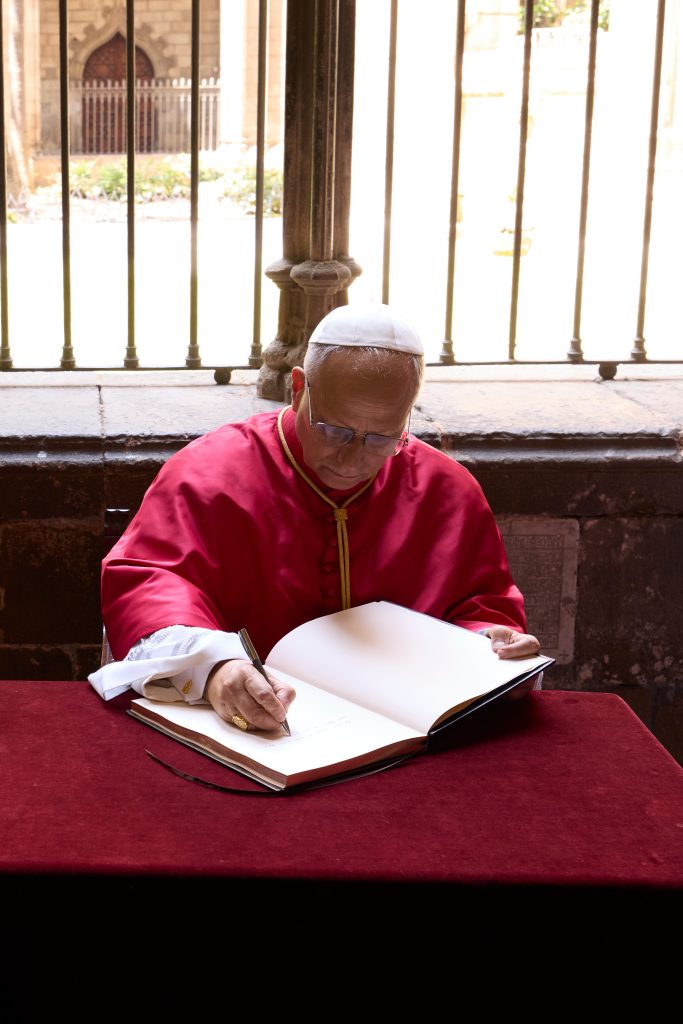
Pope Leo XIV addresses more than 400,000 priests in Feast of the Sacred Heart letter
Pope Leo XIV has addressed more than 400,000 priests worldwide in a letter for the Feast of the Sacred Heart of Jesus and the Day for the Sanctification of Priests The Holy Father, Pope Leo XIV, wrote to all priests around the world on the Day for the Sanctification of Priests, which is celebrated each year on the Feast of the Sacred Heart of Jesus. There are more than 400,000 priests worldwide, 5,525 of whom are bishops. Some 67 per cent are based either in Europe or the Americas, although Asia and Africa are experiencing significant growth in their priestly populations. The total number of African ordinations surpassed Europe for the first time in 2019. Although Africa currently has only 14 per cent of the world’s priests, it is training 34,000 priests in its major seminaries, constituting about 31 per cent of seminarians globally. Devotion to the Sacred Heart is a medieval Christian practice of popular piety, finding supporters in the great religious houses and among the saints, notably St Bernard of Clairvaux. However, it is St Margaret Mary Alacoque, a 17th-century French Visitation nun, who is best known for her promotion of the devotion. A vision she received in 1675 led to the incorporation of the Solemnity of the Sacred Heart into the Church’s liturgical calendar. In the vision, Our Lord asked “that the first Friday after the octave of the Blessed Sacrament [Corpus Christi] be dedicated to a particular feast to honour my heart, by receiving communion on that day and making reparation to it by honourable amends”. At the request of Queen Marie Leszczyńska of France, the French episcopate approved the celebration of the feast in 1765. In 1856, Pope Pius IX extended the Feast of the Sacred Heart to the Latin Church under the rite of double major. Pope Leo XIII then raised it to a first-class feast in 1889 and, in 1928, Pope Pius XI raised it to a double first-class feast and added an octave, which was removed during the 1955 reforms of the General Roman Calendar. With the simplification of feasts in 1969, it was made a solemnity, the Church’s highest rank of celebration. Long associated with the priesthood, the devotion was given a further priestly connection when Pope Saint John Paul II established the World Day of Prayer for the Sanctification of Priests in 1995 and set it on the Solemnity of the Sacred Heart. Similarly, the Year for Priests, 2009 to 2010, was inaugurated by Pope Benedict XVI on the Feast of the Sacred Heart. His letter is reproduced below: Dear brother priests, On the day when the Church ponders her Lord’s pierced Heart, from which gushes forth an inexhaustible fountain of peace and unity for all humanity, I first address to myself and to all of you the words that God spoke to the people of Israel: “Be holy, for I the Lord your God am holy” (Lev 19:2; cf. 1 Pt 1:16). This divine call echoes down the ages. Even today it resonates strongly with every believer and, in a particular way, with us priests. Holiness is neither one option among many nor an abstract ideal, for it involves the very identity of every person who wishes to share in the life of the risen One. Holiness is sharing in Christ’s mystery God invites us to share in his own holiness. When he calls us to be holy as he is holy, he indicates that the path we must follow involves being fashioned after his own Heart. And for us, dear brothers, this call is particularly radical. The Lord has promised: “And I will give you shepherds after my own heart, who will feed you with knowledge and understanding” (Jer 3:15). The holiness he asks of us is a trustful abandonment, allowing ourselves to be transformed by the Holy Spirit. Yet it is precisely here that the great paradox of our priestly life emerges. We are called to share in God’s own holiness, but we carry this treasure in earthen vessels (cf. 2 Cor 4:7). We are limited and imperfect, often weak and weary, and at times wounded. How can such a vulnerable human heart respond to such a high calling? The priest lives this tension. Yet at the same time, he must recognize that he finds peace in the open side of the Lord Jesus. A journey toward union The union of our heart with Christ’s Heart is not an experience reserved for a select few; rather, it is a sacramental, Eucharistic journey that unfolds each day of our lives. Dear brothers, by our ordination we have been configured to Christ, yet we must always renew within ourselves the gift of grace through our daily celebration of the Eucharist, prayer, meditation on the word of God and humble service to our brothers and sisters. Let us remain united to Christ in everything — in all that we do and in all that happens to us every day. Then the holiness that we have sought in vain through isolated efforts will reveal itself for what it is: a response to the grace that precedes, sustains and transforms us. Indeed, our humanity is not compartmentalized. Prayer, ministry, relationships, weariness, joys and failures — even time or love that apparently seems wasted — all become privileged places where God reveals himself and his infinite love. The priest who has an upright, simple and pure heart can be contemplative in the midst of action, merciful and faithful in times of trial, and joyful in the gift of himself. The world greatly needs pastors who offer more than simply words or programs; it needs the living witness of a reconciled heart that exudes the sweet fragrance of Christ’s holiness. A priestly life that is steady and configured to Jesus’ Heart is a credible sign of unity, peace and mercy. Thus, in an age marked by division and fear, we must be builders of peace and witnesses of the tenderness of the Good Shepherd who knows how to gather the scattered and heal the wounded. Our zeal is not restlessness, but the overflowing of a love that is “‘ecstasy,’ openness, gift and encounter” (Francis, Encyclical Letter Dilexit Nos, 28). The Heart of Christ is the heart of the saints The response to the call to holiness lies not so much in works of asceticism or striving for perfection –– though these are necessary –– but in trusting adherence to the love revealed in Jesus’ pierced Heart. The Apostle John invites us to contemplate the open side of the crucified One (cf. Jn 19:34), in which God definitively shows us what holiness is: not an inaccessibly distant or detached perfection, but a love that gives itself even to the point of being wounded and so can become a source of mercy and life. The Sacred Heart of Jesus is an exemplary image of the surpassing love of God. It is an all-powerful love precisely because it is capable of being vulnerable and of transforming sorrow into grace and suffering into hope. The Sacred Heart, therefore, is the “place” where holiness is manifested as closeness and tenderness. The priest’s holiness, then, is embodied in humble and courageous nearness, in being all things to all people, and in keeping the gate of the sheepfold open so that many can enter and find pasture and rest (cf. Jn 10:9). For this reason, we are called to a relationship with God that does not distance us from others but brings us closer to everyone — shaping patient and tender hearts, capable of closeness, compassion and listening. Thus, through the union of our imperfect hearts with Jesus’ pierced Heart, our journey toward holiness is fulfilled. It is no longer we who live, but Christ who lives in us (cf. Gal 2:20). Such holiness cannot be lived in isolation. Cherish your priestly fraternity: seek one another, listen to one another and support one another. The priest who isolates himself slowly fades away; the priest who walks alongside his brothers grows. Saint Augustine reminds us of this when he says: “How shall we avoid finding ourselves in darkness? By loving our brothers. What is the proof that we love our brothers? This: that we do not fracture unity and that we practice charity” (In Epist. Io. ad Parthos II, 3).
Jun. 14, 2026