

Diocese Of Maralal
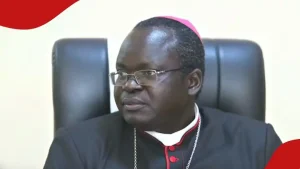
Bishop asks women to stop pursuing Catholic priests
After suspending six priests and introducing reforms across the Diocese of Maralal, Bishop Hieronymus Joya has appealed to women not to pursue relationships with Catholic clergy, defending priestly celibacy and warning that priests remain vulnerable to temptation The Bishop of Maralal has asked for women not to pursue relationships with Catholic priests. Bishop Hieronymus Emusugut Joya, I.M.C. made the remarks after introducing disciplinary measures across the Diocese of Maralal and suspending six priests over allegations ranging from adultery to the abuse of ecclesiastical authority, negligence in administration, and the mismanagement of Church property. “For those intending to tempt priests and force them into affairs that go against their beliefs and priestly calling, please stop,” the bishop said. “These priests are human and have feelings. If you convince them, they might fall.” His intervention came as he defended the Church’s expectation of priestly celibacy while addressing recent disciplinary action within the diocese. Referring to priests who maintain relationships or have children, Bishop Joya questioned how they could faithfully fulfil their ministry while carrying responsibilities incompatible with their vocation. “How can you do the business of God when you have private businesses, a woman, and a child to support?” the Kenyan bishop asked. The latest comments follow reforms announced during Mass, when the bishop outlined what he described as a determined effort to restore discipline, accountability and sound governance throughout the northern Kenyan diocese. The disciplinary measures include the suspension of Fr Paul Maina, Fr Peter Musau, Fr Stephen Lekasuyan, Fr Peter Nderitu, Fr Christopher Letikirich and Fr John Dida. According to Bishop Joya, the sanctions were imposed only after credible evidence had been gathered and canonical procedures observed. “I do not accuse any priest without credible evidence,” he said, explaining that he had acted “in accordance with the Code of Canon Law” to safeguard both “the integrity of the priesthood and the proper stewardship of Church property”. The six suspensions represent around 15 per cent of the diocese’s clergy. During his latest remarks, he also disclosed that one of the priests concerned had contributed to the closure of Wamba Hospital, although he did not elaborate further. Alongside the suspensions, Bishop Joya has introduced a series of binding regulations governing priestly life throughout the diocese. Priests are now required to return to their presbyteries by 7.00 pm each evening for community prayer and may not spend the night away from their residence without the bishop’s permission. Overnight stays by lay people in priests’ residences or religious houses have likewise been prohibited unless prior authorisation has been granted. The reforms also tighten expectations surrounding alcohol, financial administration and personal conduct. Priests are forbidden from drinking in bars or consuming alcohol in parish residences, while anyone found intoxicated is barred from celebrating the liturgy. “It is painful to state that I found the diocese with multiple problems, but no one was willing to tell me the cause of the problems and how to get the solution,” the bishop said. Research by A. W. Richard Sipe, based primarily on interviews with North American clergy, estimated that only around 50 per cent of priests were practising celibacy at any given time, with others engaging in sexual relationships with adults. Vincent Doyle has suggested that priests have fathered thousands of children globally among the approximately 415,000 Catholic clergy, indicating that non-adherence is not uncommon, although precise figures are unavailable owing to underreporting and secrecy. In Africa, qualitative reports have documented cases of priests violating celibacy through relationships and fathering children, often with cultural pressures playing a part. A 1988 report from Malawi described local priests impregnating 29 nuns in one women’s congregation. In Kenya’s Samburu region, a priest has previously been linked to fathering a child with a 16-year-old girl. Reports have also documented priests maintaining secret families in various African countries, contributing to breakaway churches of married former priests in Uganda that have attracted thousands of followers. Photo: Ramogi TV. Read more
Jul. 16, 2026