

Consistory
Report from Day 1 of the Consistory: The second session
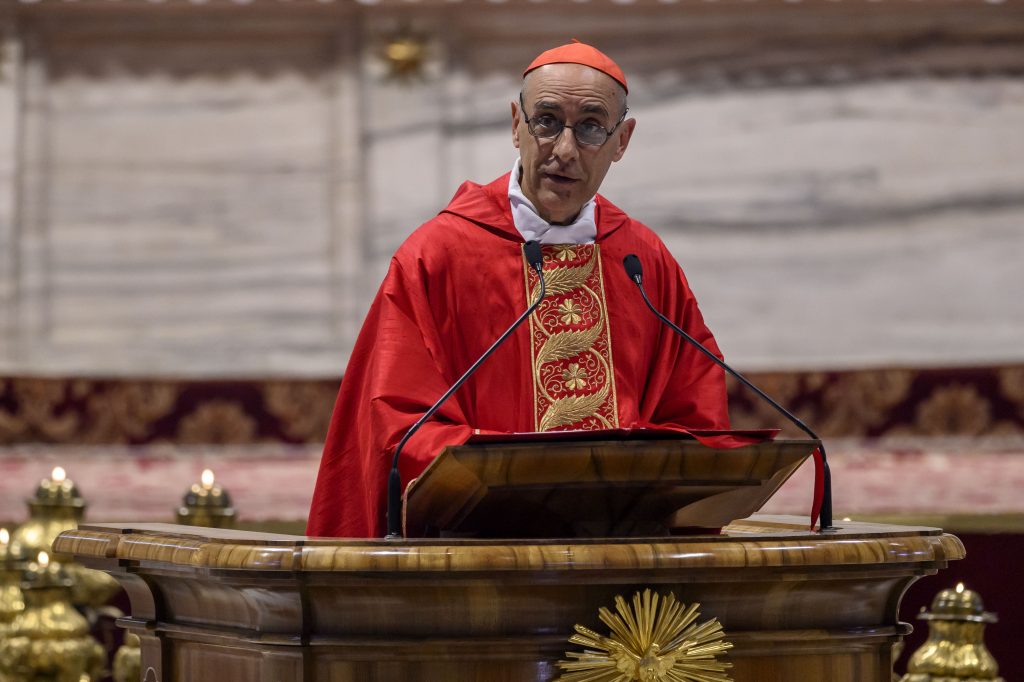
Cardinal Víctor Manuel Fernández delivered the principal theological meditation during the second session of the first day of Pope Leo XIV’s Extraordinary Consistory The College of Cardinals concluded the first day of Pope Leo XIV’s Extraordinary Consistory with Cardinal Víctor Manuel Fernández clarifying the Pope’s call for the Catholic Church to move beyond the traditional just war theory. Following presentations by the working groups, the remainder of the afternoon was devoted to open interventions from cardinals, who returned repeatedly to the themes of the Pope’s landmark encyclical. According to the Holy See Press Office, the interventions centred on the need for Christians to transform society through the witness of their lives, while many cardinals expressed gratitude for what they described as the spirit of communion fostered during the Consistory. The Holy See said the discussions stressed Christian witness as the means by which “mentalities and cultures” could be changed, with cardinals reflecting that authentic evangelisation depended not simply on words but on lives capable of demonstrating the Gospel before an increasingly sceptical world. The interventions also returned to one of the most striking passages of Magnifica Humanitas , in which Pope Leo acknowledged that the Church had been too slow in unequivocally condemning slavery. According to the Holy See, cardinals said the Pope’s forthright admission had “opened the hearts of millions to the Gospel”, bringing “light and hope to the Church”. Rather than weakening the Church’s witness, they suggested that the Pope’s willingness to confront painful chapters of history had strengthened its credibility in the modern world. Cardinals also described the encyclical as a personal appeal directed not only to Catholics generally but particularly to members of the College of Cardinals, calling them to assume responsibility for building peace in a world marked by conflict and instability. They noted the continuing importance of symbolic acts of reconciliation, recalling St John Paul II’s Prayer Meeting for Peace in Assisi in 1986 as an example of the Church exercising moral leadership beyond political divisions. The session concluded shortly before 7.30 pm with Pope Leo leading the cardinals in prayer. Earlier in the day, Cardinal Víctor Manuel Fernández, Prefect of the Dicastery for the Doctrine of the Faith, delivered the principal theological meditation on the fifth chapter of Magnifica Humanitas , offering what amounted to the clearest exposition yet of Pope Leo’s teaching on war and legitimate defence. Cardinal Fernández argued that the encyclical’s originality lay not simply in its treatment of armed conflict but in its diagnosis of what it calls the “culture” of power, a global mentality that enables wars to emerge and continue with diminishing resistance from societies increasingly shaped by modern communications and artificial intelligence. He said the encyclical’s most significant doctrinal development was its assertion that “the ‘just war’ theory […] is outdated”, explaining that Pope Leo was not abandoning the Church’s concern for legitimate defence but warning that the traditional doctrine had “all too often been used to justify any kind of war”. “The Church’s Social Doctrine is manipulated to provide a theoretical foundation for the most unjust wars,” Cardinal Fernández said. “Instead of stopping wars, it helps to justify them.” He insisted that legitimate self-defence remained part of Catholic teaching, but only when understood “in the strictest sense”, rejecting broad interpretations that had been used to justify so-called pre-emptive wars. Recalling the Catechism’s traditional conditions governing legitimate defence, Cardinal Fernández stressed that military action could only be justified where grave and certain aggression had occurred, all peaceful means had failed, success remained realistically possible, and military action would not inflict greater harm than the evil being resisted. He argued that these principles had become increasingly difficult to satisfy given the destructive capacity of modern weapons. “The destruction of entire cities cannot be considered a proportionate defensive action,” he said, before citing Gaza and southern Lebanon as examples where the scale of military intervention had become impossible to reconcile with classical Catholic teaching on proportionality. “The enormous disproportion of the military interventions in Gaza and southern Lebanon, for example, is evident,” he said. Referring to civilian casualties and widespread destruction, he added that “the percentage of civilian deaths relative to the total population, the enormous number of children killed… and the number of homes bombed allow us to speak of total destruction.” He argued that appeals to self-defence had become increasingly elastic, not only in the Middle East but also in Ukraine and elsewhere, asking: “What remains of the conditions that sought to limit wars?” Cardinal Fernández suggested that contemporary conflicts reflected a broader cultural shift identified by the encyclical as the “normalisation of war” and a “troubling revival of war as an instrument of international politics”, accompanied by what Pope Leo describes as a “loss of historical memory”. The Argentine cardinal warned that this culture was sustained through systematic misinformation, the discrediting of political opponents, and the cultivation of fear. Quoting directly from the encyclical, he said modern politics increasingly relied upon “misinformation and ridiculing opponents, and systematically cultivating fears and resentments”, creating “an environment in which new conflicts can develop almost imperceptibly”. He also criticised what he described as a false political realism that dismissed peace as naïve. “This so-called realism,” he said, “dismisses peace and dialogue as utopian or irrational positions that ignore the risks at stake.” He warned that even bishops could become trapped by such thinking through fear of appearing unrealistic. Cardinal Fernández also criticised what he called selective moral consistency in international affairs, pointing to differing responses to conflicts depending on political alliances. He argued that countries often condemned abuses committed by adversaries while overlooking similar violations committed by allies, concluding that geopolitical interests frequently displaced objective moral principles. The cardinal’s meditation concluded on a more hopeful note, presenting Catholic social teaching as offering a coherent alternative to ideological polarisation. He said the Church remained distinctive because it consistently defended unborn life while simultaneously protecting migrants, opposing war, defending vulnerable populations, and rejecting abortion, all without becoming captive to electoral politics or ideological factions. “It always proclaims the saving love of Christ,” he said, “but never separates it from the constant defence of human dignity in every circumstance, since such a defence lies at the heart of the Gospel.” He ended by turning the challenge back upon the bishops themselves, asking whether local Churches reflected the same integrity found in papal teaching or whether they too had succumbed to the culture of power that the encyclical seeks to overcome.
Jun. 27, 2026