

Castel Gandolfo
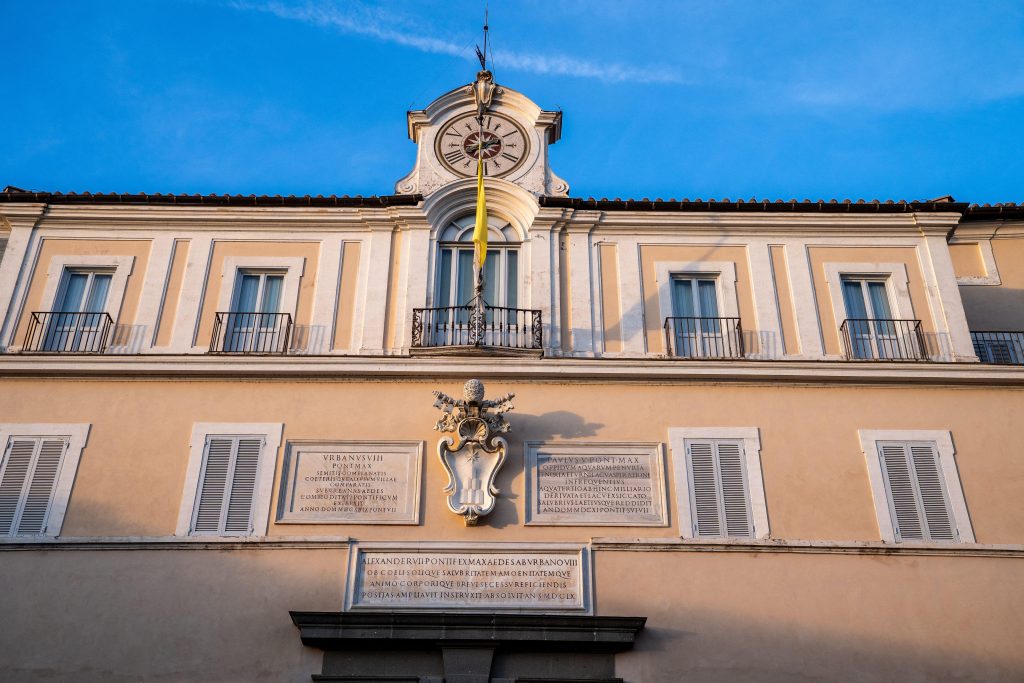
At Castel Gandolfo, Pope Leo XIV says Church must remain open to all
Pope Leo XIV has said the Catholic Church must remain open to everyone, especially those living on society’s margins, during a lunch with 200 poor and vulnerable people at Castel Gandolfo Pope Leo XIV used a lunch with 200 poor and vulnerable people at Castel Gandolfo on Saturday to outline his vision of a Church rooted in hospitality, justice and reconciliation, telling those gathered that the Catholic Church must remain open to all, particularly those living on society’s margins. Hosting the gathering in the Pontifical Gardens on 11 July, the Pope set aside prepared remarks in favour of an impromptu reflection centred on solidarity with those living on the margins of society. “I came without a prepared speech,” he told his guests, “but I did come with hunger—hunger for justice, hunger for genuine charity, hunger for a Church that truly knows how to open its doors, to welcome everyone; where there is love for all, and no one is an enemy, where all of us know how to live reconciliation, forgiveness, and peace.” The event brought together around 200 people from the Diocese of Rome living in situations of hardship, including nearly 40 children. Refugees, single mothers with children, people with disabilities and others supported by diocesan charities spent the day at Borgo Laudato Si’ in Castel Gandolfo, a section of the papal estate that has been transformed into a centre dedicated to the principles of Pope Francis’s 2015 encyclical Laudato si’ . The day began with Holy Mass before touring the papal estate and sharing lunch with the Pontiff. Guests were served traditional Italian dishes, including pasta all’amatriciana and roast veal, followed by strawberries with whipped cream. During his remarks, Pope Leo told those gathered: “As you know well, one of the Pope’s titles is Pontiff—a builder of bridges. And today we too want to build a bridge with all of you, with your families, and with the society in which we want to live—a society marked by justice, where the causes of poverty and the injustices that still exist in our world can be overcome.” “This is the Church we want to be,” His Holiness added. Returning repeatedly to the image of a shared table, the Pope suggested that such encounters offer a model for overcoming social divisions. “Whenever we come together, whenever we share this spirit of encounter around the same table—the one table where Jesus is also present among us—we are truly building a different world, a world of hope, a world that is a light in the midst of our own.” The initiative formed part of the Pope’s stay in Castel Gandolfo, where Borgo Laudato Si’ has become an increasingly prominent setting for projects linking ecological stewardship with social outreach. The programme combines care for creation with practical support for vulnerable communities through education, training and community initiatives. Ahead of the lunch, Donatella Parisi, Communications Coordinator of the Laudato Si’ Higher Education Centre, described the gathering as a visible expression of a Church open to those most often overlooked. She noted that the papal estate, long inaccessible to the public, has undergone a symbolic transformation in recent years. “This place is especially precious because it was closed to the world for 400 years, then opened by Pope Francis and today is thrown wide open by Pope Leo,” she said. “It is now welcoming these people, who for us are the guests of honour.” “The message is that the Church should always be open to everyone, especially those living on the existential peripheries,” she said, adding that Pope Leo “repeats this often”. She also linked the initiative to the Pope’s recent visit to Lampedusa, saying the event reaffirmed that “the Church is open to everyone and is a family, a community, and a safe harbour for those who need it most.” Rather than seeing those invited merely as recipients of charity, Parisi suggested they offer an important witness to the wider Church. “In reality, what we experience every day here at the Laudato Si’ Village is that these very people are the ones who give. They give their all and they enrich the Village and, I would even say, the whole Church through their presence and their call for a different way of looking at society—a perspective that points to fragility as a new source of strength for our communities.” The organisers hope the initiative will continue annually, welcoming participants from different dioceses each year. Last year’s gathering involved people from the Diocese of Albano, while this year’s guests came from Rome through diocesan charities and affiliated organisations. Holy Mass was celebrated by Cardinal Fabio Baggio, Director General of the Laudato Si’ Centre for Higher Education, and concelebrated by Archbishop Luis Marín de San Martín, Prefect of the Dicastery for the Service of Charity.
Jul. 14, 2026
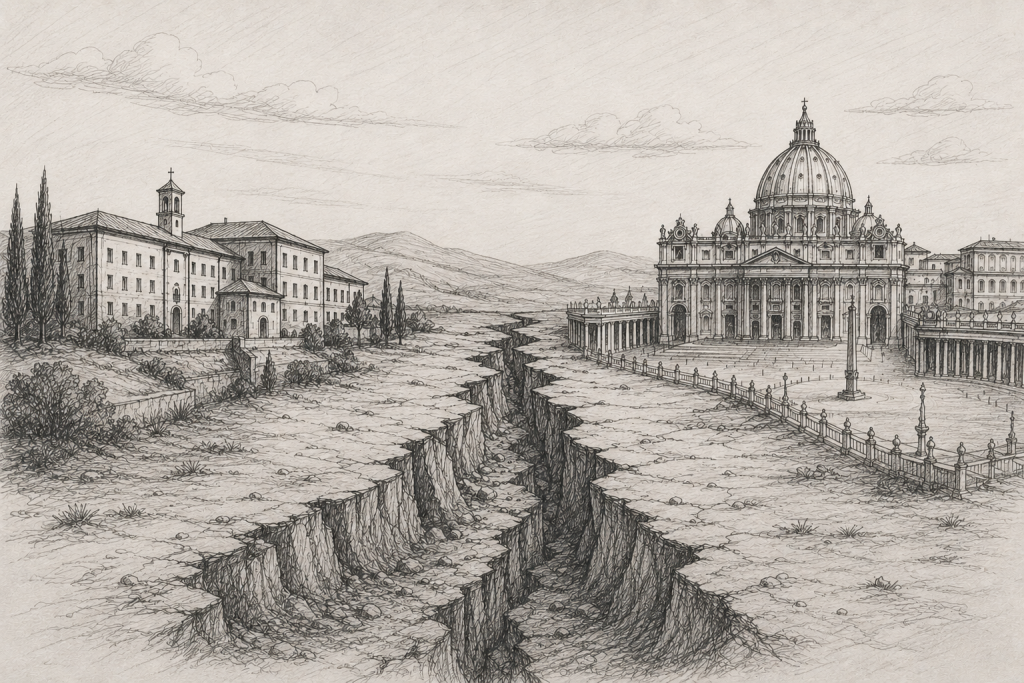
Pope Leo’s SSPX appeal reveals the real fault line
Pope Leo XIV has urged the SSPX not to proceed with its planned episcopal consecrations on 1 July. Yet his remarks may have revealed something more significant: where Rome believes the real obstacle to reconciliation lies. Analysis by Niwa Limbu Pope Leo XIV has made a fresh appeal to the Society of St Pius X (SSPX) to abandon plans to consecrate four bishops without papal approval. Speaking to journalists outside Villa Barberini in Castel Gandolfo on 16 June, the Pope said he was considering making one final request to the traditionalist society before the planned consecrations on 1 July at the SSPX seminary in Écône, Switzerland. “We have invited them, and I am still considering making another appeal, to say: ‘Do not do this. Let us try to live communion in the Church,’” the Pope said. “But it is their choice. They must understand what it means for them and for the Church.” The remarks represent Pope Leo’s clearest public intervention since the SSPX announced earlier this year that it intended to proceed with the episcopal consecrations despite the absence of a pontifical mandate. The Society has argued that the measure is necessary to ensure the continuation of its sacramental and apostolic work. Its leadership has maintained that an “objective state of grave necessity” exists within the Church, requiring the appointment of new bishops to safeguard the future of the fraternity’s ministry. The Vatican, however, has repeatedly expressed concern that episcopal consecrations carried out against the explicit will of the Roman Pontiff would constitute a grave rupture in ecclesial discipline. The prospect of such a step led to the crisis of 1988, when Archbishop Marcel Lefebvre consecrated four bishops without papal approval, resulting in Rome declaring that a schismatic act had taken place. Pope Leo indicated that the dispute is not merely procedural but touches on deeper theological questions. Referring to the SSPX’s longstanding criticisms of the Second Vatican Council, he said division within the Church remained “a painful matter”, adding that the Society continued to reject “certain fundamental elements of the Church, beginning with various points of the Second Vatican Council”. His Holiness added: “If they make those choices, I am sorry. But we must move forward.” The Pope’s comments come after months of exchanges between the Holy See and the Society. Earlier this year, the SSPX confirmed its intention to proceed with the consecrations, while subsequent contacts between Rome and the fraternity failed to produce an agreement. On 12 February, a meeting took place in Rome between SSPX Superior General Fr Davide Pagliarani and Cardinal Víctor Manuel Fernández, Prefect of the Dicastery for the Doctrine of the Faith. The encounter, described by the Vatican as “cordial and sincere”, saw Cardinal Fernández propose a structured path of theological dialogue aimed at addressing unresolved doctrinal questions, particularly those concerning the Second Vatican Council and the “minimum requirements necessary for full communion”. Cardinal Fernández made clear that any such dialogue could only proceed if the SSPX agreed to suspend the planned 1 July consecrations. He warned that proceeding without a papal mandate would constitute a “decisive rupture of ecclesial communion (schism)” with grave canonical consequences, including automatic excommunication. In a letter dated 18 February and made public the following day, Fr Pagliarani responded that, while the SSPX welcomed the idea of renewed doctrinal discussions in principle, it could not accept the condition of postponing the consecrations. “We both know in advance that we cannot agree doctrinally, particularly regarding the fundamental orientations adopted since the Second Vatican Council,” he wrote, while renewing the Society’s request for a personal audience with Pope Leo XIV. Subsequent exchanges failed to bridge the gap. In May, the Vatican reiterated its warnings, and the SSPX published a “Declaration of Catholic Faith” outlining what it considers the minimum necessary for communion while reiterating its concerns about post-conciliar errors. On 26 May, the Society publicly named the four priests slated for consecration, framing the act as a necessary service to souls amid the ongoing crisis in the Church. As the 1 July date at the Écône seminary approaches, negotiations appear effectively stalled. The SSPX maintains its position that an “objective state of grave necessity” justifies the consecrations to ensure the continuation of its sacramental ministry, while the Vatican insists on canonical obedience and prior doctrinal resolution. Generally speaking, Pope Leo XIV addressed the Society of St Pius X in a manner that was pastoral, regretful yet resolute, characteristic of his style thus far. The delivery was conversational and non-confrontational, yet doctrinally unambiguous. By speaking informally to journalists rather than issuing a formal Vatican statement, the Pope signalled personal investment without escalating the matter into a formal magisterial intervention. This approach is indicative of how Vatican communications have evolved in handling such matters. Most importantly, it marks a change from previous pontificates. It represents the first time a Pope has offered an off-the-cuff public comment on the SSPX situation in the lead-up to planned episcopal consecrations. By contrast, there was no specific public comment by Pope John Paul II on the planned 1988 SSPX episcopal consecrations prior to Archbishop Lefebvre’s announcement and the immediate lead-up in early June 1988. What is really happening remains unclear, with little clarified in the public exchanges between Rome and the Society. The Pope’s remarks reflect this ongoing and opaque reality. For many hoping for a resolution to the SSPX question, the latest developments will bring both frustration and renewed determination. The Pope’s sorrow is evident and more irenic than some had feared. Yet the public emphasis on Vatican II as the fault line confirms long-held suspicions. Rome still views critiques the of post-conciliar Church as the core obstacle, not merely Lefebvrist intransigence. If the SSPX holds to what the Church taught before Vatican II, and Leo indicates that it cannot be accepted because of what Vatican II taught, then there is a perceived mutual exclusivity between what Catholicism was and what Catholicism is. How can continuity be maintained when pre-conciliar teachings appear at odds with the post-conciliar emphases now presented as essential?
Jun. 17, 2026