

C Ne Consecrations
Vatican releases reconciliation procedure for SSPX priests and faithful
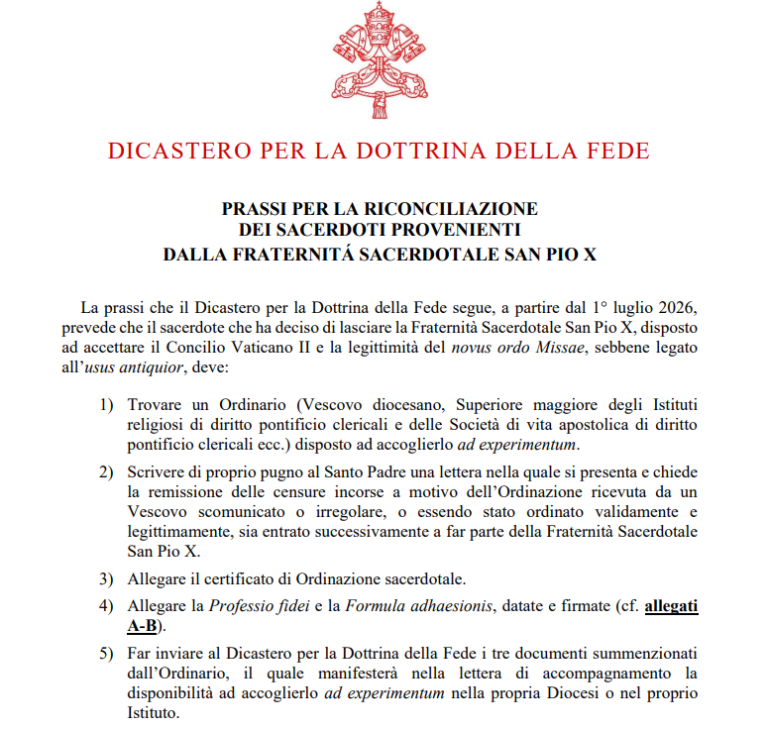
After declaring the SSPX bishops excommunicated, the Vatican has published a document outlining how priests and certain lay faithful associated with the Society can be reconciled with the Catholic Church The Dicastery for the Doctrine of the Faith has released a document entitled the “Procedure for the Reconciliation of Priests from the Society of Saint Pius X”, outlining the process of reconciliation for priests attached to the Society of Saint Pius X. The move comes after the consecrations of four new bishops for the Society and a decree which declared that the four bishops, alongside Bishop Alfonso de Galarreta, the principal consecrator, and Bishop Bernard Fellay, had “incurred the ipso facto penalty of latae sententiae excommunication”. The document is intended to help bishops understand what must be done to facilitate a person being fully reconciled with Rome after being aligned with the SSPX. The document states that “a priest who has decided to leave the Priestly Society of Saint Pius X” and is “willing to accept the Second Vatican Council and the legitimacy of the Novus Ordo Missae”, even though he might be “bound by the usus antiquior”, must go through a certain process for reconciliation. For an SSPX priest to be reconciled, he must first find an Ordinary and then write a “handwritten letter to the Holy Father in which he introduces himself and requests the remission of the censures incurred as a result of ordination received from an excommunicated or irregular Bishop, or, having been validly and legitimately ordained, subsequently entered the Priestly Fraternity of Saint Pius X.” He should then attach his certificate of priestly ordination together with a dated and signed copy of a Professio fidei and the Formula Adhaesionis , which is attached to the document and outlines the necessary theological convictions for reconciliation. The documents are then sent to the DDF by the Ordinary, “who will express in the accompanying letter his willingness to accept him ad experimentum in his diocese or his institute.” The Professio fidei document which the priest must sign begins with the Nicene Creed, and continues with a declaration that the priest believes “all those things which are contained in the written or handed-down Word of God and which are proposed by the Church—either by solemn judgment or by the ordinary and universal Magisterium—to be believed as divinely revealed”. The document continues with the priest agreeing that he “firmly embraces and holds all and everything regarding the doctrine of faith or morals that is definitively taught by the same Church”. It concludes with him agreeing that, with “a religious submission of will and intellect”, he adheres “to the teachings which either the Roman Pontiff or the College of Bishops enunciate when they exercise the authentic Magisterium, even if they do not intend to proclaim them by a definitive act.” The final document which the priest must sign, entitled Formula Adhaesionis , asks the priest to agree that he accepts “the doctrine taught in no. 25 of the Dogmatic Constitution Lumen Gentium of the Second Vatican Council regarding the Magisterium of the Church and the adherence due to it.” With regard to “certain doctrines taught by the Second Vatican Council, or regarding subsequent reforms—whether of the Liturgy or of Canon Law—which some find difficult to reconcile with previous declarations of the Magisterium”, he agrees to “follow a positive approach in interpreting the doctrine”. He is further asked to accept “the validity of the Sacrifice of the Mass and of the Sacraments celebrated with the intention of doing what the Church does, and in accordance with the rites found in the typical editions of the Roman Missal as well as the Rituals promulgated by the Supreme Pontiffs Paul VI and John Paul II.” And finally, he must “promise to adhere to the common discipline of the Church and to its laws, especially those contained in the Code of Canon Law promulgated by the Supreme Pontiff John Paul II.” This part of the document is essentially asking the priest to renounce his criticism of the Second Vatican Council and parts of Church teaching which he finds objectionable. This is a requirement which arguably goes further than what is required for priests in normal circumstances to be in good standing with the Catholic Church, with many drawing parallels between the requirements imposed on the Society’s priests and the apparent lack of censure afforded to groups such as the German Synodal Way. The document is understood to have already been in place for priests in similar situations before the 1 July consecrations took place. It is not known at present whether any priests have taken the opportunity for reconciliation. The document also makes provision for “Laypeople who are members of the Third Order of the Priestly Fraternity of St. Pius X; 2. Laypeople who habitually participate in the celebrations of the Priestly Fraternity of St. Pius X, formally sharing its doctrinal positions.” Reconciliation is not needed for those who “have attended the Priestly Fraternity of St. Pius X solely for liturgical or spiritual reasons”, or for faithful who “while aware of the tensions with the Holy See, do not reject the Magisterium or the authority of the Roman Pontiff”. The faithful who are in need of reconciliation must also sign the Professio fidei and the Formula Adhaesionis . They then present themselves to their Ordinary, who should “welcome the lay faithful member in the manner and within the timeframe he deems most appropriate, using, for example, the Rite of Admission to Full Communion with the Catholic Church for Those Who Have Already Been Validly Baptized, duly adapted.” Speaking to the SSPX faithful on the ground, the reaction was defiant. William Waith from Australia stated he “suspected this was not a valid excommunication”, with another pilgrim stating he believed it was a “war against tradition”. When questioned on the possible excommunication of those attending the event at Écône, Abbé Michel Rion, spokesperson for the consecrations, stated that “all the parishioners who are here are certain to be in the Church” and that they are “hurt and so sad that they may be considered that way”.
Jul. 2, 2026
Vatican declares SSPX bishops excommunicated after Écône consecrations
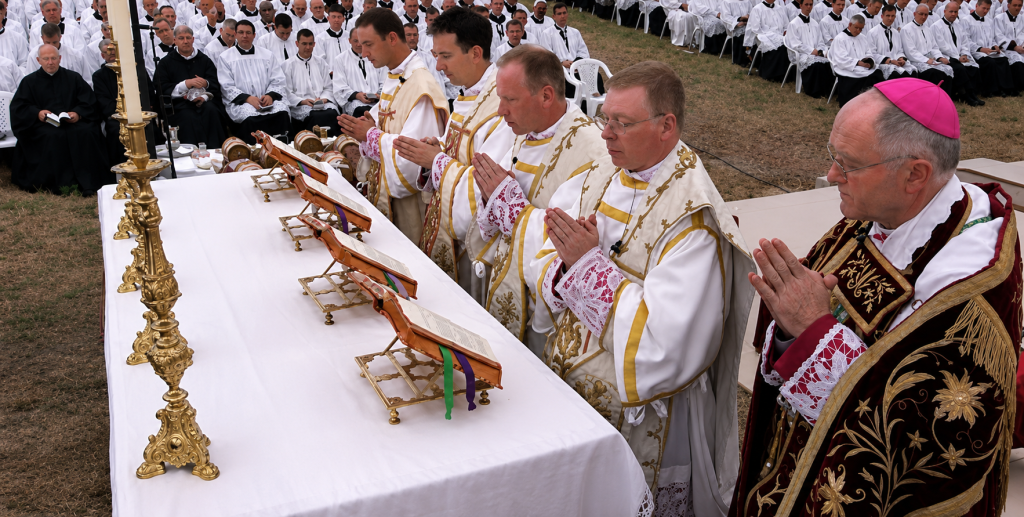
The Vatican has declared that the bishops consecrated by the Society of Saint Pius X in Écône, together with Bishop Alfonso de Galarreta, have incurred latae sententiae excommunication following Wednesday’s episcopal consecrations. The decree also warns clergy and lay faithful against adhering to what it describes as the SSPX’s schism and outlines the canonical consequences for those who do so. The Vatican has declared that the bishops of the Society of Saint Pius X have excommunicated themselves. The day after the episcopal consecrations in Écône, which saw Fr Pascal Schreiber, Fr Michel Poinsinet de Sivry, Fr Marc Hanappier and Fr Michael Goldade consecrated as bishops, the Dicastery for the Doctrine of the Faith released a decree stating: “Notwithstanding the admonitions addressed to the Superior General of the Priestly Fraternity of Saint Pius X, Bishop Alfonso de Galarreta, having performed a schismatic act by means of the episcopal consecration of four priests, without pontifical mandate and against the will of the Supreme Pontiff, has incurred ipso facto the penalties provided for in can. 1387 and can. 1364 §1 CIC 2021.” Signed by Cardinal Fernández, Prefect of the Dicastery for the Doctrine of the Faith, Mons. Armando Matteo, Secretary for the Doctrinal Section, and Archbishop John J. Kennedy, Secretary for the Disciplinary Section, the statement continues: “It is therefore declared, for all legal effects, that the aforementioned Bishop Alfonso de Galarreta, as well as Pascal Schreiber, Michael Goldade, Michel Poinsinet de Sivry, and Marc Hanappier, have incurred ipso facto the penalty of latae sententiae excommunication reserved to the Apostolic See.” The decree goes further than the excommunications declared in 1988 by stating that “clergy and lay faithful are admonished not to adhere to the schism of the Priestly Fraternity of Saint Pius X, lest they incur ipso facto the penalty of latae sententiae excommunication.” Therefore, SSPX faithful also face the possibility of incurring the excommunication declared by Rome. In this instance, the decree has been issued by the Dicastery for the Doctrine of the Faith, whereas in 1988 the document was issued by the Congregation for Bishops. The explanatory note further advises against formal association with the Society among the faithful, stating: “Finally, all the faithful are exhorted to remain steadfast in communion with the Roman Pontiff, with the bishops in communion with him, and with the whole Church (cf. Lumen Gentium , 22; can. 751 CIC), and to abstain from participating in the celebrations and activities promoted by the aforementioned Priestly Fraternity of Saint Pius X.” The explanatory note also raises further questions for SSPX faithful by stating: “It is finally noted that the Holy People of God are informed that the sacred ministers of the Priestly Fraternity of Saint Pius X administer the sacraments and the sacrament of Penance illicitly, and that the marriages assisted by them are invalid.” This relates to the question of jurisdiction, under which confessions and marriages can only be validly and licitly celebrated if the bishop or ordinary has granted the necessary faculties. The explanatory note also reassures those who wish to be fully reconciled with the Church that they will be welcomed “with sincere affection and lively solicitude”. It further states that “the Apostolic Nunciatures will make available the procedures that the Ordinaries may use in the various cases.”
Jul. 2, 2026