

Bishop Robert Barron
The tale of two JD Vances
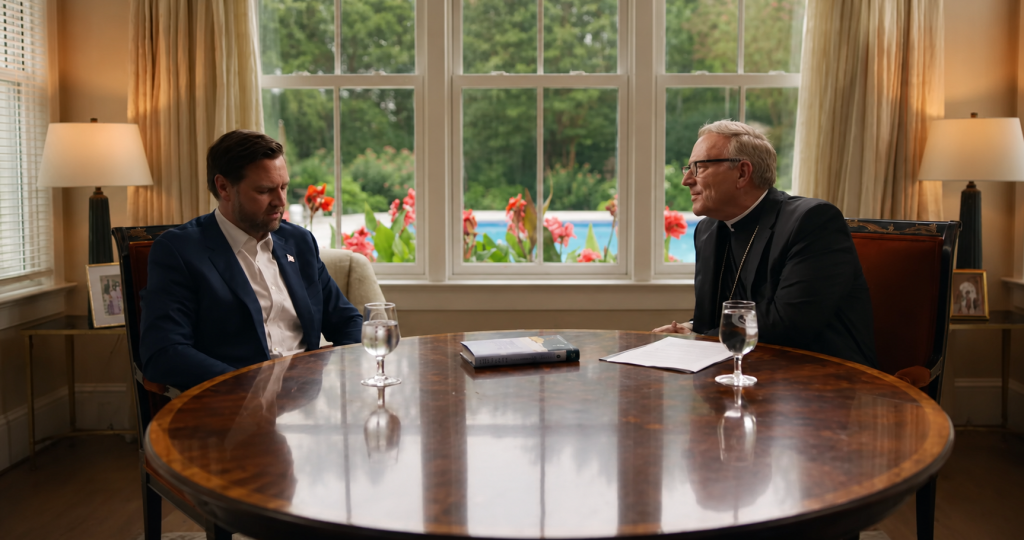
Vice President JD Vance’s interview with Bishop Robert Barron is a study in contrasts. The Catholic convert who speaks thoughtfully about Augustine, René Girard and the spiritual life sits uneasily alongside the Vice President who defends the policies and politics of the Trump administration On Friday, Bishop Robert Barron, founder of Word on Fire and Bishop of the Diocese of Winona–Rochester, sat down with Vice President JD Vance to discuss his new book, Communion: Finding My Way Back to Faith , as well as his political and spiritual journey. The interview is very much a tale of two JD Vances. The first is the man steeped in Augustinian theology whose journey is detailed in his book. The second is the JD Vance of the MAGA movement. This Vance is subservient to an ideology centred around a single man, elevating him above all else. While President Trump is rarely mentioned by name, his presence is felt throughout. At the beginning of the interview, the first Vance is centre stage. Bishop Barron and the Vice President examine the theological influences that have shaped his career, his rejection of the decadence of American elites, and his admiration for René Girard. Together, they tease out a central tenet of Augustinian theology: that right worship of God is the principle from which both successful governments and flourishing individuals flow. It is an interesting discussion, with Vance approaching the subject from the perspective of political philosophy and Bishop Barron drawing upon his pastoral experience. The two then discuss René Girard’s theory of mimetic desire, the idea that human desire is not original but imitative, leading in turn to mimetic rivalry, the hostility that develops as different people come to desire the same thing. Vance eruditely links this to social media and points out that algorithms have spread mimetic desire and therefore mimetic rivalry at a pace not seen before. One of the few occasions on which President Trump is mentioned comes when Bishop Barron asks Vance directly how Trump transformed the Republican Party from the days of Ronald Reagan into what it is today. Vance argues that Trump has brought a “national and community element to economics” and rejected the globalisation associated with the Reagan era. He describes the President’s economic policy as “conventional wisdom”, an assertion that goes unchallenged by Bishop Barron. There is no acknowledgement that this “national and community element to economics” has also been accompanied by higher inflation and military operations in Yemen, Iran, Venezuela, Syria, Iraq, Somalia and Nigeria. An interesting reflection on Vance’s political career comes when the conversation turns to the Munich Security Conference. Bishop Barron reads an extended passage from Communion reflecting on Vance’s attendance at the conference in 2023. Munich has since become a defining feature of his political career. He returned in 2024, sitting on a panel alongside the UK’s David Lammy before either man’s party entered government, and again in 2025 as Vice President, when he delivered a plenary address criticising European leaders for restricting freedom of speech while underestimating the threat posed by Russian totalitarianism. However, his time at the 2023 conference was more contemplative. He writes that those who established the conference in post-war Germany believed they were defending “Western Christian civilization, and the values particular to it”, rather than abstract concepts such as “freedom”, “liberalism” or “democracy”. Vance is right that there was a stronger sense of political Christendom in Europe during this period. However, his assertion in the interview that the “Western alliance was so strong in 1950” is demonstrably false. Leaving aside the Soviet Union, which then encompassed Ukraine, Belarus, Lithuania, Latvia and Estonia, Europe was hardly a model of unity. In 1950, Hungary, Albania, Poland, Romania, Yugoslavia and East Germany were all under communist dictatorships. Munich itself lay in West Germany, which did not regain full sovereignty until 1955. Portugal and Spain were under dictatorships of their own. Europe was in the throes of the Cold War. If there was a unifying factor amongst European nations, it would be communism before Christendom. Interestingly, the conversation then turns to the damaging effect that artificial intelligence is having on young people’s dating lives. Again, the tension between JD Vance the Catholic and JD Vance the member of the Trump administration becomes apparent. The administration has been bullish about AI and resistant of any restrictions on the technology. Speaking at the Paris AI Action Summit in 2025, Vance argued that “to restrict its development now would not only unfairly benefit incumbents in the space, it would mean paralysing one of the most promising technologies we have seen in generations”. In the same speech, he said the Trump administration wanted America to become the AI “gold standard worldwide”. Yet here he laments AI’s damaging effect on real-world relationships. Perhaps the most interesting and coherent section of the interview comes towards the end. Reflecting on his meeting with Pope Francis shortly before the late Pontiff died, Vance says that his subsequent dealings with Cardinal Parolin and Archbishop Paul Gallagher, whom he mistakenly identifies as Irish, left him feeling that “they did not want to move past the diplomatic platitudes”. He continues: “There is an impulse within the Church that is very comfortable in dealing with the highest level of generality, because then it is not challenging to people.” In this, Vance captures much of the generational frustration visible within the Church today. On the one hand is an older clergy that often speaks in abstract terms, hesitant to offer concrete instruction and, in doing so, dilutes the Christian message. On the other is a younger generation seeking clarity and structure, which finds such obsequiousness unappealing and either abandons Christianity altogether or seeks out those rare places where the faith is taught in its fullness. Vance’s analysis also points to Pope Leo XIV, as an American, as a possible antidote to this problem. While the reasons for the ambiguity found in some recent Church teaching cannot be reduced to a single cause, language and culture may well play a role. Pope Francis was steeped in the Romance languages, a native speaker of Spanish and Italian, and never entirely comfortable in English. By contrast, Benedict XVI and John Paul II, both generally associated with a more assertive style of teaching, came from the Germanic and Slavic language traditions respectively and were also fluent English speakers. There is often a greater degree of ambiguity in the Romance languages, whereas the Germanic and Slavic language groups, of which English belongs to the former, generally favour more direct expression. Pope Leo, a native English speaker who also speaks Spanish at a native level, is therefore well placed both to recognise this problem and, perhaps, to address it. The interview closes with a touch of spiritual direction. Vance admits his prayer life is not as he wishes it was and Bishop Baron offers some gentle guidance. He suggests the Vice President carry a sacramental with him in his work life, an encouraging thought for the world. Although the interview contains no major revelations and lacks the memorable moments of Bishop Barron’s interview with Shia LaBeouf, it offers an unusually revealing glimpse into the spiritual life of one of the world’s most influential Catholics. Vance is clearly a man who takes his faith seriously and displays the intellectual curiosity and humility indicative of converts. But he is also limited by being subservient to a president who is neither Catholic nor appears to take Catholicism seriously. Vance approaches politics as a Catholic convert; Trump approaches Catholics as a political constituency. As long as Vance is under Trump, there will always be the tale of two JD Vances. One hopes that, if he is one day rewarded with the higher office, he will be able to shake off the old man and entirely embrace his Catholicism. Having an unencumbered Catholic as leader of the United States could only be a good thing. Image credit: Bishop Robert Barron YouTube
Jul. 20, 2026