

Bishop Of Li Ge
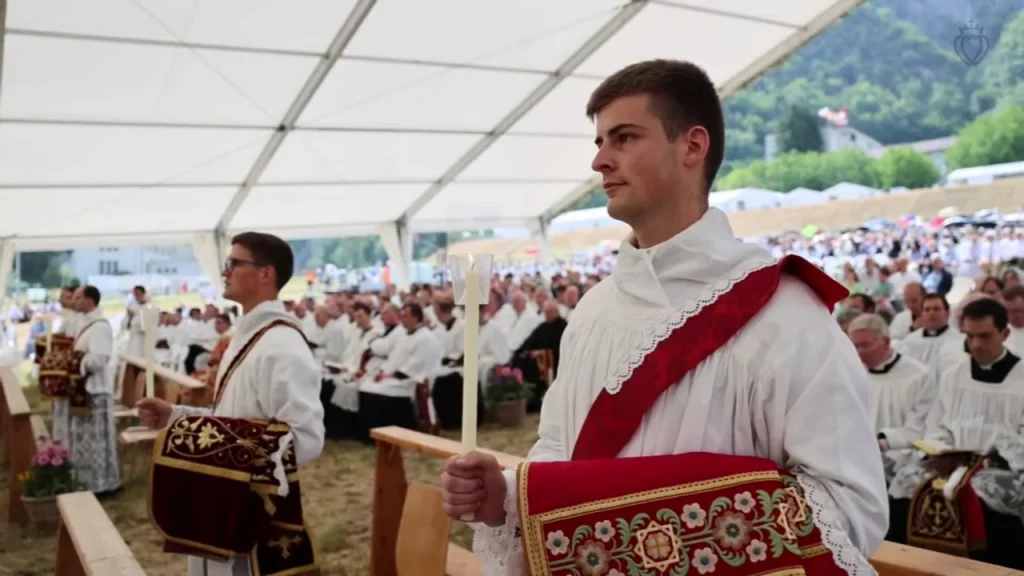
Belgian bishop offers prayers to newly ordained SSPX priest
The Bishop of Liège has offered prayers and encouragement to a newly ordained priest of the Society of Saint Pius X The Bishop of Liège has offered prayers and encouragement to a newly ordained priest of the Society of Saint Pius X (SSPX). In a statement issued after the priestly ordination of Fr Vincent Richter at the SSPX’s International Seminary of Écône in Switzerland on 29 June, the Solemnity of Saints Peter and Paul, Bishop Jean-Pierre Delville of Liège assured the new priest of his prayers and wished him well in the missionary work that now awaits him in Brazil. Fr Richter comes from Steffeshausen, a village within the Diocese of Liège. Although his priestly formation took place within the Society of Saint Pius X rather than under diocesan authority, Bishop Delville chose not to respond with criticism or public condemnation. Instead, his statement expressed personal goodwill towards the new priest, together with a reaffirmation of the Church’s understanding of the origins and present position of the SSPX. The bishop stated that he had been informed of Fr Richter’s ordination in Écône and assured him of his prayers, encouraging him to follow Christ in his future ministry in Brazil. His hope, he said, was that the newly ordained priest would carry out that mission “as an authentic disciple of the Gospel”. While Bishop Delville made no attempt to disguise the reasons for the division, his statement combined pastoral concern for one of his former diocesan faithful with a concise explanation of the theological and ecclesial issues that continue to separate the SSPX from full communion with Rome. The bishop explained that the Society of Saint Pius X brings together Catholics who, following Archbishop Marcel Lefebvre, refused to accept certain decisions of the Second Vatican Council. Importantly, Bishop Delville rejected the suggestion that the council itself abolished the Church’s older liturgical tradition. The declarations of the council, he said, “do not call into question the Latin liturgy in its ancient form”, adding that this was not the cause of the break between Rome and the Society. He also distinguished the SSPX from the Priestly Fraternity of Saint Peter, noting that the latter likewise celebrates the traditional Latin liturgy while fully accepting the teachings of the Second Vatican Council. Bishop Delville observed that Archbishop Lefebvre’s dissent was “not the first in the history of the Church”. Throughout history, he wrote, Catholics have sometimes struggled to understand that fidelity to tradition is not static but living and dynamic. To illustrate that point, the bishop turned to St John Henry Newman, citing the English cardinal’s understanding of the development of doctrine. Newman taught that the Church, “like every living organism, changes in order to remain the same”, while insisting that authentic Christian doctrine does not introduce new revelation but unfolds truths already contained within the deposit of faith. Drawing on Newman’s Essay on the Development of Christian Doctrine , Bishop Delville quoted the saint’s well-known observation that “to live is to change, and to be perfect is to have changed often”. The statement also referred to recent developments within the Society of Saint Pius X itself. Bishop Delville observed that, by ordaining four new bishops on 1 July 2026 without a papal mandate, the fraternity had further deepened what he described as its “dissidence” within the Catholic Church. Yet even in discussing that latest development, the bishop did not advocate isolation. Instead, he insisted that these actions should not prevent Catholics from continuing to seek dialogue with members of the fraternity. “This does not prevent us from seeking dialogue with it,” he wrote, nor from “challenging each other mutually and establishing fraternal relations.”
Jul. 9, 2026