

Bishop Michael Martin
Published in full: Cardinal Roche receives recourse from Charlotte father after family says Communion was denied at altar rail
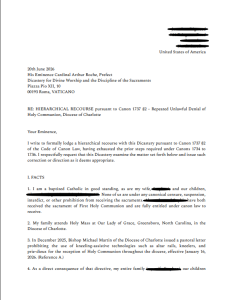
Cardinal Arthur Roche has received a formal recourse from a Charlotte father whose family says it was repeatedly denied Holy Communion after kneeling at an altar rail. AdVaticanum is publishing the appeal in full Cardinal Arthur Roche has received a letter of hierarchical recourse from a North Carolina father whose family claims it was repeatedly denied Holy Communion because they knelt at an altar rail, in a dispute arising from Bishop Michael Martin’s restrictions on kneeling for Communion in the Diocese of Charlotte. The appeal, submitted to the Dicastery for Divine Worship and the Discipline of the Sacraments on 20 June, is the latest development in a controversy that has been building for months at Our Lady of Grace parish in Greensboro, where tensions have intensified since diocesan restrictions on altar rails, kneelers and prie-dieux came into force earlier this year. The father, who filed the recourse without a canonical advocate, says that he, his wife and their two children were denied Holy Communion on three occasions after kneeling at the parish altar rail. The family also alleges that a similar incident occurred during a Confirmation Mass attended by Bishop Martin on 29 April. Speaking to AdVaticanum after the incident, the father described what happened when his family approached the rail during the liturgy. “He [Bishop Martin] was sitting in front of us when we went to the rail and he simply ignored us. All the priests turned their backs on us,” he said. He later added: “Everyone else communicated and we were denied. To be frank, it was very humiliating.” A letter of hierarchical recourse is a formal administrative appeal in Catholic canon law that allows clergy, religious or lay faithful who believe themselves aggrieved by a lower ecclesiastical authority’s decision to seek redress from that authority’s hierarchical superior. The recourse sent to Cardinal Roche opens by identifying the family and setting out their canonical status. The father states that he, his wife and children are all Catholics in good standing and emphasises that none is subject to any censure or prohibition preventing them from receiving the sacraments. “I am a baptized Catholic in good standing, as are my wife and our children,” he wrote. “None of us are under any canonical censure, suspension, interdict, or other prohibition from receiving the sacraments.” The appeal then traces the dispute back to a pastoral letter issued by Bishop Martin in December 2025, which prohibited the use of what the recourse describes as “kneeling-assistive technologies such as altar rails, kneelers, and prie-dieux” throughout the diocese from 16 January 2026. According to the father, the consequences of that directive became apparent at Our Lady of Grace when his family continued to approach Holy Communion in the same manner they had done for years. The recourse states that on 30 April, 10 May and 17 May the family approached the minister of Holy Communion and knelt at the altar rail before being passed over. “On each occasion, the minister declined to administer the Sacrament,” the document states. A significant portion of the appeal is devoted to rebutting any suggestion that the family failed to present themselves properly for Communion. “I wish to state formally and, for the avoidance of doubt: my family presented itself for Holy Communion on each of the three occasions listed above,” the father wrote. “The suggestion that we had not done so, or that the manner of our presentation was insufficient to constitute a request for the Sacrament, is without foundation.” He argues that kneeling at the altar rail had been the established practice at the parish for more than five years and that no communicant had previously been considered not to have presented himself for Communion while approaching in that manner. The appeal also raises concerns about the position of his wife, who is pregnant with the couple’s third child. The father tells Cardinal Roche that as the pregnancy progresses she will become increasingly dependent on physical support when rising from a kneeling position, and argues that the removal of altar rails and similar supports creates a practical obstacle to her continuing customary devotional practice. “I note with particular gravity that my wife is currently in her second trimester of pregnancy,” he wrote. “As her pregnancy advances, she will be physically unable to rise from a kneeling position without the assistance of the now banned kneeling-assistive technologies.” The recourse details the procedural steps taken before the matter reached Rome. The father says he submitted a written petition to Bishop Martin on 1 June seeking revocation or amendment of the policy. According to the document, the Diocese of Charlotte rejected the request on 4 June and subsequently informed him on 15 June that the policy would continue to be enforced. Having exhausted the remedies required under Canons 1734 to 1736, he lodged the present recourse under Canon 1737 §2. The appeal cites several provisions of canon law and liturgical legislation which it says are relevant to the dispute. Among them are Canon 912, which states that any baptised person not prohibited by law can and must be admitted to Holy Communion, and Canon 843 §1, which provides that sacred ministers may not deny the sacraments to those who seek them at appropriate times, are properly disposed and are not prohibited by law from receiving them. The father also points Cardinal Roche to Article 91 of Redemptionis Sacramentum , which states: “Therefore, it is not licit to deny Holy Communion to any of Christ’s faithful solely on the grounds, for example, that the person wishes to receive the Eucharist kneeling or standing.” The appeal additionally cites the American adaptation of the General Instruction of the Roman Missal , noting that although Communion is normally received standing, “Communicants should not be denied Holy Communion because they kneel.” Particular emphasis is placed on a 2002 response from the Congregation for Divine Worship and the Discipline of the Sacraments. “The Congregation considers any refusal of Holy Communion to a member of the faithful on the basis of his or her kneeling posture to be a grave violation of one of the most basic rights of the Christian faithful,” the document quotes. In the concluding sections of the recourse, the father argues that the dispute now extends beyond his own family and risks causing wider division within the diocese. “The faithful of the Diocese of Charlotte are, in great numbers, deeply devoted to the posture of kneeling before Our Lord in His Eucharist,” he wrote. “If left unresolved, this conflict is likely to cause lasting damage to the unity and peace of the local Church.” The father asks Cardinal Roche to acknowledge receipt of the recourse, suspend Bishop Martin’s directive while the case is considered, examine whether the denials of Holy Communion violated canon law, and direct that Holy Communion not be withheld solely because a communicant chooses to kneel. The Dicastery for Divine Worship and the Discipline of the Sacraments has not yet announced whether it will accept the recourse for formal examination. The letter is reproduced in full below:
Jun. 22, 2026
Bishop of the Diocese of Charlotte refuses communion to family at altar rail
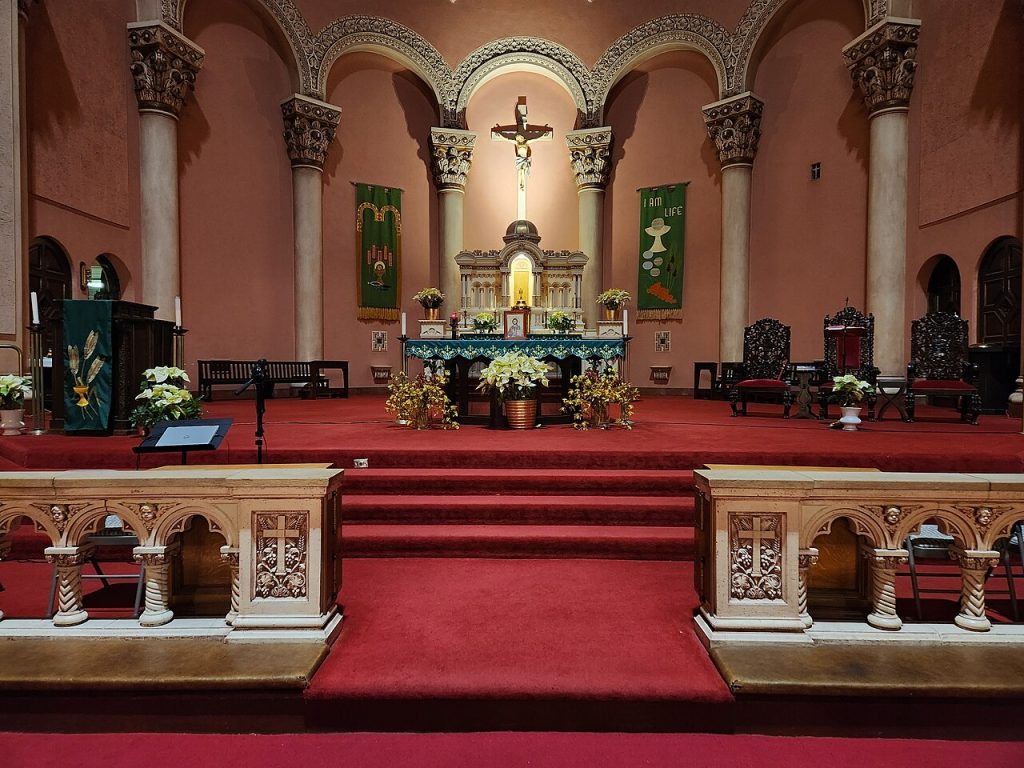
A Catholic family in North Carolina claims they were refused Holy Communion after approaching the altar rail during a Confirmation Mass, according to a report from the Diocese Bishop Michael Martin of Charlotte has refused Holy Communion to a Catholic family who approached the altar rail during a Confirmation Mass. The incident took place on April 29 at Our Lady of Grace parish in Greensboro, North Carolina. While the Confirmation ceremony took place as usual, during Communion only two or three families approached the altar rail to receive the Eucharist. One father who brought his family said to AdVaticanum: “He was sitting in front of us when we went to the rail and he simply ignored us. All the priests turned their backs on us,” he said. “Everyone else communicated and we were denied. To be frank, it was very humiliating.” The same witness said that while the wider congregation received Communion, those kneeling at the rail were passed over. Attempts were made to speak to Bishop Martin about incident after the Confirmation Mass, but he did not respond in detail. Photo taken from the confirmation Mass. Submitted anonymously. The claim comes amid the current liturgical dispute in the Diocese of Charlotte. Bishop Martin has introduced norms governing the reception of Holy Communion, emphasising that the “normative posture” in the United States is to receive standing, following a bow of the head. The controversy unfolds alongside involvement from the Dicastery for Divine Worship and the Discipline of the Sacraments, which has acknowledged receipt of a formal “hierarchical recourse” concerning Bishop Michael Martin’s handling of liturgical matters in the Diocese of Charlotte. In a letter dated February 16 and signed by Fr Pierre Paul, the dicastery confirmed that the case had been registered under protocol number 369/25 and would be examined in accordance with canonical procedures. The acknowledgement signifies that the Holy See has formally taken cognisance of the complaint, although such steps are procedural and do not in themselves indicate that any corrective action will follow. Previously, in a pastoral letter issued on December 17, he wrote, “The liturgy of the Church is the work of God and the work on behalf of God in the life of the Church. These norms for our diocese move us together towards the Church’s vision for the fuller and more active participation of the faithful.” In this pastoral letter of December 17, Bishop Michael Martin set out specific norms concerning the manner of receiving Holy Communion in the Diocese of Charlotte, including explicit reference to altar rails. He added that “our unity as believers in Holy Communion is expressed through our postures and gestures that reflect our mystical communion and unity as fellow believers,” stressing that the Eucharist is “a communal act of worship, not only an individual act of piety.” The same directive instructed parishes that had reintroduced altar rails or kneelers for the distribution of Communion to discontinue the practice and remove any such furnishings, describing them as “a visible contradiction” of the prescribed norm. It stated that Holy Communion should be received as the faithful “go in procession, witnessing that the Church journeys forward and receives Holy Communion as a pilgrim people on their way.” At the same time, the bishop’s letter reiterated that individuals are not to be denied Holy Communion on the basis of posture, even if they choose to kneel. “Clergy and catechists,” he wrote, “are to instruct communicants according to the normative posture in the United States” and “are not to teach that some other manner is better, preferred, more efficacious, etc.” AdVaticanum asked the diocese for comment, but at the time of publication it has not responded.
Apr. 29, 2026