

75th Anniversary Of Pope Benedict Xvi S Priestly Ordination
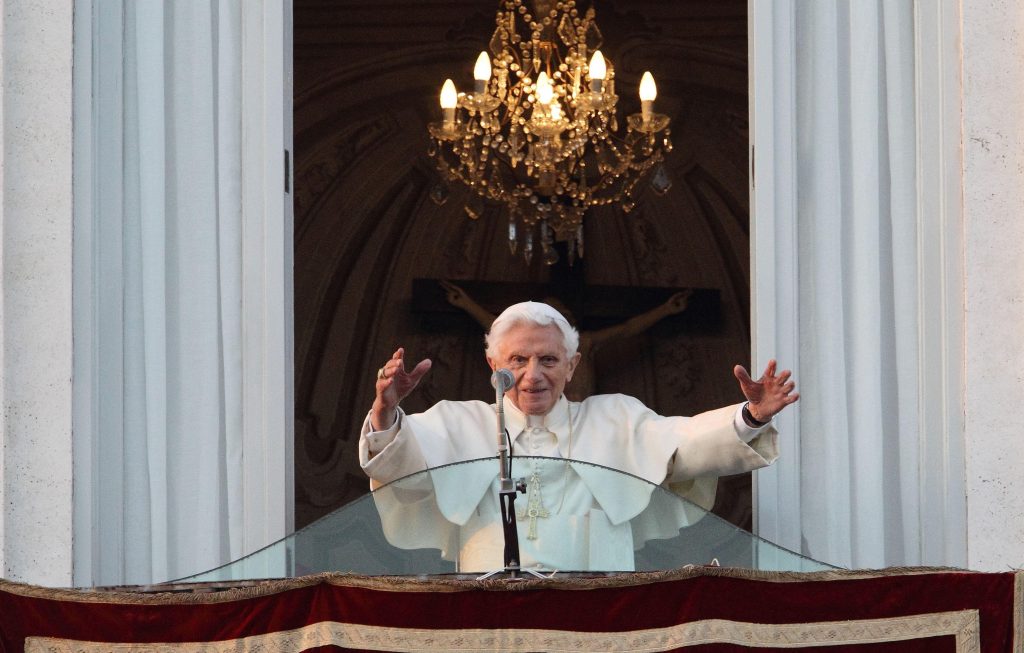
A novena of Benedict XVI’s greatest homilies and addresses, day 8: the Farewell Address at the General Audience
Day eight of our novena marking the 75th anniversary of Pope Benedict XVI’s priestly ordination features his Farewell Address at his final General Audience, delivered on 27 February 2013 To mark the 75th anniversary of Pope Benedict XVI’s priestly ordination, AdVaticanum is publishing a nine-day novena of some of the most important homilies and addresses of his public life. Today we publish Pope Benedict XVI’s Farewell Address at his final General Audience, delivered in St Peter’s Square on 27 February 2013, the day before his resignation took effect. Before tens of thousands of pilgrims gathered in the square, Benedict reflected on the years of his pontificate, thanking the faithful for accompanying him with their prayers and assuring them that he had always sought to follow the will of God. He spoke of the Church as belonging to Christ rather than any individual Pope and entrusted her future confidently to the Lord. The address stands as one of the most personal moments of Benedict’s public ministry, revealing the humility and serenity that characterised his final days as Supreme Pontiff. Venerable Brothers in the Episcopate and in the Presbyterate! Distinguished Authorities! Dear Brothers and Sisters! I thank all of you for having come in such great numbers to this last General Audience. Heartfelt thanks! I am truly moved and I see the Church alive! And I think we should also says thanks to the Creator for the fine weather which he gives us even on this winter day. Like the Apostle Paul in the biblical text which we have heard, I too feel a deep need first and foremost to thank God, who gives guidance and growth to the Church, who sows his word and thus nourishes faith in his people. At this moment my heart expands and embraces the whole Church throughout the world; and I thank God for all that I have “heard” in these years of the Petrine ministry about the faith in the Lord Jesus Christ and the love which truly circulates in the Body of the Church and makes it live in love, and about the hope which opens and directs us towards the fullness of life, towards our heavenly homeland. I feel that I bear everyone in prayer, in a present, God’s present, in which I gather together every one of my meetings, journeys and pastoral visits. In prayer I gather each and all, in order to entrust them to the Lord: that we might be filled with the knowledge of his will, with all spiritual wisdom and understanding, and that we might lead a life worthy of him and of his love, bearing fruit in every good work (cf. Col 1:9-10). At this moment I feel great confidence, because I know, we all know, that the Gospel word of truth is the Church’s strength, it is her life. The Gospel purifies and renews, it bears fruit, wherever the community of believers hears it and receives God’s grace in truth and charity. This is my confidence, this is my joy. When on 19 April nearly eight years ago I accepted the Petrine ministry, I had the firm certainty that has always accompanied me: this certainty of the life of the Church which comes from the word of God. At that moment, as I have often said, the words which echoed in my heart were: Lord, why are you asking this of me, and what is it that you are asking of me? It is a heavy burden which you are laying on my shoulders, but if you ask it of me, at your word I will cast the net, sure that you will lead me even with all my weaknesses. And eight years later I can say that the Lord has truly led me, he has been close to me, I have been able to perceive his presence daily. It has been a portion of the Church’s journey which has had its moments of joy and light, but also moments which were not easy; I have felt like Saint Peter with the Apostles in the boat on the Sea of Galilee: the Lord has given us so many days of sun and of light winds, days when the catch was abundant; there were also moments when the waters were rough and the winds against us, as throughout the Church’s history, and the Lord seemed to be sleeping. But I have always known that the Lord is in that boat, and I have always known that the barque of the Church is not mine but his. Nor does the Lord let it sink; it is he who guides it, surely also through those whom he has chosen, because he so wished. This has been, and is, a certainty which nothing can shake. For this reason my heart todays overflows with gratitude to God, for he has never let his Church, or me personally, lack his consolation, his light, his love. We are in the Year of Faith which I desired precisely to reaffirm our faith in God in a context which seems to push him more and more into the background. I should like to invite all of us to renew our firm confidence in the Lord, to entrust ourselves like children in God’s arms, certain that those arms always hold us, enabling us to press forward each day, even when the going is rough. I want everyone to feel loved by that God who gave his Son for us and who has shown us his infinite love. I want everyone to feel the joy of being a Christian. In one beautiful morning prayer, it says: “I adore you, my God, and I love you with all my heart. I thank you for having created me and made me a Christian…”. Yes, we are happy for the gift of faith; it is our most precious possession, which no one can take from us! Let us thank the Lord for this daily, in prayer and by a consistent Christian life. God loves us, but he also expects us to love him! But it is not only God whom I want to thank at this moment. The Pope is not alone in guiding the barque of Peter, even if it is his first responsibility. I have never felt alone in bearing the joy and the burden of the Petrine ministry; the Lord has set beside me so many people who, with generosity and love for God and the Church, have helped me and been close to me. Above all you, dear brother Cardinals: your wisdom, your counsel and your friendship have been invaluable to me; my co-workers, beginning with my Secretary of State who has faithfully accompanied me in these years; the Secretariat of State and the whole Roman Curia, as well as all those who in various sectors offer their service to the Holy See: many, many unseen faces which remain in the background, but precisely through their silent, daily dedication in a spirit of faith and humility they have been a sure and trustworthy support to me. I also think in a special way of the Church of Rome, my Diocese! I cannot forget my Brothers in the Episcopate and in the Presbyterate, the consecrated persons and the entire People of God: in my pastoral visits, meetings, audiences and journeys I have always felt great kindness and deep affection; yet I too have felt affection for each and all without distinction, with that pastoral charity which is the heart of every Pastor, and especially of the Bishop of Rome, the Successor of the Apostle Peter. Every day I have borne each of you in prayer, with the heart of a father. I would like my greeting and my thanksgiving to extend to everyone: the heart of the Pope reaches out to the whole world. And I wish to express my gratitude to the Diplomatic Corps accredited to the Holy See which represents the great family of the nations. Here I think too of all those who work for good communications and I thank them for their important service. At this point, I would also like to thank most heartily all those people throughout the world who in these recent weeks have sent me moving expressions of concern, friendship and prayer. Yes, the Pope is never alone; now I once again experience this so overwhelmingly that my heart is touched. The Pope belongs to everyone and so many persons feel very close to him. It is true that I receive letters from world leaders – from heads of state, from religious leaders, from representatives of the world of culture, and so on. But I also receive many many letters from ordinary people who write to me simply and from the heart, and who show me their affection, an affection born of our being together with Christ Jesus, in the Church. These people do not write to me in the way one writes, for example, to a prince or some important person whom they do not know. They write to me as brothers and sisters, as sons and daughters, with a sense of a very affectionate family bond. Here one can sense palpably what the Church is – not an organization, an association for religious or humanitarian ends, but a living body, a communion of brothers and sisters in the Body of Christ, which makes us all one. To experience the Church in this way and to be able as it were to put one’s finger on the strength of her truth and her love, is a cause for joy at a time when so many people are speaking of her decline. But we see how the Church is alive today! In these last months I have felt my energies declining, and I have asked God insistently in prayer to grant me his light and to help me make the right decision, not for my own good, but for the good of the Church. I have taken this step with full awareness of its gravity and even its novelty, but with profound interior serenity. Loving the Church means also having the courage to make difficult, painful decisions, always looking to the good of the Church and not of oneself. Here, allow me to go back once again to 19 April 2005. The real gravity of the decision was also due to the fact that from that moment on I was engaged always and forever by the Lord. Always – anyone who accepts the Petrine ministry no longer has any privacy. He belongs always and completely to everyone, to the whole Church. In a manner of speaking, the private dimension of his life is completely eliminated. I was able to experience, and I experience it even now, that one receives one’s life precisely when one gives it away. Earlier I said that many people who love the Lord also love the Successor of Saint Peter and feel great affection for him; that the Pope truly has brothers and sisters, sons and daughters, throughout the world, and that he feels secure in the embrace of your communion; because he no longer belongs to himself, he belongs to all and all belong to him. The “always” is also a “for ever” – there can no longer be a return to the private sphere. My decision to resign the active exercise of the ministry does not revoke this. I do not return to private life, to a life of travel, meetings, receptions, conferences, and so on. I am not abandoning the cross, but remaining in a new way at the side of the crucified Lord. I no longer bear the power of office for the governance of the Church, but in the service of prayer I remain, so to speak, in the enclosure of Saint Peter. Saint Benedict, whose name I bear as Pope, will be a great example for me in this. He showed us the way for a life which, whether active or passive, is completely given over to the work of God. I also thank each and every one of you for the respect and understanding with which you have accepted this important decision. I will continue to accompany the Church’s journey with prayer and reflection, with that devotion to the Lord and his Bride which I have hitherto sought to practise daily and which I would like to practise always. I ask you to remember me in prayer before God, and above all to pray for the Cardinals, who are called to so weighty a task, and for the new Successor of the Apostle Peter: may the Lord accompany him with the light and strength of his Spirit. Let us call upon the maternal intercession of the Virgin Mary, Mother of God and Mother of the Church, that she may accompany each of us and the whole ecclesial community; to her let us commend ourselves with deep confidence. Dear friends! God guides his Church, he sustains it always, especially at times of difficulty. Let us never lose this vision of faith, which is the one true way of looking at the journey of the Church and of the world. In our hearts, in the heart of each of you, may there always abide the joyful certainty that the Lord is at our side: he does not abandon us, he remains close to us and he surrounds us with his love. Thank you!
Jun. 28, 2026
A novena of Benedict XVI’s greatest homilies and addresses, day 7: Homily for the Opening of the Year of Faith
Day seven of our novena marking the 75th anniversary of Pope Benedict XVI’s priestly ordination features his homily for the Opening of the Year of Faith. Preached on the 50th anniversary of the opening of the Second Vatican Council, Benedict called Catholics to rediscover the gift of faith and proclaim the Gospel with renewed confidence To mark the 75th anniversary of Pope Benedict XVI’s priestly ordination, AdVaticanum is publishing a nine-day novena of some of the most important homilies and addresses of his public life. Today we publish Pope Benedict XVI’s homily for the Opening of the Year of Faith, delivered during Holy Mass in St Peter’s Square on 11 October 2012, the 50th anniversary of the opening of the Second Vatican Council. In his homily, Benedict reflected on the need for a renewed proclamation of the Gospel in an increasingly secularised world. He urged Catholics to rediscover the gift of faith, presenting it not as a private conviction but as a living encounter with Jesus Christ capable of transforming both individuals and society. The homily set the tone for the Year of Faith, which Benedict established to encourage a deeper understanding of the Church’s teaching and a renewed commitment to Christian witness. Dear Brother Bishops, Dear brothers and sisters! Today, fifty years from the opening of the Second Vatican Ecumenical Council , we begin with great joy the Year of Faith . I am delighted to greet all of you, particularly His Holiness Bartholomaois I, Patriarch of Constantinople, and His Grace Rowan Williams, Archbishop of Canterbury. A special greeting goes to the Patriarchs and Major Archbishops of the Eastern Catholic Churches, and to the Presidents of the Bishops’ Conferences. In order to evoke the Council, which some present had the grace to experience for themselves – and I greet them with particular affection – this celebration has been enriched by several special signs: the opening procession, intended to recall the memorable one of the Council Fathers when they entered this Basilica; the enthronement of the Book of the Gospels with the same book that was used at the Council; the consignment of the seven final Messages of the Council, and of the Catechism of the Catholic Church, which I will do before the final blessing. These signs help us not only to remember, they also offer us the possibility of going beyond commemorating. They invite us to enter more deeply into the spiritual movement which characterized Vatican II, to make it ours and to develop it according to its true meaning. And its true meaning was and remains faith in Christ, the apostolic faith, animated by the inner desire to communicate Christ to individuals and all people, in the Church’s pilgrimage along the pathways of history. The Year of Faith which we launch today is linked harmoniously with the Church’s whole path over the last fifty years: from the Council, through the Magisterium of the Servant of God Paul VI , who proclaimed a Year of Faith in 1967, up to the Great Jubilee of the year 2000, with which Blessed John Paul II re-proposed to all humanity Jesus Christ as the one Saviour, yesterday, today and forever. Between these two Popes, Paul VI and John Paul II, there was a deep and complete convergence, precisely upon Christ as the centre of the cosmos and of history, and upon the apostolic eagerness to announce him to the world. Jesus is the centre of the Christian faith. The Christian believes in God whose face was revealed by Jesus Christ. He is the fulfilment of the Scriptures and their definitive interpreter. Jesus Christ is not only the object of the faith but, as it says in the Letter to the Hebrews, he is “the pioneer and the perfecter of our faith” (12:2). Today’s Gospel tells us that Jesus Christ, consecrated by the Father in the Holy Spirit, is the true and perennial subject of evangelization. “The Spirit of the Lord is upon me, because he has anointed me to preach the good news to the poor” (Lk 4:18). This mission of Christ, this movement of his continues in space and time, over centuries and continents. It is a movement which starts with the Father and, in the power of the Spirit, goes forth to bring the good news to the poor, in both a material and a spiritual sense. The Church is the first and necessary instrument of this work of Christ because it is united to him as a body to its head. “As the Father has sent me, even so I send you” (Jn 20:21), says the Risen One to his disciples, and breathing upon them, adds, “Receive the Holy Spirit” (v.22). Through Christ, God is the principal subject of evangelization in the world; but Christ himself wished to pass on his own mission to the Church; he did so, and continues to do so, until the end of time pouring out his Spirit upon the disciples, the same Spirit who came upon him and remained in him during all his earthly life, giving him the strength “to proclaim release to the captives and recovering of sight to the blind, to set at liberty those who are oppressed” and “to proclaim the acceptable year of the Lord” (Lk 4:18-19). The Second Vatican Council did not wish to deal with the theme of faith in one specific document. It was, however, animated by a desire, as it were, to immerse itself anew in the Christian mystery so as to re-propose it fruitfully to contemporary man. The Servant of God Paul VI , two years after the end of the Council session, expressed it in this way: “Even if the Council does not deal expressly with the faith, it talks about it on every page, it recognizes its vital and supernatural character, it assumes it to be whole and strong, and it builds upon its teachings. We need only recall some of the Council’s statements in order to realize the essential importance that the Council, consistent with the doctrinal tradition of the Church, attributes to the faith, the true faith, which has Christ for its source and the Church’s Magisterium for its channel” (General Audience, 8 March 1967). Thus said Paul VI in 1967. We now turn to the one who convoked the Second Vatican Council and inaugurated it: Blessed John XXIII . In his opening speech, he presented the principal purpose of the Council in this way: “What above all concerns the Ecumenical Council is this: that the sacred deposit of Christian doctrine be safeguarded and taught more effectively […] Therefore, the principal purpose of this Council is not the discussion of this or that doctrinal theme… a Council is not required for that… [but] this certain and immutable doctrine, which is to be faithfully respected, needs to be explored and presented in a way which responds to the needs of our time” (AAS 54 [1962], 790,791-792). So said Pope John at the inauguration of the Council. In the light of these words, we can understand what I myself felt at the time: during the Council there was an emotional tension as we faced the common task of making the truth and beauty of the faith shine out in our time, without sacrificing it to the demands of the present or leaving it tied to the past: the eternal presence of God resounds in the faith, transcending time, yet it can only be welcomed by us in our own unrepeatable today. Therefore I believe that the most important thing, especially on such a significant occasion as this, is to revive in the whole Church that positive tension, that yearning to announce Christ again to contemporary man. But, so that this interior thrust towards the new evangelization neither remain just an idea nor be lost in confusion, it needs to be built on a concrete and precise basis, and this basis is the documents of the Second Vatican Council , the place where it found expression. This is why I have often insisted on the need to return, as it were, to the “letter” of the Council – that is to its texts – also to draw from them its authentic spirit, and why I have repeated that the true legacy of Vatican II is to be found in them. Reference to the documents saves us from extremes of anachronistic nostalgia and running too far ahead, and allows what is new to be welcomed in a context of continuity. The Council did not formulate anything new in matters of faith, nor did it wish to replace what was ancient. Rather, it concerned itself with seeing that the same faith might continue to be lived in the present day, that it might remain a living faith in a world of change. If we place ourselves in harmony with the authentic approach which Blessed John XXIII wished to give to Vatican II, we will be able to realize it during this Year of Faith , following the same path of the Church as she continuously endeavours to deepen the deposit of faith entrusted to her by Christ. The Council Fathers wished to present the faith in a meaningful way; and if they opened themselves trustingly to dialogue with the modern world it is because they were certain of their faith, of the solid rock on which they stood. In the years following, however, many embraced uncritically the dominant mentality, placing in doubt the very foundations of the deposit of faith, which they sadly no longer felt able to accept as truths. If today the Church proposes a new Year of Faith and a new evangelization, it is not to honour an anniversary, but because there is more need of it, even more than there was fifty years ago! And the reply to be given to this need is the one desired by the Popes, by the Council Fathers and contained in its documents. Even the initiative to create a Pontifical Council for the promotion of the new evangelization , which I thank for its special effort for the Year of Faith , is to be understood in this context. Recent decades have seen the advance of a spiritual “desertification”. In the Council’s time it was already possible from a few tragic pages of history to know what a life or a world without God looked like, but now we see it every day around us. This void has spread. But it is in starting from the experience of this desert, from this void, that we can again discover the joy of believing, its vital importance for us, men and women. In the desert we rediscover the value of what is essential for living; thus in today’s world there are innumerable signs, often expressed implicitly or negatively, of the thirst for God, for the ultimate meaning of life. And in the desert people of faith are needed who, with their own lives, point out the way to the Promised Land and keep hope alive. Living faith opens the heart to the grace of God which frees us from pessimism. Today, more than ever, evangelizing means witnessing to the new life, transformed by God, and thus showing the path. The first reading spoke to us of the wisdom of the wayfarer (cf. Sir 34:9-13): the journey is a metaphor for life, and the wise wayfarer is one who has learned the art of living, and can share it with his brethren – as happens to pilgrims along the Way of Saint James or similar routes which, not by chance, have again become popular in recent years. How come so many people today feel the need to make these journeys? Is it not because they find there, or at least intuit, the meaning of our existence in the world? This, then, is how we can picture the Year of Faith , a pilgrimage in the deserts of today’s world, taking with us only what is necessary: neither staff, nor bag, nor bread, nor money, nor two tunics – as the Lord said to those he was sending out on mission (cf. Lk 9:3), but the Gospel and the faith of the Church, of which the Council documents are a luminous expression, as is the Catechism of the Catholic Church, published twenty years ago. Venerable and dear Brothers, 11 October 1962 was the Feast of Mary Most Holy, Mother of God. Let us entrust to her the Year of Faith , as I did last week when I went on pilgrimage to Loreto. May the Virgin Mary always shine out as a star along the way of the new evangelization. May she help us to put into practice the Apostle Paul’s exhortation, “Let the word of Christ dwell in you richly, teach and admonish one another in all wisdom […] And whatever you do, in word or deed, do everything in the name of the Lord Jesus, giving thanks to God the Father through him” (Col 3:16-17). Amen.
Jun. 27, 2026
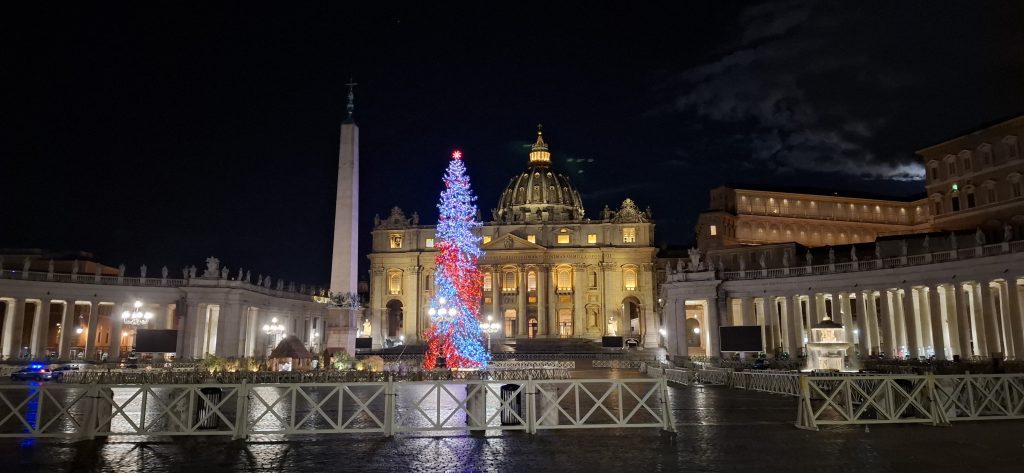
A novena of Benedict XVI’s greatest homilies and addresses, day 6: the 2012 Christmas Address to the Roman Curia
Day six of our novena marking the 75th anniversary of Pope Benedict XVI’s priestly ordination features his 2012 Christmas Address to the Roman Curia To mark the 75th anniversary of Pope Benedict XVI’s priestly ordination, AdVaticanum is publishing a nine-day novena of some of the most important homilies and addresses of his public life. Today we publish Pope Benedict XVI’s Christmas Address to the Roman Curia, delivered on 21 December 2012. In what would be his final Christmas address before his resignation, Benedict reflected on some of the principal challenges facing the Church and society. Returning to themes that had shaped his pontificate, he addressed the relationship between faith and reason, the interpretation of the Second Vatican Council and the growing tendency to separate human freedom from the order of creation. Delivered just weeks before he announced his resignation, the address offers one of the clearest summaries of Benedict’s theological vision and his understanding of the challenges confronting the Church in the modern world. Dear Cardinals, Brother Bishops and Priests, Dear Brothers and Sisters, It is with great joy that I meet you today, dear Members of the College of Cardinals, Representatives of the Roman Curia and the Governorate, for this traditional event in the days leading up to the feast of Christmas. I greet each one of you cordially, beginning with Cardinal Angelo Sodano, whom I thank for his kind words and for the warm good wishes that he extended to me on behalf of all present. The Dean of the College of Cardinals reminded us of an expression that appears frequently during these days in the Latin liturgy: Prope est iam Dominus, venite, adoremus! The Lord is already near, come, let us adore him! We too, as one family, prepare ourselves to adore the Child in the stable at Bethlehem who is God himself and has come so close as to become a man like us. I willingly reciprocate your good wishes and I thank all of you from my heart, including the Papal Representatives all over the world, for the generous and competent assistance that each of you offers me in my ministry. Once again we find ourselves at the end of a year that has seen all kinds of difficult situations, important questions and challenges, but also signs of hope, both in the Church and in the world. I shall mention just a few key elements regarding the life of the Church and my Petrine ministry. First of all, as the Dean of the College of Cardinals mentioned, there were the journeys to Mexico and Cuba – unforgettable encounters with the power of faith, so deeply rooted in human hearts, and with the joie de vivre that issues from faith. I recall how, on my arrival in Mexico, there were endless crowds of people lining the long route, cheering and waving flags and handkerchiefs. I recall how, on the journey to the attractive provincial capital Guanajuato, there were young people respectfully kneeling by the side of the road to receive the blessing of Peter’s Successor; I recall how the great liturgy beside the statue of Christ the King made Christ’s kingship present among us – his peace, his justice, his truth. All this took place against the backdrop of the country’s problems, afflicted as it is by many different forms of violence and the hardships of economic dependence. While these problems cannot be solved simply by religious fervour, neither can they be solved without the inner purification of hearts that issues from the power of faith, from the encounter with Jesus Christ. And then there was Cuba – here too there were great liturgical celebrations, in which the singing, the praying and the silence made tangibly present the One that the country’s authorities had tried for so long to exclude. That country’s search for a proper balancing of the relationship between obligations and freedom cannot succeed without reference to the basic criteria that mankind has discovered through encounter with the God of Jesus Christ. As further key moments in the course of the year, I should like to single out the great Meeting of Families in Milan and the visit to Lebanon, where I consigned the Post-Synodal Apostolic Exhortation that is intended to offer signposts for the life of churches and society in the Middle East along the difficult paths of unity and peace. The last major event of the year was the Synod on the New Evangelization, which also served as a collective inauguration of the Year of Faith, in which we commemorate the opening of the Second Vatican Council fifty years ago, seeking to understand it anew and appropriate it anew in the changed circumstances of today. All these occasions spoke to fundamental themes of this moment in history: the family (Milan), serving peace in the world and dialogue among religions (Lebanon) and proclaiming the message of Jesus Christ in our day to those who have yet to encounter him and to the many who know him only externally and hence do not actually recognize him. Among these broad themes, I should like to focus particularly on the theme of the family and the nature of dialogue, and then to add a brief observation on the question of the new evangelization. The great joy with which families from all over the world congregated in Milan indicates that, despite all impressions to the contrary, the family is still strong and vibrant today. But there is no denying the crisis that threatens it to its foundations – especially in the western world. It was noticeable that the Synod repeatedly emphasized the significance, for the transmission of the faith, of the family as the authentic setting in which to hand on the blueprint of human existence. This is something we learn by living it with others and suffering it with others. So it became clear that the question of the family is not just about a particular social construct, but about man himself – about what he is and what it takes to be authentically human. The challenges involved are manifold. First of all there is the question of the human capacity to make a commitment or to avoid commitment. Can one bind oneself for a lifetime? Does this correspond to man’s nature? Does it not contradict his freedom and the scope of his self-realization? Does man become himself by living for himself alone and only entering into relationships with others when he can break them off again at any time? Is lifelong commitment antithetical to freedom? Is commitment also worth suffering for? Man’s refusal to make any commitment – which is becoming increasingly widespread as a result of a false understanding of freedom and self-realization as well as the desire to escape suffering – means that man remains closed in on himself and keeps his “I” ultimately for himself, without really rising above it. Yet only in self-giving does man find himself, and only by opening himself to the other, to others, to children, to the family, only by letting himself be changed through suffering, does he discover the breadth of his humanity. When such commitment is repudiated, the key figures of human existence likewise vanish: father, mother, child – essential elements of the experience of being human are lost. The Chief Rabbi of France, Gilles Bernheim, has shown in a very detailed and profoundly moving study that the attack we are currently experiencing on the true structure of the family, made up of father, mother, and child, goes much deeper. While up to now we regarded a false understanding of the nature of human freedom as one cause of the crisis of the family, it is now becoming clear that the very notion of being – of what being human really means – is being called into question. He quotes the famous saying of Simone de Beauvoir: “one is not born a woman, one becomes so” (on ne naît pas femme, on le devient). These words lay the foundation for what is put forward today under the term “gender” as a new philosophy of sexuality. According to this philosophy, sex is no longer a given element of nature, that man has to accept and personally make sense of: it is a social role that we choose for ourselves, while in the past it was chosen for us by society. The profound falsehood of this theory and of the anthropological revolution contained within it is obvious. People dispute the idea that they have a nature, given by their bodily identity, that serves as a defining element of the human being. They deny their nature and decide that it is not something previously given to them, but that they make it for themselves. According to the biblical creation account, being created by God as male and female pertains to the essence of the human creature. This duality is an essential aspect of what being human is all about, as ordained by God. This very duality as something previously given is what is now disputed. The words of the creation account: “male and female he created them” (Gen 1:27) no longer apply. No, what applies now is this: it was not God who created them male and female – hitherto society did this, now we decide for ourselves. Man and woman as created realities, as the nature of the human being, no longer exist. Man calls his nature into question. From now on he is merely spirit and will. The manipulation of nature, which we deplore today where our environment is concerned, now becomes man’s fundamental choice where he himself is concerned. From now on there is only the abstract human being, who chooses for himself what his nature is to be. Man and woman in their created state as complementary versions of what it means to be human are disputed. But if there is no pre-ordained duality of man and woman in creation, then neither is the family any longer a reality established by creation. Likewise, the child has lost the place he had occupied hitherto and the dignity pertaining to him. Bernheim shows that now, perforce, from being a subject of rights, the child has become an object to which people have a right and which they have a right to obtain. When the freedom to be creative becomes the freedom to create oneself, then necessarily the Maker himself is denied and ultimately man too is stripped of his dignity as a creature of God, as the image of God at the core of his being. The defence of the family is about man himself. And it becomes clear that when God is denied, human dignity also disappears. Whoever defends God is defending man. At this point I would like to address the second major theme, which runs through the whole of the past year from Assisi to the Synod on the New Evangelization: the question of dialogue and proclamation. Let us speak firstly of dialogue. For the Church in our day I see three principal areas of dialogue, in which she must be present in the struggle for man and his humanity: dialogue with states, dialogue with society – which includes dialogue with cultures and with science – and finally dialogue with religions. In all these dialogues the Church speaks on the basis of the light given her by faith. But at the same time she incorporates the memory of mankind, which is a memory of man’s experiences and sufferings from the beginnings and down the centuries, in which she has learned about the human condition, she has experienced its boundaries and its grandeur, its opportunities and its limitations. Human culture, of which she is a guarantee, has developed from the encounter between divine revelation and human existence. The Church represents the memory of what it means to be human in the face of a civilization of forgetfulness, which knows only itself and its own criteria. Yet just as an individual without memory has lost his identity, so too a human race without memory would lose its identity. What the Church has learned from the encounter between revelation and human experience does indeed extend beyond the realm of pure reason, but it is not a separate world that has nothing to say to unbelievers. By entering into the thinking and understanding of mankind, this knowledge broadens the horizon of reason and thus it speaks also to those who are unable to share the faith of the Church. In her dialogue with the state and with society, the Church does not, of course, have ready answers for individual questions. Along with other forces in society, she will wrestle for the answers that best correspond to the truth of the human condition. The values that she recognizes as fundamental and non-negotiable for the human condition she must propose with all clarity. She must do all she can to convince, and this can then stimulate political action. In man’s present situation, the dialogue of religions is a necessary condition for peace in the world and it is therefore a duty for Christians as well as other religious communities. This dialogue of religions has various dimensions. In the first place it is simply a dialogue of life, a dialogue of being together. This will not involve discussing the great themes of faith – whether God is Trinitarian or how the inspiration of the sacred Scriptures is to be understood, and so on. It is about the concrete problems of coexistence and shared responsibility for society, for the state, for humanity. In the process, it is necessary to learn to accept the other in his otherness and the otherness of his thinking. To this end, the shared responsibility for justice and peace must become the guiding principle of the conversation. A dialogue about peace and justice is bound to move beyond the purely pragmatic to become an ethical struggle for the truth and for the human being: a dialogue concerning the values that come before everything. In this way what began as a purely practical dialogue becomes a quest for the right way to live as a human being. Even if the fundamental choices themselves are not under discussion, the search for an answer to a specific question becomes a process in which, through listening to the other, both sides can obtain purification and enrichment. Thus this search can also mean taking common steps towards the one truth, even if the fundamental choices remain unaltered. If both sides set out from a hermeneutic of justice and peace, the fundamental difference will not disappear, but a deeper closeness will emerge nevertheless. Two rules are generally regarded nowadays as fundamental for interreligious dialogue: 1. Dialogue does not aim at conversion, but at understanding. In this respect it differs from evangelization, from mission; 2. Accordingly, both parties to the dialogue remain consciously within their identity, which the dialogue does not place in question either for themselves or for the other. These rules are correct, but in the way they are formulated here I still find them too superficial. True, dialogue does not aim at conversion, but at better mutual understanding – that is correct. But all the same, the search for knowledge and understanding always has to involve drawing closer to the truth. Both sides in this piece-by-piece approach to truth are therefore on the path that leads forward and towards greater commonality, brought about by the oneness of the truth. As far as preserving identity is concerned, it would be too little for the Christian, so to speak, to assert his identity in a such a way that he effectively blocks the path to truth. Then his Christianity would appear as something arbitrary, merely propositional. He would seem not to reckon with the possibility that religion has to do with truth. On the contrary, I would say that the Christian can afford to be supremely confident, yes, fundamentally certain that he can venture freely into the open sea of the truth, without having to fear for his Christian identity. To be sure, we do not possess the truth, the truth possesses us: Christ, who is the truth, has taken us by the hand, and we know that his hand is holding us securely on the path of our quest for knowledge. Being inwardly held by the hand of Christ makes us free and keeps us safe: free – because if we are held by him, we can enter openly and fearlessly into any dialogue; safe – because he does not let go of us, unless we cut ourselves off from him. At one with him, we stand in the light of truth. Finally, at least a brief word should be added on the subject of proclamation, or evangelization, on which the post-synodal document will speak in depth, on the basis of the Synod Fathers’ propositions. I find that the essential elements of the process of evangelizing appear most eloquently in Saint John’s account of the calling of two of John the Baptist’s disciples, who become disciples of Jesus Christ (1:35-39). First of all, we have the simple act of proclamation. John the Baptist points towards Jesus and says: “Behold the Lamb of God!” A similar act is recounted a few verses later. This time it is Andrew, who says to his brother Simon “We have found the Messiah” (1:41). The first and fundamental element is the straightforward proclamation, the kerygma, which draws its strength from the inner conviction of the one proclaiming. In the account of the two disciples, the next stage is that of listening and following behind Jesus, which is not yet discipleship, but rather a holy curiosity, a movement of seeking. Both of them, after all, are seekers, men who live over and above everyday affairs in the expectation of God – in the expectation that he exists and will reveal himself. Stimulated by the proclamation, their seeking becomes concrete. They want to come to know better the man described as the Lamb of God by John the Baptist. The third act is set in motion when Jesus turns round, approaches them and asks: “What do you seek?” They respond with a further question, which demonstrates the openness of their expectation, their readiness to take new steps. They ask: “Rabbi, where are you staying?” Jesus’ answer “Come and see!” is an invitation to walk with him and thereby to have their eyes opened with him. The word of proclamation is effective in situations where man is listening in readiness for God to draw near, where man is inwardly searching and thus on the way towards the Lord. His heart is touched when Jesus turns towards him, and then his encounter with the proclamation becomes a holy curiosity to come to know Jesus better. As he walks with Jesus, he is led to the place where Jesus lives, to the community of the Church, which is his body. That means entering into the journeying community of catechumens, a community of both learning and living, in which our eyes are opened as we walk. “Come and see!” This saying, addressed by Jesus to the two seeker-disciples, he also addresses to the seekers of today. At the end of the year, we pray to the Lord that the Church, despite all her shortcomings, may be increasingly recognizable as his dwelling-place. We ask him to open our eyes ever wider as we make our way to his house, so that we can say ever more clearly, ever more convincingly: “we have found him for whom the whole world is waiting, Jesus Christ, the true Son of God and true man”. With these sentiments, I wish you all from my heart a blessed Christmas and a happy New Year. Thank you.
Jun. 26, 2026
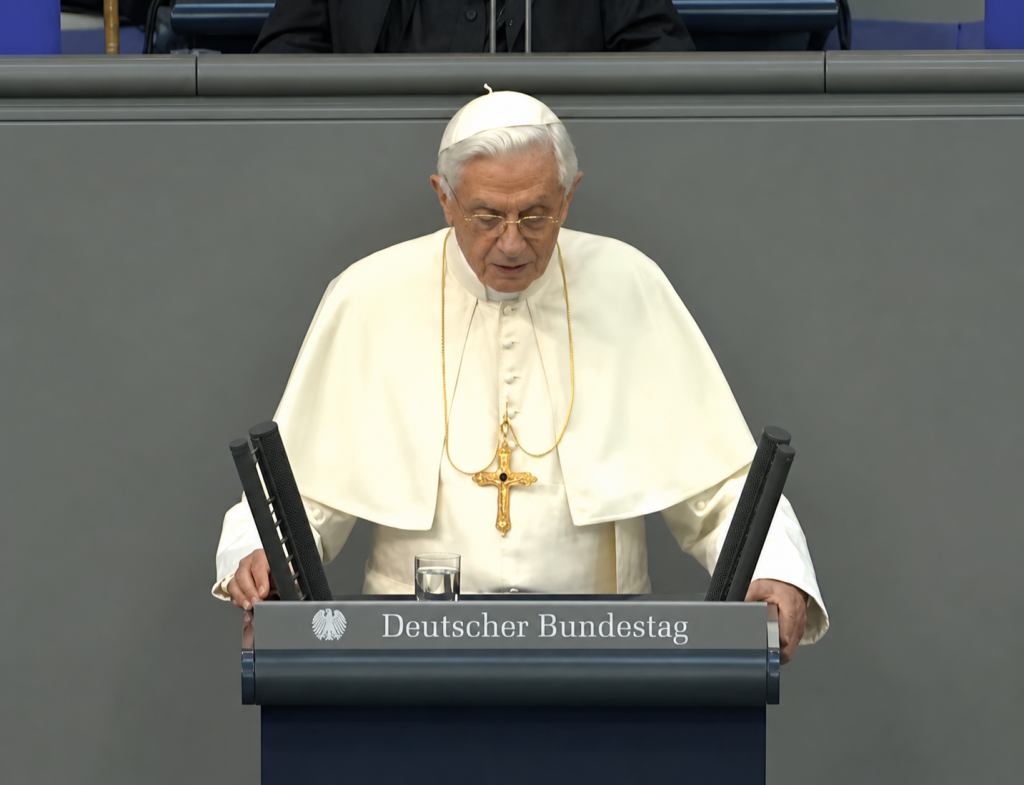
A novena of Benedict XVI’s greatest homilies and addresses, day 5: the Bundestag address
Day four of our novena marking the 75th anniversary of Pope Benedict XVI’s priestly ordination features his Westminster Hall address, delivered during his 2010 Apostolic Journey to the United Kingdom To mark the 75th anniversary of Pope Benedict XVI’s priestly ordination, AdVaticanum is publishing a nine-day novena of some of the most important homilies and addresses of his public life. Today we publish Pope Benedict XVI’s address to the German Bundestag, delivered during his Apostolic Journey to Germany on 22 September 2011. Addressing members of the German Parliament in Berlin, Benedict reflected on the foundations of law, the exercise of political authority and the responsibility of legislators to pursue justice rather than power. Drawing on Scripture, classical philosophy and the Western legal tradition, he argued that political life cannot be sustained by majority rule alone but must remain rooted in objective moral principles. It is one of the clearest statements of Benedict’s understanding of natural law and the relationship between faith, reason and public life. Mr President of the Federal Republic, Mr President of the Bundestag, Madam Chancellor, Madam President of the Bundesrat, Ladies and Gentlemen Members of the House, It is an honour and a joy for me to speak before this distinguished house, before the Parliament of my native Germany, that meets here as a democratically elected representation of the people, in order to work for the good of the Federal Republic of Germany. I should like to thank the President of the Bundestag both for his invitation to deliver this address and for the kind words of greeting and appreciation with which he has welcomed me. At this moment I turn to you, distinguished ladies and gentlemen, not least as your fellow-countryman who for all his life has been conscious of close links to his origins, and has followed the affairs of his native Germany with keen interest. But the invitation to give this address was extended to me as Pope, as the Bishop of Rome, who bears the highest responsibility for Catholic Christianity. In issuing this invitation you are acknowledging the role that the Holy See plays as a partner within the community of peoples and states. Setting out from this international responsibility that I hold, I should like to propose to you some thoughts on the foundations of a free state of law. Allow me to begin my reflections on the foundations of law [Recht] with a brief story from sacred Scripture. In the First Book of the Kings, it is recounted that God invited the young King Solomon, on his accession to the throne, to make a request. What will the young ruler ask for at this important moment? Success – wealth – long life – destruction of his enemies? He chooses none of these things. Instead, he asks for a listening heart so that he may govern God’s people, and discern between good and evil (cf. 1 Kg 3:9). Through this story, the Bible wants to tell us what should ultimately matter for a politician. His fundamental criterion and the motivation for his work as a politician must not be success, and certainly not material gain. Politics must be a striving for justice, and hence it has to establish the fundamental preconditions for peace. Naturally a politician will seek success, without which he would have no opportunity for effective political action at all. Yet success is subordinated to the criterion of justice, to the will to do what is right, and to the understanding of what is right. Success can also be seductive and thus can open up the path towards the falsification of what is right, towards the destruction of justice. “Without justice – what else is the State but a great band of robbers?”, as Saint Augustine once said. We Germans know from our own experience that these words are no empty spectre. We have seen how power became divorced from right, how power opposed right and crushed it, so that the State became an instrument for destroying right – a highly organized band of robbers, capable of threatening the whole world and driving it to the edge of the abyss. To serve right and to fight against the dominion of wrong is and remains the fundamental task of the politician. At a moment in history when man has acquired previously inconceivable power, this task takes on a particular urgency. Man can destroy the world. He can manipulate himself. He can, so to speak, make human beings and he can deny them their humanity. How do we recognize what is right? How can we discern between good and evil, between what is truly right and what may appear right? Even now, Solomon’s request remains the decisive issue facing politicians and politics today. For most of the matters that need to be regulated by law, the support of the majority can serve as a sufficient criterion. Yet it is evident that for the fundamental issues of law, in which the dignity of man and of humanity is at stake, the majority principle is not enough: everyone in a position of responsibility must personally seek out the criteria to be followed when framing laws. In the third century, the great theologian Origen provided the following explanation for the resistance of Christians to certain legal systems: “Suppose that a man were living among the Scythians, whose laws are contrary to the divine law, and was compelled to live among them … such a man for the sake of the true law, though illegal among the Scythians, would rightly form associations with like-minded people contrary to the laws of the Scythians.” [1] This conviction was what motivated resistance movements to act against the Nazi regime and other totalitarian regimes, thereby doing a great service to justice and to humanity as a whole. For these people, it was indisputably evident that the law in force was actually unlawful. Yet when it comes to the decisions of a democratic politician, the question of what now corresponds to the law of truth, what is actually right and may be enacted as law, is less obvious. In terms of the underlying anthropological issues, what is right and may be given the force of law is in no way simply self-evident today. The question of how to recognize what is truly right and thus to serve justice when framing laws has never been simple, and today in view of the vast extent of our knowledge and our capacity, it has become still harder. How do we recognize what is right? In history, systems of law have almost always been based on religion: decisions regarding what was to be lawful among men were taken with reference to the divinity. Unlike other great religions, Christianity has never proposed a revealed law to the State and to society, that is to say a juridical order derived from revelation. Instead, it has pointed to nature and reason as the true sources of law – and to the harmony of objective and subjective reason, which naturally presupposes that both spheres are rooted in the creative reason of God. Christian theologians thereby aligned themselves with a philosophical and juridical movement that began to take shape in the second century B.C. In the first half of that century, the social natural law developed by the Stoic philosophers came into contact with leading teachers of Roman Law. [2] Through this encounter, the juridical culture of the West was born, which was and is of key significance for the juridical culture of mankind. This pre-Christian marriage between law and philosophy opened up the path that led via the Christian Middle Ages and the juridical developments of the Age of Enlightenment all the way to the Declaration of Human Rights and to our German Basic Law of 1949, with which our nation committed itself to “inviolable and inalienable human rights as the foundation of every human community, and of peace and justice in the world”. For the development of law and for the development of humanity, it was highly significant that Christian theologians aligned themselves against the religious law associated with polytheism and on the side of philosophy, and that they acknowledged reason and nature in their interrelation as the universally valid source of law. This step had already been taken by Saint Paul in the Letter to the Romans, when he said: “When Gentiles who have not the Law [the Torah of Israel] do by nature what the law requires, they are a law to themselves … they show that what the law requires is written on their hearts, while their conscience also bears witness …” ( Rom 2:14f.). Here we see the two fundamental concepts of nature and conscience, where conscience is nothing other than Solomon’s listening heart, reason that is open to the language of being. If this seemed to offer a clear explanation of the foundations of legislation up to the time of the Enlightenment, up to the time of the Declaration on Human Rights after the Second World War and the framing of our Basic Law, there has been a dramatic shift in the situation in the last half-century. The idea of natural law is today viewed as a specifically Catholic doctrine, not worth bringing into the discussion in a non-Catholic environment, so that one feels almost ashamed even to mention the term. Let me outline briefly how this situation arose. Fundamentally it is because of the idea that an unbridgeable gulf exists between “is” and “ought”. An “ought” can never follow from an “is”, because the two are situated on completely different planes. The reason for this is that in the meantime, the positivist understanding of nature has come to be almost universally accepted. If nature – in the words of Hans Kelsen – is viewed as “an aggregate of objective data linked together in terms of cause and effect”, then indeed no ethical indication of any kind can be derived from it. [3] A positivist conception of nature as purely functional, as the natural sciences consider it to be, is incapable of producing any bridge to ethics and law, but once again yields only functional answers. The same also applies to reason, according to the positivist understanding that is widely held to be the only genuinely scientific one. Anything that is not verifiable or falsifiable, according to this understanding, does not belong to the realm of reason strictly understood. Hence ethics and religion must be assigned to the subjective field, and they remain extraneous to the realm of reason in the strict sense of the word. Where positivist reason dominates the field to the exclusion of all else – and that is broadly the case in our public mindset – then the classical sources of knowledge for ethics and law are excluded. This is a dramatic situation which affects everyone, and on which a public debate is necessary. Indeed, an essential goal of this address is to issue an urgent invitation to launch one. The positivist approach to nature and reason, the positivist world view in general, is a most important dimension of human knowledge and capacity that we may in no way dispense with. But in and of itself it is not a sufficient culture corresponding to the full breadth of the human condition. Where positivist reason considers itself the only sufficient culture and banishes all other cultural realities to the status of subcultures, it diminishes man, indeed it threatens his humanity. I say this with Europe specifically in mind, where there are concerted efforts to recognize only positivism as a common culture and a common basis for law-making, reducing all the other insights and values of our culture to the level of subculture, with the result that Europe vis-à-vis other world cultures is left in a state of culturelessness and at the same time extremist and radical movements emerge to fill the vacuum. In its self-proclaimed exclusivity, the positivist reason which recognizes nothing beyond mere functionality resembles a concrete bunker with no windows, in which we ourselves provide lighting and atmospheric conditions, being no longer willing to obtain either from God’s wide world. And yet we cannot hide from ourselves the fact that even in this artificial world, we are still covertly drawing upon God’s raw materials, which we refashion into our own products. The windows must be flung open again, we must see the wide world, the sky and the earth once more and learn to make proper use of all this. But how are we to do this? How do we find our way out into the wide world, into the big picture? How can reason rediscover its true greatness, without being sidetracked into irrationality? How can nature reassert itself in its true depth, with all its demands, with all its directives? I would like to recall one of the developments in recent political history, hoping that I will neither be misunderstood, nor provoke too many one-sided polemics. I would say that the emergence of the ecological movement in German politics since the 1970s, while it has not exactly flung open the windows, nevertheless was and continues to be a cry for fresh air which must not be ignored or pushed aside, just because too much of it is seen to be irrational. Young people had come to realize that something is wrong in our relationship with nature, that matter is not just raw material for us to shape at will, but that the earth has a dignity of its own and that we must follow its directives. In saying this, I am clearly not promoting any particular political party – nothing could be further from my mind. If something is wrong in our relationship with reality, then we must all reflect seriously on the whole situation and we are all prompted to question the very foundations of our culture. Allow me to dwell a little longer on this point. The importance of ecology is no longer disputed. We must listen to the language of nature and we must answer accordingly. Yet I would like to underline a point that seems to me to be neglected, today as in the past: there is also an ecology of man. Man too has a nature that he must respect and that he cannot manipulate at will. Man is not merely self-creating freedom. Man does not create himself. He is intellect and will, but he is also nature, and his will is rightly ordered if he respects his nature, listens to it and accepts himself for who he is, as one who did not create himself. In this way, and in no other, is true human freedom fulfilled. Let us come back to the fundamental concepts of nature and reason, from which we set out. The great proponent of legal positivism, Kelsen, at the age of 84 – in 1965 – abandoned the dualism of “is” and “ought”. (I find it comforting that rational thought is evidently still possible at the age of 84!) Previously he had said that norms can only come from the will. Nature therefore could only contain norms, he adds, if a will had put them there. But this, he says, would presuppose a Creator God, whose will had entered into nature. “Any attempt to discuss the truth of this belief is utterly futile”, he observed. [4] Is it really? – I find myself asking. Is it really pointless to wonder whether the objective reason that manifests itself in nature does not presuppose a creative reason, a Creator Spiritus? At this point Europe’s cultural heritage ought to come to our assistance. The conviction that there is a Creator God is what gave rise to the idea of human rights, the idea of the equality of all people before the law, the recognition of the inviolability of human dignity in every single person and the awareness of people’s responsibility for their actions. Our cultural memory is shaped by these rational insights. To ignore it or dismiss it as a thing of the past would be to dismember our culture totally and to rob it of its completeness. The culture of Europe arose from the encounter between Jerusalem, Athens and Rome – from the encounter between Israel’s monotheism, the philosophical reason of the Greeks and Roman law. This three-way encounter has shaped the inner identity of Europe. In the awareness of man’s responsibility before God and in the acknowledgment of the inviolable dignity of every single human person, it has established criteria of law: it is these criteria that we are called to defend at this moment in our history. As he assumed the mantle of office, the young King Solomon was invited to make a request. How would it be if we, the law-makers of today, were invited to make a request? What would we ask for? I think that, even today, there is ultimately nothing else we could wish for but a listening heart – the capacity to discern between good and evil, and thus to establish true law, to serve justice and peace. I thank you for your attention!
Jun. 25, 2026
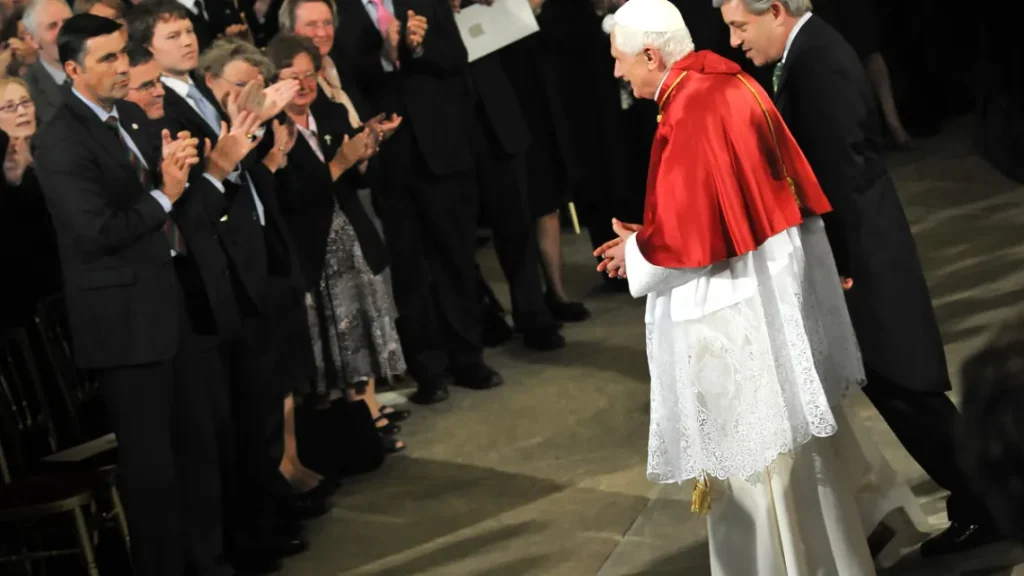
A novena of Benedict XVI’s greatest homilies and addresses, day 4: the Westminster Hall address
Day four of our novena marking the 75th anniversary of Pope Benedict XVI’s priestly ordination features his Westminster Hall address, delivered during his 2010 Apostolic Journey to the United Kingdom To mark the 75th anniversary of Pope Benedict XVI’s priestly ordination, AdVaticanum is publishing a nine-day novena of some of the most important homilies and addresses of his public life. Today we publish Pope Benedict XVI’s address to Westminster Hall, delivered during his Apostolic Journey to the United Kingdom on 17 September 2010. Speaking in the historic chamber where Saint Thomas More was condemned for refusing to act against his conscience, Benedict examined the relationship between faith and politics, the moral foundations of democracy and the place of religion in public life. The address is one of the clearest expressions of Benedict’s political thought, setting out his conviction that reason and faith are not rivals but partners in the search for truth and justice. Mr Speaker, Thank you for your words of welcome on behalf of this distinguished gathering. As I address you, I am conscious of the privilege afforded me to speak to the British people and their representatives in Westminster Hall, a building of unique significance in the civil and political history of the people of these islands. Allow me also to express my esteem for the Parliament which has existed on this site for centuries and which has had such a profound influence on the development of participative government among the nations, especially in the Commonwealth and the English-speaking world at large. Your common law tradition serves as the basis of legal systems in many parts of the world, and your particular vision of the respective rights and duties of the state and the individual, and of the separation of powers, remains an inspiration to many across the globe. As I speak to you in this historic setting, I think of the countless men and women down the centuries who have played their part in the momentous events that have taken place within these walls and have shaped the lives of many generations of Britons, and others besides. In particular, I recall the figure of Saint Thomas More, the great English scholar and statesman, who is admired by believers and non-believers alike for the integrity with which he followed his conscience, even at the cost of displeasing the sovereign whose “good servant” he was, because he chose to serve God first. The dilemma which faced More in those difficult times, the perennial question of the relationship between what is owed to Caesar and what is owed to God, allows me the opportunity to reflect with you briefly on the proper place of religious belief within the political process. This country’s Parliamentary tradition owes much to the national instinct for moderation, to the desire to achieve a genuine balance between the legitimate claims of government and the rights of those subject to it. While decisive steps have been taken at several points in your history to place limits on the exercise of power, the nation’s political institutions have been able to evolve with a remarkable degree of stability. In the process, Britain has emerged as a pluralist democracy which places great value on freedom of speech, freedom of political affiliation and respect for the rule of law, with a strong sense of the individual’s rights and duties, and of the equality of all citizens before the law. While couched in different language, Catholic social teaching has much in common with this approach, in its overriding concern to safeguard the unique dignity of every human person, created in the image and likeness of God, and in its emphasis on the duty of civil authority to foster the common good. And yet the fundamental questions at stake in Thomas More’s trial continue to present themselves in ever-changing terms as new social conditions emerge. Each generation, as it seeks to advance the common good, must ask anew: what are the requirements that governments may reasonably impose upon citizens, and how far do they extend? By appeal to what authority can moral dilemmas be resolved? These questions take us directly to the ethical foundations of civil discourse. If the moral principles underpinning the democratic process are themselves determined by nothing more solid than social consensus, then the fragility of the process becomes all too evident – herein lies the real challenge for democracy. The inadequacy of pragmatic, short-term solutions to complex social and ethical problems has been illustrated all too clearly by the recent global financial crisis. There is widespread agreement that the lack of a solid ethical foundation for economic activity has contributed to the grave difficulties now being experienced by millions of people throughout the world. Just as “every economic decision has a moral consequence” (Caritas in Veritate, 37), so too in the political field, the ethical dimension of policy has far-reaching consequences that no government can afford to ignore. A positive illustration of this is found in one of the British Parliament’s particularly notable achievements – the abolition of the slave trade. The campaign that led to this landmark legislation was built upon firm ethical principles, rooted in the natural law, and it has made a contribution to civilization of which this nation may be justly proud. The central question at issue, then, is this: where is the ethical foundation for political choices to be found? The Catholic tradition maintains that the objective norms governing right action are accessible to reason, prescinding from the content of revelation. According to this understanding, the role of religion in political debate is not so much to supply these norms, as if they could not be known by non-believers – still less to propose concrete political solutions, which would lie altogether outside the competence of religion – but rather to help purify and shed light upon the application of reason to the discovery of objective moral principles. This “corrective” role of religion vis-à-vis reason is not always welcomed, though, partly because distorted forms of religion, such as sectarianism and fundamentalism, can be seen to create serious social problems themselves. And in their turn, these distortions of religion arise when insufficient attention is given to the purifying and structuring role of reason within religion. It is a two-way process. Without the corrective supplied by religion, though, reason too can fall prey to distortions, as when it is manipulated by ideology, or applied in a partial way that fails to take full account of the dignity of the human person. Such misuse of reason, after all, was what gave rise to the slave trade in the first place and to many other social evils, not least the totalitarian ideologies of the twentieth century. This is why I would suggest that the world of reason and the world of faith – the world of secular rationality and the world of religious belief – need one another and should not be afraid to enter into a profound and ongoing dialogue, for the good of our civilization. Religion, in other words, is not a problem for legislators to solve, but a vital contributor to the national conversation. In this light, I cannot but voice my concern at the increasing marginalization of religion, particularly of Christianity, that is taking place in some quarters, even in nations which place a great emphasis on tolerance. There are those who would advocate that the voice of religion be silenced, or at least relegated to the purely private sphere. There are those who argue that the public celebration of festivals such as Christmas should be discouraged, in the questionable belief that it might somehow offend those of other religions or none. And there are those who argue – paradoxically with the intention of eliminating discrimination – that Christians in public roles should be required at times to act against their conscience. These are worrying signs of a failure to appreciate not only the rights of believers to freedom of conscience and freedom of religion, but also the legitimate role of religion in the public square. I would invite all of you, therefore, within your respective spheres of influence, to seek ways of promoting and encouraging dialogue between faith and reason at every level of national life. Your readiness to do so is already implied in the unprecedented invitation extended to me today. And it finds expression in the fields of concern in which your Government has been engaged with the Holy See. In the area of peace, there have been exchanges regarding the elaboration of an international arms trade treaty; regarding human rights, the Holy See and the United Kingdom have welcomed the spread of democracy, especially in the last sixty-five years; in the field of development, there has been collaboration on debt relief, fair trade and financing for development, particularly through the International Finance Facility, the International Immunization Bond, and the Advanced Market Commitment. The Holy See also looks forward to exploring with the United Kingdom new ways to promote environmental responsibility, to the benefit of all. I also note that the present Government has committed the United Kingdom to devoting 0.7% of national income to development aid by 2013. In recent years it has been encouraging to witness the positive signs of a worldwide growth in solidarity towards the poor. But to turn this solidarity into effective action calls for fresh thinking that will improve life conditions in many important areas, such as food production, clean water, job creation, education, support to families, especially migrants, and basic healthcare. Where human lives are concerned, time is always short: yet the world has witnessed the vast resources that governments can draw upon to rescue financial institutions deemed “too big to fail”. Surely the integral human development of the world’s peoples is no less important: here is an enterprise, worthy of the world’s attention, that is truly “too big to fail”. This overview of recent cooperation between the United Kingdom and the Holy See illustrates well how much progress has been made, in the years that have passed since the establishment of bilateral diplomatic relations, in promoting throughout the world the many core values that we share. I hope and pray that this relationship will continue to bear fruit, and that it will be mirrored in a growing acceptance of the need for dialogue and respect at every level of society between the world of reason and the world of faith. I am convinced that, within this country too, there are many areas in which the Church and the public authorities can work together for the good of citizens, in harmony with this Parliament’s historic practice of invoking the Spirit’s guidance upon those who seek to improve the conditions of all mankind. For such cooperation to be possible, religious bodies – including institutions linked to the Catholic Church – need to be free to act in accordance with their own principles and specific convictions based upon the faith and the official teaching of the Church. In this way, such basic rights as religious freedom, freedom of conscience and freedom of association are guaranteed. The angels looking down on us from the magnificent ceiling of this ancient Hall remind us of the long tradition from which British Parliamentary democracy has evolved. They remind us that God is constantly watching over us to guide and protect us. And they summon us to acknowledge the vital contribution that religious belief has made and can continue to make to the life of the nation. Mr Speaker, I thank you once again for this opportunity briefly to address this distinguished audience. Let me assure you and the Lord Speaker of my continued good wishes and prayers for you and for the fruitful work of both Houses of this ancient Parliament. Thank you and God bless you all!
Jun. 24, 2026