

250th Anniversary Year Of American Independence
“The future belongs to God”: US bishops consecrate America to the Sacred Heart
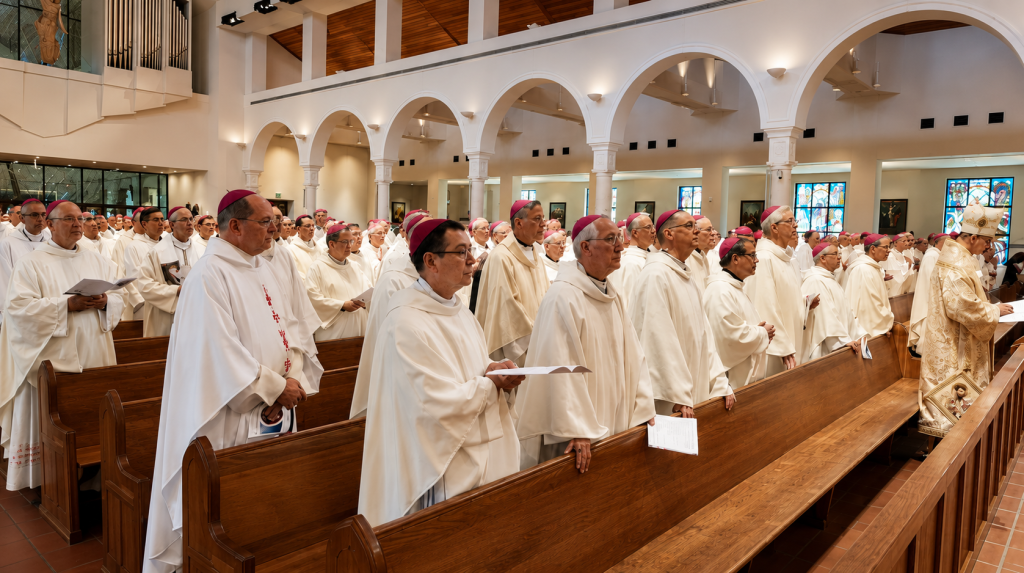
Gathering in Orlando, the Catholic bishops of the United States placed both the Church and the nation under the protection of the Sacred Heart The Catholic bishops of the United States have consecrated the nation to the Sacred Heart of Jesus, marking the 250th anniversary year of American independence. The act of consecration took place on 11 June during the spring plenary assembly of the United States Conference of Catholic Bishops in Orlando, Florida. Bishops from across the country took part in the public act of prayer and devotion that organisers said was intended to place both the Church and the nation under the protection and mercy of Christ. Preaching at the Mass, Archbishop William Lori of Baltimore said the occasion was not primarily a celebration of the nation’s approaching semiquincentennial but an act of faith. “We gather, not first to celebrate ourselves, but to consecrate. To entrust. To place the Church in the United States, and indeed the whole nation, into the Sacred Heart of Jesus Christ,” Archbishop Lori said. He told the congregation that the consecration acknowledged that history is ultimately shaped by God’s providence rather than human achievement alone. “We consecrate our nation, not because it is perfect, but because it is beloved by God,” he said. “We entrust to the Heart of Christ our achievements and failures, our hopes and anxieties, our present challenges and our future aspirations.” The archbishop said the Church approached the moment with gratitude for the blessings received throughout American history while recognising the need for repentance and renewal. “We cannot come to the Heart of Christ while pretending we have no need of His mercy,” he said. Drawing on the Gospel reading in which Christ tells His disciples to remain in His love, Archbishop Lori described the Sacred Heart as “the revelation of God’s love made flesh” and said devotion to it offered an antidote to political and ideological division. “The Sacred Heart does not divide; it reconciles. It does not harden hearts; it transforms them. It does not simply invite us to receive love; it sends us forth to share it,” he said. “The future belongs to God,” Archbishop Lori said. “And so we place into His Heart not only ourselves but generations yet unborn, and all those who will inherit the Church and the nation we leave behind.” The consecration itself was led by Archbishop Paul Coakley of Oklahoma City, president of the bishops’ conference. In the prayer, the bishops entrusted the nation to the Sacred Heart and asked for healing, justice, reconciliation and peace. The prayer gave thanks for the blessings received by the United States, sought forgiveness for sins committed against God and human dignity, and asked that the Church become an ever clearer sign of Christ’s presence in society. Repeated invocations of “Most Sacred Heart of Jesus, have mercy on us” were offered throughout the ceremony. The act of consecration followed a period of reflection by several bishops on the significance of devotion to the Sacred Heart in contemporary society. Archbishop Alexander Sample of Portland argued that devotion to the Sacred Heart offered an answer to what he described as the spiritual anxieties of modern life, including loneliness, insecurity and the search for identity. “The Sacred Heart of Jesus is not merely a symbol,” Archbishop Sample said. “It is the living Heart of the Risen Lord, still beating with love for humanity.” Reflecting on Christ’s sacrificial love, Archbishop Sample said believers could find freedom from the need to base their worth on success or failure. “When we know that we are loved by Christ, we no longer need to build our identity on achievements or failures,” he said. Archbishop Shelton Fabre of Louisville focused on the relationship between devotion to the Sacred Heart and ecclesial unity. He urged bishops to model genuine communion within the Church and resist reducing people to ideological categories. “The Sacred Heart of Jesus never encounters us as categories,” Archbishop Fabre said. “Jesus Christ does not love abstractions. He loves people.” He argued that Christian communion is founded not upon personal preference or political affinity but upon participation in the life of Christ. Archbishop Bernard Hebda of St Paul and Minneapolis spoke about the transforming power of Christ’s love upon wounded hearts. Referring to the motto of St John Henry Newman, Cor ad cor loquitur , or “heart speaks to heart”, he encouraged deeper prayer and a more intimate relationship with Christ. “Drawing near to the heart of Jesus, entering into that intimate dialogue with Jesus, changes everything,” Archbishop Hebda said. Before the Mass, the bishops participated in Eucharistic adoration and venerated relics associated with St Margaret Mary Alacoque, the seventeenth-century French Visitation nun whose visions helped spread devotion to the Sacred Heart throughout the Catholic world. The consecration took place against the backdrop of preparations for the 250th anniversary of the Declaration of Independence in 2026 and formed part of the programme of commemorations taking place across the United States. Devotion to the Sacred Heart occupies a prominent place in Catholic spirituality. Rooted in the Gospel accounts of Christ’s love and sacrifice, it gained renewed prominence through the revelations received by St Margaret Mary between 1673 and 1675. The devotion was subsequently promoted by numerous popes and religious orders and became one of the most widespread expressions of Catholic piety. In 1899, Pope Leo XIII consecrated the entire human race to the Sacred Heart, describing the act as one of the most important of his pontificate.
Jun. 12, 2026